How we make this list: we compare pricing pages, product documentation and public user reviews. Ratings come from G2, Capterra or Trustpilot, with the date we checked them.
What Is the Best AI Radiology Software?
The best AI radiology software for most large hospitals is Aidoc, because its CARE foundation model covers 14 acute indications on body CT in one triage workflow, and it is deployed at more than 1,600 sites. Viz.ai is the better pick when stroke care coordination is the priority, since it alerts the stroke team on a phone within seconds and its Viz LVO module carries a Medicare add-on payment. For cancer screening programs, Lunit INSIGHT is the strongest choice, with FDA-cleared mammography and chest X-ray products used in more than 60 countries.
AI radiology software reads medical images alongside the radiologist. It flags suspected findings, orders the worklist so urgent cases come first, and measures lesions and scores. None of these tools replaces the radiologist: every product here is decision support, and a qualified clinician still makes the final call. The value is speed and consistency: a suspected bleed, clot or fracture gets seen sooner, and findings that are easy to miss on a busy shift get a second look.
Buyers should check two things first. Confirm the exact regulatory clearance for the product and the country where it will be used, because clearance is granted per algorithm and per market, not per vendor. Then confirm how the tool fits the existing reading workflow, because an accurate algorithm that forces radiologists into a separate viewer will be ignored.
How We Compared the Best AI Radiology Software
We compared each tool on five points. Regulatory status came first: FDA 510(k) clearances and CE marks as stated by the vendor or the FDA, since clearance decides what a hospital can legally run. Finding breadth came second: how many conditions the software detects and on which modalities. Workflow fit came third: whether results appear inside the existing PACS and worklist or require a separate application. Evidence came fourth: published validation data and the size of real deployments. No vendor in this guide publishes a public price list, so the starting price for each tool below is listed as quote.
Best AI Radiology Software at a Glance
| Tool |
Best For |
FDA Clearance |
Starting Price |
| Aidoc |
Comprehensive CT triage in large health systems |
Yes, 14 acute indications on body CT |
Quote |
| Viz.ai |
Stroke detection and care coordination |
Yes, 50+ algorithms |
Quote |
| Annalise.ai |
Chest X-ray and head CT decision support |
Yes, 12 triage findings |
Quote |
| Lunit INSIGHT |
Mammography and chest X-ray screening |
Yes, MMG, DBT and CXR Triage |
Quote |
| RapidAI |
Stroke centers using CT perfusion |
Yes, 17 authorizations |
Quote |
| Avicenna.AI |
Emergency radiology triage on CT |
Yes, CINA family |
Quote |
| Gleamer |
Fracture and chest detection on X-ray |
Yes, BoneView |
Quote |
| Nanox.AI |
Incidental findings and population health on CT |
Yes, HealthCCSng, HealthOST, HealthFLD |
Quote |
Quick comparison
| Tool | Best for | Starting price | Free plan |
|---|
 Aidoc | Large health systems that need comprehensive triage across many acute CT findings in one workflow | quote | No free plan. Enterprise subscription only, priced per module and by study volume. |
 Viz.ai | Stroke networks and hospitals that need AI detection tied directly to care team coordination | quote | No free plan. Quoted per-facility annual subscription, sold modularly by disease suite. |
 Annalise.ai | Radiology groups that want deep decision support on chest X-rays and non-contrast head CT | quote | No free plan. Enterprise pricing quoted per deployment. |
 Lunit INSIGHT | Cancer screening programs that need AI for mammography and chest X-ray at national scale | quote | No free plan. Priced per study or per annual examination volume, by product. |
 RapidAI | Stroke centers that rely on CT perfusion and quantitative imaging for treatment decisions | quote | No free plan. Enterprise subscription, sold per site and per module. |
 Avicenna.AI | Emergency departments that need fast triage of acute findings on CT, including incidental pulmonary embolism | quote | No free plan. Enterprise pricing quoted per algorithm. |
 Gleamer | Emergency departments and imaging centers that read high volumes of trauma and chest X-rays | quote | No free plan. Priced per exam analyzed or as an annual volume subscription. |
 Nanox.AI | Health systems and population health programs that want to find chronic disease on routine CT scans | quote | No free plan. Enterprise pricing quoted per deployment. |
Is your product missing or out of date?
We review this list regularly. Vendors can request a listing, send updated pricing or ask about featured placement.
#1
Aidoc
Best for: Large health systems that need comprehensive triage across many acute CT findings in one workflow
Visit aidoc.com
Starting pricequote
Free planNo free plan. Enterprise subscription only, priced per module and by study volume.
Aidoc is the broadest triage platform in this guide. Its CARE foundation model powers a single body CT workflow covering aortic dissection, large aortic aneurysm, spleen, liver and kidney injury, pelvic fracture, intestinal ischemia, bowel obstruction, abdominal-pelvic abscess, diverticulitis, appendicitis and obstructive renal stones, plus three previously cleared indications. In the FDA-reviewed pivotal study the 11 newly cleared indications reached a mean sensitivity of 97 percent and a mean specificity of 98 percent, with roughly an order-of-magnitude reduction in false alerts compared with single-condition tools. Aidoc reports analyzing 60 million patient cases per year. The trade-off is scope: a small imaging center needing one or two findings pays for breadth it does not use, and the per-module quote model reveals total cost only after a sales process.
What we like- FDA-cleared triage covering 14 acute indications
- Deployed at more than 1,600 medical centers
- AiOS platform also runs third-party algorithms
Watch out for- Pricing is quoted per algorithm and per volume, so budgeting requires a sales conversation
#2
Viz.ai
Best for: Stroke networks and hospitals that need AI detection tied directly to care team coordination
Visit viz.ai
Starting pricequote
Free planNo free plan. Quoted per-facility annual subscription, sold modularly by disease suite.
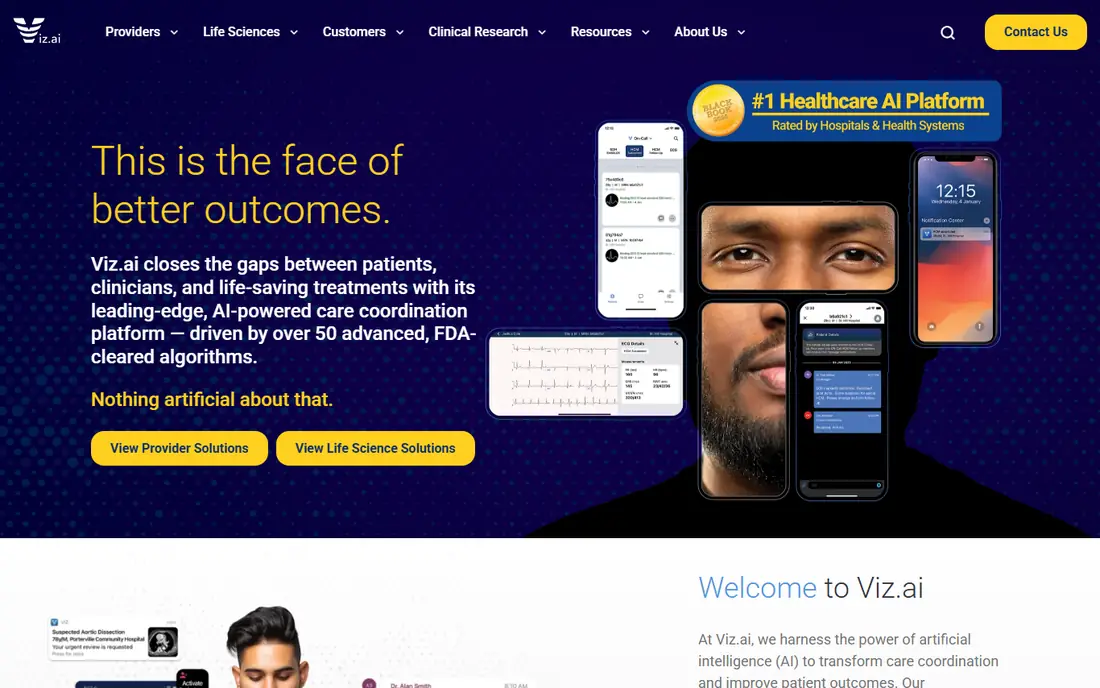
Viz.ai is different from most tools in this guide because detection is only half the product. The platform reads the scan, flags the suspected finding, then coordinates the response: it pings the on-call specialist, shares the images and tracks the transfer and treatment steps. The flagship module, Viz LVO, flags suspected large vessel occlusion strokes on CT angiography and alerts the stroke team in parallel. Viz.ai sells disease suites (Viz Neuro, Cardio, Vascular, Pulmonary), each licensed per facility with pricing scaled by the number of algorithms and the population served. The Medicare add-on payment of up to 1,040 dollars per eligible Viz LVO use is a real commercial advantage for stroke centers, because it offsets part of the subscription. The main limitation is focus: a hospital that wants general chest X-ray or mammography AI will need another vendor alongside Viz.ai.
What we like- More than 50 FDA-cleared algorithms
- Viz LVO carries a Medicare add-on payment of up to 1,040 dollars per eligible use
- Alerts reach specialists on their phones within seconds
Watch out for- No public price list and no self-serve trial
- Neurovascular focus means general radiology coverage is narrower
#3
Annalise.ai
Best for: Radiology groups that want deep decision support on chest X-rays and non-contrast head CT
Visit harrison.ai
Starting pricequote
Free planNo free plan. Enterprise pricing quoted per deployment.
Annalise.ai, now consolidated under the Harrison.ai Radiology brand, is built for breadth on two of the highest-volume study types in radiology: chest X-ray and head CT. Annalise Enterprise CXR detects up to 124 findings in under 20 seconds, while the head CT product detects up to 130 findings in under 90 seconds. For the United States, Annalise Triage is a narrower product with 12 FDA-cleared findings, five on chest X-ray and seven on non-contrast head CT, aimed at worklist prioritization for time-sensitive cases. Results integrate with existing PACS, RIS and EMR systems or can be viewed in a web-based viewer. The depth of the finding list is the selling point: instead of flagging one or two emergencies, the software gives the radiologist a structured view of everything it detected, which supports both triage and reporting.
What we like- Detects up to 124 findings on chest X-ray and up to 130 findings on head CT
- Annalise Triage holds 12 FDA-cleared findings for the United States market
Watch out for- The product rebranded to Harrison.ai Radiology in October 2026, which can confuse procurement
- The United States triage offering covers fewer findings than the global portfolio
#4
Lunit INSIGHT
Best for: Cancer screening programs that need AI for mammography and chest X-ray at national scale
Visit lunit.io
Starting pricequote
Free planNo free plan. Priced per study or per annual examination volume, by product.
Lunit is a South Korean medical AI company founded in 2013, and its INSIGHT family is one of the most widely deployed cancer screening AI products in the world. INSIGHT MMG analyzes two-dimensional mammograms, INSIGHT DBT covers three-dimensional digital breast tomosynthesis, and INSIGHT CXR reads chest radiographs for multiple abnormality types. The chest X-ray triage variant holds a separate FDA clearance in the United States. The Volpara acquisition added breast density measurement and RiskPathways program tools used by American breast centers. Pricing is quoted per study or per annual examination volume, and on-premises and cloud deployments are priced differently. Buyers should plan for the effect on recall rates: detection AI changes how many patients are called back, and a program that deploys it without modeling the downstream diagnostic work will import a cost it did not budget for.
What we like- FDA 510(k) clearances for INSIGHT MMG, INSIGHT DBT and INSIGHT CXR Triage, plus CE marks in Europe
- Deployed in more than 60 countries
Watch out for- Mammography, tomosynthesis and chest X-ray products are licensed separately, so a full screening stack means several line items
- INSIGHT Risk has been filed with the FDA but was not cleared at the time of writing
#5
RapidAI
Best for: Stroke centers that rely on CT perfusion and quantitative imaging for treatment decisions
Visit rapidai.com
Starting pricequote
Free planNo free plan. Enterprise subscription, sold per site and per module.
RapidAI grew out of iSchemaView RAPID, the perfusion software used to select patients in the landmark DEFUSE 3 and DAWN stroke trials, and that clinical pedigree still shapes the product. The Rapid Enterprise Platform now covers CT perfusion, LVO and LMVO detection, ASPECTS scoring, intracranial hemorrhage, aneurysm, aortic disease and pulmonary embolism, with five new FDA clearances announced in November 2025 for Rapid DeltaFuse, Rapid LMVO, Rapid MLS, Rapid OH and Rapid Aortic. Rapid DeltaFuse aligns serial non-contrast head CTs to show subtle changes over time, and Rapid OH, which detects suspected obstructive hydrocephalus, qualifies for a CMS New Technology Add-on Payment. The main caution is measurement consistency: a 2024 study in the American Journal of Neuroradiology found that CT perfusion volumes from RapidAI and Viz.ai are not interchangeable, so a hospital that changes platforms should expect its thresholds to need recalibration.
What we like- Deep CT perfusion heritage from the RAPID software used in the DEFUSE 3 and DAWN stroke trials
- 17 FDA authorizations
- Rapid Edge Cloud keeps service running during disruptions
Watch out for- Enterprise only, with no public pricing
- Perfusion volumes differ from competing platforms, so switching vendors changes the numbers a team acts on
#6
Avicenna.AI
Best for: Emergency departments that need fast triage of acute findings on CT, including incidental pulmonary embolism
Visit avicenna.ai
Starting pricequote
Free planNo free plan. Enterprise pricing quoted per algorithm.
Avicenna.AI is a French company founded in 2018 that specializes in emergency radiology. Its CINA family detects and prioritizes life-threatening conditions on CT scans and notifies clinicians through the systems radiologists already use. The first clearance came in 2020 for CINA triage of intracranial hemorrhage and large vessel occlusion, validated on 814 cases from more than 250 imaging centers with 96 percent accuracy. Since then the company has added CINA-PE and CINA-AD for pulmonary embolism and aortic dissection, CINA-CSpine for cervical spine fractures, CINA-iPE for incidental pulmonary embolism found on routine scans, and CINA-ASPECTS, its first tool in the computer-aided diagnosis category, which scores stroke severity rather than only flagging a finding. CINA-iPE is a useful differentiator: it catches clots that appear by chance on scans ordered for other reasons, a common source of missed findings. The product is deliberately narrow, and that is both its strength and its limit.
What we like- The CINA family covers intracranial hemorrhage, large vessel occlusion, pulmonary embolism, aortic dissection, cervical spine fracture, incidental pulmonary embolism and ASPECTS scoring
- Alerts fire within seconds inside existing radiology systems
Watch out for- Focused on emergency and incidental findings, so it does not cover general diagnostic support such as chest X-ray or mammography
#7
Gleamer
Best for: Emergency departments and imaging centers that read high volumes of trauma and chest X-rays
Visit gleamer.ai
Starting pricequote
Free planNo free plan. Priced per exam analyzed or as an annual volume subscription.
Gleamer is a French company whose strength is plain film. BoneView, its first product, detects fractures, effusions, dislocations and bone lesions on standard trauma X-rays and labels each region as positive, doubt or negative based on confidence, with worklist prioritization driven by those labels. Multi-reader studies reported improved sensitivity for fracture detection and fewer false negatives, with the gain concentrated among less experienced readers in emergency settings. ChestView detects thoracic abnormalities including pneumothorax and early signs of cancer, BoneAge supports paediatric bone age assessment, BoneMetrics provides musculoskeletal measurements, and the newer LungCT, BoneCT and BreastView modules extend the suite beyond X-ray. The company reports more than 650 paying clinical customers across more than 40 countries. Two things to check before buying are price and ownership: the per-exam model means a seasonal surge in X-ray volume raises the bill, and RadNet agreed to acquire Gleamer in February 2026 for around 215 million euros upfront.
What we like- BoneView holds FDA 510(k) clearance including paediatric fracture detection
- ChestView, BoneAge, BoneMetrics and BreastView cover the full X-ray workflow
- More than 650 paying clinical customers
Watch out for- Pricing is per exam and not published, which makes budgeting hard for departments whose plain film volume swings seasonally
- RadNet agreed to acquire Gleamer in February 2026
#8
Nanox.AI
Best for: Health systems and population health programs that want to find chronic disease on routine CT scans
Visit nanox.vision
Starting pricequote
Free planNo free plan. Enterprise pricing quoted per deployment.
Nanox.AI, formerly Zebra Medical Vision, takes a different angle from every other tool in this guide. Instead of reading scans ordered to answer a specific question, it analyzes routine CT scans for signs of chronic disease that nobody was looking for. HealthCCSng detects coronary artery calcification on non-gated CT scans that include the entire heart, a major risk factor for coronary artery disease. HealthOST detects vertebral height loss and measures bone mineral density on chest and abdominal CT, flagging osteoporosis risk. HealthFLD measures liver density on contrast and non-contrast CT to detect fatty liver, an early sign of metabolic dysfunction-associated steatotic liver disease. All three hold FDA 510(k) clearance and CE marks. Results can be integrated into PACS or EMR workflows and can populate findings into radiology reports. The business case is population health: a health system can identify at-risk patients from imaging it already performs and steer them into preventive care. The risk is follow-through. A flagged calcium score only helps if someone contacts the patient and starts treatment.
What we like- HealthCCSng, HealthOST and HealthFLD all hold FDA 510(k) clearance and CE marks
- Finds asymptomatic chronic disease on scans ordered for other reasons
Watch out for- Incidental findings focus means it does not replace acute diagnostic AI for stroke or trauma
- The value depends on having a follow-up care pathway
How to Choose AI Radiology Software for Your Practice
Start with the clinical problem, not the vendor list. A stroke center needs perfusion and LVO detection with care coordination: RapidAI or Viz.ai. A screening program needs mammography and chest X-ray AI: Lunit or Annalise.ai. An emergency department with heavy X-ray volume needs fracture detection: Gleamer. A health system wanting one platform for many acute findings should look at Aidoc or Avicenna.AI, and a population health team should look at Nanox.AI.
Then check the regulatory picture for your country and your exact product, since clearance is per algorithm and per market. Ask each vendor for the clearance letter for the module you plan to buy. Then run a pilot on your own cases and measure three things: how often the AI changes the order of the worklist, how many false alerts it creates, and whether radiologists open the results inside their normal viewer. Finally, get the quote in writing with the modules, the study volume, implementation, training, support and renewal terms itemized.
Frequently asked questions
What is the best AI radiology software overall?
Aidoc is the best overall pick for large hospitals, because its CARE foundation model covers 14 acute indications on body CT in one triage workflow and it is deployed at more than 1,600 sites. Viz.ai is the better choice for stroke networks, Lunit INSIGHT leads for cancer screening, and Gleamer leads for X-ray fracture detection. The right answer depends on which studies your department reads most.
Is AI radiology software FDA cleared?
Most established products hold FDA 510(k) clearance, but clearance is granted per algorithm and per indication, not to a vendor as a whole. Aidoc, Viz.ai, Lunit, RapidAI, Avicenna.AI, Gleamer and Nanox.AI all hold clearances for specific modules, and Annalise Triage holds 12 cleared findings in the United States. Ask for the clearance letter covering the exact module you plan to use.
How much does AI radiology software cost?
No vendor in this guide publishes a public price list. Pricing is quoted per site, per module or per study volume, and third-party estimates of 25,000 to 300,000 dollars per year appear in industry listings. The only hard numbers tied to reimbursement are Medicare add-on payments, such as up to 1,040 dollars per eligible use of Viz LVO. Request a written quote that itemizes modules, volume, implementation, training, support and renewal terms.
Can AI radiology software replace a radiologist?
No. Every tool in this guide is decision support. The AI flags findings, prioritizes the worklist, measures lesions and drafts report text, but a qualified radiologist still reviews the images and makes the final diagnosis. The value is speed and consistency: urgent cases reach the top of the list sooner, and subtle findings get a second look.
Does AI radiology software work with my existing PACS?
Most of these tools integrate with standard PACS, RIS and EMR systems through DICOM and HL7 interfaces, and several offer cloud or on-premises deployment. Aidoc, Annalise.ai, RapidAI, Avicenna.AI, Gleamer and Nanox.AI all describe integration into the existing reading workflow rather than a separate viewer. Confirm the integration method and the IT effort during the pilot, because a tool that forces radiologists into a second application is likely to be ignored.
Sources we checked (8)
- https://www.aidoc.com/comprehensive-abdomen-ct-triage/
- https://www.viz.ai
- https://harrison.ai/news/annalise-ai-launches-the-most-comprehensive-radiology-triage-suite-for-chest-x-rays-and-head-cts-in-the-u-s/
- https://www.lunit.io
- https://www.rapidai.com/press-release/rapidai-extends-the-reach-of-deep-clinical-ai-with-five-new-fda-clearances
- https://avicenna.ai/resources/news/fda-clearances-aspects-and-ipe/
- https://www.gleamer.ai
- https://www.nanox.vision/ai/
Is your product missing or out of date?
We review this list regularly. Vendors can request a listing, send updated pricing or ask about featured placement.

Shihab Mia · Founder, Rankite
Shihab has 5+ years in B2B and SaaS SEO. He writes Rankite's software buying guides from pricing pages, documentation and public user reviews. More about Shihab.