How we make this list: we compare pricing pages, product documentation and public user reviews. Ratings come from G2, Capterra or Trustpilot, with the date we checked them.
Key takeaways
- All eight tools are built for payers first. They work on claims, risk, network and payment data, not on hospital clinical workflows.
- Pricing is quote-only across the board. No vendor in this guide publishes a starting price or offers a free plan.
- Payment integrity and risk adjustment deliver the fastest payback for most plans, because they change money that is already moving.
- Two familiar names have changed hands. Edifecs is now a Cotiviti business and Apixio is now part of Datavant, so check which company stands behind your contract.
What does AI healthcare analytics software do for a payer?
It turns claims, clinical, provider and member data into decisions a health plan can act on before money is spent. Claims arrive daily, clinical records arrive in many formats, and provider contracts set the rules for what gets paid. AI tools read that data at a scale no team can match, then flag the items that need a human look. The common jobs are spotting billing errors before payment, scoring member risk, finding care gaps, ranking providers by cost and quality, and finding fraud patterns across millions of claims. A coder, a nurse reviewer, or a network manager still makes the call. That matters for regulated work such as risk adjustment, where the plan must defend every code it submits to CMS.
Which payer use cases pay back fastest?
Payment integrity and risk adjustment usually pay back fastest, because they recover or protect revenue on claims the plan already processes. A prepay edit that stops an overpayment costs far less than a postpay recovery effort months later. Risk adjustment pays back when better coding lifts the accuracy of the risk scores that set plan revenue for Medicare Advantage and ACA lines. Utilization management comes next, since prior authorization and care management change the cost of care directly. Network analytics pays back more slowly, because contract changes take a full cycle to show in claims. Measure the result in dollars recovered or avoided per member per month, and set the review date before you sign.
How should a health plan compare vendors and prices?
Compare vendors on the use cases they prove with your own data, not on feature lists, because every platform in this market is priced by custom quote. Ask each vendor to run a pilot on a sample of your claims and show the savings, the false positive rate, and the staff time saved. Ask how the model was trained, how often it is updated, and whether your team can see why a claim was flagged. Ask for the full price: license, implementation, data feeds, and any per-claim or per-member fee. Ask for two reference clients in your line of business and your size band. Get the quote in writing with the modules listed, so you can compare like with like.
What should a payer check before signing a contract?
Check data ownership, model transparency, audit support and exit terms before you sign, because payer analytics contracts run for years and touch regulated data. Confirm the vendor signs a business associate agreement and meets HIPAA and HITRUST expectations. Ask who owns the models built on your data, and whether your data can train models sold to other plans. Ask how the vendor supports a CMS audit, including RADV, and whether it will defend its coding suggestions in writing. Ask what happens to your data if you leave, and how long the vendor keeps it. A short pilot with clear success measures protects both sides better than a long list of promises.
Quick comparison
| Tool | Best for | Starting price | Free plan |
|---|
 Cotiviti | Large health plans that want payment integrity, risk adjustment and quality analytics from one vendor | quote | None |
 Clarify Health | Health plans that need provider network analytics and value-based contract management | quote | None |
 HealthEdge | Health plans modernizing core claims administration with embedded AI | quote | None |
 MedeAnalytics | Health plans that want cross-domain analytics across cost, utilization, quality and risk | quote | None |
 SAS Health | Large payers that want to build and govern their own AI models on SAS Viya | quote | None |
 Optum | Large health plans that want the broadest payer analytics and workflow suite | quote | None |
 Centauri Health Solutions | Medicare Advantage and Medicaid plans focused on risk adjustment and quality programs | quote | None |
 Milliman MedInsight | Health plans that want a payer data warehouse with strong benchmarking | quote | None |
Is your product missing or out of date?
We review this list regularly. Vendors can request a listing, send updated pricing or ask about featured placement.
The eight tools below were checked against live vendor sites on 12 Nov 2026. Each serves health plans directly, and all prices are quote-only.
#1
Cotiviti
Best for: Large health plans that want payment integrity, risk adjustment and quality analytics from one vendor
Visit cotiviti.com
Starting pricequote
Free planNone
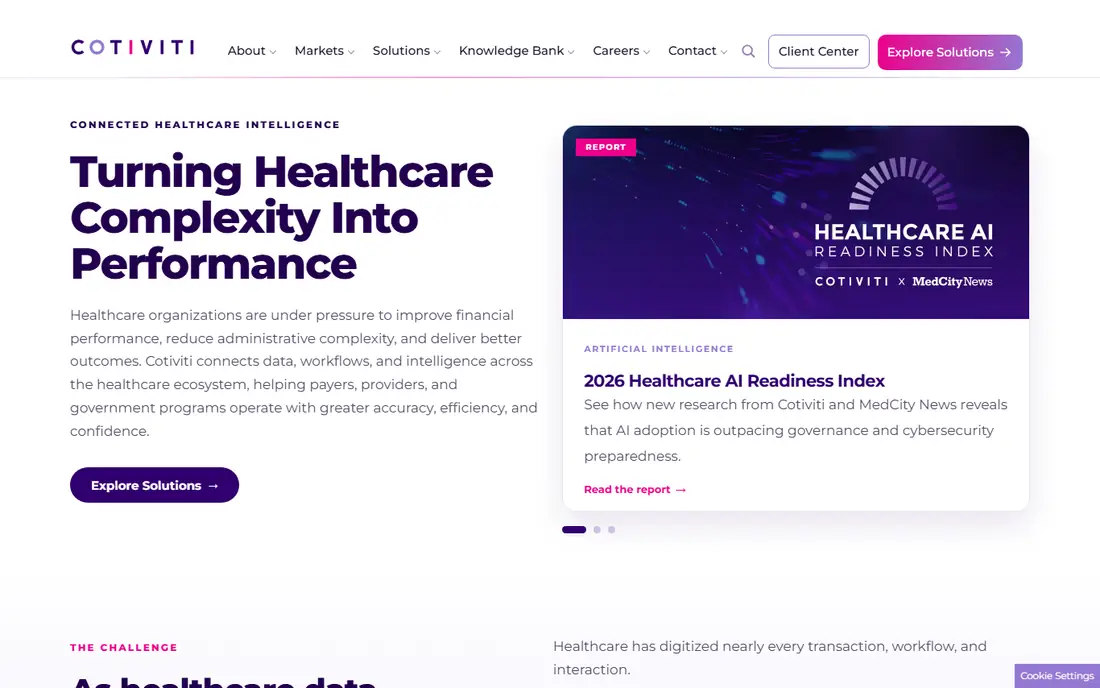
Cotiviti is the largest payer analytics name in this guide, and the default choice for plans that want one vendor across payment accuracy, risk adjustment and quality. The company says it works with more than 200 payers, including all of the top 25 national health plans, and that its payment integrity work identifies and corrects about $10 billion in medical spend each year. In September 2026 it added itemized bill review and inpatient coding validation to its Payment Accuracy suite. Cotiviti completed its purchase of Edifecs on 31 March 2025, adding interoperability and value-based payment tools. Everest Group named it a leader for market impact in its 2026 pre-payment integrity assessment. The trade-off is scale. Implementation is a real program, and the price is set by quote, so small plans should ask for a scoped pilot first.
What we like- Serves more than 200 payers including all top 25 national plans
- Prepay and postpay payment integrity in one suite
- Strong risk adjustment and quality analytics
Watch out for- Built for large plans, so smaller plans may find the scope and the implementation effort heavy
- Pricing is not published, which makes early budgeting hard
#2
Clarify Health
Best for: Health plans that need provider network analytics and value-based contract management
Visit clarifyhealth.com
Starting pricequote
Free planNone
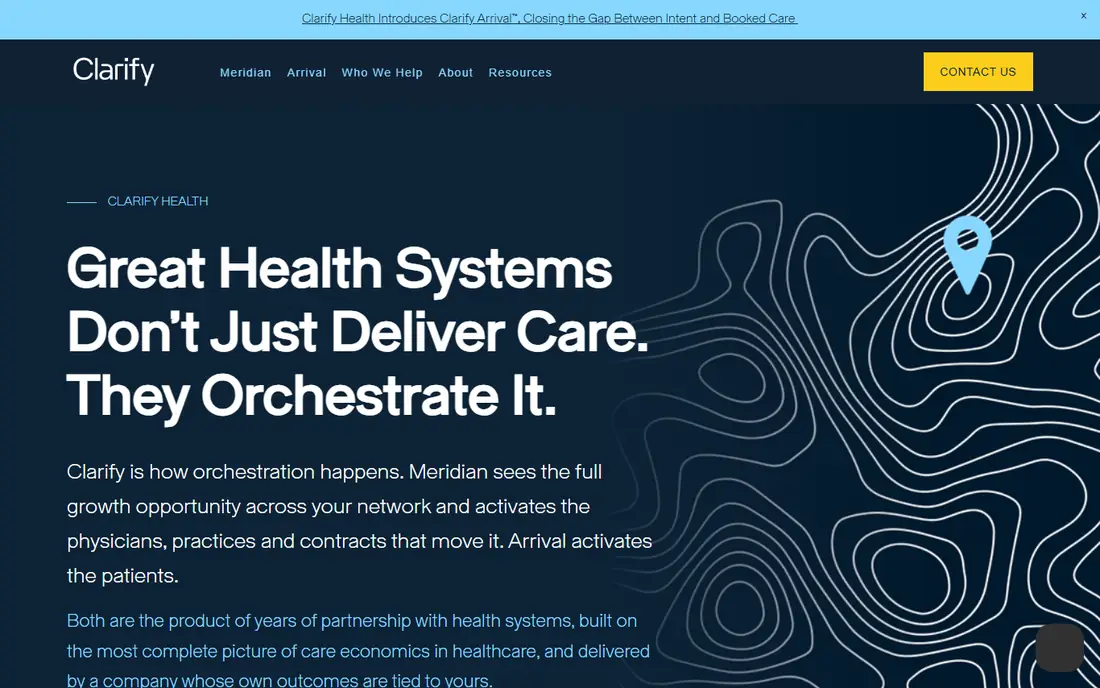
Clarify Health is the pick for plans that care most about their provider networks and their value-based contracts. Its Atlas Platform maps more than 300 million longitudinal patient journeys, and its Performance IQ Suite applies machine learning to cost, quality and utilization so plans can rank providers and find real savings. Clarify Contracts helps plans design value-based contracts, track financial performance and settle payments with providers. Its Clara IQ generative AI layer lets users ask questions of the data in plain language. Clarify says its insights have produced $2.6 billion in customer-verified return, a vendor figure buyers should confirm in reference calls. The platform is broad, so a plan that only needs risk adjustment may find a narrower tool faster to deploy.
What we like- Atlas Platform covers 300 million plus lives
- Performance IQ Suite for cost, quality and utilization
- Named Best in KLAS for Data Analytics Platform (Payers)
Watch out for- Platform breadth can mean a long setup for plans that only need one use case
- No public pricing
#3
HealthEdge
Best for: Health plans modernizing core claims administration with embedded AI
Visit healthedge.com
Starting pricequote
Free planNone

HealthEdge is the choice for a plan that wants analytics built into the systems that run its daily work, not bolted on beside them. On 1 October 2026 the company launched a unified AI platform after its merger with UST HealthProof, and it renamed its products under one Edge banner. HealthRules Edge is the core claims system, Payment Accuracy Edge covers payment integrity, Clinical Edge covers care management, Provider Atlas Edge covers provider data, and Revenue Align Edge covers risk adjustment. The company says six of the nine largest national health plans use its platform. The risk is scope. Replacing a core claims system is a multi-year program, so a plan that only wants analytics should look at the standalone modules first.
What we like- Cloud-native core system
- Unified platform after merger with UST HealthProof
- Supports six of the nine largest national plans
Watch out for- Core system replacement is a multi-year program, so it is a poor fit for a plan that only wants analytics
- Product names changed in October 2026, so older references can confuse buyers
#4
MedeAnalytics
Best for: Health plans that want cross-domain analytics across cost, utilization, quality and risk
Visit medeanalytics.com
Starting pricequote
Free planNone
MedeAnalytics is built for plans that want one view of cost, utilization, quality, risk and network performance across every line of business. Its Health Fabric platform pulls claims, clinical, financial, operational and social risk data into a single governed store, and its Mede Insights layer turns that data into work that teams can act on. In October 2026 it launched Mede Foundation, adding a conversational AI copilot called Avi, an insight engine called Detect 360, and self-service Dynamic Reporting. The pitch is broad by design, so buyers should confirm which modules sit inside the quoted price and which are priced apart. Advisory services are part of the offer, which can help a thin team but also lifts the total cost.
What we like- Health Fabric unifies claims, clinical, financial and social risk data
- New Mede Foundation platform launched October 2026
- Medicare Advantage Insights and Employer Group Performance modules
Watch out for- The platform pitch is broad, so plans should confirm which modules are included in the quote
- Advisory services are bundled, which can raise the total cost
#5
SAS Health
Best for: Large payers that want to build and govern their own AI models on SAS Viya
Visit sas.com
Starting pricequote
Free planNone
SAS Health is the pick for a large payer that wants to build, test and govern its own AI models rather than buy a fixed suite. The offer sits on SAS Viya, and in June 2025 SAS added SAS Health Cost of Care Analytics, which groups claims into episodes of care and calculates expected and risk-adjusted costs. Ready-made models cover medication adherence risk, document analysis and payment integrity. Explainable AI matters when a plan must show a regulator why a claim was denied or a risk score changed. The trade-off is skill. The platform needs data science staff to run well, and enterprise licensing is not published. Plans without that team should weigh a more packaged tool.
What we like- SAS Health Cost of Care Analytics launched July 2025
- Ready-made models for payment integrity, medication adherence and document analysis
- Explainable AI focus
Watch out for- It is a platform to build on, not a ready-made payer suite, so plans need in-house data science skill
- Enterprise licensing is complex and not published
#6
Optum
Best for: Large health plans that want the broadest payer analytics and workflow suite
Visit optum.com
Starting pricequote
Free planNone
Optum is the broadest suite in this guide, and it suits a large plan that wants analytics, workflows and engagement tools from one supplier. Its Value Connect suite brings payer and provider data together with more than 1,600 predictive models, and its Symmetry Suite is used by nine of the ten largest payers. Optum Insight works with about 300 health plans, and Frost and Sullivan named Optum a market leader in its 2025 payer-provider collaboration radar. The main caution is the parent company. Optum is part of UnitedHealth Group, so a plan that competes with UnitedHealthcare should weigh that relationship in its vendor review. Pricing is by quote, and the suite is large enough that a buyer should scope the modules carefully.
What we like- Value Connect suite with more than 1,600 predictive models
- Symmetry Suite used by nine of the ten largest payers
- About 300 health plan clients
Watch out for- Optum is part of UnitedHealth Group, so plans that compete with UnitedHealthcare may want to weigh that relationship
- The suite is large and pricing is not public
#7
Centauri Health Solutions
Best for: Medicare Advantage and Medicaid plans focused on risk adjustment and quality programs
Visit centaurihs.com
Starting pricequote
Free planNone
Centauri Health Solutions is a focused pick for Medicare Advantage and Medicaid plans that live or die on risk adjustment accuracy and Star ratings. Its end-to-end risk adjustment service covers medical record retrieval, coding, analytics and RAPS and EDPS submissions, and its Centauri Insights Suite targets member conditions, risk gaps and quality gaps with machine learning. The company also runs HEDIS and Stars quality program support, clinical data exchange, and eligibility and enrollment work for dual-eligible members. The trade-off is that services and software come bundled, so buyers should ask for the technology fee and the managed service fee as separate lines. Centauri is smaller than the national platforms above, so a very large plan should check capacity in a reference call.
What we like- End-to-end risk adjustment with retrieval, coding and analytics
- Centauri Insights Suite
- HEDIS and Stars quality program support
Watch out for- Services and software are bundled, so buyers should separate the technology fee from the managed service fee
- Smaller footprint than the national platforms above
#8
Milliman MedInsight
Best for: Health plans that want a payer data warehouse with strong benchmarking
Visit medinsight.com
Starting pricequote
Free planNone
Milliman MedInsight is the pick for a plan that wants a solid payer data warehouse with trusted benchmarks behind it. Its Payer Insights application brings claims and clinical data into one store, then gives finance, clinical and operations teams the same view of cost drivers, utilization trends and quality performance. The platform was named Best in KLAS for payer data analytics platforms in the 2025 report, the sixth straight year it has held that spot. The limit is depth. MedInsight is strongest on reporting, benchmarking and data warehousing, so a plan that needs NLP chart review or AI fraud detection will likely pair it with a second tool. It runs on Milliman data standards, a plus for plans that already use Milliman actuarial work.
What we like- Payer Insights unifies claims and clinical data
- Best in KLAS for payer data analytics platforms in 2025, six years running
- Milliman benchmarking data
Watch out for- The platform is strongest on reporting and benchmarking, so plans that need deep AI fraud or NLP risk coding may need a second tool
- Implementation depends on Milliman data standards
Comparison table
| Tool |
Best for |
Starting price |
Free plan |
| Cotiviti |
Payment integrity, risk adjustment, quality |
quote |
None |
| Clarify Health |
Network analytics, value-based contracts |
quote |
None |
| HealthEdge |
Core claims modernization |
quote |
None |
| MedeAnalytics |
Cross-domain analytics, all lines |
quote |
None |
| SAS Health |
Build and govern own AI models |
quote |
None |
| Optum |
Broadest payer analytics suite |
quote |
None |
| Centauri Health Solutions |
Risk adjustment, quality for MA and Medicaid |
quote |
None |
| Milliman MedInsight |
Data warehouse, benchmarking |
quote |
None |
How we picked
We checked each vendor site on 12 November 2026 and kept only tools built for payers with a live official site. Every tool in this guide is priced by quote, so no starting price is listed. We dropped Edifecs, bought by Cotiviti on 31 March 2025, and Talix, bought by Edifecs in 2021. We dropped Apixio because its platform is now part of Datavant and its old homepage no longer loads. Prices were checked on each vendor pricing or product page on 12 Nov 2026, and quote-only is stated plainly where no price is shown.
Frequently asked questions
How much does AI healthcare analytics software for payers cost?
Expect a custom quote. None of the eight vendors in this guide publishes a starting price, and none offers a free plan. Price depends on member count, lines of business, modules bought, and whether the vendor also runs the work. Ask for license, implementation and per-member fees as separate lines, and ask about year two and year three prices. A pilot on your own claims is the best way to test value before you agree to a multi-year term.
Which tool is best for a small health plan?
Start with a focused tool rather than a broad suite. Centauri Health Solutions fits smaller Medicare Advantage and Medicaid plans because it pairs risk adjustment software with the staff who run it. MedeAnalytics can also fit a regional plan that wants one view across lines of business. Avoid a core system replacement such as HealthEdge unless you are already planning one. Ask every vendor for a reference client close to your member count before you sign.
Can these tools replace a claims system?
No, not on their own, except for HealthEdge, which sells a core claims system as part of its platform. The other seven tools sit beside your claims system and read its data. They flag errors, score risk and rank providers, but they do not adjudicate claims. If your claims system is old and failing, treat that as a separate project with its own business case.
How do these tools help with Medicare Advantage risk adjustment?
They find conditions in charts and claims that support a higher and more accurate risk score, then help you prove each code. Tools such as Cotiviti, Centauri and Clarify Health use models to surface missed diagnosis codes, rank members by likely risk, and build the audit trail a plan needs for a CMS review. Certified coders and clinical review are still needed, since the plan must defend every code it submits.
What happened to Edifecs, Talix and Apixio?
All three were bought and folded into larger companies. Edifecs was bought by Cotiviti on 31 March 2025 and now trades as a Cotiviti business. Talix was bought by Edifecs in September 2021, so its risk adjustment tools now sit inside the same group. Apixio was bought by Centene in 2020, then sold on, and its connected care platform is now part of Datavant, while its payment integrity arm became Machinify. Its old homepage no longer loads.
Sources we checked (9)
- https://www.cotiviti.com/about
- https://medicaex.com/businesswire/clarify-health-launches-industrys-first-ai-powered-predictive-analytics-solution-for-provider-network-creators/
- https://healthedge.com/press-release/healthedge-and-healthproof-merge-creating-disruptive-ai-powered-healthcare-payer-technology-and-services-leader/
- https://www.businesswire.com/news/home/20261029609264/en/MedeAnalytics-Introduces-Mede-Foundation-an-AI-Native-Platform-Powering-Enterprise-Decision-Intelligence-for-Health-Plans
- https://www.sas.com/en_us/news/press-releases/2025/june/ai-models-solutions-healthcare-payers.html
- https://business.optum.com/content/dam/noindex-resources/business/pdfs/sell-sheets/value-connect-integrated-suite-payer-provider-collaboration.pdf
- https://www.centaurihs.com/wp-content/uploads/2023/03/Health-Plan-Solutions-Overview-Mar-2023_Final_2.pdf
- https://medinsight.com/healthcare-data-analytics-software/platform/payer/insights/
- https://www.apixio.com/
Is your product missing or out of date?
We review this list regularly. Vendors can request a listing, send updated pricing or ask about featured placement.

Shihab Mia · Founder, Rankite
Shihab has 5+ years in B2B and SaaS SEO. He writes Rankite's software buying guides from pricing pages, documentation and public user reviews. More about Shihab.