How we make this list: we compare pricing pages, product documentation and public user reviews. Ratings come from G2, Capterra or Trustpilot, with the date we checked them.
Key takeaways
- AI observability tools trace model calls, prompts, and tool use, so teams can find why an agent failed or gave a wrong answer.
- Arize AI leads for production monitoring with evals and drift detection, while LangSmith suits teams building on LangChain.
- Langfuse is the leading open source option, with tracing, evals, and prompt management in one platform.
- Helicone suits teams that want a simple proxy for logging and cost tracking across model providers.
- Observability matters most in production, where prompts, models, and data change often and failures are hard to reproduce.
Quick comparison
Is your product missing or out of date?
We review this list regularly. Vendors can request a listing, send updated pricing or ask about featured placement.
Starting priceSee website
Free planYes
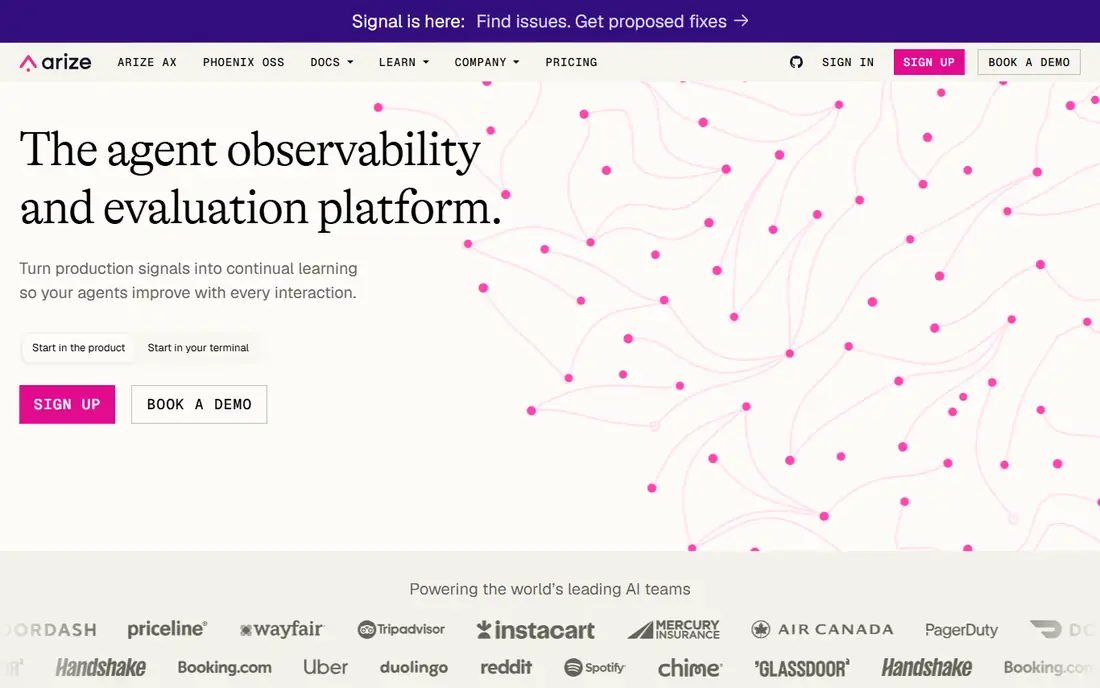
Arize AI monitors LLM apps in production, tracking traces, evals, drift, and performance across models, prompts, and data. It suits teams running agents and chat apps at scale, since it flags quality drops, hallucinations, and data drift before users complain. The platform works across frameworks and model providers, so teams are not locked to one stack.
The trade-offs are price and complexity. Enterprise pricing is quote-based, setup takes planning for large estates, and the breadth of features can overwhelm small teams. Even so, Arize suits production teams that need serious monitoring, evals, and drift detection for LLM apps that serve real users.
What we like- Strong production monitoring
- Evals and drift detection
- Works across frameworks and models
Watch out for- Enterprise pricing is quote-based
- Setup takes planning
- Breadth can overwhelm small teams
Starting priceFree
Free planYes
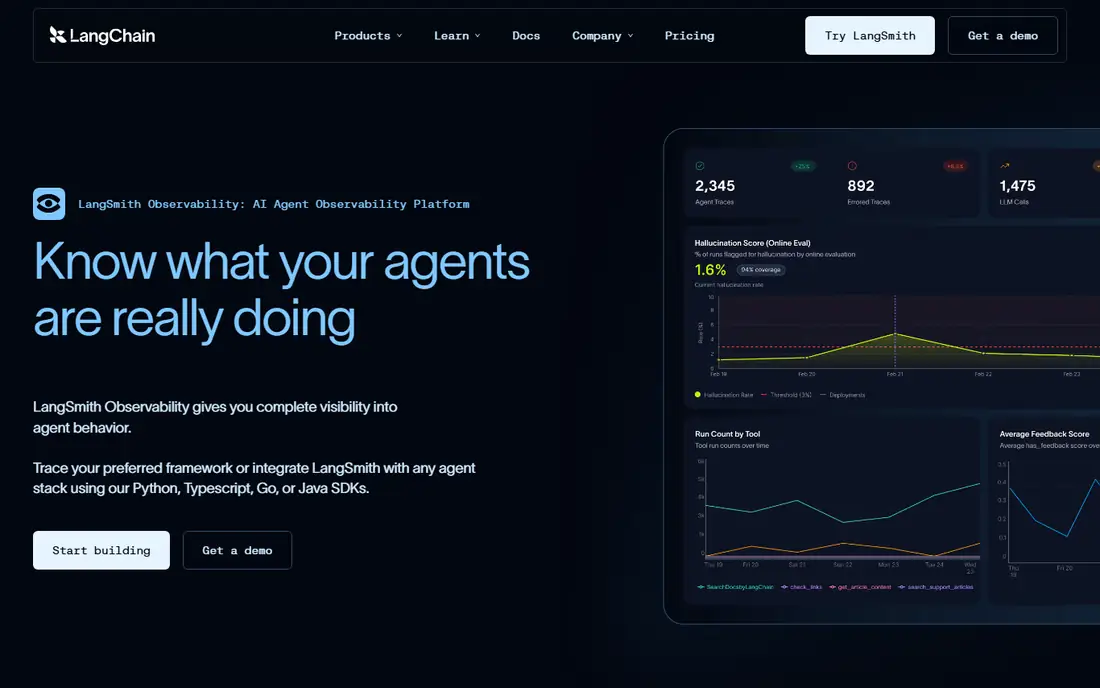
LangSmith is the observability platform from the LangChain team, built for tracing, debugging, evaluating, and monitoring agents built with LangChain and LangGraph. Traces show every model call, tool call, and retrieval step, which makes it far easier to find why an agent failed. Evals compare prompts and models on test sets, and the prompt hub versions prompts for production use.
The limits are ecosystem and scale. LangSmith works best with LangChain code, paid tiers are needed at higher volumes, and some features assume LangChain patterns. Even so, LangSmith suits LangChain teams that want tracing, evals, and prompt management in one place built for their stack.
What we like- Deep LangChain and LangGraph integration
- Tracing, evals, and prompt hub
- Good debugging views
Watch out for- Best with LangChain
- Paid tiers needed at scale
- Some features need LangChain code patterns
Starting priceFree
Free planYes
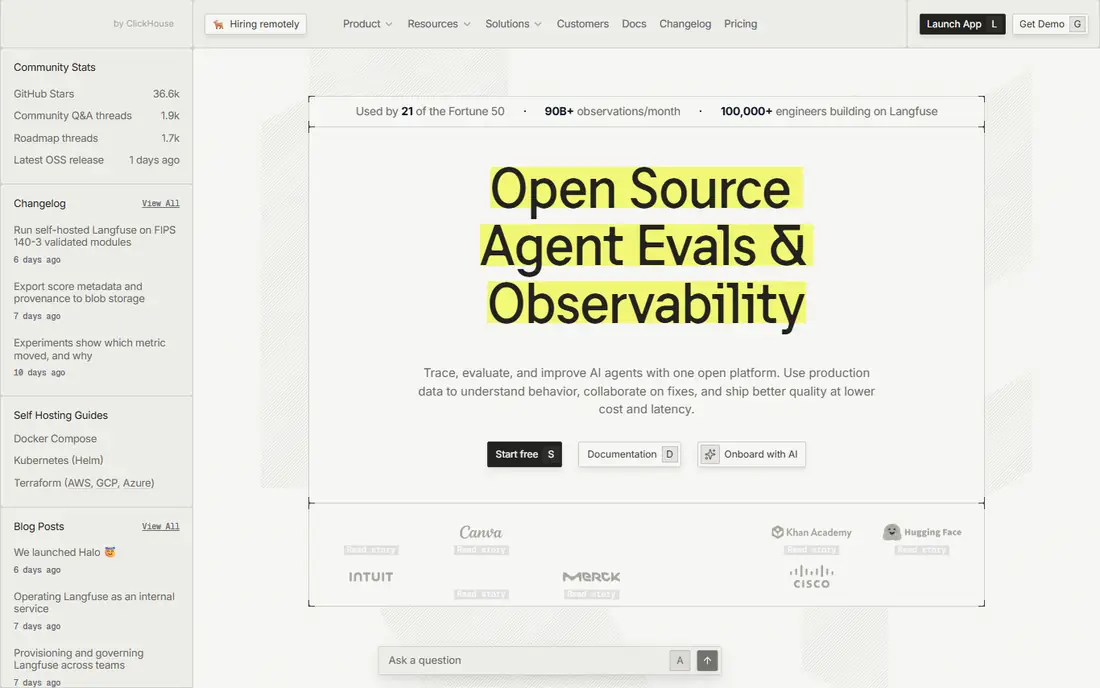
Langfuse is the leading open source LLM observability platform, with tracing, evals, prompt management, and analytics in one system that teams can self-host or use as a cloud service. It suits teams that want data control, since self-hosting keeps traces inside their own infrastructure, and its generous cloud free tier makes it easy to try. The platform works with many frameworks through SDKs and OpenTelemetry.
The trade-offs are ops and enterprise depth. Self-hosting needs operations work, the enterprise feature set is smaller than Arize, and docs are thinner in places. Even so, Langfuse suits teams that want open source observability with tracing, evals, and prompt management at low cost.
What we like- Open source and self-hostable
- Tracing, evals, and prompt management
- Generous cloud free tier
Watch out for- Self-hosting needs ops work
- Smaller enterprise feature set
- Docs are thinner than Arize
Starting priceFree
Free planYes
Helicone works as a proxy between your app and model providers, logging every request, response, cost, and latency with minimal code changes. It suits teams that want fast visibility into spend and usage across OpenAI, Anthropic, and other providers, since one integration covers them all. Caching, rate limiting, and user tracking add practical value for production apps.
The limits are architecture and evals. A proxy adds a network hop, evals are thinner than Arize or LangSmith, and enterprise features need paid tiers. Even so, Helicone suits teams that want quick logging, cost tracking, and multi-provider visibility without heavy instrumentation.
What we like- Simple proxy setup
- Cost and usage tracking
- Works across providers with one key
Watch out for- Proxy adds a hop
- Evals are thinner than Arize
- Enterprise features need paid tiers
Starting priceFree
Free planYes
Weights and Biases Weave, part of the W and B platform, adds tracing and evals for LLM apps on top of the experiment tracking that ML teams already use. It suits teams that train or fine-tune models and want evals, traces, and model versions in one place, with dashboards for comparing prompts and models. The integration with W and B training runs helps teams that work across both training and serving.
The trade-offs are ecosystem and maturity. Weave works best for teams already on W and B, tracing is newer than LangSmith or Langfuse, and pricing grows with use. Even so, Weave suits ML teams that want evals and tracing tied to their existing experiment platform.
What we like- Strong evals and experiment tracking
- Tracing for agents
- Ties to W and B training tools
Watch out for- Best for teams already on W and B
- Tracing is newer than LangSmith
- Pricing grows with use
Starting priceSee website
Free planYes
HoneyHive focuses on evals and testing for LLM apps, with test sets, evaluators, and tracing that help teams measure quality before and after prompt changes. It suits quality-focused teams that want to catch regressions in agent behavior, since evals run on real traffic and curated tests. The platform also covers tracing for debugging failed runs.
The limits are price and ecosystem. Pricing is quote-based for larger use, the community is smaller than LangSmith or Langfuse, and integrations are fewer. Even so, HoneyHive suits teams that put evals and quality measurement at the center of their LLM workflow.
What we like- Strong evals and test sets
- Tracing for debugging
- Good for quality-focused teams
Watch out for- Pricing is quote-based for larger use
- Smaller community
- Fewer integrations than LangSmith
Starting priceFree
Free planYes
Traceloop, built on OpenLLMetry, provides OpenTelemetry-based tracing for LLM apps, with open source SDKs that instrument LangChain, LlamaIndex, and other frameworks. It suits teams that already use OpenTelemetry for infrastructure, since LLM traces can sit alongside service traces in tools such as Jaeger, Grafana, or Datadog. The open approach avoids vendor lock-in for trace data.
The limits are evals and polish. Evals are thinner than Arize or HoneyHive, the dashboard is simpler, and enterprise support is newer. Even so, Traceloop suits engineering teams that want standards-based tracing for LLM apps inside their existing observability stack.
What we like- OpenTelemetry-based tracing
- Open source SDKs
- Works with many frameworks
Watch out for- Evals are thinner than rivals
- Dashboard is simpler
- Enterprise support is newer
Starting priceSee website
Free planNo
Datadog LLM Observability adds LLM tracing, evals, and cost tracking inside Datadog, so teams that already monitor infrastructure and apps can see model calls alongside service metrics. That pairing helps on-call teams connect an agent failure to a service outage, a slow database, or a model latency spike. Alerting and dashboards follow Datadog patterns that ops teams already know.
The trade-offs are cost and eval depth. It needs a Datadog subscription, LLM evals are thinner than Arize or HoneyHive, and pricing is usage-based. Even so, Datadog LLM Observability suits teams already on Datadog that want LLM visibility inside their existing monitoring stack.
What we like- LLM traces inside Datadog
- Ties to infra and APM data
- Strong alerting
Watch out for- Needs a Datadog subscription
- LLM evals are thinner
- Pricing is usage-based
How we chose
We compared AI observability tools on tracing depth, evals, prompt management, cost tracking, framework support, and data control, favoring tools with proven production use. We excluded model playgrounds that only test prompts without tracing production traffic. Prices mix free tiers and usage-based plans, so we wrote See website where a vendor does not publish a clear starting price.
Buying guide
Start by listing what you need to see: traces for debugging, evals for quality, cost tracking for budgets, alerts for failures, or all of these. A short list of must-have views keeps the trial focused and stops vendors from selling you dashboards you will never open. Teams that only need logging can start with Helicone or Traceloop, while teams that need quality measurement need Arize, LangSmith, or HoneyHive, and teams that need both should trial one platform on a single production service first. Next, check framework fit, since LangSmith suits LangChain teams and Datadog suits Datadog shops, while Langfuse and Traceloop fit many stacks and model providers.
Then think about data control and cost. Self-hosting with Langfuse keeps traces private, while cloud platforms charge by traces or events, which grows with traffic. Set retention limits and sampling for high-volume apps, so observability bills stay sane. Also protect sensitive data in traces, since prompts can contain user text, API keys, or personal details that should be redacted before storage. Finally, build evals early: a trace without evals tells you what happened, but only evals tell you whether quality is getting better or worse over time, and they give your team a shared definition of good output.
Frequently asked questions
What is AI observability?
It is the practice of tracing, monitoring, and evaluating LLM apps in production, recording prompts, model responses, tool calls, costs, and errors so teams can debug failures and track quality.
How is it different from normal app monitoring?
Normal monitoring tracks servers and APIs, while AI observability tracks model behavior: prompts, outputs, hallucinations, and eval scores, which change with data and model versions in ways servers do not.
Do I need observability for a small LLM app?
Yes, at least basic tracing and cost tracking. Even small apps fail in ways that are hard to reproduce, and a trace shows exactly which prompt and tool call caused the failure, which saves hours of guessing.
What are evals in LLM observability?
Evals are tests that score model outputs against expected answers, rules, or model judges, so teams can measure quality, catch regressions, and compare prompts or models over time.
Is open source observability good enough?
Often yes. Langfuse and Traceloop cover tracing and basic evals well, especially for teams that want data control and low cost. Larger production teams may still add Arize or LangSmith for deeper evals and drift detection.
Sources we checked (0)
Is your product missing or out of date?
We review this list regularly. Vendors can request a listing, send updated pricing or ask about featured placement.

Shihab Mia · Founder, Rankite
Shihab has 5+ years in B2B and SaaS SEO. He writes Rankite's software buying guides from pricing pages, documentation and public user reviews. More about Shihab.
 Arize AI
 LangSmith
 Langfuse
 Helicone
 Weights and Biases Weave
 HoneyHive
 Traceloop
 Datadog LLM Observability