How we make this list: we compare pricing pages, product documentation and public user reviews. Ratings come from G2, Capterra or Trustpilot, with the date we checked them.
Key takeaways
- Monte Carlo is the best-known data observability platform for automated data quality monitoring.
- Soda suits teams wanting data contracts and testing with an open-source core.
- Acceldata offers enterprise observability across quality, performance, and cost.
- Anomalo excels at ML-driven anomaly detection for data quality.
- Datafold is the choice for data diffing and CI for analytics engineering.
Quick comparison
| Tool | Best for | Starting price | Free plan |
|---|
 Monte Carlo Monte Carlo | automated data observability | See website | See website |
 Soda Soda | data contracts and testing | See website | See website |
 Acceldata Acceldata | enterprise data observability | See website | See website |
 Anomalo Anomalo | ML anomaly detection | See website | See website |
 Bigeye Bigeye | data quality monitoring | See website | See website |
 Metaplane Metaplane | self-serve observability | See website | See website |
 Datafold Datafold | data diffing and CI | See website | See website |
 Lightup Lightup | data quality monitoring | See website | See website |
Is your product missing or out of date?
We review this list regularly. Vendors can request a listing, send updated pricing or ask about featured placement.
Starting priceSee website
Free planSee website
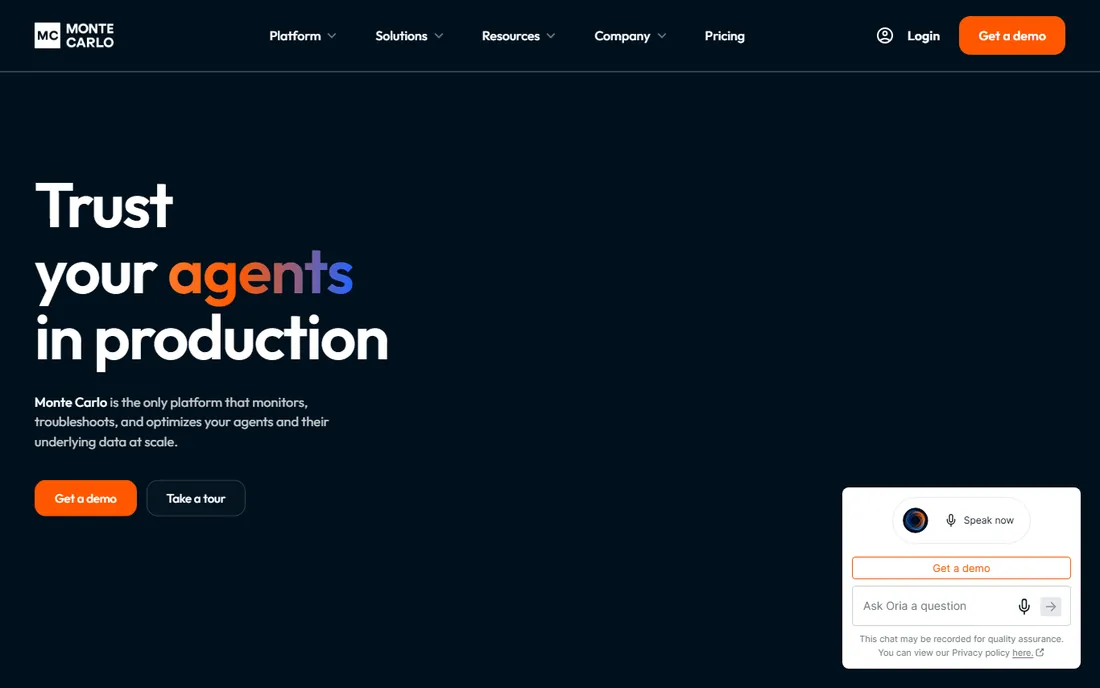
Monte Carlo pioneered data observability: automated monitoring across freshness, volume, distribution, schema, and lineage, catching data downtime before stakeholders notice. The platform learns what normal looks like and alerts on anomalies. Integrations span the modern data stack, from warehouses to BI tools.
Pricing is enterprise-oriented. The platform's breadth takes time to master. But as the category-defining data observability platform, Monte Carlo sets the standard others are measured against. Its incident management workflows help teams move from detection to resolution systematically. Assigning ownership, tracking status, and documenting root causes turns chaotic firefighting into a repeatable process that improves over time.
What we like- Category leader
- Automated monitoring
- Broad integrations
Watch out for- Enterprise pricing
- Can be complex
Starting priceSee website
Free planSee website
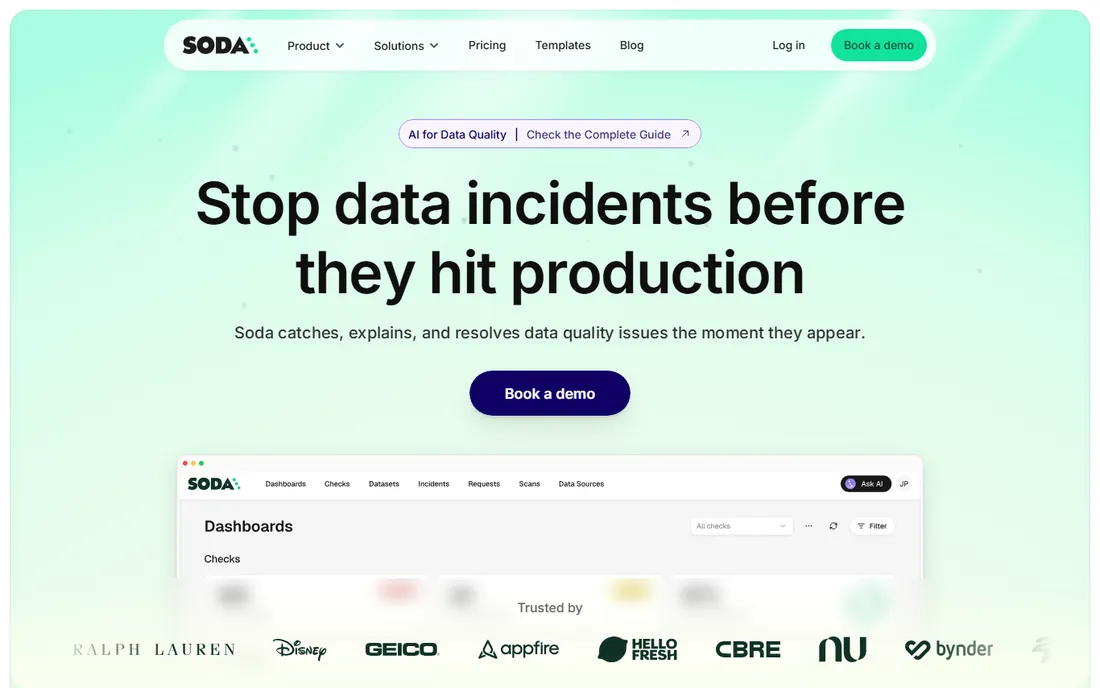
Soda brings software engineering practices to data quality: data contracts, testing in code, and an open-source core (SodaCL) that engineers adopt bottom-up. Teams define quality expectations as code and enforce them in pipelines. The approach resonates with data engineers who already live in version control.
It requires more hands-on work than fully automated platforms. The company is smaller than Monte Carlo. But for contract-driven, code-first data quality, Soda's philosophy is compelling. Teams that already treat infrastructure as code find Soda's approach natural. The learning curve is gentler for engineers than for analysts, which shapes who adopts it first within organizations.
What we like- Open-source core
- Data contracts
- Engineer-friendly
Watch out for- More DIY than competitors
- Smaller company
Starting priceSee website
Free planSee website
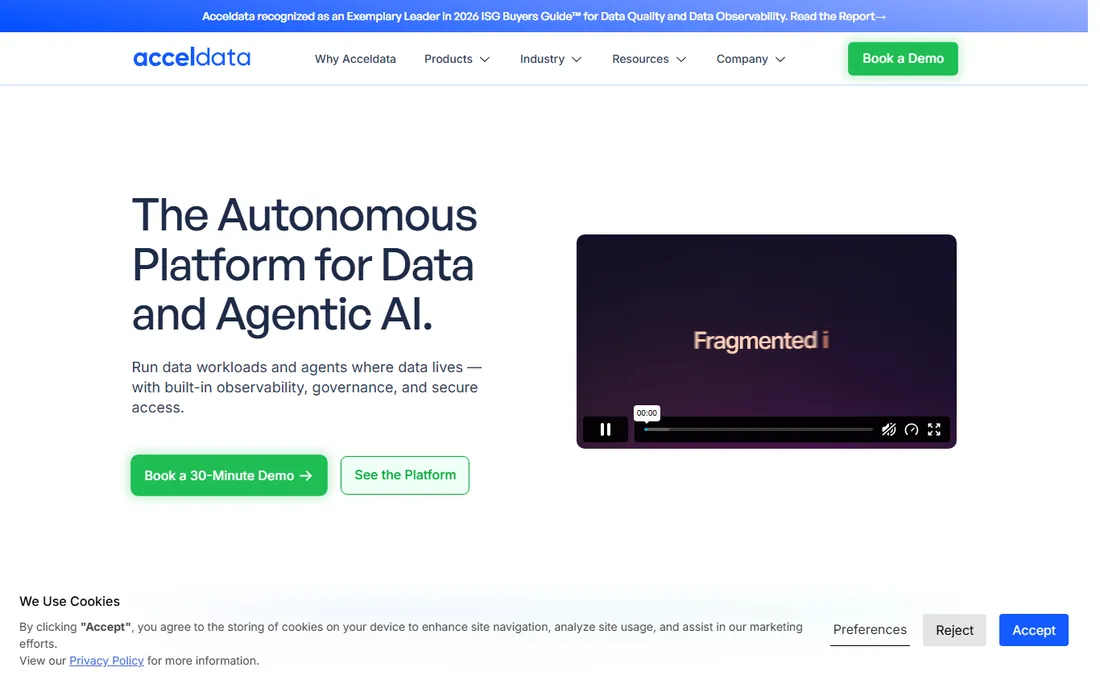
Acceldata offers comprehensive data observability for enterprises: data quality, pipeline performance, and cost intelligence in one platform. Large organizations with complex data estates get unified monitoring. The cost visibility features address FinOps concerns alongside quality, which matters as data bills grow.
Enterprise complexity and pricing apply. Smaller teams find it heavy. But for large-scale data operations needing quality, performance, and cost in one view, Acceldata delivers. The unified view prevents the tool sprawl that plagues enterprise data teams. Instead of separate tools for quality, performance, and cost, one platform correlates them: a slow pipeline and a quality incident may share a root cause.
What we like- Broad platform
- Quality plus performance plus cost
- Enterprise scale
Watch out for- Enterprise complexity
- Pricing
Starting priceSee website
Free planSee website
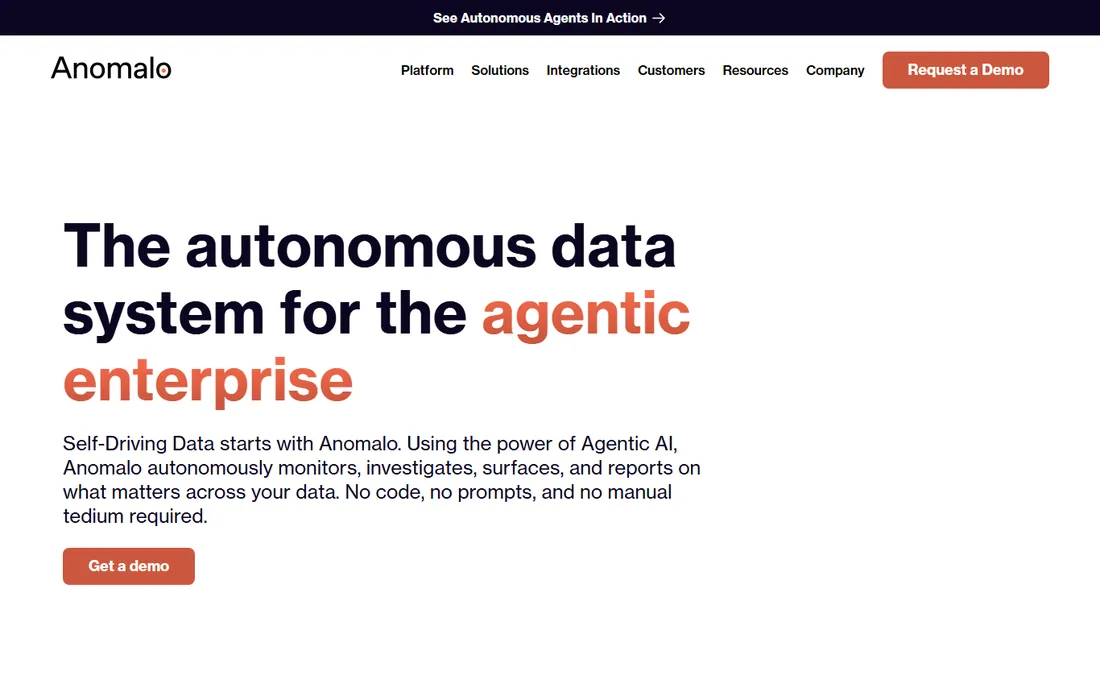
Anomalo applies machine learning to data quality: unsupervised anomaly detection that finds issues without manual threshold configuration, plus root cause analysis to speed resolution. Data teams get intelligent monitoring that improves over time as the models learn each dataset's patterns.
The focus is narrower than full observability platforms. Pricing is enterprise. But for ML-powered anomaly detection on critical datasets, Anomalo's depth stands out. Its unsupervised approach means coverage starts immediately, without waiting for engineers to write rules. This is particularly valuable for wide tables with hundreds of columns where manual rule-writing is impractical.
What we like- Strong ML detection
- Unsupervised monitoring
- Root cause analysis
Starting priceSee website
Free planSee website
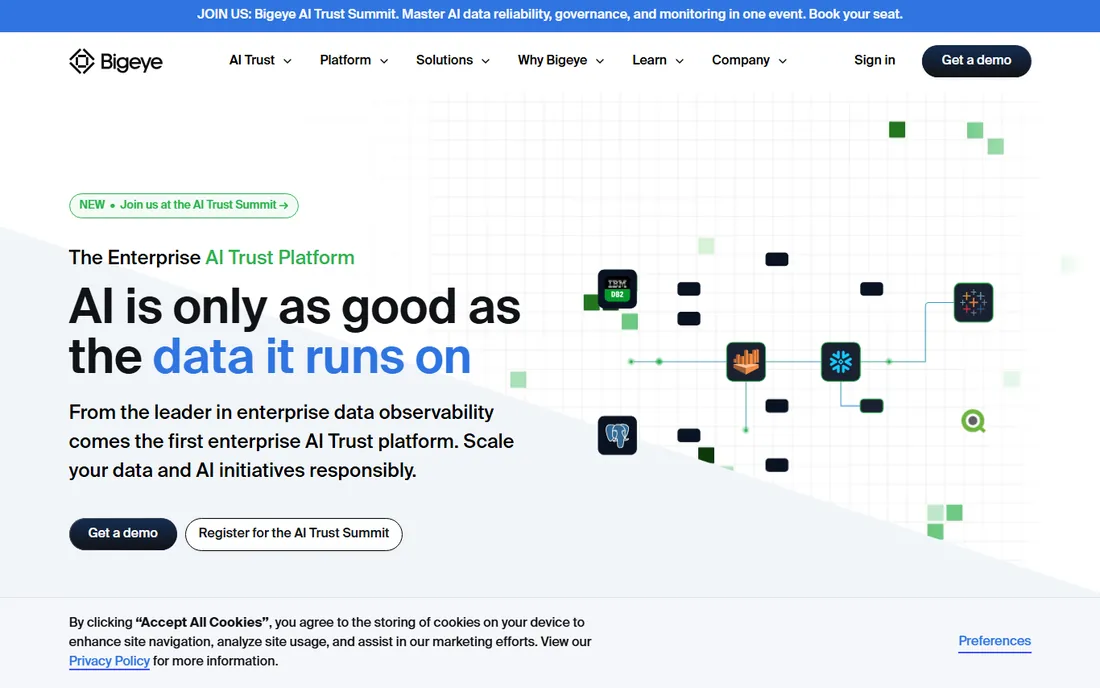
Bigeye provides automated data quality monitoring: autometrics that profile data and detect anomalies without manual rule-writing, covering warehouses and pipelines. The user experience is approachable for analytics teams. Coverage automation reduces setup burden significantly.
The space is crowded with similar offerings. Pricing is enterprise-oriented. But for accessible automated data quality monitoring, Bigeye is a solid contender. Its automated metric generation means teams get monitoring coverage without manual setup for every table. For data estates with thousands of tables, this automation is the difference between observability and aspiration.
What we like- Automated metrics
- Broad coverage
- User-friendly
Watch out for- Competitive crowded space
- Pricing
Starting priceSee website
Free planSee website
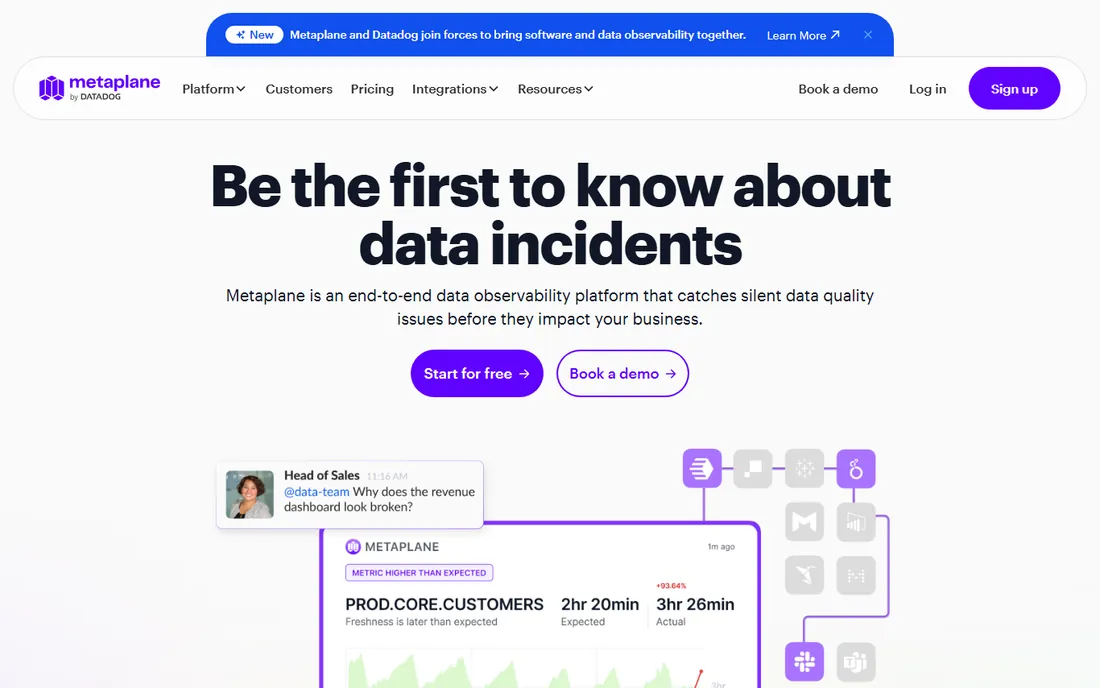
Metaplane is self-serve data observability: connect sources and start monitoring in minutes, with ML-powered anomaly detection and a Snowflake native app for secure in-platform processing. Small and mid-size data teams get observability without enterprise procurement cycles.
The company is smaller; scope is narrower than Monte Carlo or Acceldata. But for fast, self-serve data observability, Metaplane's time-to-value is excellent. Teams frustrated by enterprise sales cycles appreciate getting started without a procurement process. The product-led approach means evaluation happens with real data, not slide decks.
What we like- Self-serve setup
- Quick time to value
- Snowflake native app
Watch out for- Smaller company
- Narrower scope
Starting priceSee website
Free planSee website
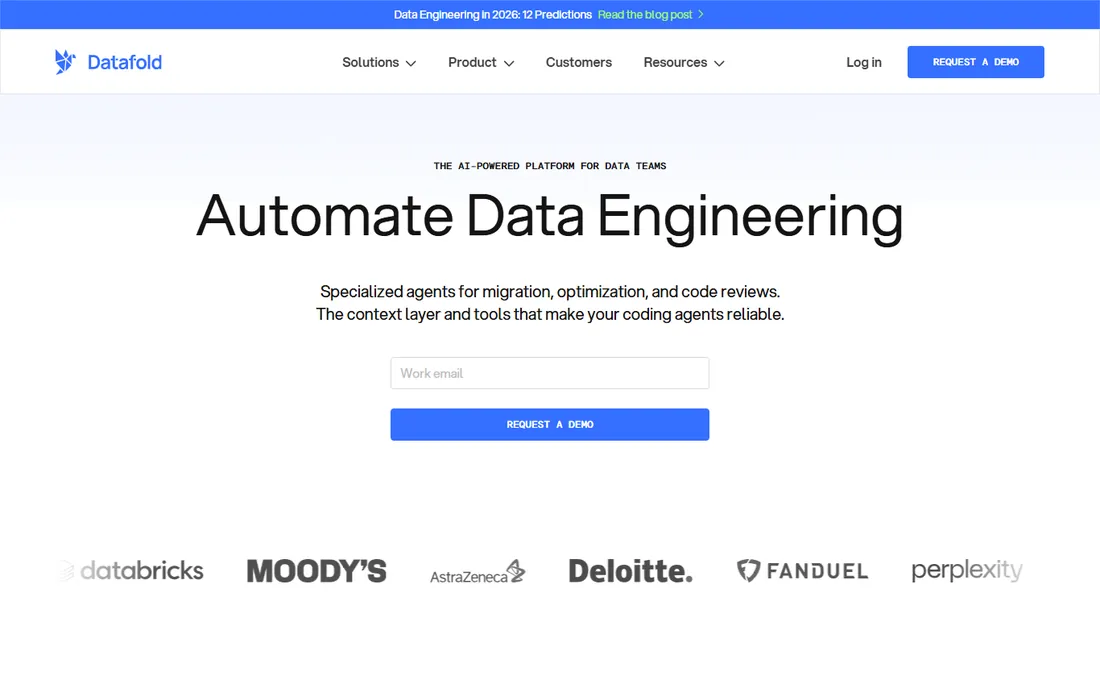
Datafold brings CI/CD practices to analytics engineering: data diffing that shows exactly how code changes affect data before deployment, preventing bad dbt models from reaching production. Teams ship data changes with confidence. The diffing capability is unique and powerful for dbt-heavy workflows.
The focus is specialized; it complements rather than replaces broad observability. Pricing targets professional teams. But for preventing data incidents at the source, Datafold's diffing is unmatched. Catching issues before deployment is always cheaper than catching them in production. A bad dbt model that ships can corrupt downstream tables for hours before anyone notices; Datafold prevents that class of incident entirely.
What we like- Data diffing
- CI for dbt
- Prevents bad deploys
Starting priceSee website
Free planSee website
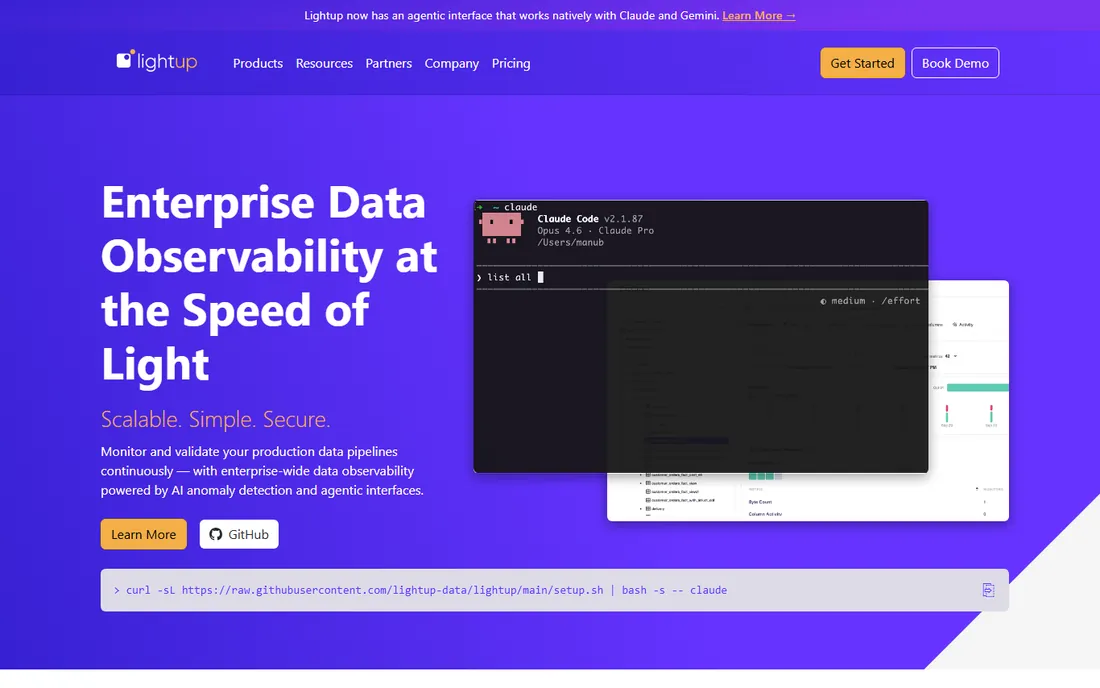
Lightup offers data quality monitoring with automated anomaly detection: connect data sources, get intelligent monitoring without extensive configuration. The straightforward approach suits teams wanting observability without complexity or lengthy onboarding.
It is a smaller, less-known vendor. Feature depth trails category leaders. But for straightforward automated data quality monitoring, Lightup delivers value. Teams wanting observability without enterprise overhead find it refreshingly simple. The tradeoff is depth: evaluate whether its detection capabilities match your data complexity before committing.
What we like- Automated monitoring
- Anomaly detection
- Straightforward
Automated monitoring vs data contracts
Two philosophies dominate: automated observability (Monte Carlo, Bigeye, Anomalo, Metaplane, Lightup) that learns normal and alerts on anomalies, and contract-driven quality (Soda, Datafold) where engineers define expectations explicitly. Automated approaches catch unknown unknowns; contracts enforce known requirements. Neither replaces the other.
Most mature data teams use both: contracts for critical pipelines where requirements are clear, automated monitoring for broad coverage where they are not. When evaluating, consider which philosophy matches your team's culture and maturity. Engineering-heavy teams often prefer contracts; analytics-heavy teams prefer automation.
What to check before you buy
Start with your data stack. Verify native integrations with your warehouses, lakes, BI tools, and transformation layer (especially dbt). Observability that does not connect to your stack is useless. Prioritize vendors with deep integrations for your specific technologies. Shallow integrations that only read metadata miss the data-level issues that matter most.
Then assess alert quality. The difference between good and bad observability is alert signal-to-noise: too many false positives and engineers ignore everything. Ask about anomaly detection approaches, alert tuning, and how the platform reduces noise. Trial with real data to judge. A useful test: run the trial for two weeks and count actionable versus ignored alerts. If engineers start muting the platform during the trial, that pattern will only worsen in production.
Finally, consider incident workflow. Detection is only half the battle; resolution matters. Evaluate root cause analysis, lineage for impact assessment, and integrations with incident management (PagerDuty, Slack). The goal is faster resolution, not just faster detection. The best platforms turn alerts into investigations with context attached. Lineage showing downstream impact, recent changes to the pipeline, and historical patterns should accompany every alert.
Frequently asked questions
What is data observability?
The practice of monitoring data pipelines and datasets for quality issues: freshness, volume, schema changes, distribution anomalies, and lineage. Like application observability (Datadog, New Relic) but for data. The goal is catching "data downtime" before it affects decisions or customers. Just as DevOps transformed software reliability, data observability is transforming data reliability. Organizations that invest early avoid the painful period of discovering data issues through angry stakeholders.
How is this different from data quality tools?
Traditional data quality tools focus on profiling and cleansing. Data observability adds continuous monitoring, automated anomaly detection, lineage, and incident management. Modern platforms combine both; the distinction is increasingly historical. When vendors use the terms interchangeably, focus on capabilities rather than labels. Ask for specific demonstrations of monitoring, alerting, and incident workflows rather than accepting category claims.
What does data observability cost?
Typically quote-based enterprise pricing, often tied to monitored tables or data volume. Self-serve options (Metaplane) are more accessible. Open-source cores (Soda) reduce license costs but need engineering time. Budget for implementation alongside licenses. The hidden cost is often the engineering time to achieve full coverage. Factor implementation effort into total cost comparisons, not just license fees.
Do I need data observability if I use dbt tests?
dbt tests catch known issues you thought to test for. Observability catches unknown issues: schema drift, volume anomalies, distribution shifts you did not anticipate. They complement each other; Datafold even brings observability thinking into the dbt workflow itself. Use both for defense in depth.
How long does implementation take?
Self-serve tools (Metaplane) deliver value in days. Enterprise platforms (Monte Carlo, Acceldata) typically take weeks to months for full deployment across complex estates. Start with critical pipelines and expand coverage over time. Do not try to monitor everything on day one; prioritize by business impact.
Can small data teams use these tools?
Yes. Metaplane and Soda are particularly accessible for smaller teams. Start with your most critical datasets; you do not need enterprise-wide deployment on day one. The ROI case is often strongest for small teams where one bad dataset affects everything. A single prevented incident can justify the investment.
How we chose
We selected data observability tools that appear consistently in data engineering comparisons, practitioner discussions, and analyst coverage. Each vendor's site was checked to confirm the product is current in 2026. Pricing details come from vendor pages where published; most pricing is quote-based. No hands-on pipeline monitoring was conducted for this guide; assessments reflect documented capabilities and community reputation today.
Sources we checked (10)
- https://www.montecarlodata.com
- https://www.soda.io
- https://www.acceldata.io
- https://www.anomalo.com
- https://www.bigeye.com
- https://www.metaplane.dev
- https://www.datafold.com
- https://www.lightup.ai
- https://github.com/njain006/costly-oss/blob/HEAD/docs/connectors/monte-carlo.md
- https://Slashdot.org/software/comparison/Lightup-vs-Metaplane/
Is your product missing or out of date?
We review this list regularly. Vendors can request a listing, send updated pricing or ask about featured placement.

Shihab Mia · Founder, Rankite
Shihab has 5+ years in B2B and SaaS SEO. He writes Rankite's software buying guides from pricing pages, documentation and public user reviews. More about Shihab.