How we make this list: we compare pricing pages, product documentation and public user reviews. Ratings come from G2, Capterra or Trustpilot, with the date we checked them.
Key takeaways
- Magnifi is the best AI research pick for a beginner who wants to learn while investing, with a free tier and Premium at $8.25 a month on annual billing.
- Fidelity Go is the cheapest managed start for small balances, with no advisory fee under $25,000 and only $10 needed to begin investing.
- Betterment and Wealthfront both charge 0.25% a year, but Betterment has no minimum while Wealthfront needs $500 to start.
- Schwab Intelligent Portfolios charges no advisory fee, yet it needs a $5,000 minimum and holds a cash allocation that can drag returns.
- A flat monthly fee, such as Acorns at $4 a month, costs a larger share of a small balance than a percentage fee, so check the math on your own balance.
Quick comparison
| Tool | Best for | Starting price | Free plan |
|---|
 Magnifi | AI research and portfolio planning | Free; Premium $8.25 per month (billed annually) | Yes |
 Fidelity Go | Small balances with no advisory fee | $0 under $25,000; 0.35% per year above that | No |
 Betterment | Goal-based managed portfolios | $5 per month or 0.25% per year | No |
 Wealthfront | Tax-loss harvesting for taxable accounts | 0.25% per year | No |
 Schwab Intelligent Portfolios | No advisory fee with a larger minimum | $0 advisory fee | No |
 SoFi Automated Investing | Simple managed investing with adviser access | 0.25% per year | No |
 Vanguard Digital Advisor | Low-cost index portfolios | About 0.15% per year (net) | No |
 Acorns | Round-ups and spare-change investing | $4 per month | No |
Is your product missing or out of date?
We review this list regularly. Vendors can request a listing, send updated pricing or ask about featured placement.
The best AI investing apps for beginners
Starting priceFree; Premium $8.25 per month (billed annually)
Free planYes
Magnifi is the closest thing on this list to an AI investing companion rather than a set-and-forget manager. You can ask it plain-language questions about a stock or fund, check how a holding fits your portfolio, and see hidden overlap across funds you already own. Linking outside brokerages gives a single view of scattered accounts, which helps a beginner who started in one app and opened another later.
The free tier covers account overview, performance, risk and exposure analysis, and basic discovery, which is enough to learn the workflow. Premium, at $8.25 a month billed annually or $14 a month billed monthly, adds scenario testing, forecasts, and deeper research. Magnifi fits a beginner who wants to understand decisions, not just hand them over, and who will actually use the research tools enough to justify Premium.
What we like- Conversational AI assistant for research
- Links Fidelity, Robinhood, and Schwab accounts
- Portfolio health score and risk checks
Watch out for- Premium tools sit behind $99 a year
- It is a research tool, not a fully managed robo-adviser for everyone
- Fund costs still apply
Starting price$0 under $25,000; 0.35% per year above that
Free planNo
Fidelity Go is the easiest managed start for a beginner with a small balance. There is no account minimum to open, $10 is enough to begin investing, and the advisory fee is $0 while the balance stays under $25,000. The portfolios use Fidelity Flex funds, which carry 0% expense ratios, so the fund cost that usually sits on top of an advisory fee is not a factor here.
The catch arrives as you grow. At $25,000 the advisory fee becomes 0.35% a year, which is higher than Betterment or Wealthfront, though that tier also adds tax-loss harvesting for taxable accounts and coaching calls. Fidelity Go fits a beginner starting small inside the Fidelity system, and it stays sensible as long as you recheck the fee when your balance crosses $25,000.
What we like- No advisory fee under $25,000
- Only $10 needed to begin investing
- Fidelity Flex funds carry 0% expense ratios
Watch out for- Advisory fee jumps to 0.35% above $25,000
- Tax-loss harvesting starts at $25,000
- Coaching calls also start at $25,000
Starting price$5 per month or 0.25% per year
Free planNo
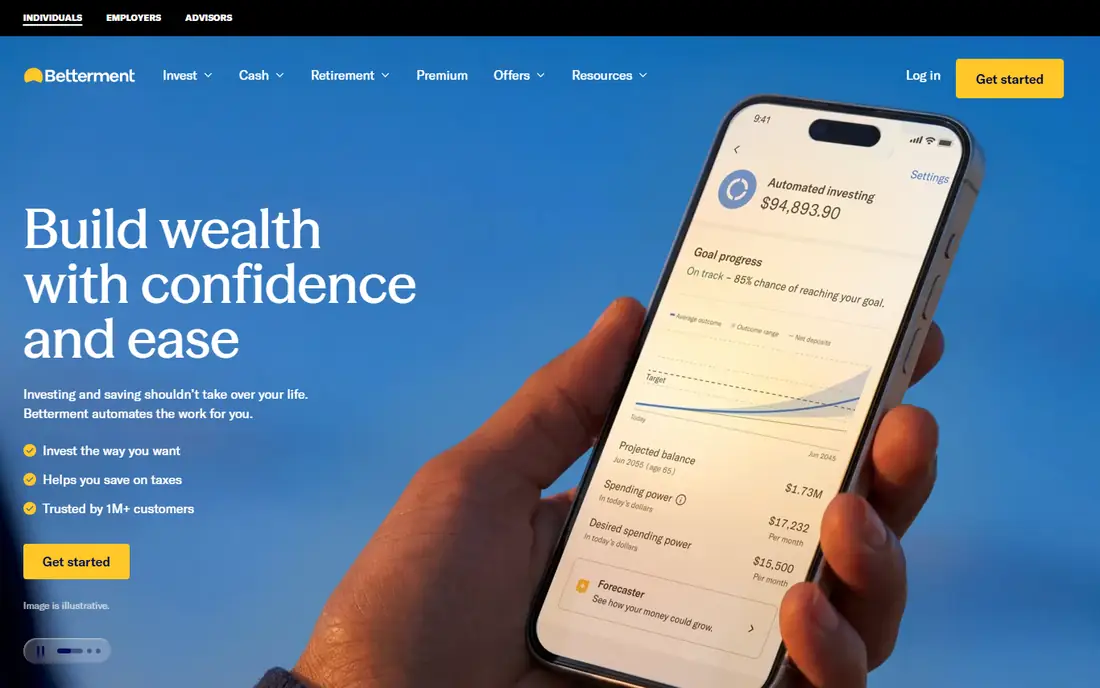
Betterment is the most complete beginner robo-adviser for goal planning. You set a goal, such as retirement or a major purchase, answer risk questions, and Betterment builds and rebalances a diversified ETF portfolio for that goal. Tax-loss harvesting runs in taxable accounts, and the app explains each goal's progress in plain terms rather than raw market jargon.
Pricing needs a close look. Accounts pay $5 a month if the balance is under $24,000 without $200 a month in recurring deposits, or 0.25% a year otherwise, which means a $1,000 balance can cost $60 a year on the monthly plan. Human adviser access sits in Premium at 0.65% a year with a $100,000 minimum. Betterment fits a beginner who will set up regular deposits and wants goal tools, not someone investing a one-off small sum and leaving it alone.
What we like- No account minimum
- Goal-based portfolios for retirement and other aims
- Tax-loss harvesting in taxable accounts
Watch out for- $5 a month hits small balances hard
- Human adviser access needs Premium at $100,000
- Fee structure needs reading
Starting price0.25% per year
Free planNo
Wealthfront keeps its pricing simple, which beginners often prefer. The advisory fee is 0.25% a year on every balance, the minimum is $500, and tax-loss harvesting runs in taxable accounts without a balance threshold. Planning tools cover retirement, college savings, and home buying, and the portfolio rebalances automatically as markets move.
The trade is human help. Wealthfront offers no dedicated human financial adviser, so a beginner who wants to talk through a complex choice will need to look elsewhere. Direct indexing, which can improve tax handling further, needs $100,000. Wealthfront fits a taxable-account beginner who values tax-loss harvesting and a clean percentage fee, and who is comfortable managing the plan without an adviser call.
What we like- Daily tax-loss harvesting in taxable accounts
- Simple flat percentage fee
- Planning tools for retirement and college
Watch out for- $500 minimum to start
- No human adviser access
- Direct indexing needs $100,000
#5
Schwab Intelligent Portfolios
Best for: No advisory fee with a larger minimum
Visit schwab.com
Starting price$0 advisory fee
Free planNo
Schwab Intelligent Portfolios looks free, and on advisory fees it is. There is no percentage charge, and the portfolios use low-cost ETFs from Schwab and others. That headline is genuine, but it comes with two conditions a beginner should understand: a $5,000 minimum to open, and a cash allocation that Schwab sets between 6% and 30% of the portfolio.
Cash does not fall with the market, but it also does not grow with it, so in strong markets that allocation can hold returns back compared with a fully invested portfolio. Tax-loss harvesting is available only once enrolled taxable assets reach $50,000. Schwab fits a beginner who already has $5,000, banks with Schwab, and values a $0 advisory fee over full investment, rather than someone starting with a few hundred dollars.
What we like- No advisory fee
- Large established brokerage behind it
- Tax-loss harvesting from $50,000 for enrolled accounts
Watch out for- $5,000 minimum to start
- Required cash allocation of 6% to 30% can drag returns
- Premium advice costs extra
#6
SoFi Automated Investing
Best for: Simple managed investing with adviser access
Visit sofi.com
Starting price0.25% per year
Free planNo
SoFi Automated Investing is a straightforward managed option with one clear extra: access to certified financial planners. A beginner can set a goal, answer risk questions, and let SoFi build and rebalance a diversified ETF portfolio, then ask a planner a question when a life event changes the plan. That human contact, even in limited form, is something Wealthfront does not offer.
The portfolio itself is less advanced on tax handling, since SoFi does not offer tax-loss harvesting. The advisory fee is 0.25% a year, and fund expense ratios apply on top. SoFi fits a beginner who wants managed investing plus a person to call, especially if they already use SoFi for banking or loans, and who invests mainly in retirement accounts where tax-loss harvesting matters less.
What we like- Access to certified financial planners
- Simple goal setup
- Fits users already in the SoFi system
Watch out for- No tax-loss harvesting
- 0.25% fee with a $50 minimum in some listings
- Portfolio fund expenses vary
Starting priceAbout 0.15% per year (net)
Free planNo
Vanguard Digital Advisor is the low-fee choice for a beginner who trusts index investing and does not need many extras. The net advisory fee is about 0.15% a year for an all-index portfolio, after credits for fund revenue, and the minimum is $100. Portfolios are built from Vanguard index funds, which keeps fund costs low and the strategy easy to explain.
The service is deliberately plain. It offers fewer automated features than Betterment or Wealthfront, and the digital-only service does not include a regular human adviser, though a separate personal adviser service exists at a higher fee. Vanguard fits a cost-focused beginner who wants a simple index portfolio and will not miss tax-loss harvesting or AI research tools.
What we like- Lowest percentage fee on this list
- All-index Vanguard portfolios
- $100 minimum to start
Watch out for- Fewer automated features than rivals
- No regular human adviser in the digital-only service
- Tax-loss harvesting is not published
Starting price$4 per month
Free planNo
Acorns works best for a person who has not managed to save regularly. Link a card, and Acorns rounds up purchases to the next dollar and invests the spare change once it reaches $5. Bronze at $4 a month bundles a diversified portfolio, an IRA account, and checking with real-time round-ups, while Silver at $8 and Gold at $12 add savings, IRA matches, and accounts for kids.
The math deserves attention. At $4 a month, a $1,000 balance pays $48 a year, or 4.8% of the balance, which is far more than a 0.25% percentage fee. Acorns earns its fee when round-ups are the only habit that actually sticks, or when you use the bundled IRA and checking features. If you already save regularly, a percentage-fee robo-adviser will usually cost less.
What we like- Round-ups turn spare change into investments
- IRA and checking bundled in plans
- Very easy first step for non-investors
Watch out for- Flat fee is expensive on small balances
- No tax-loss harvesting
- Higher tiers cost $8 or $12 a month
How we chose
We compared vendor pricing pages, product documentation, and public reviews on G2, Capterra, and Reddit, and we checked fees, minimums, tax-loss harvesting, human adviser access, and account types for each platform. A platform made this list only if it is live in the United States now and a beginner can open and use it without a large minimum or an adviser relationship. We did not claim hands-on testing, and we treated third-party fee roundups as leads to check against each vendor's own pricing page.
Fees in this market change, and some platforms publish different figures for different account sizes, so we stated the tier that matters for a beginner rather than a single blended number. Where sources disagreed on a minimum or fee, we used the most recent vendor-aligned figure and noted the condition, such as a balance threshold or a recurring deposit rule.
What a beginner should check before opening an account
Start with the fee on your balance, not the headline rate. A percentage fee is easy to compare: 0.25% on $10,000 is $25 a year, while $5 a month is $60 a year. A $0 advisory fee still leaves fund costs and, at Schwab, a cash allocation to consider. Run the numbers for the balance you actually have, not the balance you hope to reach.
Match the account to the goal
A taxable account, a Roth IRA, and a traditional IRA are taxed differently, and not every platform offers every account type. Retirement saving usually belongs in an IRA first for most beginners, while a taxable account suits money you may need before retirement. Check that the platform offers the account you need before you fund it, since moving investments later can trigger taxes in a taxable account.
Decide how much help you want
A fully managed robo-adviser suits a beginner who wants to set a goal and leave the portfolio alone. An AI research tool like Magnifi suits someone who wants to learn and make their own picks with guidance. A round-up app suits someone whose main problem is saving at all. There is no best type in the abstract, only the type that matches how you will actually behave.
Keep the habit simple
Set a recurring deposit, even a small one, and check the account on a schedule rather than daily. Daily checks invite reaction to market moves, which is the behavior a managed portfolio is meant to prevent. Revisit the risk level when your life changes, such as a new job, a home purchase, or a shorter timeline, not when the market has a bad week.
Frequently asked questions
What is the best AI investing app for beginners?
Magnifi is the best AI-first pick for learning and research, while Fidelity Go is the best managed pick for small balances because its advisory fee is $0 under $25,000. Betterment suits goal planning, and Wealthfront suits taxable accounts that benefit from tax-loss harvesting. The right choice depends on whether you want research help, full management, or a saving habit.
How much money do I need to start?
It depends on the platform. Fidelity Go needs $10 to begin investing, Vanguard Digital Advisor needs $100, Wealthfront needs $500, and Schwab Intelligent Portfolios needs $5,000. Betterment and Acorns have no large minimum in the usual sense, though Acorns charges a monthly subscription. Start with the platform whose minimum and fee fit the amount you actually have.
Is AI investing safe?
AI tools can research, plan, and rebalance, but they cannot remove market risk, and no app can guarantee returns. A diversified portfolio lowers single-stock risk, yet it can still fall in a broad market decline. This is not financial advice, and you should only invest money you can leave invested for your timeline, with an emergency fund kept separate.
Do robo-advisers replace a human financial adviser?
For simple goal-based investing, a robo-adviser covers portfolio building, rebalancing, and basic tax handling well. For complex choices, such as tax planning across accounts, stock options, or retirement withdrawals, a human adviser adds judgment a questionnaire cannot. Betterment Premium and SoFi offer human access, while Wealthfront and Vanguard Digital Advisor do not in their basic services.
What fees should a beginner watch besides the advisory fee?
Fund expense ratios sit inside every portfolio and apply at all providers, though Fidelity Flex funds in Fidelity Go carry 0% expense ratios. Transfer-out fees, premium advice fees, and subscription tiers can also add cost. Schwab's cash allocation is another hidden cost, since cash held in a portfolio does not earn market returns.
Sources we checked (8)
- https://www.magnifi.com
- https://www.fidelity.com
- https://www.betterment.com
- https://www.wealthfront.com
- https://www.schwab.com
- https://www.sofi.com
- https://www.vanguard.com
- https://www.acorns.com
Is your product missing or out of date?
We review this list regularly. Vendors can request a listing, send updated pricing or ask about featured placement.

Shihab Mia · Founder, Rankite
Shihab has 5+ years in B2B and SaaS SEO. He writes Rankite's software buying guides from pricing pages, documentation and public user reviews. More about Shihab.