How we make this list: we compare pricing pages, product documentation and public user reviews. Ratings come from G2, Capterra or Trustpilot, with the date we checked them.
Key takeaways
- Enterprise platforms such as o9, Blue Yonder, RELEX, and ToolsGroup are quote only and typically run into six or seven figures annually.
- Mid market options publish entry prices: Netstock from 900 dollars per month, while Prediko pricing reports conflict, so its price is listed as See website.
- SAP IBP is reported from around 150,000 dollars per year, and Blue Yonder mid market deployments are reported at 250,000 dollars or more per year.
- Probabilistic forecasting, which outputs a demand distribution rather than a single number, suits intermittent and lumpy demand far better than point forecasts.
- AI forecasts still need human review: verify outputs, keep planner overrides, and treat vendor accuracy claims as marketing until proven on your own data.
Quick comparison
| Tool | Best for | Starting price | Free plan |
|---|
 o9 Solutions | Large enterprise integrated planning | See website | No |
 Blue Yonder | Large retail and CPG networks | See website | No |
 RELEX Solutions | Grocery and specialty retail | See website | No |
 SAP IBP | SAP centric enterprises | See website | No |
 Kinaxis Maestro | Concurrent demand and supply planning | See website | No |
 ToolsGroup SO99+ | Large catalogues with spiky demand | See website | No |
 Netstock | SME and mid market teams | $900 per month | No |
 Prediko | Shopify brands | See website | No |
Is your product missing or out of date?
We review this list regularly. Vendors can request a listing, send updated pricing or ask about featured placement.
#1o9 Solutions
Best for: Large enterprise integrated planning4.2/5 on
G2 (19 reviews, checked Oct 2026)
Visit o9solutions.com
Starting priceSee website
Free planNo

What we like- O9 Solutions offers the AI digital brain for integrated business planning, linking demand, supply, and finance in one planning model with fast scenario runs. It suits large enterprises and Fortune 500 companies in automotive, consumer goods, and retail, where one model must serve demand, supply, and finance teams together. The digital twin approach lets planners test scenarios quickly instead of rebuilding models per question.
Watch out for- Pricing is quote only and typically runs into six or seven figures annually, with a wide scope that means a longer rollout. The platform needs clean data and a dedicated team, and it is far more than a mid size team needs. Implementation timelines and total cost at realistic scale should be confirmed before signing.
Starting priceSee website
Free planNo
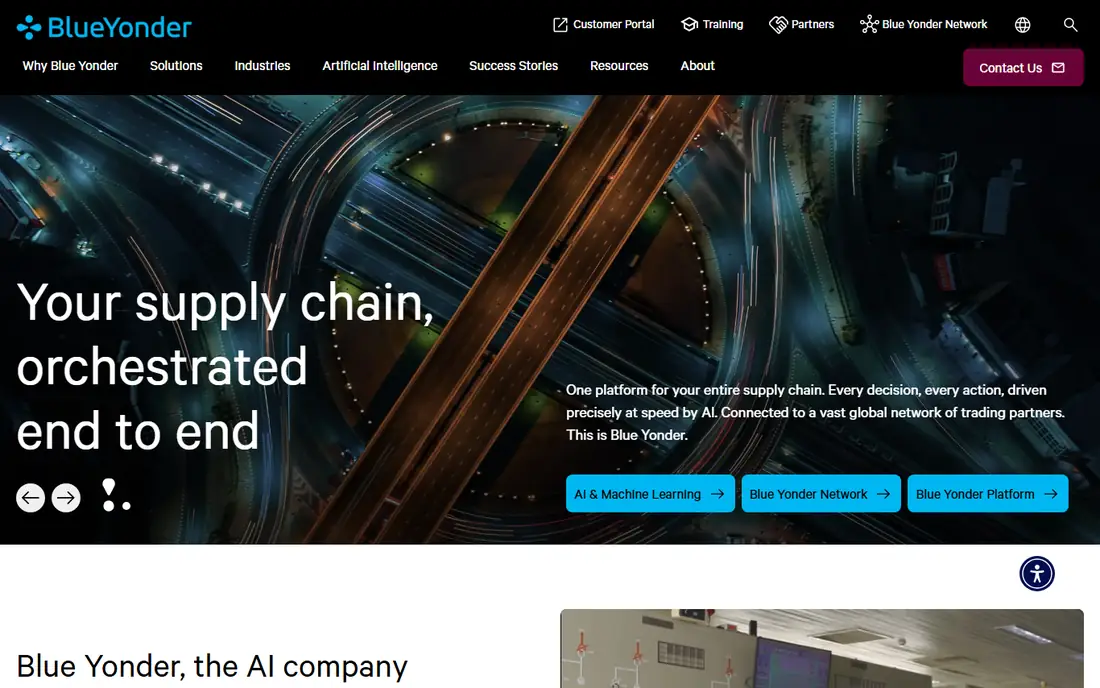
What we like- Blue Yonder offers ML demand sensing across item location networks, with demand and supply planning that connects statistical forecasting and machine learning with scenario planning, causal demand signals, and inventory management. It suits global enterprise retailers and CPG networks with thousands of SKUs, and 2026 additions include root cause analysis for supply and demand problems, audit trails showing forecast changes and overrides, and a planner brief tool. An Inventory Ops agent can track down sourcing issues and broken bills of materials.
Watch out for- Pricing is quote only, with mid market deployments reported at 250,000 dollars or more per year, plus implementation costs. Rollouts can take several months, and large datasets can slow processing. The platform needs skilled internal teams or dedicated support, and its configuration complexity suits large teams better than small ones.
Starting priceSee website
Free planNo
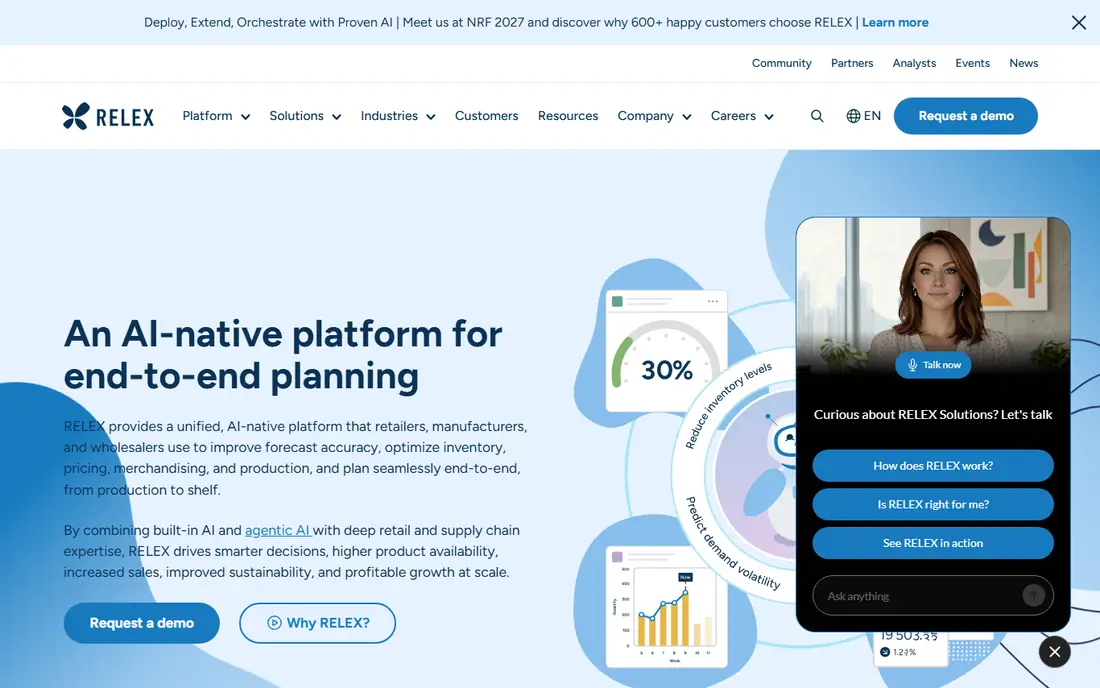
What we like- RELEX Solutions offers unified supply chain and AI promotion planning, with grocery specific strengths such as spoilage prediction and batch level perishability. It handles seasonal variation, promotional lifts, and weather signal inputs for complex multi location supply chains, and it optimizes inventory allocation across locations simultaneously. Vendor reporting cites 20 to 30 percent waste reduction and 15 percent service level improvement.
Watch out for- Pricing is quote only, and scope can exceed what a small team needs, with implementation cost and complexity requiring scale to justify. It is not suited to businesses below roughly 5 million dollars in revenue. Retail focus means manufacturing planning depth lags enterprise manufacturing platforms.
#4SAP IBP
Best for: SAP centric enterprises4.2/5 on
G2 (303 reviews, checked Oct 2026)
Visit sap.com
Starting priceSee website
Free planNo
What we like- SAP Integrated Business Planning offers native S and 4HANA integration plus sales and operations planning, with Joule AI embedded across more than 400 AI use cases in vendor reporting. It suits companies already on SAP, where native fit removes the integration layer other platforms need. Planning, forecasting, and execution live in one SAP stack.
Watch out for- Pricing is reported from around 150,000 dollars per year, and the platform is resource heavy to run, needing a dedicated team. Implementation is complex, and the value depends heavily on existing SAP maturity. Non SAP companies get little benefit from the native integration.
#5Kinaxis Maestro
Best for: Concurrent demand and supply planning4.0/5 on
G2 (14 reviews, checked Oct 2026)
Visit kinaxis.com
Starting priceSee website
Free planNo
What we like- Kinaxis Maestro offers real time concurrent planning and scenario modeling, with an agent marketplace added in 2026. It suits global manufacturers and distributors, including pharma, where demand and supply must move together rather than in sequence. Simulations at 2.3 million SKU scale are reported in comparison coverage. Concurrent planning means a demand change ripples through supply instantly.
Watch out for- Pricing is quote only and enterprise grade, and the platform can be more than a mid size team needs. Implementation requires planning maturity and clean data. The breadth of concurrent planning adds complexity for teams that only need forecasting.
Starting priceSee website
Free planNo
What we like- ToolsGroup SO99+ leads in probabilistic forecasting and inventory optimization, outputting a full demand distribution rather than a single point forecast. It suits large catalogues with spiky, intermittent, or long tail demand, where point forecasts mislead and risk adjusted inventory decisions matter. It works best with detailed history, which large distributors typically have.
Watch out for- Pricing is quote only and enterprise grade. The platform works best with detailed history, so thin data limits its value. Probabilistic methods need planner training, since teams used to single number forecasts must learn to act on distributions.
#7Netstock
Best for: SME and mid market teams4.6/5 on
G2 (179 reviews, checked Oct 2026)
Visit netstock.com
Starting price$900 per month
Free planNo
What we like- Netstock offers ABC classification plus ERP connected replenishment, with entry pricing from 900 dollars per month published in 2026 comparison reporting. It suits SME and mid market distributors and manufacturers who need ERP native forecasting without enterprise budgets. The ERP connection keeps inventory data current without manual exports.
Watch out for- There is no free plan, and 900 dollars per month is still a real commitment for small teams. Scope is narrower than enterprise platforms, with less scenario depth. Customization and training may be needed for complex ERP setups.
#8Prediko
Best for: Shopify brands4.8/5 on
G2 (6 reviews, checked Oct 2026)
Visit prediko.io
Starting priceSee website
Free planNo
What we like- Prediko offers Shopify native demand forecasting with one click purchase orders, plus Amazon and QuickBooks connections. It suits Shopify brands that need forecasting inside the store stack, without a separate planning platform. Entry pricing is reported from 49 dollars per month in one 2026 source, though another source lists 500 dollars per month, so the price is listed as See website pending vendor confirmation.
Watch out for- Shopify focus limits fit for non Shopify businesses. The pricing conflict between sources means buyers should confirm the current plan before budgeting. Depth lags enterprise platforms for multi warehouse or multi channel planning at scale.
How we chose
We ranked tools on forecast method, planning scope, ERP and POS integration, implementation transparency, and published pricing. Tools earned credit for machine learning in the forecasting engine itself, not just a reporting dashboard, plus probabilistic methods, promotion modeling, and native ERP connections. We excluded general business intelligence tools, since forecasting engines define this category. Figures come from published pricing and 2026 comparison reporting, and readers should confirm current terms directly, since enterprise pricing is quote only and mid market prices change.
Start with your demand complexity and change appetite, not the vendor with the best demo. Complex networks with volatile demand justify the enterprise tier, while straightforward reorder logic does not. Next, check data readiness: enterprise tools need clean history, promotion calendars, and ERP data, and a platform bought before data cleanup delivers little. Then decide between point and probabilistic forecasts: intermittent or lumpy demand needs distributions, while stable fast movers work fine with point forecasts. Check integration honestly, confirming compatibility with your SAP, Oracle, Microsoft Dynamics, or Shopify stack, not just API availability claims. Finally, verify outputs on your own data before trusting accuracy claims, keep planner overrides in the workflow, and budget for implementation time, since enterprise rollouts take months and mid market tools still need weeks of setup. Confirm whether onboarding, training, and ongoing optimization are included in the quoted price or billed separately as professional services.
Frequently asked questions
What is AI demand forecasting software?
AI demand forecasting software uses machine learning models, often combined with statistical methods, to predict future product demand from sales history, seasonality, promotions, market signals, and external factors. Modern tools generate forecasts per SKU or store and feed them into replenishment, pricing, and inventory decisions.
How much does AI demand forecasting software cost?
Enterprise platforms such as o9, Blue Yonder, RELEX, and ToolsGroup are quote only and typically run into six or seven figures annually. Mid market options publish entry prices, with Netstock from 900 dollars per month. Confirm current prices with the vendor, since enterprise pricing is negotiated per deployment.
What is the difference between probabilistic and traditional forecasting?
Traditional forecasting outputs a single number per item, a point forecast. Probabilistic forecasting outputs a full demand distribution, showing the probability of each outcome, which feeds risk adjusted inventory decisions. It is most valuable for intermittent, lumpy, or long tail demand where point forecasts mislead.
Which tool is best for small business?
Netstock from 900 dollars per month and GMDH Streamline with a free version suit SMB distributors. Shopify brands should look at Prediko, while individual forecasters can use Forecast Pro workbench approaches without a platform purchase.
How long does implementation take?
Enterprise rollouts take several months depending on data readiness, while mid market tools typically go live in weeks. Data cleanup, ERP integration, and planner training drive the timeline more than software installation.
Should I trust vendor accuracy claims?
Treat vendor accuracy claims as marketing until proven on your own data. Run a backtest on historical sales, compare against your current method, and keep human overrides in place, since AI forecasts still miss promotions, weather shocks, and market shifts.
Sources we checked (0)
Is your product missing or out of date?
We review this list regularly. Vendors can request a listing, send updated pricing or ask about featured placement.

Shihab Mia · Founder, Rankite
Shihab has 5+ years in B2B and SaaS SEO. He writes Rankite's software buying guides from pricing pages, documentation and public user reviews. More about Shihab.