How we make this list: we compare pricing pages, product documentation and public user reviews. Ratings come from G2, Capterra or Trustpilot, with the date we checked them.
Key takeaways
- CodeRabbit suits thorough automated reviews, with the most detailed line-by-line analysis across all major Git platforms.
- GitHub Copilot Code Review suits GitHub-native teams already paying for Copilot, with smooth PR integration.
- Qodo suits test-first teams, pairing review depth with test generation.
- Graphite Reviewer suits stacked PR workflows, with stack-aware context that understands change chains.
- Greptile suits large repos and monorepos, with full-codebase context on big codebases.
- CodeAnt AI suits teams that want review plus security scanning in one pass.
- Sourcery suits Python codebases, with Python-specific refactoring suggestions.
- Bito suits enterprise compliance, with an on-prem deployment option.
- AI accuracy note: AI review tools reliably catch style issues, common bug patterns, security anti-patterns, and obvious performance wins, but they miss context-dependent logic and produce false positives. Verify AI suggestions before merging, and never let an AI reviewer be the only approval on risky changes.
Quick comparison
Is your product missing or out of date?
We review this list regularly. Vendors can request a listing, send updated pricing or ask about featured placement.
Starting priceFree
Free planYes
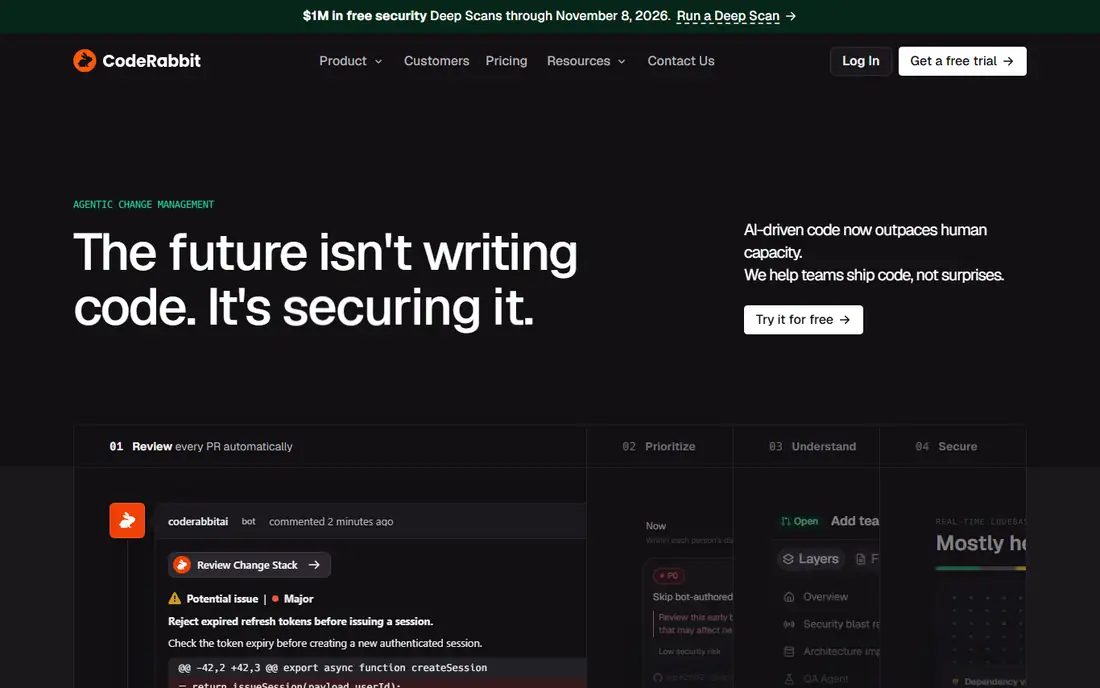
CodeRabbit is the strongest all-purpose choice, with the most detailed line-by-line analysis across all four major Git platforms. It reviews public repositories for free, offers a free tier for open source, and adds Jira integration plus customizable review depth on paid plans. Pro costs $24 per user per month billed annually, with a Pro Plus tier at $48.
The trade off is noise. Independent tests put CodeRabbit noise near 28 percent, meaning more than a quarter of comments add little value, and a noisy reviewer on top of sloppy PRs makes human review worse, not better. For thorough automated reviews, CodeRabbit is still the best pick, provided your team keeps PRs small and clean.
What we like- Most detailed line-by-line analysis
- Works across GitHub, GitLab, Bitbucket, and Azure DevOps
- Jira integration
Watch out for- Pro costs $24 per user per month annual
- Noise rate near 28% in independent tests
- No stacked PR workflow
Starting priceSee website
Free planNo
GitHub Copilot Code Review suits GitHub-native teams already paying for Copilot, with smooth PR integration on github.com and in VS Code. It generates PR descriptions, explains code in the IDE, and reviews pull requests as part of the Copilot subscription. Pricing runs Pro $10, Business $19 per seat, and Enterprise $39 per seat, with review billed via AI credits.
The limits are platform and context. Copilot code review is GitHub only, review costs vary from about $0.25 to $5 per review on default settings, and context is diff-only on some plans. For GitHub teams, it is the easiest start.
What we like- Smooth PR integration
- AI-generated PR descriptions
- In-IDE explanations
Watch out for- GitHub only
- Review billed via AI credits
- Diff-only context on some plans
Starting priceSee website
Free planNo
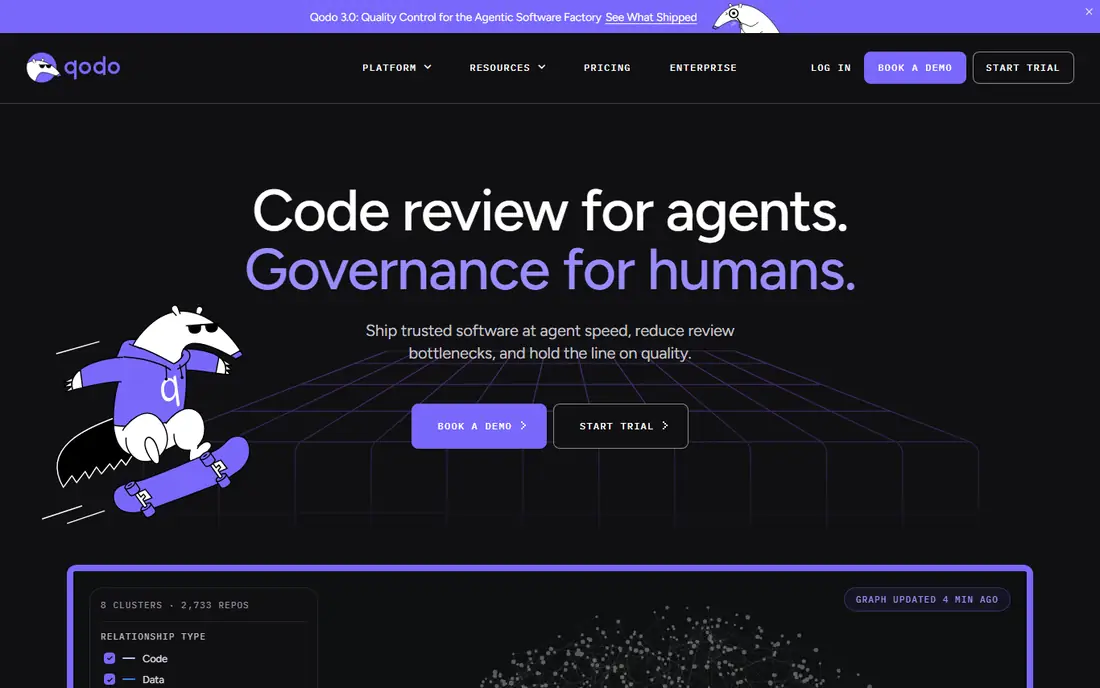
Qodo, formerly CodiumAI, suits test-first teams, pairing review depth with test generation. Slash commands such as review and describe speed common tasks, PR summaries explain changes, and severity-based issue prioritization surfaces the most important findings first. It integrates with GitHub, GitLab, and Bitbucket.
The trade off is billing. Pro Teams start from $30 per month base plus credits, cross-repo features are gated to Enterprise, and credit-based billing is complex to forecast. For teams that want review plus test generation, Qodo is the best choice.
What we like- Test generation alongside review
- Slash commands for review and describe
- Severity-based issue prioritization
Watch out for- Pro Teams from $30 per month base plus credits
- Cross-repo features gated to Enterprise
- Credit-based billing is complex
Starting priceSee website
Free planNo
Graphite Reviewer suits stacked PR workflows, with stack-aware context that understands chains of dependent pull requests rather than reviewing each diff in isolation. It detects logic and edge-case issues, tracks PR comment metrics, and integrates with GitHub merge queues. Pricing runs from $20 per committer per month, with Team plans at $40 per user per month billed annually.
The limits are platform and packaging. Graphite is built around GitHub, and review comes as part of a broader workflow product rather than a standalone reviewer. For teams that stack PRs, Graphite is the best pick.
What we like- Stack-aware context for change chains
- Logic and edge-case detection
- PR comment metrics
Watch out for- GitHub focused
- Pricing from $20 per committer per month
- Review is part of a broader workflow product
Starting priceFree
Free planYes
Greptile suits large repos and monorepos, with full-codebase context that understands code across repositories rather than just the changed diff. The free Starter tier covers one developer with 50 credits per month, and Pro costs $30 per seat per month. Reviews cost 1 to 10 credits at $1 each, depending on size.
The trade off is platform coverage. Greptile supports GitHub and GitLab, with self-managed GitLab and Bitbucket Data Center on enterprise plans, but no Bitbucket Cloud or Azure DevOps. For big codebases, Greptile is the best choice.
What we like- Full-codebase context on big repos
- Free Starter for one developer with 50 credits per month
- Multi-repo support
Watch out for- Pro costs $30 per seat per month
- No Bitbucket or Azure DevOps
- Credit costs 1 to 10 credits per review
Starting priceSee website
Free planNo
CodeAnt AI suits teams that want review plus security scanning in one pass. It combines code review with static application security testing, secrets detection, and infrastructure-as-code checks, with one-click fixes and summaries for security and code quality. It supports GitHub and GitLab, with IDE support for VS Code, Cursor, and JetBrains.
The limits are price and trial. Premium costs $24 per user per month, the trial runs 14 days with 100 PR reviews, and vendor guides self-rank CodeAnt first, so treat those claims with caution. For bundled review plus security, CodeAnt AI is the best pick.
What we like- Review plus SAST, secrets, and infrastructure-as-code scanning in one pass
- One-click fixes
- Multi-platform support
Watch out for- Premium costs $24 per user per month
- 14-day trial only
- Vendor self-ranks first in its own guides
Starting priceFree
Free planYes
Sourcery suits Python codebases, with Python-specific refactoring suggestions that general reviewers miss. The free tier is genuinely useful for Python teams, offering instant feedback on style, structure, and common Python pitfalls. Paid plans run from $20 per developer per month.
The trade off is language scope. Sourcery covers Python only, so multi-language teams need a second reviewer. For Python-first teams, Sourcery is the best choice.
What we like- Python-specific refactoring suggestions
- Free tier genuinely useful for Python
- Instant feedback
Watch out for- Python only
- Paid plans from $20 per developer per month
- Less useful for multi-language teams
Starting priceSee website
Free planNo
Bito suits enterprise compliance, with an on-prem deployment option that keeps code inside your infrastructure. Security integrations with Snyk, PR summaries, and one-click fixes speed review, while onboarding acceleration helps new developers learn codebase standards. Team pricing runs $12 per seat per month billed annually, or $15 monthly.
The limits are metering and community. Some plans meter reviews by lines of code, and the community is smaller than CodeRabbit. For enterprises that need on-prem review, Bito is the best pick.
What we like- On-prem deployment option
- Security integrations with Snyk
- PR summaries and one-click fixes
Watch out for- Team pricing $12 to $15 per seat per month
- LOC-metered reviews for some plans
- Smaller community than CodeRabbit
How we chose
We compared review depth, platform coverage, noise rates, test generation, security scanning, stacked PR support, and pricing transparency. Tools that review across all major Git platforms scored higher than GitHub-only tools, and tools with free tiers scored higher than trial-only tools. We weighted noise heavily, since a reviewer that floods PRs with false positives degrades team engagement with AI feedback. We did not test any tool hands-on, and prices here reflect published list prices that vendors change often.
Buying guide: what to check before you pay
Start with your platform. GitHub-only teams suit Copilot or Graphite, while multi-platform teams suit CodeRabbit or CodeAnt AI. Next, check noise rates on a trial. A noisy reviewer on top of sloppy PRs makes review worse, so run the tool on real PRs for two weeks and measure how many comments engineers act on. Ask about billing model too, since seat-based tools charge per developer while usage-based tools charge per review or per credit, and the cheaper model depends on your PR volume. Check security needs as well, since CodeAnt AI and Bito bundle security scanning while others focus on code quality alone. Finally, fix PR hygiene first. Small diffs, tests passing locally, AI-generated PR summaries written before submission, and a one-sentence why at the top make any reviewer work better. Verify AI suggestions before merging, and never let an AI reviewer be the only approval on risky changes.
Frequently asked questions
Can AI code review replace human reviewers?
Not yet. These tools catch bugs and enforce standards, but none should be the only approval on risky changes. Human reviewers catch context-dependent logic, business rules, and design trade-offs that AI misses.
Is there a free AI code review tool?
Yes, with limits. CodeRabbit reviews public repositories for free, Greptile Starter is free for one developer with 50 credits a month, and Sourcery free tier is genuinely useful for Python. Open-source PR-Agent can be self-hosted with your own model keys.
How much does AI code review cost per pull request?
It depends on the billing model. Cursor Bugbot averages $1.00 to $1.50 per review, GitHub estimates $0.25 to $5 per Copilot review on default settings, and Greptile charges 1 to 10 credits at $1 each. Seat-based tools such as CodeRabbit charge per developer instead.
Which AI code review tools work with GitLab or Bitbucket?
CodeRabbit and CodeAnt AI support GitHub, GitLab, Bitbucket, and Azure DevOps. Greptile and Qodo add self-managed GitLab and Bitbucket Data Center on enterprise plans. Copilot code review, Graphite, and Sourcery are built around GitHub or specific languages.
What do AI review tools actually catch?
AI reliably catches style and formatting issues, common bug patterns such as null pointer risks and off-by-one errors, security anti-patterns such as hardcoded secrets and SQL injection, obvious performance wins such as N+1 queries, and documentation gaps. It misses context-dependent logic and produces false positives, so verify before merging.
Sources we checked (0)
Is your product missing or out of date?
We review this list regularly. Vendors can request a listing, send updated pricing or ask about featured placement.

Shihab Mia · Founder, Rankite
Shihab has 5+ years in B2B and SaaS SEO. He writes Rankite's software buying guides from pricing pages, documentation and public user reviews. More about Shihab.
 CodeRabbit
 GitHub Copilot Code Review
 Qodo
 Graphite Reviewer
 Greptile
 CodeAnt AI
 Sourcery
 Bito