How we make this list: we compare pricing pages, product documentation and public user reviews. Ratings come from G2, Capterra or Trustpilot, with the date we checked them.
Key takeaways
- A nonprofit does not just need a ledger. It needs fund tracking that shows a donor or auditor exactly how each restricted gift was spent.
- Aplos is the only tool here built from the ground up for fund accounting at a small-organization price, starting at $79 per month.
- QuickBooks Online works for most small nonprofits because their CPA already knows it, but fund tracking relies on classes rather than true fund accounting.
- Large organizations with grants, multiple entities or an audit committee should look at Sage Intacct or Blackbaud Financial Edge NXT, and budget for implementation help.
Quick comparison
| Tool | Best for | Starting price | Free plan |
|---|
 Aplos | True fund accounting for small nonprofits and churches | $79 per month | Free trial (15 days) |
 QuickBooks Online | Nonprofits whose CPA already speaks QuickBooks | $38 per month | Free trial |
 Blackbaud Financial Edge NXT | Large nonprofits with complex funds and grants | See website | No |
 Sage Intacct | Multi-entity, multi-grant and multi-location reporting | See website | No |
 Xero | Clean general books at a low entry price | $27 per month | Free trial |
 FreshBooks | Invoicing-led teams with simple books | See website | Free trial |
 Wave | Free books for brand-new, tiny organizations | Free | Yes |
 Zoho Books | Free tier for micro nonprofits with growth room | Free | Yes |
Is your product missing or out of date?
We review this list regularly. Vendors can request a listing, send updated pricing or ask about featured placement.
The best accounting software for nonprofits
#1Aplos
Best for: True fund accounting for small nonprofits and churches4.7/5 on
G2 (97 reviews, checked Oct 2026)
Visit aplos.com
Starting price$79 per month
Free planFree trial (15 days)
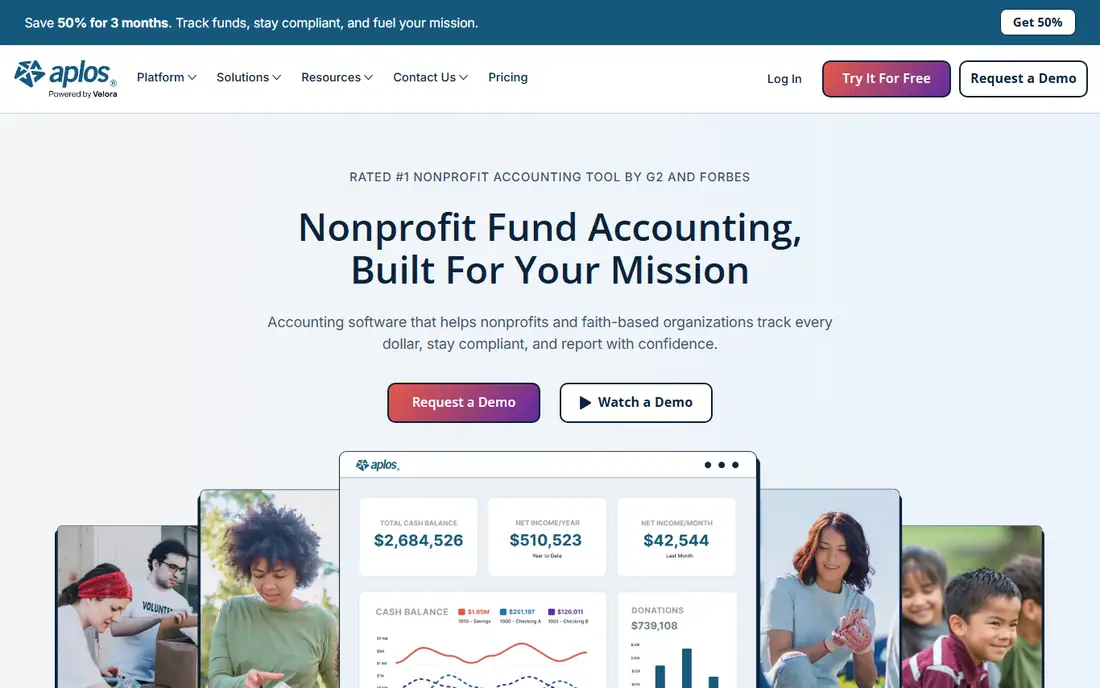
Aplos is the rare accounting tool that starts from nonprofit needs instead of adapting a business ledger. Funds, grants and donations sit at the center of the design, so a treasurer can pull a balance sheet or income statement filtered by fund in a few clicks. That matters at board meetings and at audit time, when the question is always which dollars paid for which program.
The suite also covers donor management, online giving forms and budgeting, which replaces two or three separate subscriptions for many small organizations. Pricing starts at $79 per month for the Lite plan, with Core at $129 and Advanced from $229. The 15-day trial needs no credit card. The trade-off is ecosystem size: QuickBooks connects to more payroll and expense tools, so a nonprofit with unusual integration needs should check Aplos coverage first.
What we like- Fund accounting built in, not bolted on
- Donor management included
- Board-ready reports by fund
Watch out for- Fewer third-party integrations than QuickBooks
- Advanced plans get pricey above $1 million in revenue
#2QuickBooks Online
Best for: Nonprofits whose CPA already speaks QuickBooks4.0/5 on
G2 (3,871 reviews, checked Oct 2026)
Visit quickbooks.intuit.com
Starting price$38 per month
Free planFree trial
QuickBooks Online is the default file for US nonprofits, and that familiarity is a real asset. A new treasurer or bookkeeper probably already knows the interface, and almost any CPA can open the file without training. Nonprofits can also buy through TechSoup at a steep discount, which changes the value math for small budgets.
The honest limit is fund accounting. QuickBooks tracks programs and grants through classes and locations, which works when set up carefully but breaks when staff tag transactions inconsistently. The Plus plan at $140 per month is the usual nonprofit choice, since it includes classes, projects and locations. If your organization handles restricted grants, budget for a ProAdvisor setup session so the class structure matches your chart of accounts from day one.
What we like- Most US accountants know it
- Huge integration library
- Nonprofit pricing through TechSoup
Watch out for- Fund tracking uses classes, not native fund accounting
- Plus plan needed for serious program tracking
#3Blackbaud Financial Edge NXT
Best for: Large nonprofits with complex funds and grants4.1/5 on
G2 (132 reviews, checked Oct 2026)
Visit blackbaud.com
Starting priceSee website
Free planNo
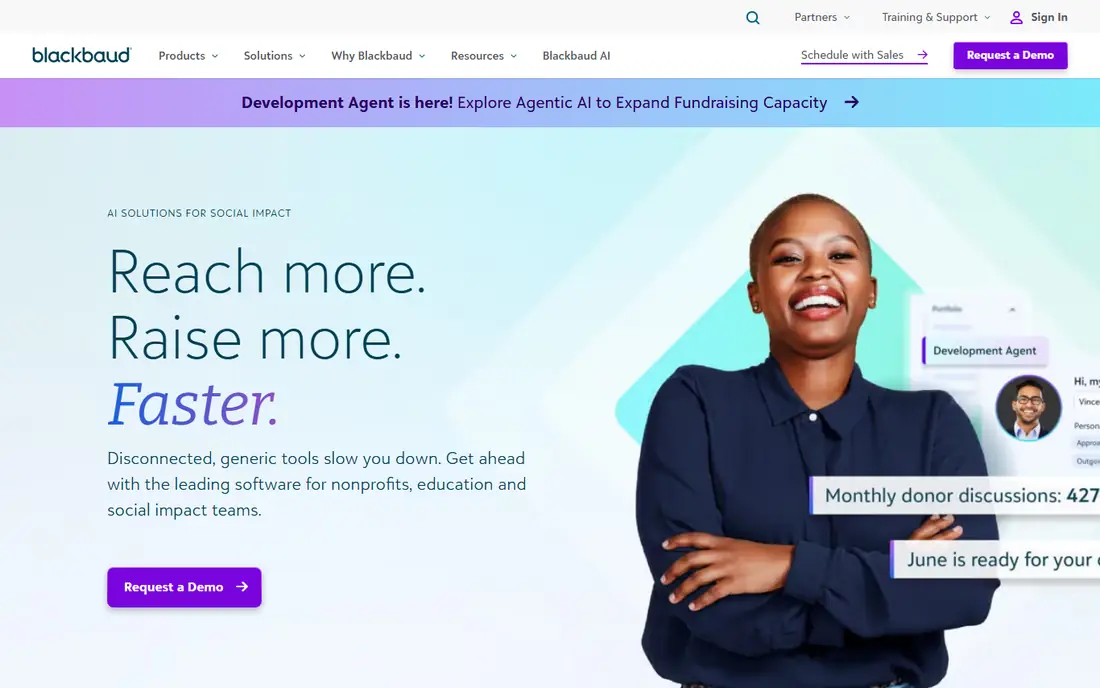
Blackbaud Financial Edge NXT is the enterprise answer for nonprofits that outgrow general tools. It handles subfund accounting, grant records and multi-year budgets as core features, and it connects deeply with Raiser's Edge NXT, so fundraising and finance share one donor record. For a university, hospital foundation or national charity, that single record is worth the price.
That price is not published, and independent guides place smaller deployments in the thousands per year, rising well beyond that for mid-size organizations. Implementation needs vendor or partner help, and staff training takes time. A small nonprofit will find this heavy and expensive. A large one with an audit committee and a fundraising team will find it the safest long-term choice.
What we like- Purpose-built fund and grant accounting
- Deep integration with Raiser's Edge NXT fundraising
- Strong internal controls
Watch out for- Quote-only pricing
- Implementation is a project, not an afternoon
- More than small organizations need
#4Sage Intacct
Best for: Multi-entity, multi-grant and multi-location reporting4.3/5 on
G2 (4,521 reviews, checked Oct 2026)
Visit sage.com
Starting priceSee website
Free planNo
Sage Intacct suits nonprofits that have grown past one set of books. Its dimensional model tags every transaction by fund, grant, program and location at once, so a finance director can slice the same data for a funder report, a board packet and a functional expense statement without rebuilding reports. That flexibility is why larger nonprofits pick it over simpler tools.
The vendor positions Intacct for organizations with more than 20 employees or above $4 million in annual revenue, and implementation typically runs 3 to 6 months with expert help. Pricing is quoted per organization. A small nonprofit should not start here. A growing one that consolidates entities, manages many grants or faces a real audit should compare Intacct directly against Blackbaud before deciding.
What we like- Dimensional accounting by fund, grant and entity
- Strong grant compliance reporting
- Automation agents for close and payables
Watch out for- Quote-only pricing
- Implementation typically takes 3 to 6 months
- Sized for organizations above $4 million in revenue
#5Xero
Best for: Clean general books at a low entry price4.4/5 on
G2 (1,832 reviews, checked Oct 2026)
Visit xero.com
Starting price$27 per month
Free planFree trial
Xero is a strong general ledger with a price that undercuts QuickBooks at the entry tier. The Early plan costs $27 per month after an introductory period, with Growing at $59 and Established at $97. Bank feeds reconcile cleanly, the interface stays simple, and the mobile app covers approvals and expense capture for staff in the field.
For nonprofits, the same caveat as QuickBooks applies: there is no native fund accounting, so programs and restricted gifts must be tracked with tracking categories. The Early plan also caps invoices at 20 and bills at 5, which rules it out for any organization with monthly grant volume. Xero fits a small nonprofit with simple finances and a bookkeeper who already knows it, not a grant-heavy organization.
What we like- Simple interface
- Strong bank reconciliation
- Multi-currency on the top plan
Watch out for- No native fund accounting
- Early plan caps invoices and bills
#6FreshBooks
Best for: Invoicing-led teams with simple books4.5/5 on
G2 (981 reviews, checked Oct 2026)
Visit freshbooks.com
Starting priceSee website
Free planFree trial
FreshBooks started as an invoicing tool and still does that job better than most accounting platforms. Sending a professional invoice, tracking payment and nudging late payers takes minutes, and the interface suits staff who are not accountants. For a nonprofit that mostly bills for services, rents space or sells event tickets, that speed matters.
As a fund accounting tool, though, FreshBooks falls short. It has no fund structure and no grant reporting, so a nonprofit with restricted gifts would need spreadsheets alongside it. Pricing is not shown on the homepage extract, so confirm the current plan prices before buying. Choose FreshBooks when invoicing is the main job; choose Aplos or QuickBooks when fund reporting is the main job.
What we like- Fast invoicing and payment collection
- Friendly interface
- Good client and donor billing
Watch out for- No fund accounting
- Reporting is thinner than Aplos or QuickBooks for grant work
#7Wave
Best for: Free books for brand-new, tiny organizations4.3/5 on
G2 (328 reviews, checked Oct 2026)
Visit waveapps.com
Starting priceFree
Free planYes
Wave is the honest answer for a volunteer treasurer starting from zero. Core accounting, invoicing and receipt capture cost nothing, and setup takes an afternoon rather than a week. For a neighborhood association or a new charity with no restricted funds, Wave keeps the books clean and tax-ready without spending a dollar.
The limits arrive fast. Wave has no fund accounting and no grant tracking, so the first restricted grant means either a spreadsheet workaround or a move to Aplos or QuickBooks. Paid add-ons cover payroll and payment processing, which is where Wave earns its money. Treat Wave as a starting point with a planned exit, not as a permanent home for a growing nonprofit.
What we like- Core accounting and invoicing cost nothing
- Simple setup
- Payroll and payments available as add-ons
Watch out for- No fund accounting
- No grant tracking
- Support is thinner than paid rivals
#8Zoho Books
Best for: Free tier for micro nonprofits with growth room4.4/5 on
G2 (329 reviews, checked Oct 2026)
Visit zoho.com
Starting priceFree
Free planYes
Zoho Books offers the most generous free tier on this list, with paid plans starting at $15 per organization per month for Standard and rising to $240 for Ultimate. The free plan suits a micro nonprofit, and the paid tiers add inventory, projects and automation without per-user pricing surprises. Multi-currency support helps organizations with international programs.
Like Xero and FreshBooks, Zoho Books is a general ledger, not a fund accounting system. Tracking categories and custom reports can approximate fund views, but the setup is manual and the audit trail is weaker than Aplos. A small nonprofit with simple finances and tight cash will get real value here, especially inside the wider Zoho suite. A grant-heavy organization should still prefer Aplos.
What we like- Genuine free plan
- Standard plan only $15 per organization per month
- Multi-currency and automation included
Watch out for- No native fund accounting
- Nonprofit-specific reports need manual setup
How we chose
We compared vendor homepages, pricing pages and independent nonprofit accounting roundups in October 2026, and opened each homepage to confirm it loads and belongs to the product named. We weighted fund and grant tracking first, since that is the feature that separates nonprofit accounting from business accounting, then price, audit readiness, donor integration and the learning curve for volunteer treasurers. Prices change often, so confirm the current figure on the vendor pricing page before buying.
What to check before you commit
Start with your funding mix, not the feature list. If every dollar is unrestricted, a general ledger like Xero, Wave or Zoho Books will serve you well. If restricted grants fund your programs, you need fund accounting, which points to Aplos at the small end and Blackbaud or Sage Intacct at the large end. QuickBooks sits in the middle, workable with careful class setup and a CPA who knows the method.
Then count the people who will touch the books. A volunteer treasurer needs a simple interface and good bank feeds, which favors Aplos, Wave and Xero. A finance team needs approval workflows, audit trails and multi-entity consolidation, which favors Sage Intacct and Blackbaud. Ask vendors who owns setup: Aplos and QuickBooks can be self-serve, while Blackbaud and Intacct need implementation partners and a longer timeline.
Finally, plan for the audit. Ask each vendor how its reports map to a statement of financial position, a statement of activities and a statement of functional expenses, and whether funders can receive filtered reports without seeing other funds. A tool that cannot produce a clean fund report will cost you bookkeeper hours every quarter, which quickly erases a low subscription price. This article is general guidance, not accounting or tax advice for your organization.
Frequently asked questions
What is the best accounting software for nonprofits overall?
For most small nonprofits, Aplos, because fund accounting is built in rather than approximated with classes or tags. QuickBooks Online is the safer pick when your CPA already works in it. Large organizations should compare Blackbaud Financial Edge NXT and Sage Intacct.
Do nonprofits get discounts on accounting software?
Yes, in several cases. QuickBooks offers nonprofit pricing through TechSoup, and some vendors offer discounted or donated plans on request. Always ask about nonprofit pricing before paying list price, and check TechSoup eligibility for your 501(c)(3) status.
What is fund accounting and why does it matter?
Fund accounting tracks money by its purpose, so restricted grants stay separate from general operating funds. It matters because donors and auditors need proof that each gift paid for its intended program. Tools without it force you to recreate that separation in spreadsheets, which is error-prone.
Can QuickBooks handle nonprofit fund accounting?
Partly. QuickBooks tracks programs and grants through classes and locations, which works when the setup is disciplined. It is not native fund accounting, so organizations with many restricted funds or strict grant compliance usually prefer Aplos, Blackbaud or Sage Intacct.
When should a nonprofit move from Wave or Zoho Books to Aplos?
Move when you receive your first restricted grant, when a funder asks for fund-level reports, or when spreadsheet workarounds start taking more time than the subscription would cost. That point usually arrives once annual revenue passes the low six figures or grant count passes a handful.
Is free accounting software safe for a nonprofit?
Free tools like Wave and Zoho Books are legitimate for simple finances, with bank-level encryption and standard security practices. The risk is not safety but fit: free tools lack fund accounting, so a nonprofit with restricted funds can produce misleading reports. Match the tool to your funding complexity first.
Sources we checked (8)
- https://www.aplos.com
- https://quickbooks.intuit.com
- https://www.blackbaud.com
- https://www.sage.com/en-us/sage-business-cloud/intacct/
- https://www.xero.com
- https://www.freshbooks.com
- https://www.waveapps.com
- https://www.zoho.com/us/books/
Is your product missing or out of date?
We review this list regularly. Vendors can request a listing, send updated pricing or ask about featured placement.

Shihab Mia · Founder, Rankite
Shihab has 5+ years in B2B and SaaS SEO. He writes Rankite's software buying guides from pricing pages, documentation and public user reviews. More about Shihab.