How we make this list: we compare pricing pages, product documentation and public user reviews. Rankite is independent; if a vendor ever pays for a featured spot, that listing is clearly labeled Partner.
Key takeaways
- Sage Intacct is the finance-team favorite for multi-entity accounting; Oracle NetSuite is the full ERP for companies that have outgrown pure accounting.
- Xero scales cleanly from small to mid-market ($25 to $90/month); QuickBooks Enterprise keeps desktop loyalists with advanced inventory and pricing.
- Acumatica and Odoo offer modern cloud ERP without per-user pricing pain; Dynamics 365 Business Central suits Microsoft-centric companies.
- Zoho Books and QuickBooks Online Advanced cover the lighter end of mid-market at friendlier prices.
Quick comparison
| Tool | Best for | Starting price | Free plan |
|---|
 Sage Intacct Sage Intacct | Finance teams that need multi-entity accounting and fast closes | See website (quote-based) | Free demo |
 Oracle NetSuite Oracle NetSuite | Companies that have outgrown accounting and need full ERP | See website (quote-based) | Free product tour |
 Xero Xero | Growing businesses that want clean books that scale | From $25/month (Early plan) | Free trial |
 QuickBooks Enterprise QuickBooks Enterprise | Businesses that want desktop power with advanced inventory | See website | Free trial |
 Acumatica Acumatica | Mid-market companies that hate per-user pricing | See website (quote-based) | Free demo |
 Dynamics 365 Business Central Dynamics 365 Business Central | Companies already living in Microsoft 365 | See website | Free trial |
 Odoo Odoo | Companies that want open-source ERP flexibility | Free (Community edition); Enterprise see website | Yes (Community) |
 Zoho Books Zoho Books | Budget-conscious businesses wanting solid mid-market accounting | See website (free plan available) | Yes |
 QuickBooks Online Advanced QuickBooks Online Advanced | Growing businesses that want cloud QuickBooks with deeper reporting | See website | Free trial |
Is your product missing or out of date?
We review this list regularly. Vendors can request a listing, send updated pricing or ask about featured placement.
The best accounting software for medium sized business
Month-end arrives and your controller is stitching together five spreadsheets, the inventory numbers do not match the books, and consolidating three entities takes a week. That is the moment a medium-sized business outgrows small-business accounting. The tools below are built for what comes next: multi-entity consolidation, real inventory, approvals, audit trails and reporting that does not require an Excel hero.
#1
Sage Intacct
Best for: Finance teams that need multi-entity accounting and fast closes
Visit sage.com
Starting priceSee website (quote-based)
Free planFree demo
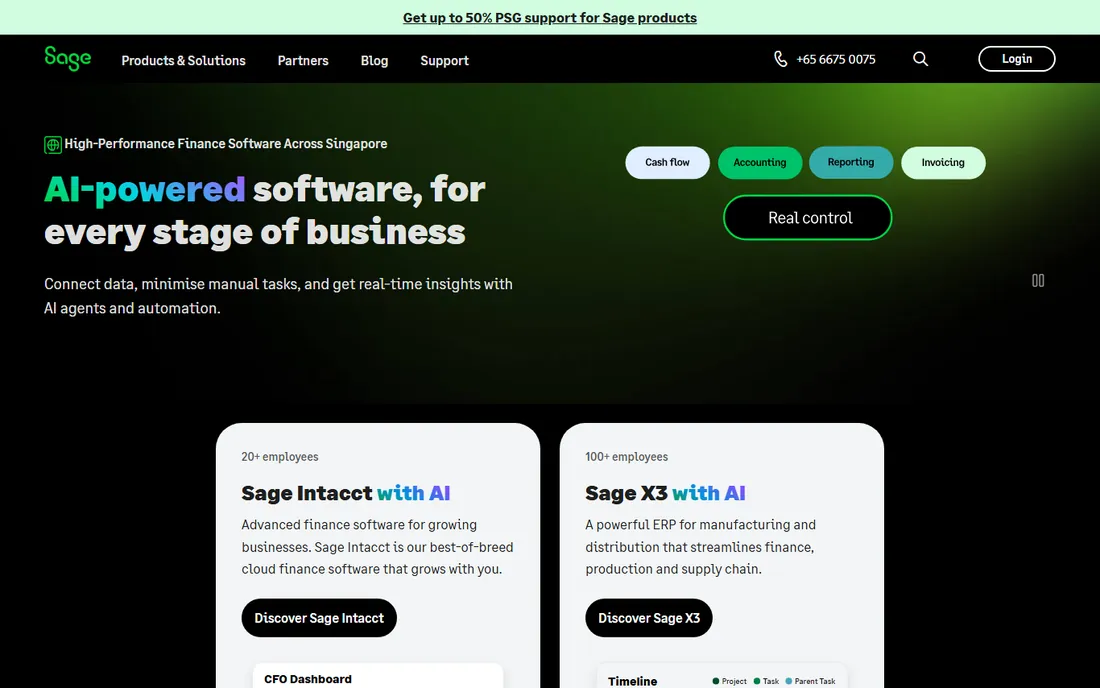
Sage Intacct is the finance team's upgrade from entry-level accounting: true multi-entity consolidation, dimensional chart of accounts, automated close workflows and audit-ready controls. It is the first and only AICPA-preferred finance solution, which tells you how accountants feel about it.
Pricing is quote-based and implementations are real projects. But for the 50 to 500 person company consolidating entities and drowning in spreadsheets, Intacct's automation routinely cuts close times dramatically.
What we like- Purpose-built for multi-entity consolidation and dimensional reporting
- Strong automation for AP, close and revenue recognition
- The AICPA-preferred finance solution with deep accountant trust
Watch out for- Quote-based pricing puts it firmly in the investment category
- Implementation needs planning and often a partner
- Overkill for single-entity businesses
#2
Oracle NetSuite
Best for: Companies that have outgrown accounting and need full ERP
Visit netsuite.com
Starting priceSee website (quote-based)
Free planFree product tour
NetSuite is what companies buy when accounting software is no longer enough: a full cloud ERP where financials, order management, inventory, CRM and ecommerce share one database. Oracle's backing and the huge customer base mean deep functionality for distribution, manufacturing, services and retail.
It is the most expensive and most complex option on this list, and implementations take months. But for the company planning to double in size, NetSuite is the platform that scales without a second migration.
What we like- The complete suite: financials, inventory, CRM, ecommerce and HR in one database
- Proven at scale with thousands of mid-market customers
- Strong global and multi-subsidiary support
Watch out for- The biggest investment and longest implementation here
- Complexity demands administrators
- Smaller companies can feel lost in its breadth
#3
Xero
Best for: Growing businesses that want clean books that scale
Visit xero.com
Starting priceFrom $25/month (Early plan)
Free planFree trial
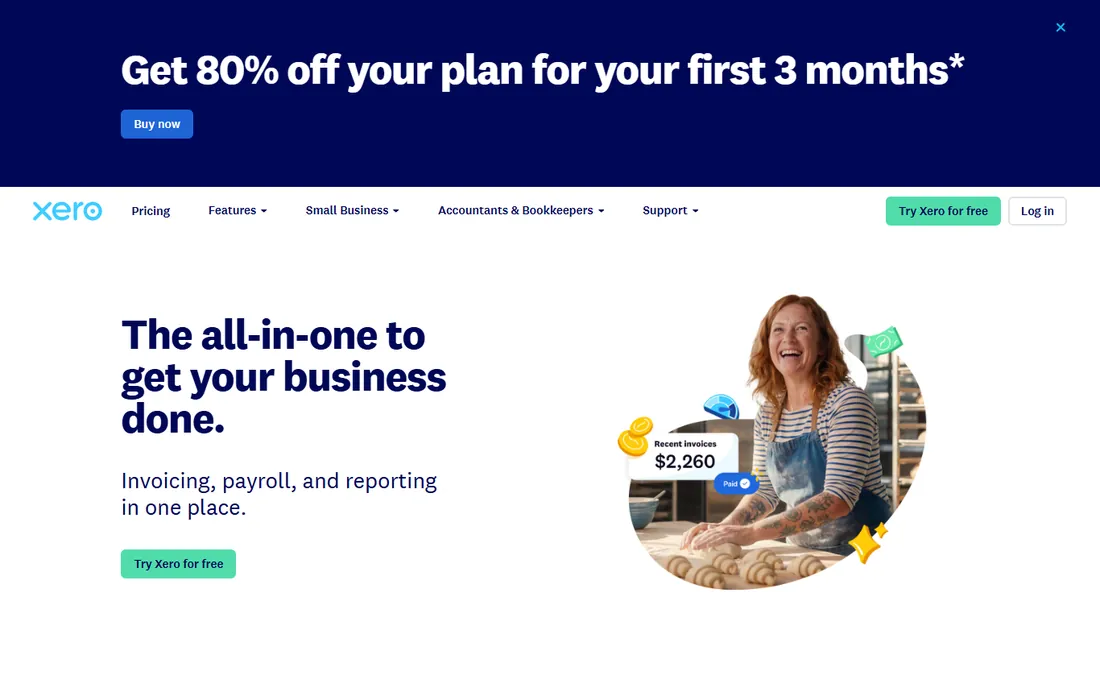
Xero is the elegant middle path: real double-entry accounting that a non-accountant can run, with pricing from $25/month for the Early plan through $55/month Growing to $90/month Established. The app marketplace (1,000+ integrations) lets it punch above its weight on payroll, expenses, inventory and reporting.
It is not an ERP: complex manufacturing or multi-warehouse inventory needs more. But for the service business or light-product company scaling from 10 to 100 people, Xero's combination of usability and price is hard to beat.
What we like- Beautiful, intuitive accounting with plans from $25/month (Early) to $90/month (Established)
- 1,000+ app integrations extend it enormously
- Strong multi-currency and project tracking on higher plans
Watch out for- Inventory management is basic compared to ERP options
- Payroll is a separate add-on in the US
- Very large or complex businesses outgrow it
Starting priceSee website
Free planFree trial
QuickBooks Enterprise is the top of Intuit's desktop line: everything small businesses like about QuickBooks, scaled for bigger companies with advanced inventory tracking, custom pricing, and capacity for far more users and data. US accountants know it cold.
The desktop foundation is both the appeal and the limit: it is not cloud-native. But for the distributor, contractor or manufacturer whose team lives in QuickBooks and needs more of it, Enterprise is the natural step up.
What we like- The familiar QuickBooks workflow scaled up: advanced inventory, pricing rules and job costing
- Handles larger data files and more users than Pro/Premier
- Strong US accountant familiarity
Watch out for- Desktop software in a cloud world, even with hosting options
- The interface shows its age
- Per-user pricing adds up
Starting priceSee website (quote-based)
Free planFree demo
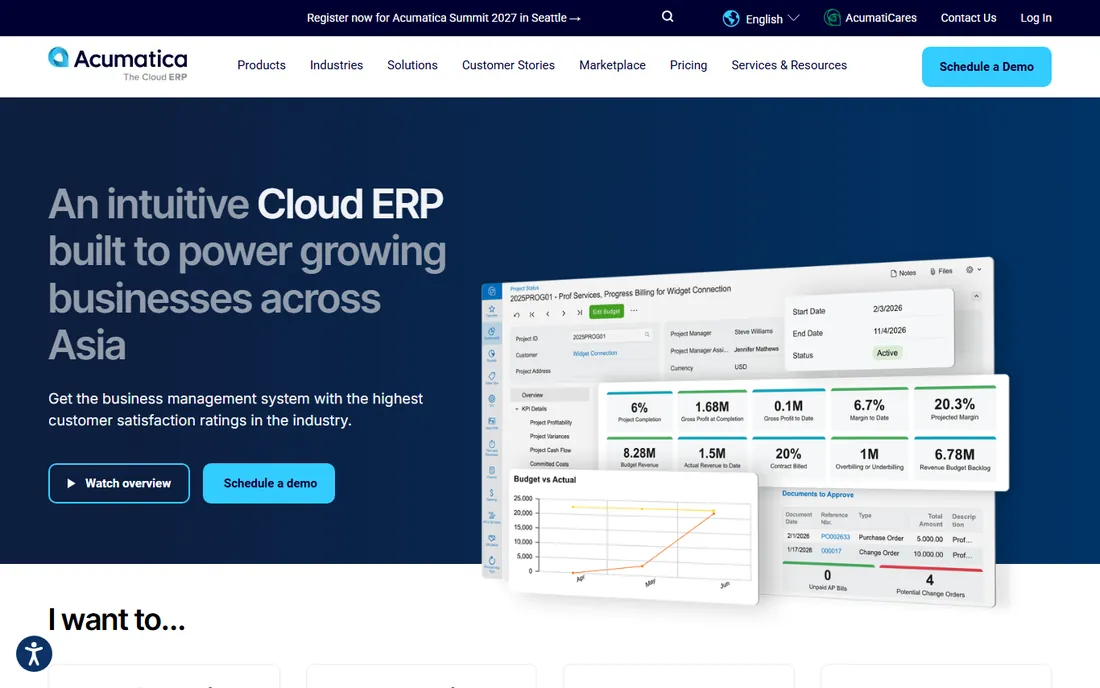
Acumatica's pitch is simple: a real cloud ERP without the per-user tax. Unlimited users, resource-based pricing, and editions tuned for manufacturing, distribution, construction and retail. Customer satisfaction ratings lead the industry, and the interface is genuinely modern.
You will talk to sales for pricing and work with a partner to implement. But for the growing company that expects headcount to rise, Acumatica's pricing model alone can justify the switch.
What we like- Unlimited users: pricing is resource-based, so growth does not multiply the bill
- True cloud ERP with strong manufacturing, distribution and construction editions
- Consistently top-rated for usability
Watch out for- Quote-based pricing requires a sales conversation
- Implementations need partners
- The brand is less known than NetSuite or Sage
#6
Dynamics 365 Business Central
Best for: Companies already living in Microsoft 365
Visit microsoft.com
Starting priceSee website
Free planFree trial
Business Central is Microsoft's mid-market ERP: financials, inventory, purchasing, projects and manufacturing in one system that talks natively to Excel, Teams, Outlook and Power BI. For the company already on Microsoft 365, the integration story is compelling.
Licensing is characteristically Microsoft (study the plans), and partner quality varies. But for the Microsoft shop that wants ERP without leaving the ecosystem, nothing integrates like the home team.
What we like- Native integration with Microsoft 365, Teams and Power BI
- Full ERP scope: financials, supply chain, projects and manufacturing
- Microsoft's ecosystem and partner network
Watch out for- Pricing and licensing take study
- Implementations vary widely by partner
- The interface carries Microsoft's enterprise complexity
#7
Odoo
Best for: Companies that want open-source ERP flexibility
Visit odoo.com
Starting priceFree (Community edition); Enterprise see website
Free planYes (Community)
Odoo is the open-source alternative to the ERP establishment: a huge suite of business apps with accounting at the core, available as a free Community edition or a paid Enterprise edition with hosting and extra apps. No proprietary formats, no lock-in, and a massive global community.
It demands more technical involvement than the polished commercial options. But for the company with developers or a good Odoo partner, it delivers ERP scope at a fraction of the cost.
What we like- The Community edition is genuinely free and open source
- Dozens of integrated apps (CRM, inventory, projects, ecommerce) beyond accounting
- No vendor lock-in: you own the data and the code
Watch out for- The free Community edition lacks some Enterprise features
- Implementations need technical skill or a partner
- Support depends on the community or paid plans
#8
Zoho Books
Best for: Budget-conscious businesses wanting solid mid-market accounting
Visit zoho.com
Starting priceSee website (free plan available)
Free planYes
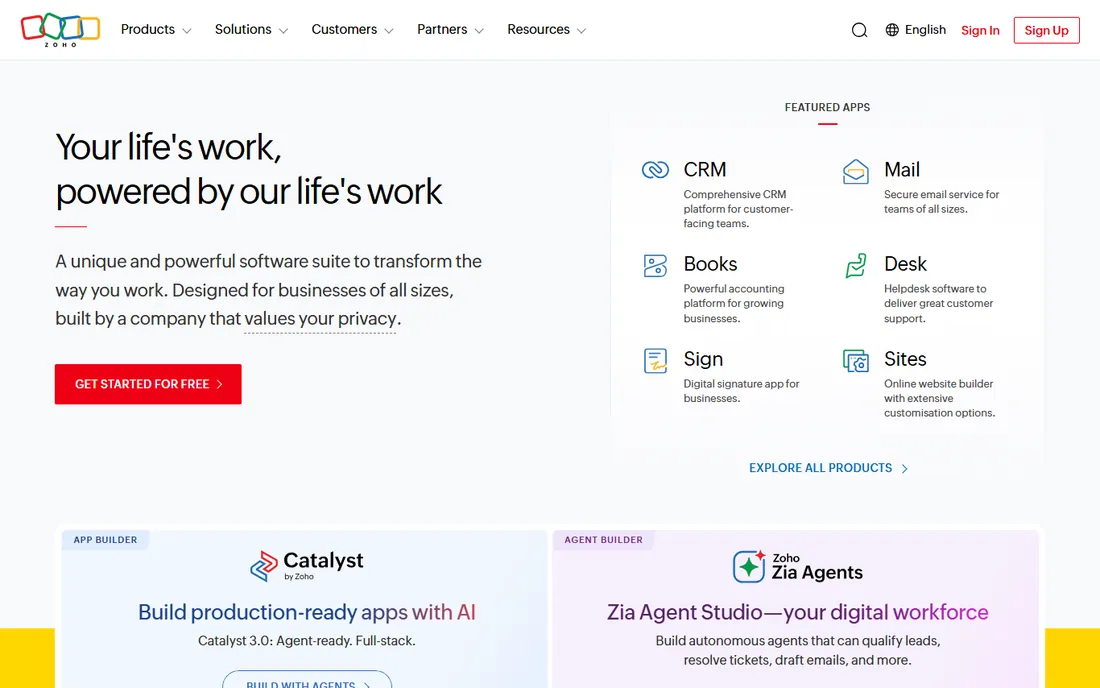
Zoho Books is the value play in this category: proper double-entry accounting with invoicing, expenses, time tracking and basic inventory, at prices far below the ERP vendors. The free plan covers small operations, and paid tiers stay cheap.
It will not replace Intacct for a multi-entity close. But for the 20 to 100 person company that needs solid accounting without an ERP project, Zoho Books plus Zoho's companion apps is remarkable value.
What we like- Real accounting (invoicing, expenses, projects, inventory basics) at Zoho's characteristically low prices
- A free plan for small operations
- Integrates with Zoho CRM, Inventory and the wider suite
Watch out for- Less depth than Intacct or NetSuite for complex needs
- The interface prioritizes simplicity over power
- Advanced multi-entity needs exceed it
Starting priceSee website
Free planFree trial
QuickBooks Online Advanced is Intuit's answer for businesses outgrowing Simple Start and Plus: more users, custom reporting, advanced permissions, workflow automation and priority support, all in the cloud. It keeps the QuickBooks familiarity while adding the controls a growing finance function needs.
It costs notably more than the basic plans, and desktop Enterprise still wins on deep inventory. But for the cloud-first company scaling on QuickBooks, Advanced is the right tier.
What we like- The cloud QuickBooks experience with advanced reporting, custom fields and workflow automation
- More users and better permissions than lower tiers
- Familiar to US accountants and bookkeepers
Watch out for- Monthly cost exceeds the simpler plans significantly
- Some power users still miss desktop Enterprise features
- Intuit's upsell ecosystem is ever-present
What changes when you outgrow small-business accounting
The jump to mid-market accounting is not about more invoices. It is about consolidation (multiple entities, currencies, locations), controls (approvals, audit trails, segregation of duties), inventory reality (multiple warehouses, landed cost, serial tracking), and reporting (dimensions, budgets vs. actuals, board-ready financials).
Map your pain before shopping: if the close takes weeks, prioritize Intacct or NetSuite; if inventory is the mess, look at Enterprise, Acumatica or Business Central; if you just need cleaner books with room to grow, Xero or QBO Advanced may be enough. And budget for implementation: the software price is often half the first-year cost once data migration, training and partner time are counted.
How we chose
We focused on accounting and ERP software built for companies past the startup stage: multi-user, multi-entity capable, with real reporting and controls. For each we opened the vendor's homepage, confirmed the product is current, and took pricing only from vendor pages. Xero's plan prices ($25/$55/$90) are published on its site; the enterprise vendors quote, so we wrote "See website."
Frequently asked questions
What is the best accounting software for a medium-sized business?
Sage Intacct for finance teams needing multi-entity consolidation and fast closes; Oracle NetSuite if you need full ERP beyond accounting; Xero for growing businesses wanting clean, scalable books from $25/month. The right answer depends on whether your pain is consolidation, inventory, or scale.
How much does accounting software for mid-sized businesses cost?
It ranges widely: Xero runs $25 to $90/month and Zoho Books is even cheaper, while Sage Intacct, NetSuite, Acumatica and Business Central are quote-based enterprise purchases that typically run into five figures annually including implementation. Budget for data migration and training on top of the license.
Should a medium business use QuickBooks Enterprise or QuickBooks Online Advanced?
Enterprise suits desktop-based businesses with complex inventory and job costing needs; Online Advanced suits cloud-first businesses wanting advanced reporting, more users and workflow automation. Companies deeply invested in desktop workflows usually pick Enterprise; everyone else defaults to Online Advanced.
When should a business move from Xero or QuickBooks to NetSuite or Intacct?
When the close takes weeks, multi-entity consolidation happens in spreadsheets, inventory needs exceed basic tracking, or audit and compliance demands outgrow the controls. Most companies make the jump between 50 and 200 employees, or when investor or board reporting demands it.
Is Odoo really free?
The Community edition is free and open source, including the accounting app. Odoo Enterprise (extra apps, hosting, support) is paid per user. Many small companies run happily on Community; growing ones usually move to Enterprise or a partner-supported setup.
What is the difference between accounting software and ERP?
Accounting software handles the books: GL, AP, AR, invoicing and reporting. ERP adds operational modules (inventory, manufacturing, order management, CRM, HR) in one database. NetSuite, Acumatica, Business Central and Odoo are ERPs; Sage Intacct, Xero and Zoho Books are accounting-first.
Sources we checked (8)
- https://sage.com/
- https://netsuite.com/
- https://www.xero.com
- https://quickbooks.intuit.com
- https://www.acumatica.com/
- https://www.microsoft.com
- https://odoo.com/
- https://zoho.com
Is your product missing or out of date?
We review this list regularly. Vendors can request a listing, send updated pricing or ask about featured placement.

Shihab Mia · Founder, Rankite
Shihab has spent more than a decade helping SaaS and e-commerce brands grow through search. He writes Rankite's software buying guides from pricing pages, documentation and public user reviews. More about Shihab.