How we make this list: we compare pricing pages, product documentation and public user reviews. Rankite is independent; if a vendor ever pays for a featured spot, that listing is clearly labeled Partner.
Key takeaways
- The standard stack: a ledger (QuickBooks Online $38/month or Xero $25/month) plus a connector (A2X from $29/month or Link My Books from $17/month) that turns Amazon and Shopify payouts into clean books.
- Amazon, eBay, Etsy and Walmart payouts arrive net of fees, refunds and taxes; posting gross revenue by hand is where most e-commerce books go wrong, and connectors fix exactly that.
- Oracle NetSuite (custom-quoted) is the pick for sellers running inventory, warehouses and financials in one system rather than bolting apps together.
- Free or near-free ledgers work at low volume: Wave's Starter plan is free and Zoho Books is free under $50K annual revenue; both pair with a connector once payouts get complicated.
Quick comparison
| Tool | Best for | Starting price | Free plan |
|---|
 QuickBooks Online QuickBooks Online | Most e-commerce sellers, from new Shopify stores to Amazon FBA businesses | $38/month (Simple Start) | Yes (free tier offered) |
 Xero Xero | Sellers who want every team member on the books without per-seat fees | $25/month (Early plan) | Free trial (30 days) |
 A2X A2X | Amazon and Shopify sellers who want accrual-accurate payout reconciliation | $29/month | Free trial (posts up to 3 entries) |
 Link My Books Link My Books | New and multi-channel sellers who want connector pricing that scales gently | $17/month (Lite, up to 200 orders) | Free trial (14 days) |
 Oracle NetSuite Oracle NetSuite | Scaling brands that want ERP, inventory and financials in one system | See website (annual license, custom-quoted) | No (free product tour offered) |
 Sage Sage | E-commerce sellers who want accounting and payroll bundled | See website | Free trial (30 days, per UK site) |
 FreshBooks FreshBooks | Online sellers who also bill services: agencies with stores, coaches, freelancers | $23/month (Lite plan) | Free trial (30 days) |
 Zoho Books Zoho Books | Sellers wanting inventory and automation at the lowest paid price | $15/month (Standard plan) | Yes (free while annual revenue stays under $50K) |
 Wave Wave | Solo sellers and side hustles that need free books today | $0 (Starter plan) | Yes (Starter plan is free) |
Is your product missing or out of date?
We review this list regularly. Vendors can request a listing, send updated pricing or ask about featured placement.
The best accounting software for e-commerce
Selling on Amazon, Shopify, eBay, Etsy and Walmart creates an accounting problem that service businesses never face: every payout you receive is already net of platform fees, refunds, chargebacks and collected taxes. Import it as gross revenue and your books overstate sales while your fees vanish. The tools below split into two jobs, ledgers that keep the books and connectors that translate payouts into them, with real prices for each.
Starting price$38/month (Simple Start)
Free planYes (free tier offered)
QuickBooks Online is the default ledger under most e-commerce stacks because the connectors were built for it first. A2X, Link My Books and similar tools post clean accrual entries to QBO, where bank reconciliation, sales tax tracking and 1099 filing handle the rest. Simple Start is $38 per month, Essentials $85, Plus $140 and Advanced $340, all per Intuit's own pricing page.
The plan choice follows your order volume and inventory. Plus at $140 per month adds inventory tracking, which Amazon and Shopify sellers with real stock need. Essentials is fine for a young store under 5,000 orders a month that uses a connector for the heavy lifting. Watch the add-ons: payroll and payment processing stack on top. Intuit runs 50 percent off promos for new signups, so time your purchase.
What we like- The largest app ecosystem for e-commerce, with A2X, Link My Books and hundreds of other connectors
- Bank reconciliation, inventory (Plus) and 1099 filing built in
Watch out for- The tier ladder gets expensive as you add payroll and Advanced
- The Simple Start plan is thin on inventory and multi-currency for cross-border sellers
#2
Xero
Best for: Sellers who want every team member on the books without per-seat fees
Visit xero.com
Starting price$25/month (Early plan)
Free planFree trial (30 days)
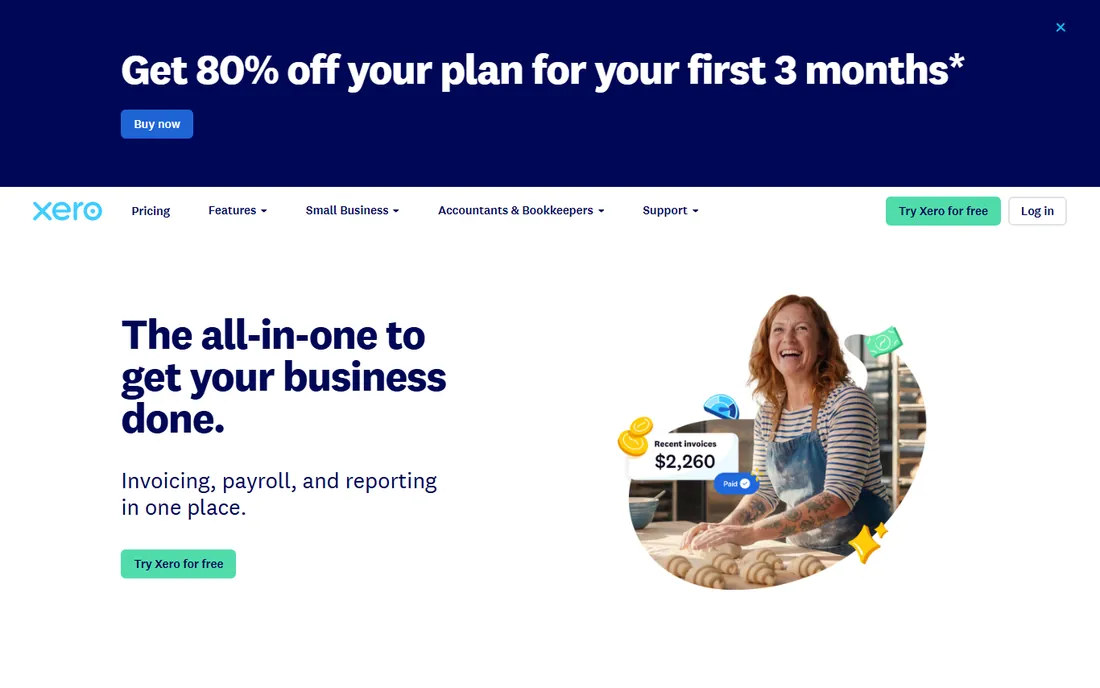
Xero is the sensible alternative ledger. Plans run $25 per month for Early, $55 for Growing and $90 for Established on xero.com's own pages, and every plan allows unlimited users, which matters when the bookkeeper, the accountant and the operations manager all need access. Multi-currency on Established handles sellers buying stock in one currency and selling in another.
The practical question is the connector. A2X and Link My Books both support Xero, posting accrual entries that reconcile to payouts exactly like they do for QuickBooks. The Early plan's 20-invoice cap makes it a non-starter for most stores, so budget for Growing at minimum. If your accountant works in Xero and your volumes are moderate, the lower headline price and unlimited users beat QuickBooks.
What we like- Unlimited users on all plans
- Strong bank reconciliation and short-term cash flow forecasts
- Multi-currency on Established for cross-border sellers
Watch out for- Early plan caps invoices at 20 per month, so most sellers need Growing ($55) or Established ($90)
- Connector ecosystem is solid but smaller than QuickBooks
Starting price$29/month
Free planFree trial (posts up to 3 entries)
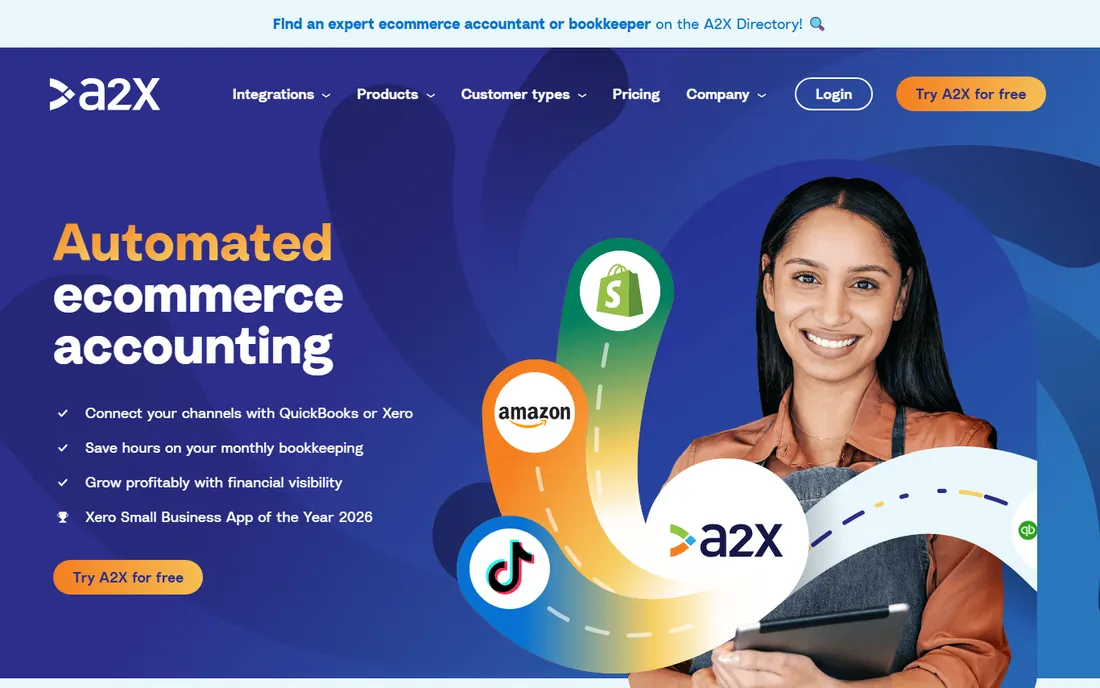
A2X answers the core e-commerce accounting question: how did this payout become this deposit? Instead of importing gross sales, it posts one summary entry per settlement that nets exactly to the bank deposit, with fees, refunds and taxes coded to the right accounts. Plans start at $29 per month for up to 200 orders per channel according to the vendor's own site, with Basic at $45, Professional at $79 and Advanced at $115 on Shopify's app listing.
The fit is sellers who want investor-grade accuracy or who sell across borders where tax treatment gets complicated. The catch is the per-channel billing: selling on Amazon plus Shopify means two subscriptions, which pushes multi-channel sellers toward flat-rate alternatives. A2X is the quality-first choice; Link My Books is the price-first choice. Both post to the same ledgers, so switching later does not orphan your books.
What we like- Posts summarized accrual entries that reconcile exactly to each payout, with sales, fees, refunds and taxes broken out
- Supports Amazon, Shopify, eBay, Etsy, Walmart, QuickBooks, Xero, Sage and NetSuite
Watch out for- Per-channel pricing means multi-channel sellers pay for each platform
- COGS tracking starts at the Basic tier and up, not the cheapest plan
#4
Link My Books
Best for: New and multi-channel sellers who want connector pricing that scales gently
Visit linkmybooks.com
Starting price$17/month (Lite, up to 200 orders)
Free planFree trial (14 days)
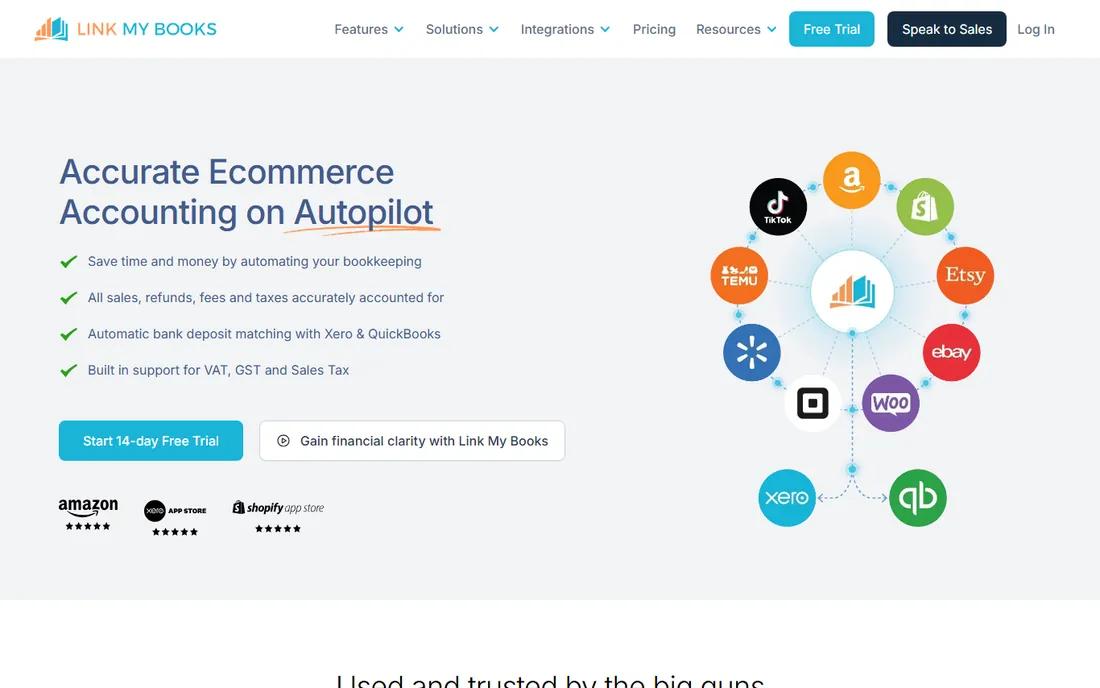
Link My Books does the same job as A2X with a friendlier price curve. The Lite plan is $17 per month for up to 200 orders, Pro $29 and Premium $56 at the 200-order band per the vendor's own site, and the price scales with total order volume instead of charging per sales channel. That single difference makes it the cheaper pick for sellers on three or four platforms.
Feature-wise it covers payouts, refunds, fees and taxes with automatic bank deposit matching in Xero and QuickBooks, plus built-in support for VAT, GST and sales tax. The guided setup wizard suits sellers without accounting backgrounds, and a free onboarding call comes with every plan. Pick A2X when accuracy scrutiny or accountant preference demands it; pick Link My Books when the budget and the channel count both keep growing.
What we like- Pricing scales with order volume, not per channel, so Amazon plus Shopify plus eBay costs the same as one channel
- Lite starts at $17 per month with unlimited marketplaces on Amazon
Watch out for- COGS and deeper profit analytics sit on higher tiers
- Smaller brand than A2X, so fewer third-party accountants know it by name
#5
Oracle NetSuite
Best for: Scaling brands that want ERP, inventory and financials in one system
Visit netsuite.com
Starting priceSee website (annual license, custom-quoted)
Free planNo (free product tour offered)
Oracle NetSuite is the step up from the ledger-plus-connector stack. When a brand outgrows QuickBooks plus A2X, NetSuite replaces both with a single cloud ERP that runs the general ledger, inventory, order management, CRM and e-commerce from one database. Revenue recognition, multi-entity consolidation and demand planning all ride on the same platform.
The pricing reflects the category: an annual license made of the core platform plus modules plus user count, with a one-time implementation fee, all custom-quoted after a sales conversation. That is the honest trade. Stores doing seven figures with real inventory, warehouses or multiple entities save on connector sprawl and gain one source of truth. Stores under seven figures should stay on QuickBooks or Xero plus a connector and revisit NetSuite when the monthly close starts hurting.
What we like- One system for general ledger, order management, inventory, CRM and commerce, so no connector stack to maintain
- Multi-entity consolidation and advanced revenue recognition built in
Watch out for- Custom-quoted annual licenses plus implementation fees make it a five-figure annual commitment
- Overkill for stores under roughly $1M in revenue
#6
Sage
Best for: E-commerce sellers who want accounting and payroll bundled
Visit sage.com
Starting priceSee website
Free planFree trial (30 days, per UK site)
Sage plays two roles in this market. Sage Accounting is the small-business ledger, notable for bundling payroll and the Sage Copilot assistant into its plans; the UK site offers 12 months free, then from £20 per month. Sage Intacct is the midmarket financial system with multi-entity accounting, automated close workflows and audit trails, aimed at companies that have outgrown QuickBooks.
For e-commerce sellers, the honest assessment is mixed. The payroll bundling is genuinely convenient, and Intacct is a real NetSuite competitor for larger brands. But connector support for Amazon and Shopify payouts is thinner than the QuickBooks and Xero ecosystems, and US pricing is opaque. Consider Sage when payroll integration matters more than connector choice, or when your accountant already runs Sage Intacct.
What we like- Sage Accounting bundles payroll and an AI assistant in one subscription
- Sage Intacct gives scaling companies multi-entity accounting with real-time visibility
Watch out for- US pricing is not published on a single page, so every buyer talks to sales
- The small-business accounting product trails QuickBooks and Xero on e-commerce connector depth
#7
FreshBooks
Best for: Online sellers who also bill services: agencies with stores, coaches, freelancers
Visit freshbooks.com
Starting price$23/month (Lite plan)
Free planFree trial (30 days)
FreshBooks belongs on this list for hybrid sellers, not pure product stores. If your business mixes client work with an online store, FreshBooks handles the service side better than any ledger here: professional invoices, retainers, proposals, project profitability and automated late-payment follow-ups. Plans are $23 per month for Lite, $43 for Plus and $70 for Premium, with a 30-day trial and money-back guarantee.
The e-commerce limits are real. There is no native Shopify integration, inventory tracking is basic, and Lite's 5-client cap means most sellers need Plus. Use FreshBooks when services dominate the revenue and the store is a side channel. Use QuickBooks or Xero when product sales dominate. For dropshippers and Amazon-first sellers, skip it entirely.
What we like- Excellent invoicing with automated reminders, late fees and client portals
- Unlimited time tracking and expenses on every plan
- Double-entry reports from Plus ($43/month) up
Watch out for- No native Shopify integration, so e-commerce data arrives through Zapier or connectors
- Inventory is light and Lite caps billable clients at 5
#8
Zoho Books
Best for: Sellers wanting inventory and automation at the lowest paid price
Visit zoho.com
Starting price$15/month (Standard plan)
Free planYes (free while annual revenue stays under $50K)
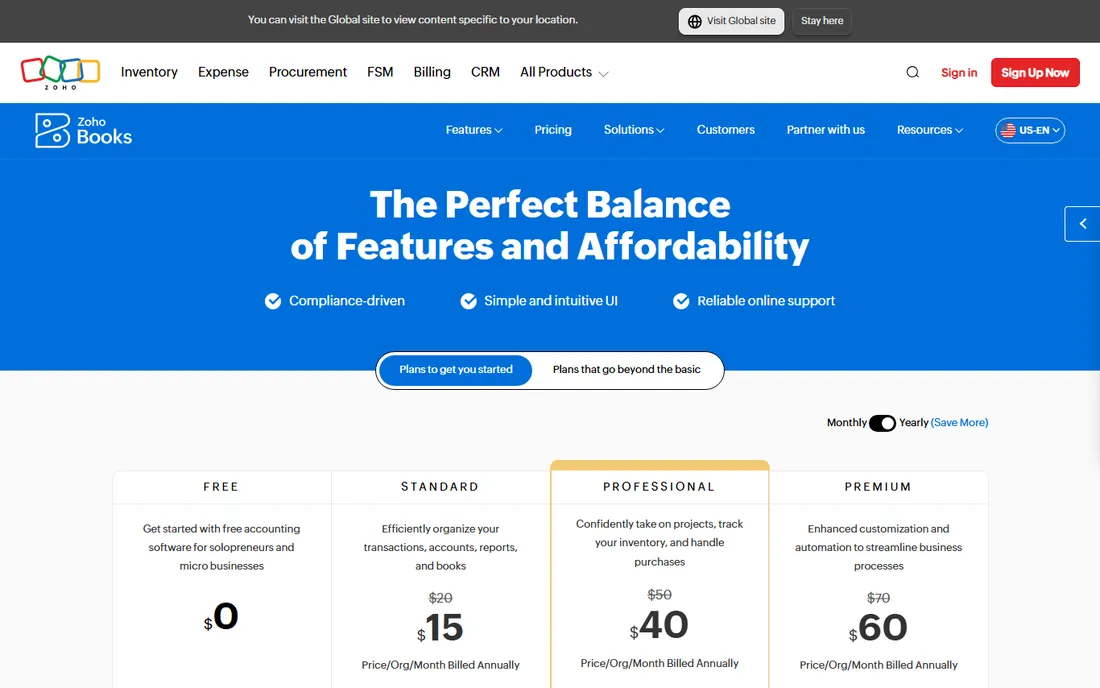
Zoho Books is the value ledger for e-commerce. The free plan handles 1,000 invoices a year, bank reconciliation, mileage and 1099 filing while revenue stays under $50K, which covers a new store's first year. Standard at $15 per month adds bank feeds and sales tax, Professional at $40 adds inventory with serial and batch tracking, and Elite at $120 integrates Shopify stores and connects Amazon, eBay and Etsy sales channels.
That Elite tier makes Zoho the only ledger here with native marketplace connections on a published plan, a real edge for sellers who want to skip the connector subscription. The weakness is payroll: Zoho Books has no native US payroll, so sellers add a separate provider. For sellers who reconcile payouts carefully and want the books done right for under $50 a month, Zoho Books Professional with a connector is the strongest cheap stack on this list.
What we like- Free plan covers 1,000 invoices per year with bank reconciliation and 1099 filing
- Professional ($40/month) adds inventory, sales orders and multi-currency
- Elite ($120/month) integrates Shopify
Watch out for- No native US payroll
- The Amazon and Shopify connector ecosystem is smaller than QuickBooks or Xero
#9
Wave
Best for: Solo sellers and side hustles that need free books today
Visit waveapps.com
Starting price$0 (Starter plan)
Free planYes (Starter plan is free)
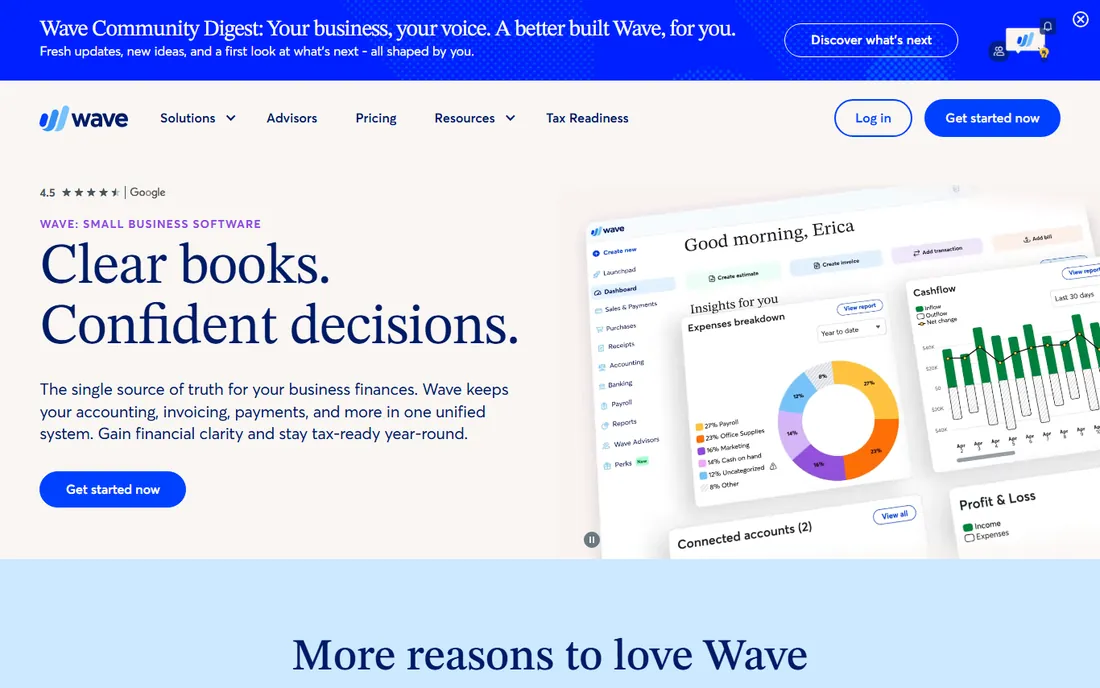
Wave is the starting line. The free Starter plan covers unlimited invoices and bookkeeping records, which is enough for a new Etsy or Shopify seller testing the waters. Pro at $19 per month per the vendor's own FAQ adds automatic bank imports, unlimited receipt capture and payment reminders, plus discounted payment processing on the first ten transactions a month.
The limit is manual work. Without a connector subscription, every payout needs manual splitting into sales, fees and taxes, and the free plan means typing each transaction. That breaks down around a few hundred orders a month. Wave works as a free first year, and the natural upgrade is Zoho Books or QuickBooks with A2X or Link My Books once the order volume justifies the connector fee.
What we like- Free Starter plan includes unlimited estimates, invoices and bookkeeping records
- Pro at $19 per month adds bank auto-import, receipt capture and payment reminders
Watch out for- Free plan needs manual transaction entry, which gets painful past a few hundred orders a month
- Payment processing costs 2.9% plus $0.60 per transaction
Why payouts break e-commerce books
A marketplace payout is a settlement, not revenue. Amazon pays you sales minus its fees, minus refunds, minus advertising charges, plus tax it collected on your behalf. Post the deposit as income and two things happen: your revenue is understated or overstated depending on the month, and the fees never appear as expenses, so your profit margin looks wrong. At tax time the mismatch shows up as unexplained differences between 1099-K totals and your books.
Connectors exist to fix this mechanically. A2X and Link My Books import the settlement report, split it into sales, fees, refunds and tax, and post a summary entry that reconciles exactly to the bank deposit. Your ledger then holds clean accrual numbers instead of hand-entered guesses. The second common break is inventory: selling a product without recording its cost of goods sold means the profit and loss report shows revenue with no cost, which flatters margins and misstates taxes. Zoho Books Professional, QuickBooks Plus and NetSuite all track COGS; FreshBooks Lite and Wave Starter do not.
The third break is sales tax. Economic nexus rules mean a store can owe sales tax in a dozen states before it knows it. QuickBooks, Xero, Zoho Books and NetSuite all track and report sales tax by jurisdiction; pair the ledger with a filing tool like TaxJar or Avalara when nexus spreads past your home state. Fix payouts first, inventory second, tax third, and the books stay audit-ready.
The stack math: what the full setup costs per month
Price the ledger and the connector together, because neither works alone at scale. A new Shopify store on QuickBooks Simple Start ($38) plus Link My Books Lite ($17) pays $55 a month with real accrual books. Swap in A2X Mini ($29) for higher accuracy and the same store pays $67. A mid-size Amazon seller on QuickBooks Plus ($140) plus A2X Professional ($79) pays $219, which is the point where the connector earns its fee by replacing hours of manual reconciliation.
The cheapest credible stack is Wave Pro ($19) plus Link My Books Lite ($17) at $36 a month, or Zoho Books Standard ($15) plus Link My Books Lite ($17) at $32. The expensive end is NetSuite, where the annual license replaces the whole stack but runs into five figures a year. Budget the stack, not the app: a $17 connector that saves four hours of monthly bookkeeping pays for itself at any wage above a few dollars an hour.
Frequently asked questions
What is the best accounting software for Amazon sellers?
QuickBooks Online or Xero as the ledger, plus A2X or Link My Books as the connector. The connector turns each Amazon settlement into a clean accrual entry that reconciles to the bank deposit, which is the part hand-posting gets wrong. Budget $55 to $67 a month for the full stack with Link My Books, or $67 to $115 with A2X.
What is the best accounting software for Shopify stores?
Shopify sellers have the same answer: QuickBooks Online or Xero plus a connector. Zoho Books Elite ($120/month) is the exception worth a look, since it integrates Shopify directly on a published plan. At low volume, Wave Pro ($19/month) plus Link My Books Lite ($17/month) is the cheapest working setup.
Do I need a connector like A2X, or is QuickBooks enough?
At low volume you can manage without one, but past a few hundred orders a month the connector earns its fee. It automates the payout splitting that takes hours by hand and removes the errors that make tax time painful. A2X starts at $29 a month per channel, Link My Books at $17 a month across channels.
What is the cheapest accounting software for e-commerce?
Wave's Starter plan is free, and Zoho Books is free under $50K annual revenue. For a paid ledger, Zoho Books Standard ($15/month) is the cheapest real accounting plan. The full stack, ledger plus connector, starts around $32 a month with Zoho Books plus Link My Books Lite.
When should an e-commerce brand move to NetSuite?
When QuickBooks plus a connector stops being enough: usually past $1M in annual revenue, with real inventory, multiple warehouses or entities, and a monthly close that takes weeks. NetSuite replaces the ledger, the connector and the inventory tools in one system, but the annual license plus implementation runs into five figures.
How does e-commerce accounting handle sales tax?
Ledgers like QuickBooks, Xero, Zoho Books and NetSuite track sales tax by jurisdiction and report what you owe. Once nexus spreads past your home state, add a filing tool like TaxJar or Avalara to calculate and file in each state. Connectors like A2X and Link My Books help by coding the tax portion of each payout correctly in the first place.
How we chose
We searched for what online sellers actually buy: accounting software for e-commerce, accounting for Amazon sellers, Shopify accounting, QuickBooks for Amazon and A2X alternatives. For each candidate we opened the vendor's own pricing page, checked prices against public reviews on G2 and Capterra and practitioner discussion on Reddit, and weighed ledger depth, marketplace payout handling, connector quality and fit for US sellers from startup to seven figures. Where a price could not be verified on the vendor's page we wrote "See website" rather than guessing.
Sources we checked (12)
- https://quickbooks.intuit.com/pricing/
- https://www.xero.com/us/pricing-plans/
- https://www.a2xaccounting.com/
- https://linkmybooks.com/
- https://linkmybooks.com/blog/best-accounting-software-for-shopify-sellers
- https://netsuite.com/
- https://sage.com/
- https://www.freshbooks.com/pricing
- https://www.zoho.com/us/books/pricing/
- https://www.waveapps.com/pricing
- https://www.g2.com/categories/accounting
- https://www.capterra.com/accounting-software/
Is your product missing or out of date?
We review this list regularly. Vendors can request a listing, send updated pricing or ask about featured placement.

Shihab Mia · Founder, Rankite
Shihab has spent more than a decade helping SaaS and e-commerce brands grow through search. He writes Rankite's software buying guides from pricing pages, documentation and public user reviews. More about Shihab.