How we make this list: we compare pricing pages, product documentation and public user reviews. Rankite is independent; if a vendor ever pays for a featured spot, that listing is clearly labeled Partner.
Key takeaways
- Distributors outgrow plain bookkeeping when stock spreads across warehouses: NetSuite, Acumatica and Epicor Kinetic are the full ERP answers, all custom-quoted.
- The cheapest published starting points are Zoho Books ($15/month) and Odoo ($24.90/user/month), but both need add-ons or configuration for serious warehouse work.
- Cin7 Core starts at $349/month and Fishbowl Inventory at $229/month, the two clearest mid-market options with published prices and real distribution features.
- QuickBooks shops usually land on QuickBooks Enterprise or Fishbowl: both keep the accounting workflow the team already knows.
Quick comparison
| Tool | Best for | Starting price | Free plan |
|---|
 NetSuite NetSuite | Distributors moving to a full cloud ERP | See website (custom quote) | No |
 Acumatica Acumatica | Growing distributors that want ERP without per-user fees | See website (consumption-based, custom quote) | No |
 Epicor Kinetic Epicor Kinetic | Distributors with manufacturing or complex operations | See website (custom quote) | No |
 Cin7 Cin7 | Multichannel distributors selling wholesale, retail and online | $349/month (Core Standard) | Free trial (14 days) |
 Fishbowl Fishbowl | Manufacturers and distributors already on QuickBooks | $229/month (Inventory Essentials, billed annually) | No |
 Katana Katana | Small manufacturers and light distributors | See website | No |
 Zoho Books Zoho Books | Small distributors with simple inventory and tight budgets | $15/month (Standard, annual billing) | Yes |
 QuickBooks Enterprise QuickBooks Enterprise | Growing businesses that want to stay in the QuickBooks world | See website | No |
 Brightpearl Brightpearl | Retail and wholesale brands selling on Shopify, Amazon and BigCommerce | See website (custom quote) | No |
 Odoo Odoo | Distributors that want ERP modules at a low per-user price | $24.90/user/month (Standard, annual billing) | Yes (One App Free) |
Is your product missing or out of date?
We review this list regularly. Vendors can request a listing, send updated pricing or ask about featured placement.
The best accounting software for distribution businesses
A distributor's books are only as honest as its stock counts. When the warehouse says one number and the ledger says another, margins drift, purchasing guesses, and month-end becomes detective work. The best accounting software for a distribution business closes that gap: inventory, purchasing, sales orders and the general ledger share one set of numbers. These ten systems cover the real options, from full ERPs for multi-warehouse operations to leaner tools for smaller distributors.
Starting priceSee website (custom quote)
Free planNo
NetSuite is the default answer when a distributor has genuinely outgrown entry-level accounting. Everything lives in one system: the general ledger, purchasing, sales orders, inventory across warehouses, and even ecommerce through SuiteCommerce. For distribution specifically, the relevant depth is in lot and serial traceability, landed cost tracking, and multi-location fulfillment rules that keep pick, pack and ship honest.
The catch is commercial, not functional. Oracle publishes no prices, and total cost depends on the base license, user count, modules and implementation. Small distributors often find the first-year bill (licenses plus implementation) runs into five figures. If you can fund the project and have more than one warehouse or entity, it is the most complete platform on this list. If you cannot, start further down.
What we like- True cloud ERP with financials, inventory, order management and CRM in one database
- Advanced Inventory with lot, serial and bin tracking across multiple locations
- Demand planning and warehouse management built in, not bolted on
Watch out for- No published pricing, so every deal starts with a sales process
- Implementation typically runs into months and needs a partner
#2
Acumatica
Best for: Growing distributors that want ERP without per-user fees
Visit acumatica.com
Starting priceSee website (consumption-based, custom quote)
Free planNo
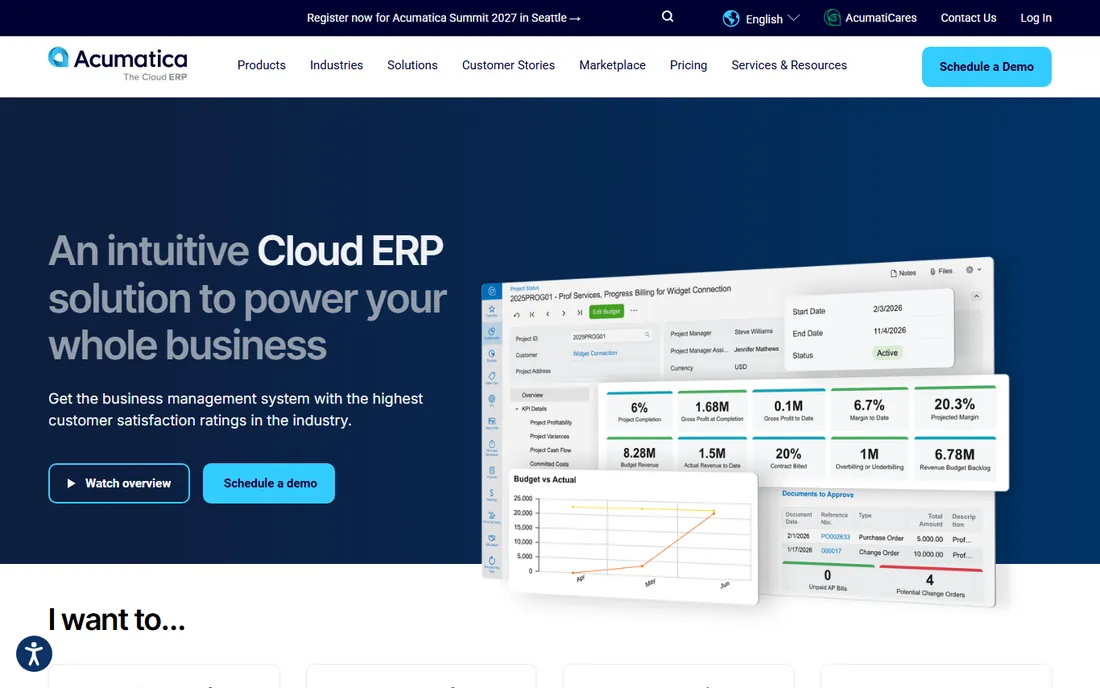
Acumatica sells against NetSuite on one idea: you pay for the resources you consume, not for every person who logs in. For distributors with large warehouse teams and seasonal staff, unlimited users is a genuine cost advantage. The distribution edition covers sales order management, advanced inventory, requisition management and warehouse workflows, with financials sharing the same data.
The pricing model is unusual enough to need attention. Acumatica prices by commercial transaction volume tiers plus the applications you use, so two distributors can pay very different amounts. Quotes come through partners, which means a longer buying process. Distributors that expect headcount growth without wanting license costs to grow with it should put Acumatica on the shortlist next to NetSuite.
What we like- Unlimited-user licensing, so warehouse staff, sales and accountants all get access without seat math
- Strong distribution edition with order management, purchasing and inventory
- Flexible deployment (SaaS, private cloud or on-premises)
Watch out for- Pricing is quote-based and tied to transaction volume tiers, which makes early budgeting fuzzy
- Implementation still needs a partner
#3
Epicor Kinetic
Best for: Distributors with manufacturing or complex operations
Visit epicor.com
Starting priceSee website (custom quote)
Free planNo
Epicor Kinetic fits distributors that also make things, or that run operations a plain accounting tool cannot model. Its strength is the operational layer: bills of material, production scheduling, quality holds and traceability, all tied to the same financials. Distributors in industrial supply, building materials and automotive aftermarket are Epicor's home turf, and the Prophet 21 product line serves pure distributors.
The buying experience is enterprise-shaped. Epicor publishes no prices, implementations run through partners, and the platform rewards companies that invest in configuration. Smaller distributors with straightforward buy-sell-store workflows will find it heavier than they need. For operations with real manufacturing complexity, it is one of the strongest fits available.
What we like- Deep roots in manufacturing and distribution workflows, including make-to-stock and assemble-to-order
- Strong lot and serial traceability with quality management
- Cloud, on-premises and hybrid deployment options
Watch out for- No published pricing and a sales-led process
- Implementations are projects, not signups, and reviewers note occasional performance quirks
#4
Cin7
Best for: Multichannel distributors selling wholesale, retail and online
Visit cin7.com
Starting price$349/month (Core Standard)
Free planFree trial (14 days)
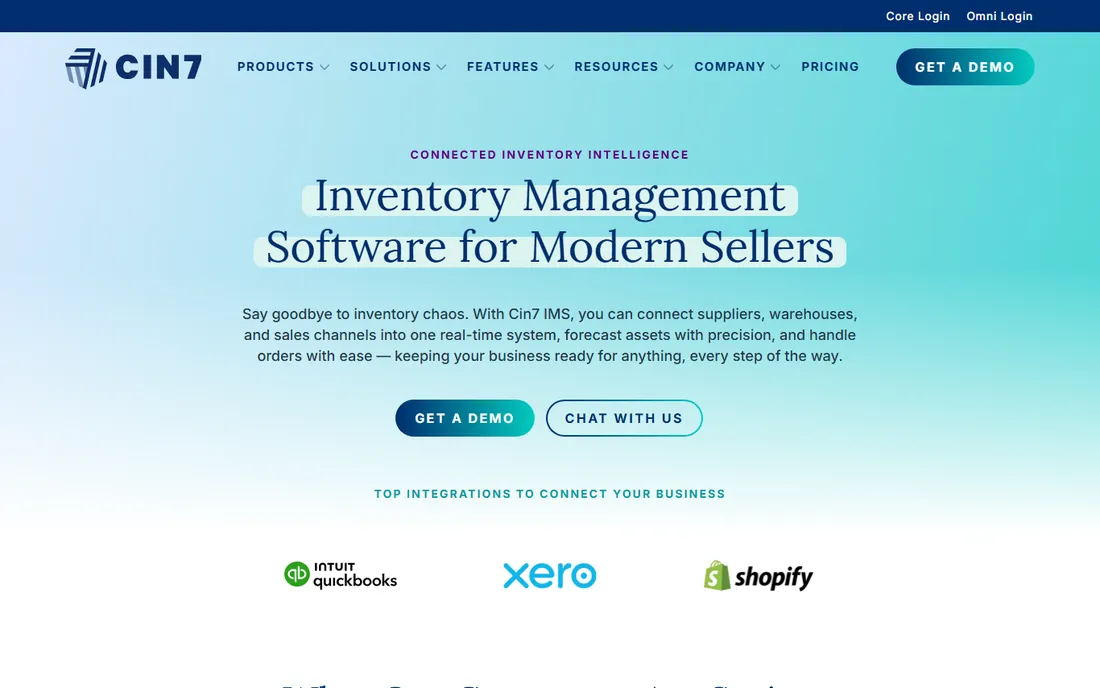
Cin7 Core is built for product businesses that sell through several channels at once and need one trustworthy stock number. Standard at $349 per month covers five users and the core inventory modules, with Pro at $599 and Advanced at $1,199 above it. For distributors that also run a web store or sell on marketplaces, the channel integrations keep the warehouse and the storefronts in sync.
The plan limits deserve a careful read. Users, connections and annual order volumes are capped per tier, and businesses that outgrow them move up a tier rather than paying small overages. Implementation and EDI work can add one-time costs. A 14-day free trial of Core lets you test the workflow before committing. For multichannel distributors that want published pricing and a fast start, Cin7 is the clearest mid-market pick.
What we like- Published pricing with three clear Core tiers
- One inventory record across retail, wholesale and online channels
- 700-plus integrations including QuickBooks, Xero and Shopify
Watch out for- Plans cap users, integrations and order volume, so costs step up as you grow
- Reviewers report a learning curve and occasional slowdowns
Starting price$229/month (Inventory Essentials, billed annually)
Free planNo
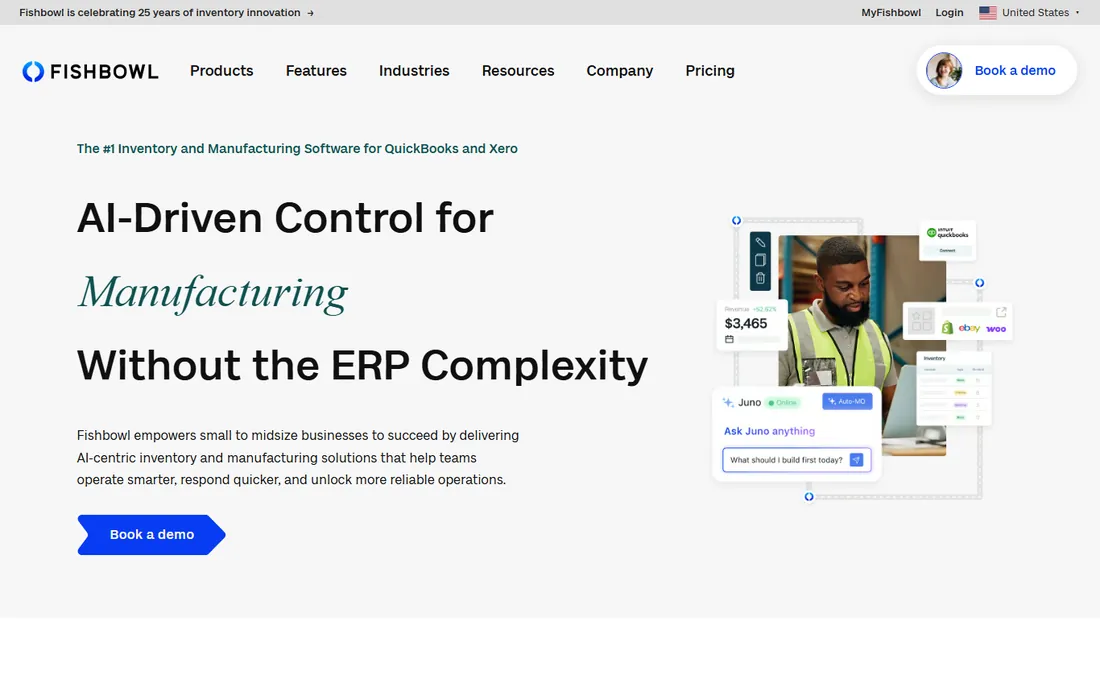
Fishbowl exists for one large audience: businesses whose accounting lives in QuickBooks and whose warehouse has outgrown spreadsheets. Fishbowl Inventory handles stock, orders and barcoding, and posts everything back to QuickBooks so the books stay honest. Essentials at $229 per month (billed annually, two users) is the entry point, with Growth at $429 and Scale at $729.
Read the product split before you budget. Manufacturing, multi-warehouse and EDI workflows sit in Fishbowl Advanced, which starts at $595 per month for the warehouse product and $675 for manufacturing, priced by users and deployment. Fishbowl also requires an implementation package whose cost is quoted, not published. For a QuickBooks-based distributor that only needs finished-goods control, Essentials is a fair price. For manufacturers, price the Advanced tier instead.
What we like- The deepest QuickBooks integration of any inventory tool on this list
- Barcode scanning, pick/pack/ship and work orders in the Advanced tiers
- Published starting prices, unusual in this category
Watch out for- The $229 tier covers finished-goods inventory only, manufacturing needs the separate Advanced product from $595 per month
- Implementation packages are required and not priced publicly
Starting priceSee website
Free planNo
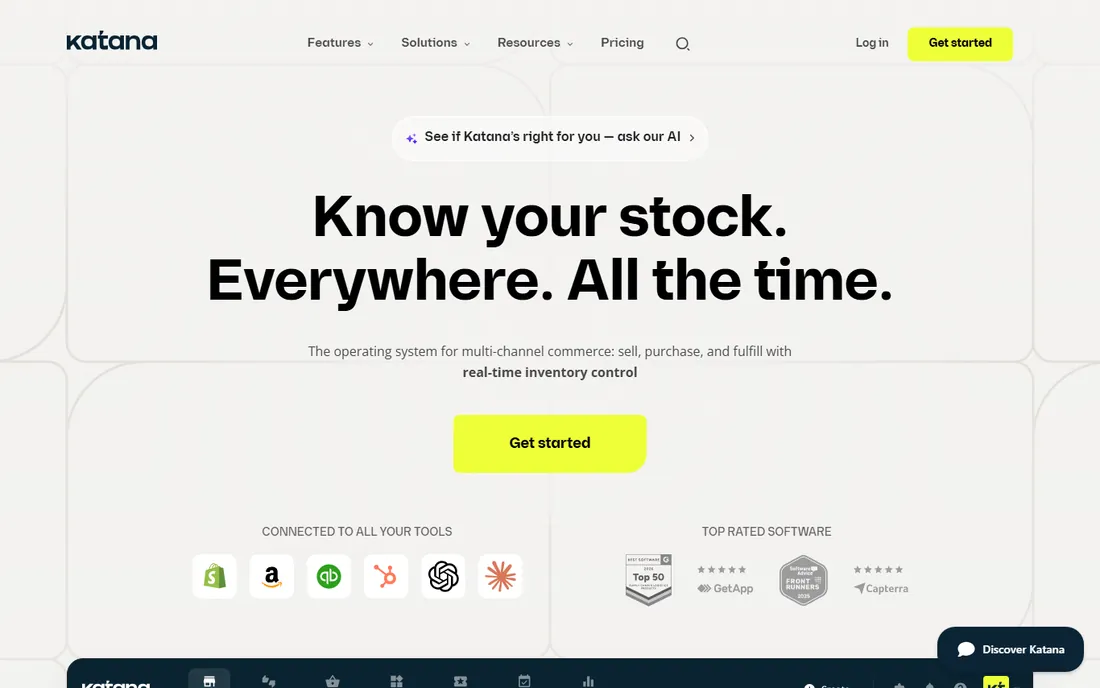
Katana is the approachable end of this list: a cloud inventory and manufacturing platform designed for small businesses that make and sell physical products. The visual production planning and real-time stock view suit D2C brands, batch producers and make-to-order shops. Setup is measured in days, and the integrations cover the accounting and ecommerce tools small teams already use.
The honest limitation is scale. Katana targets businesses with straightforward operations; distributors running several warehouses, EDI trading partners or complex landed-cost accounting will outgrow it. Pricing is the other question mark: Katana does not publish a clear price list, and third-party figures disagree, so treat any number you see online as unverified until Katana quotes you. For a small maker-distributor, it is worth a demo. For a serious distribution operation, it is a stepping stone.
What we like- Visual, easy-to-learn interface that teams adopt without heavy training
- Live inventory with manufacturing orders and material planning
- Native integrations with Shopify, WooCommerce, QuickBooks Online and Xero
Watch out for- Pricing is not published on a clear public page, with third-party figures that conflict
- Built for smaller operations, so multi-warehouse distributors will hit ceilings
#7
Zoho Books
Best for: Small distributors with simple inventory and tight budgets
Visit zoho.com
Starting price$15/month (Standard, annual billing)
Free planYes
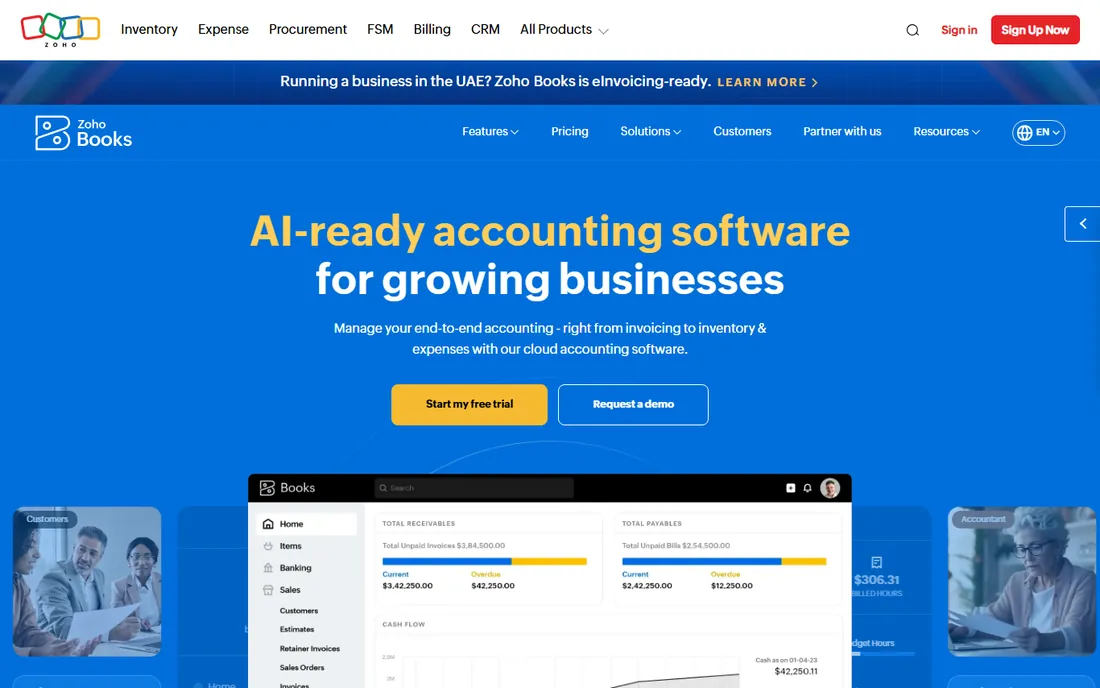
Zoho Books is the budget pick for distributors whose inventory needs are simple: one or two locations, straightforward buy-sell flow, no lot traceability. Standard at $15 per month (annual billing) covers three users with unlimited invoices, and the ladder runs through Professional at $40, Premium at $60, Elite at $120 and Ultimate at $240. A free plan exists for businesses under the revenue threshold.
The catch is scope. Zoho Books is accounting software with inventory features, not a distribution system. Businesses that need barcode-driven warehousing add Zoho Inventory, which is a separate subscription. US distributors should also note that fewer American accountants work in Zoho than in QuickBooks, which can matter at year end. For a small distributor watching every dollar, though, the price-to-function ratio is hard to beat.
What we like- Genuinely low prices with a free plan for very small businesses
- Clean accounting with multi-currency, bank feeds and automation
- Pairs with Zoho Inventory for stock control
Watch out for- Inventory depth is basic next to the ERP tools here
- Advanced warehousing needs the separate Zoho Inventory subscription
Starting priceSee website
Free planNo
QuickBooks Enterprise is the in-place upgrade for businesses that have run on QuickBooks for years and need more depth without changing systems. The Platinum and Diamond editions add Advanced Inventory with bin tracking, FIFO costing and barcode scanning, plus Advanced Pricing for customer-specific price rules. Editions are sold by user count, from one to forty users.
The commercial picture changed: Enterprise is subscription-only now, and Intuit does not publish flat list prices, so confirm the quote before budgeting. It is also still fundamentally desktop software; remote access means paying a hosting provider on top. For a distributor whose team and accountant both live in QuickBooks, staying put avoids a migration. For anyone starting fresh, the cloud-native options above are easier to run.
What we like- Advanced Inventory, Advanced Pricing and job costing in the higher editions
- Industry-specific editions for wholesale, manufacturing and contractors
- The accountant ecosystem every US bookkeeper knows
Watch out for- Intuit no longer publishes flat prices, so quotes come from Intuit or resellers
- It is desktop software at heart, with cloud access only through paid hosting
#9
Brightpearl
Best for: Retail and wholesale brands selling on Shopify, Amazon and BigCommerce
Visit brightpearl.com
Starting priceSee website (custom quote)
Free planNo
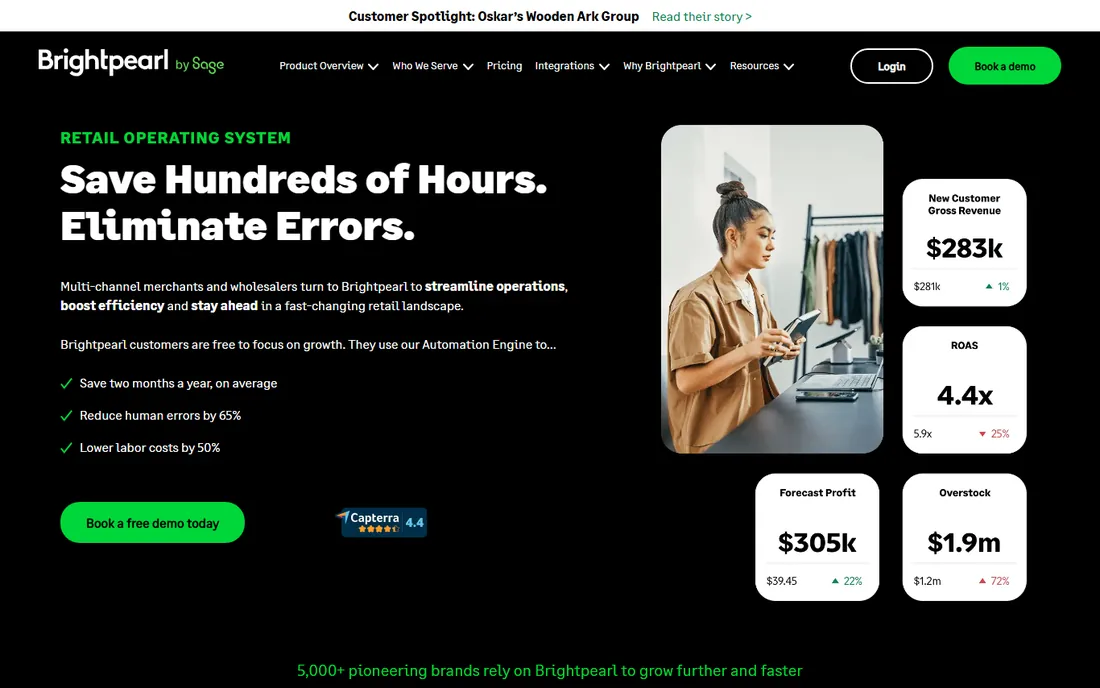
Brightpearl targets a specific distributor: the brand that sells direct to consumers and wholesale at the same time. Orders from Shopify, Amazon, eBay and wholesale channels land in one system, inventory allocates across warehouses, and the built-in accounting keeps the books aligned. Automation handles the repetitive order-to-cash work that eats staff time.
The two caveats are fit and price. Brightpearl is retail-shaped; industrial distributors with EDI, lot traceability and field sales will find it less natural than Epicor or NetSuite. And with no published pricing, every evaluation starts with a sales conversation. For a growing retail-wholesale brand drowning in channel spreadsheets, it is purpose-built. For everyone else, it is a narrower pick.
What we like- Built for multichannel retail and wholesale with order management at the center
- Strong inventory with multi-warehouse support
- Accounting, CRM and reporting in one system
Watch out for- No public pricing at all, everything is quoted
- Best fit is retail-led businesses, less so for industrial distribution
#10
Odoo
Best for: Distributors that want ERP modules at a low per-user price
Visit odoo.com
Starting price$24.90/user/month (Standard, annual billing)
Free planYes (One App Free)
Odoo is the value play in ERP: a single per-user price covers dozens of integrated apps, including inventory with double-entry valuation, purchase automation, barcode operations and manufacturing. Standard runs $24.90 per user per month on annual billing for new customers, and the One App Free plan lets tiny teams start at no cost. The Community edition is free and open source for businesses willing to self-host.
The price is honest but incomplete. Odoo implementations are real projects, and partner-led setups for inventory and accounting commonly cost more than the first year of licenses. Multi-company, Odoo Studio customization and external API access require the Custom plan. Distributors with in-house technical skill can get remarkable value here. Those without it should budget the implementation first and the licenses second.
What we like- One subscription covers every app: accounting, inventory, purchase, sales, manufacturing and more
- Published per-user pricing far below traditional ERP
- Open-source Community edition for self-hosters
Watch out for- The low price assumes you can configure it
- Most distributors need a partner for implementation, which is the real cost
- Advanced features like multi-company sit on the Custom plan
How we chose
We started with the searches distributors actually run: accounting software for distribution, distribution ERP, and wholesale inventory accounting. For each candidate we checked the vendor's own pricing page, read public reviews on G2 and Capterra and practitioner threads on Reddit, and compared inventory depth, warehouse features, accounting strength and company-size fit. Where a vendor publishes no price, we wrote "See website" instead of repeating an unverified estimate. Every tool on this list is a real product, available today.
What a distribution business should check before buying
The wrong question is "which accounting software is best." The right one is "where does our operation break the software." Walk your own workflow before any demo, because the failure points are specific.
Start with inventory truth. Count your SKUs, your locations and your units of measure. If you track lots, serial numbers or expiry dates, say so on the first call: half the tools on this list handle it, half do not, and the difference decides between Fishbowl Advanced, NetSuite or Epicor and the simpler options. Ask how the system handles landed costs, because freight, duties and brokerage decide your real margins.
Then map the order flow. A distributor lives on purchase orders, sales orders, transfer orders and returns. Ask each vendor to walk a return and a warehouse transfer live, not just a sale. Check EDI support if any customer requires it: EDI capability separates the ERPs from the inventory apps fast, and adding it later is painful.
Finally, check the accounting side with your accountant, not just the warehouse manager. Multi-currency, intercompany transactions, revenue recognition on long projects and audit trails all live here. A system the warehouse loves and the accountant cannot close the month in is a failed purchase. Bring both people to every demo.
What the pricing really looks like
Published prices in this category cover the middle of the market. Cin7 Core starts at $349 per month, Fishbowl Inventory at $229, Zoho Books at $15 and Odoo at $24.90 per user. Those numbers are real and current. The ERPs (NetSuite, Acumatica, Epicor, Brightpearl) publish nothing, which means the quote depends on users, modules, transaction volume and how badly the rep wants the deal.
Budget three layers, not one. Licenses are the visible layer. Implementation is the second: data migration, configuration, training and integrations, which for ERP projects often matches or exceeds the first year of licenses. The third layer is the add-ons: EDI connections, extra warehouses, barcode hardware, payroll, and the accounting-adjacent tools each platform assumes you already own.
Two rules keep budgets honest. First, get the quote in writing with the user count, modules and renewal terms spelled out, because ERP renewals carry annual uplifts. Second, price your actual headcount on per-user tools: Odoo at $24.90 looks cheap for five users and less cheap for fifty, which is exactly where Acumatica's unlimited-user model changes the math.
Frequently asked questions
What is the best accounting software for a small distribution business?
For small distributors, the shortlist is Zoho Books ($15/month) for simple needs, Odoo ($24.90/user/month) for modular ERP depth, Cin7 Core ($349/month) for multichannel sales, and Fishbowl ($229/month) if the books live in QuickBooks. Each covers inventory plus accounting without an enterprise project. Pick based on your channels and whether you also manufacture.
Do I need an ERP, or is accounting software with inventory enough?
If you run one or two warehouses, straightforward purchasing and no manufacturing, accounting software with inventory (Zoho Books, Cin7, Fishbowl) is enough. You need an ERP when you add a third warehouse, multiple entities, EDI customers, lot traceability or light manufacturing. The usual signal is month-end: if closing takes weeks because stock and books disagree, you have outgrown the simpler tools.
How much does accounting software for distribution cost?
Published starting prices run from $15 per month (Zoho Books) to $349 per month (Cin7 Core), with per-user tools like Odoo at $24.90 per user per month. The ERP tier (NetSuite, Acumatica, Epicor) is custom-quoted, and first-year totals with implementation commonly reach five figures. Always budget implementation and add-ons separately from the license.
Can QuickBooks handle a distribution business?
QuickBooks Online handles simple distribution through its Plus and Advanced plans, and QuickBooks Enterprise adds Advanced Inventory with bin tracking and barcode workflows. Many distributors pair QuickBooks with Fishbowl for the warehouse side. It breaks down at multi-entity operations, heavy EDI or complex manufacturing, which is when distributors move to NetSuite or Acumatica.
What is landed cost, and why does it matter?
Landed cost is the true cost of getting goods into your warehouse: product cost plus freight, duties, insurance and brokerage. Distributors that ignore it misprice products and misunderstand margins. NetSuite, Acumatica, Epicor and Cin7 handle landed costs natively. Simpler tools often need workarounds, so confirm this on the first demo if you import goods.
How long does implementation take?
Inventory tools like Cin7, Fishbowl and Katana typically go live in weeks. ERP implementations (NetSuite, Acumatica, Epicor) run three to nine months depending on warehouses, entities and integrations. The biggest schedule risk is dirty data: cleaning SKUs, customers and suppliers before migration saves more time than any software choice.
Sources we checked (4)
- https://cin7.com/pricing/
- https://techbullion.com/6-best-inventory-management-software-in-2026-with-integrations/
- https://www.g2.com/categories/erp-systems
- https://www.capterra.com/enterprise-resource-planning-software/
Is your product missing or out of date?
We review this list regularly. Vendors can request a listing, send updated pricing or ask about featured placement.

Shihab Mia · Founder, Rankite
Shihab has spent more than a decade helping SaaS and e-commerce brands grow through search. He writes Rankite's software buying guides from pricing pages, documentation and public user reviews. More about Shihab.