How we make this list: we compare pricing pages, product documentation and public user reviews. Rankite is independent; if a vendor ever pays for a featured spot, that listing is clearly labeled Partner.
Key takeaways
- An auto repair shop does not need accounting software the way a retailer does. It needs work orders that turn into invoices, parts and labor tracked per job, and numbers that land in the ledger without retyping.
- Two architectures compete here: shop management systems with built-in or synced accounting (Tekmetric, Shopmonkey, Shop-Ware, AutoFluent, RO Writer, Mitchell1), and general ledgers (QuickBooks Online, Xero) fed by the shop system.
- Every shop management tool on this list is quote-based with demos, not trials. Budget a demo cycle; the buying decision is the workflow, not the price.
- QuickBooks Online ($38/month) remains the ledger most shop systems sync to and most accountants expect. Xero ($27/month) fits multi-user shops that dislike per-seat pricing.
- If your shop runs on paper repair orders, any of the six shop systems beats perfect accounting software: the win is work orders, parts tracking and labor captured at the counter.
Quick comparison
| Tool | Best for | Starting price | Free plan |
|---|
 Tekmetric Tekmetric | Modern independent shops wanting cloud shop management | See website (quote-based) | No (demo available) |
 Shopmonkey Shopmonkey | Shops wanting payments, inspections and accounting in one login | See website (quote-based) | No (demo available) |
 Shop-Ware Shop-Ware | Shops wanting cloud-native workflow plus accounting links | See website (quote-based) | No (demo available) |
 AutoFluent AutoFluent | Tire dealers and service centers wanting built-in accounting | See website (quote-based) | No (demo available) |
 RO Writer RO Writer | Franchise and multi-location operations | See website (quote-based) | No (demo available) |
 Mitchell1 Manager SE Mitchell1 Manager SE | Shops wanting repair-data depth with accounting links | See website (quote-based) | No (demo available) |
 QuickBooks Online QuickBooks Online | Shops whose bookkeeper insists on QuickBooks | $38/month (Simple Start) | Free trial (30 days) |
 Xero Xero | Multi-user shops that dislike per-seat fees | $27/month (Early) | Free trial |
Is your product missing or out of date?
We review this list regularly. Vendors can request a listing, send updated pricing or ask about featured placement.
The best accounting software for auto repair shop
Generic accounting software fails auto repair shops in predictable ways. QuickBooks does not know what a work order is, cannot track a part from estimate to installed, and has no concept of billed labor hours versus clocked hours. That is why this category is really two products: shop management systems that run the counter (estimates, work orders, parts, labor, inspections, payments) and push financials to the books, and the ledgers themselves. A shop needs one of the first and usually one of the second. The six shop systems below plus the two ledgers cover how independent shops, tire dealers and franchises actually run their numbers.
#1
Tekmetric
Best for: Modern independent shops wanting cloud shop management
Visit tekmetric.com
Starting priceSee website (quote-based)
Free planNo (demo available)
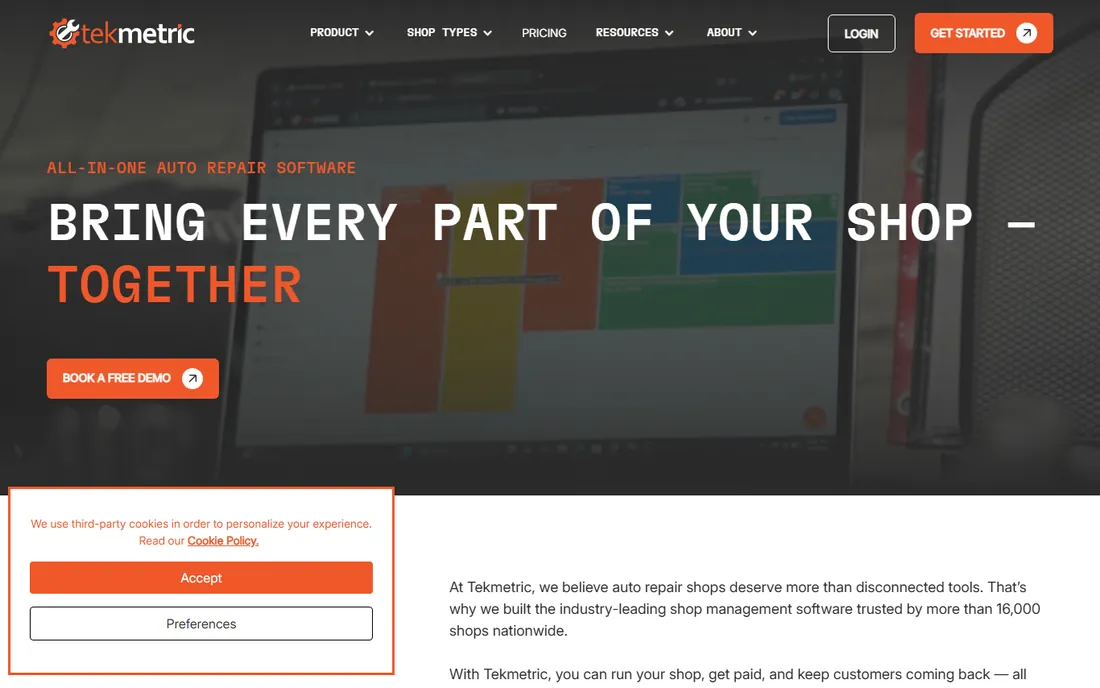
Tekmetric is the cloud shop management system most independent shops evaluate first. It runs the whole counter workflow: estimates, digital vehicle inspections with photos, work orders, parts ordering, labor tracking, payments and customer messaging, with the financials flowing to QuickBooks Online rather than living in a separate accounting module. The reporting is the reason shops stay: gross profit per work order, technician efficiency, parts margin and labor rate analytics that paper shops never had.
The buying process is a demo and a quote, standard for this category. Tekmetric suits shops that want modern customer-facing tooling (text updates, digital inspections, online payments) with the accounting handled in QuickBooks. Shops that want accounting inside the shop system itself should look at AutoFluent or RO Writer instead.
What we like- Cloud-native with digital vehicle inspections and texting built in
- QuickBooks Online integration pushes shop financials to the ledger
- Strong reporting on technician efficiency, parts margins and labor
Watch out for- Quote-based pricing with no public tiers
- The feature depth means a real onboarding effort, not a weekend setup
#2
Shopmonkey
Best for: Shops wanting payments, inspections and accounting in one login
Visit shopmonkey.io
Starting priceSee website (quote-based)
Free planNo (demo available)
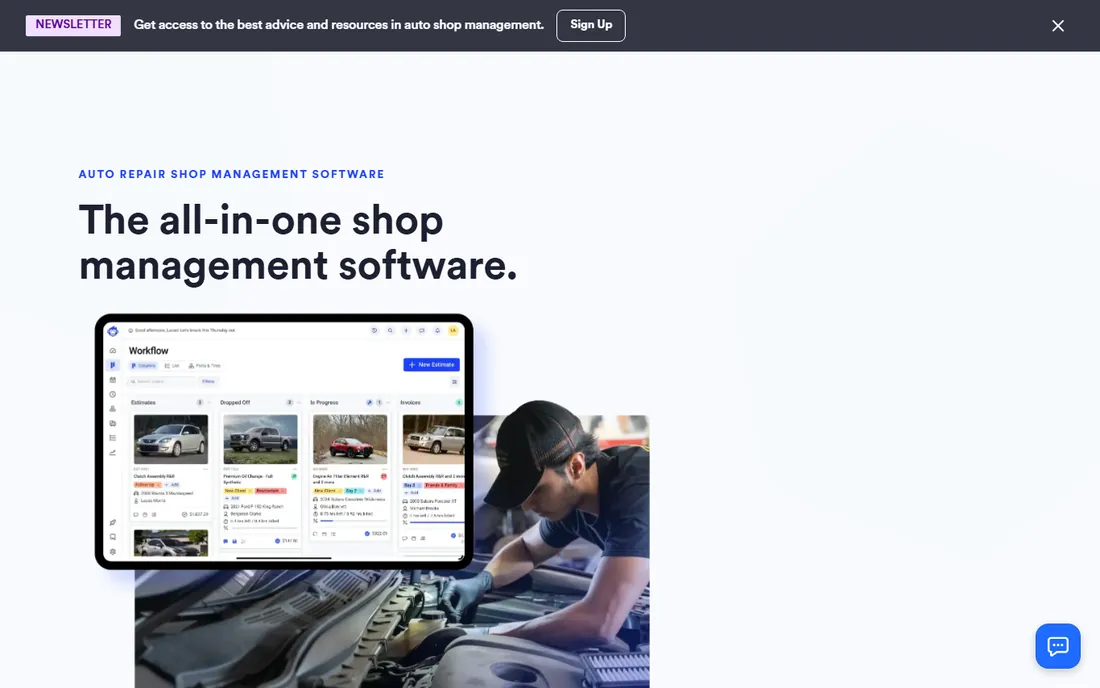
Shopmonkey positions itself as the operating system for the shop: estimates, work orders, digital inspections, parts, labor, inventory, customer communications and integrated payments in one cloud login, with QuickBooks sync handling the books. For a shop owner, the appeal is fewer vendors: the same system that writes the estimate takes the payment and sends the numbers to accounting.
The trade is the payments bundle. Integrated processing is convenient, but compare the processing rates against your current merchant account; convenience has a price per transaction. On the accounting side, the model is sync-to-QuickBooks, so your bookkeeper still works in QBO. Demo it with a real repair order from your shop, not the vendor's sample data.
What we like- All-in-one workflow from estimate to payment including built-in payment processing
- QuickBooks integration for the accounting side
- Well-regarded ease of use for service advisors
Watch out for- Quote-based pricing
- Payment processing ties you to their rates unless you negotiate
#3
Shop-Ware
Best for: Shops wanting cloud-native workflow plus accounting links
Visit shop-ware.com
Starting priceSee website (quote-based)
Free planNo (demo available)

Shop-Ware is the cloud-native challenger: no on-premise server, advisors working from tablets, digital inspections with customer approvals by text, and parts and labor flowing through work orders to the invoice. Accounting connects through integrations with QuickBooks and Xero rather than a built-in ledger, which keeps the shop system focused on the counter.
For a shop choosing between the cloud options, the comparison with Tekmetric and Shopmonkey comes down to workflow preference: run the same estimate-to-invoice process in each demo and see which one your advisors fight less. Pricing is quote-based across all three, so the decision is fit, not price. Shops with unreliable internet should ask hard questions about offline behavior before committing to any cloud system.
What we like- True cloud architecture with no server in the shop
- Clean advisor workflow with digital inspections and approvals
- Integrations with QuickBooks and Xero for accounting
Watch out for- Quote-only pricing
- Younger and smaller than Mitchell1 or RO Writer, so the ecosystem is thinner
Starting priceSee website (quote-based)
Free planNo (demo available)
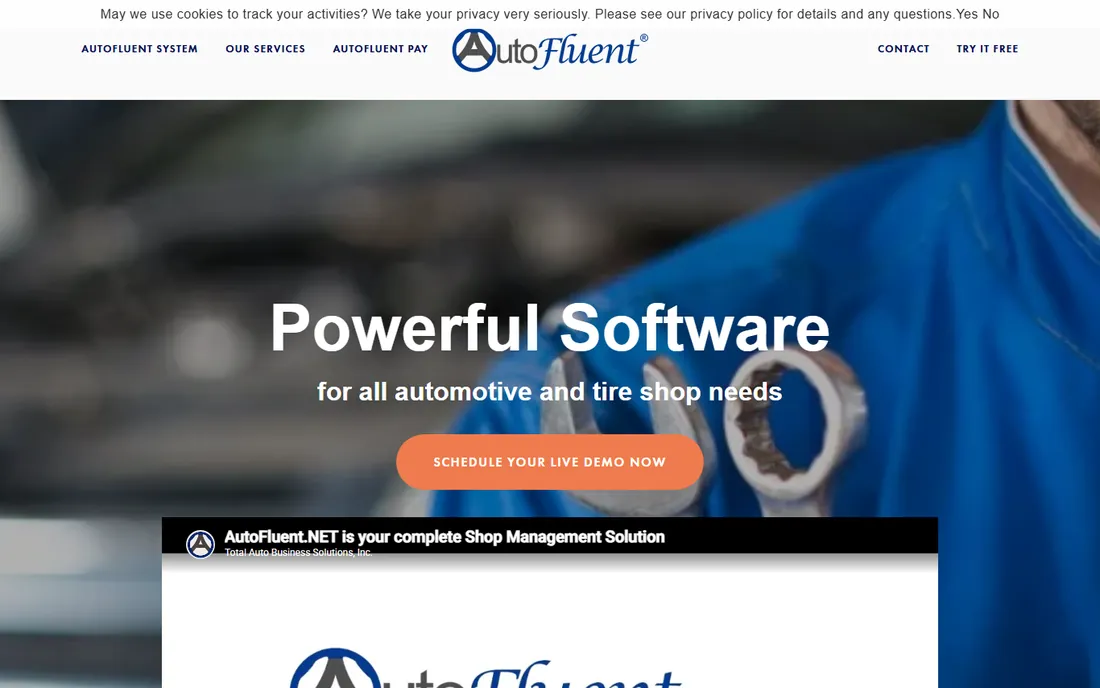
AutoFluent (by Total Auto Business Solutions) is the specialist: shop management plus point-of-sale plus inventory plus accounting built for tire dealers and auto service centers, with features the generalists do not have. Tire fitment data, vendor catalog integration, automated reordering from distributors (TireVault), and wholesale e-commerce are native, and the accounting module means the books can live in the same system as the work orders. A QuickBooks Online integration exists for shops whose accountants insist on QBO.
The honest assessment: this is a deep, mature product with an interface that shows its age next to Tekmetric or Shopmonkey. Tire dealers consistently choose it for the tire-specific depth; general repair shops tend to prefer the modern cloud tools. If tires are a major profit center, the fitment and ordering features outweigh the interface. Pricing is quote-based.
What we like- Built-in accounting and inventory designed for tire and auto service, not synced from elsewhere
- Deep tire-specific features (fitment, TireVault ordering, vendor catalogs)
- QuickBooks Online integration for shops that still want QBO
Watch out for- Interface reflects its long history more than modern cloud tools
- Pricing through the vendor
Starting priceSee website (quote-based)
Free planNo (demo available)
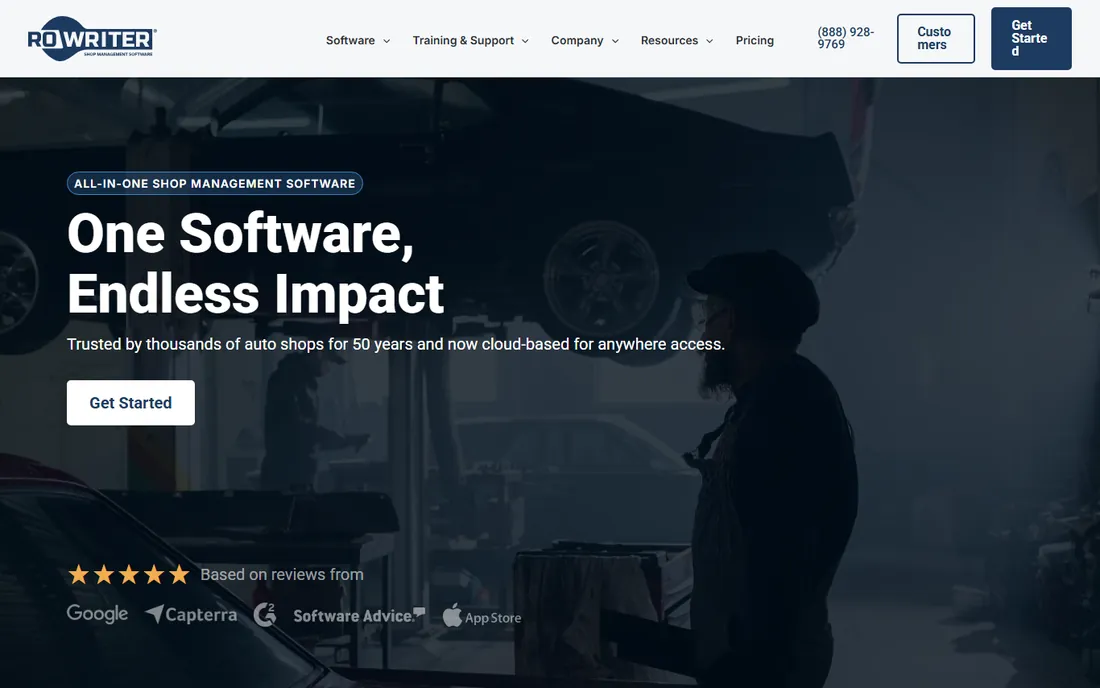
RO Writer (now part of Constellation Software's Perseus Group) is the veteran of franchise and multi-shop operations. It combines point-of-sale, work order management, the Smart eCat electronic parts catalog, inventory, customer communications and accounting-oriented reporting in one system, with multi-location visibility for owners running several stores. Its history with Midas franchisees means the workflows assume standardized, repeatable operations.
Independent single shops sometimes find it heavier than the cloud-native tools, while multi-location owners value the consolidated reporting. The accounting story is built-in rather than synced: the shop's financials live in RO Writer, with exports for the accountant. Evaluate it against your growth plan: one shop today and five tomorrow argues for RO Writer; one shop forever argues for Tekmetric or Shopmonkey.
What we like- Long-established in franchise operations (notably Midas) with multi-location management
- Smart eCat parts catalog with fast pricing lookups
- Integrated accounting and payroll-adjacent reporting for the shop
Watch out for- Quote-based pricing
- The product's franchise heritage shows in workflows tuned for standardized operations
#6
Mitchell1 Manager SE
Best for: Shops wanting repair-data depth with accounting links
Visit mitchell1.com
Starting priceSee website (quote-based)
Free planNo (demo available)

Mitchell1's advantage is data: the same company behind ProDemand repair information builds Manager SE, so labor times, parts information and service schedules flow into estimates with unusual depth. The shop management side covers work orders, estimating, inventory, customer history and marketing, with QuickBooks integration moving financials to the ledger.
The evaluation trap is the product family: Mitchell1 sells several products, and Manager SE is the shop management suite you want for this comparison. Its strength is the repair-data integration; its weakness versus the cloud-native tools is interface modernity. Shops whose estimators live in ProDemand already will feel at home. Pricing is quote-based with demos.
What we like- Backed by Mitchell1's repair information empire (ProDemand data integrates naturally)
- Mature shop management with estimating, work orders and inventory
- Accounting integration with QuickBooks
Watch out for- Quote-based pricing
- The product family is broad, so make sure you are evaluating Manager SE specifically
Starting price$38/month (Simple Start)
Free planFree trial (30 days)
QuickBooks Online is the accounting half of the standard shop stack: Tekmetric, Shopmonkey, Shop-Ware, AutoFluent and Mitchell1 all integrate with it, pushing invoices, payments, parts purchases and payroll-adjacent data into the ledger your accountant expects. Pricing is $38/month (Simple Start) to $85 (Essentials), $140 (Plus) and $340 (Advanced), with a 30-day trial.
For a shop, the plan decision hinges on parts inventory: Plus adds inventory tracking that Simple Start and Essentials lack, and a shop carrying significant parts stock usually needs it. But do not buy QuickBooks expecting it to run the counter; without a shop management system feeding it, you are back to spreadsheets for work orders. The stack is shop system plus QBO, not QBO alone.
What we like- The ledger nearly every shop system syncs to and nearly every bookkeeper knows
- Plus plan ($140/month) adds inventory tracking useful for parts
- Massive app ecosystem
Watch out for- Knows nothing about work orders, labor hours or parts fitment on its own
- Per-plan user limits where Xero includes unlimited users
#8
Xero
Best for: Multi-user shops that dislike per-seat fees
Visit xero.com
Starting price$27/month (Early)
Free planFree trial

Xero is the alternative ledger, and its case for shops is the user model: unlimited users on every plan means the whole counter staff can have appropriate access without per-seat math. US pricing is $27/month (Early), $59 (Growing) and $97 (Established) after the October 2026 increase. Shop-Ware integrates with Xero natively; other shop systems center on QuickBooks, so verify your chosen shop system's Xero support before committing.
The practical barrier is the accountant network: fewer US bookkeepers work in Xero than QuickBooks, though ecommerce and multi-entity accountants often prefer it. If your bookkeeper is Xero-native and your shop system supports the sync, the unlimited-user math beats QuickBooks for any shop with more than a couple of people touching the books. If your accountant only speaks QuickBooks, do not make them learn Xero for your sake.
What we like- Unlimited users on every plan: owner, advisors, bookkeeper and accountant in one file
- Clean bank reconciliation for matching deposits
- Shop-Ware and others integrate with it
Watch out for- Smaller US accountant network than QuickBooks
- Early plan caps (20 invoices, 5 bills) push active shops to Growing at $59/month
What shop accounting actually needs
Forget the general ledger feature list. A repair shop's accounting needs are five specific things. First, work orders that become invoices without retyping: the estimate, the authorized work, the parts used and the labor hours should flow to the invoice automatically. Second, parts tracking: what was ordered, what arrived, what went onto which job, and what it cost versus what it billed. Third, labor accounting: billed hours per technician, efficiency (billed versus clocked), and labor gross profit. Fourth, payments and receivables: deposits, completed-job payments, fleet accounts and aging. Fifth, a clean handoff to the real books: either built-in accounting (AutoFluent, RO Writer) or a reliable sync to QuickBooks or Xero (everyone else).
When you demo, bring one real repair order and run it end to end: estimate, authorization, parts ordering, technician clock-in, completion, invoice, payment. The tool that handles your actual workflow with the fewest workarounds wins. Then check the month-end: can the owner see gross profit per work order, parts margin and labor efficiency without exporting to Excel? That report is the accounting feature that matters most.
QuickBooks sync vs built-in ledgers
The architectural split on this list deserves a direct comparison. Tekmetric, Shopmonkey, Shop-Ware and Mitchell1 sync to QuickBooks (Shop-Ware also to Xero): the shop system runs operations, the ledger holds the official books, and your accountant works where they always have. The advantage is familiarity and a deep accountant network; the risk is the sync itself, which needs monitoring when mappings break or duplicates appear.
AutoFluent and RO Writer keep accounting inside the shop system: one database, one vendor, no sync to break. The advantage is simplicity and data that always agrees with itself; the risk is accountant acceptance, since fewer bookkeepers work inside shop systems than in QuickBooks. The deciding question is who does your books: if the answer is an outside bookkeeper or CPA firm, the QuickBooks-sync architecture causes fewer fights. If the books stay in-house with shop staff, a built-in ledger removes a subscription and a failure point.
How we chose
We started with the searches shop owners run: accounting software for auto repair shop, auto repair shop management software, and shop management software with QuickBooks integration. We kept tools in two groups: shop management systems with real accounting capability (built-in or synced), and the general ledgers those systems connect to. We excluded generic accounting software with no shop features and pure point-of-sale tools with no accounting story. For each tool we verified the current vendor site and product name, checked pricing against vendor-published pages, and compared the work-order-to-ledger workflow. Where pricing was quote-based we wrote "See website".
Frequently asked questions
What is the best accounting software for a small auto repair shop?
Most independent shops do best with a cloud shop management system (Tekmetric, Shopmonkey or Shop-Ware) synced to QuickBooks Online. The shop system runs work orders, parts and labor; QuickBooks holds the official books. Tire-focused shops should evaluate AutoFluent; franchises and multi-location owners should look at RO Writer.
How much does auto repair shop software cost?
The shop management systems on this list are all quote-based, so pricing depends on bays, users and locations; expect a demo and a sales conversation. The ledger side is published: QuickBooks Online $38 to $340/month, Xero $27 to $97/month. Budget for both the shop system and the ledger.
Do I need QuickBooks if my shop software has accounting built in?
Not necessarily. AutoFluent and RO Writer include accounting, so the books can live in the shop system. The reason shops keep QuickBooks anyway is the accountant: most bookkeepers and CPA firms work in QuickBooks, and handing them a QBO file is simpler than training them on shop software. Ask your accountant before dropping it.
Can shop management software track parts inventory?
Yes, all six shop systems on this list track parts: ordering, receiving, stock levels and cost versus billed price per job. AutoFluent goes deepest for tire dealers with fitment data and distributor ordering. If parts inventory is also tracked in QuickBooks Plus, decide which system is the source of truth to avoid double counting.
What is the difference between Tekmetric, Shopmonkey and Shop-Ware?
All three are cloud shop management systems with QuickBooks sync. Tekmetric leads on reporting and technician analytics; Shopmonkey bundles payments and emphasizes ease of use; Shop-Ware emphasizes cloud-native architecture and also integrates with Xero. The differences are workflow feel, not feature checklists, so demo all three with a real repair order.
How long does it take to switch shop management software?
Longer than the demo suggests. Data migration (customers, vehicles, history, inventory), advisor training, and changing customer-facing processes (texting, digital inspections, payments) typically take weeks, not days. Plan the switch for a slower period, run the old system in parallel briefly, and train advisors before go-live, not after.
Sources we checked (8)
- https://www.tekmetric.com/
- https://www.shopmonkey.io/
- https://shop-ware.com/
- https://autorepairsoftware.com/
- https://info.rowriter.com/
- https://mitchell1.com/
- https://quickbooks.intuit.com/
- https://www.xero.com/us/
Is your product missing or out of date?
We review this list regularly. Vendors can request a listing, send updated pricing or ask about featured placement.

Shihab Mia · Founder, Rankite
Shihab has spent more than a decade helping SaaS and e-commerce brands grow through search. He writes Rankite's software buying guides from pricing pages, documentation and public user reviews. More about Shihab.