How we make this list: we compare pricing pages, product documentation and public user reviews. Ratings come from G2, Capterra or Trustpilot, with the date we checked them.

Key takeaways
- Most 3PL pricing is custom quote, so the per-order number on paper rarely matches the final bill once storage and surcharges are added.
- ShipBob suits lightweight direct-to-consumer brands that need national two-day coverage, while ShipMonk suits startups and subscription boxes.
- Red Stag is the pick for heavy, bulky or high-value items, with an accuracy guarantee that other providers do not match.
- Expect an all-in cost near $3 to $6 per order for standard products, plus storage and receiving, based on 2026 comparison guides.
- Always model both providers against your real order mix before signing, since postage markups and storage rates change the winner.
Quick comparison
| Tool | Best for | Starting price | Free plan |
|---|
 ShipBob | Lightweight DTC and Shopify brands | See website (custom quote) | No |
 ShipMonk | Startups and subscription boxes | $250 per month minimum | No |
 Red Stag Fulfillment | Heavy, bulky and high-value items | See website (custom quote) | No |
 Stord | Tech-first DTC and omnichannel brands | See website (custom quote) | No |
 Flexport | Importers wanting freight plus fulfillment | $5,000 per month minimum fulfillment spend | No |
 Easyship | International and multi-carrier shipping | See website | No |
 Simpl Fulfillment | Founder-led brands past self-fulfillment | $7 per order (pick, packaging and postage included) | No |
 Fulfillment by Amazon | Amazon-first sellers | See website (per-unit fulfillment plus storage fees) | No |
Is your product missing or out of date?
We review this list regularly. Vendors can request a listing, send updated pricing or ask about featured placement.
The best 3PL companies
#1ShipBob
Best for: Lightweight DTC and Shopify brands3.7/5 on
G2 (122 reviews, checked Oct 2026)
Visit shipbob.com
Starting priceSee website (custom quote)
Free planNo
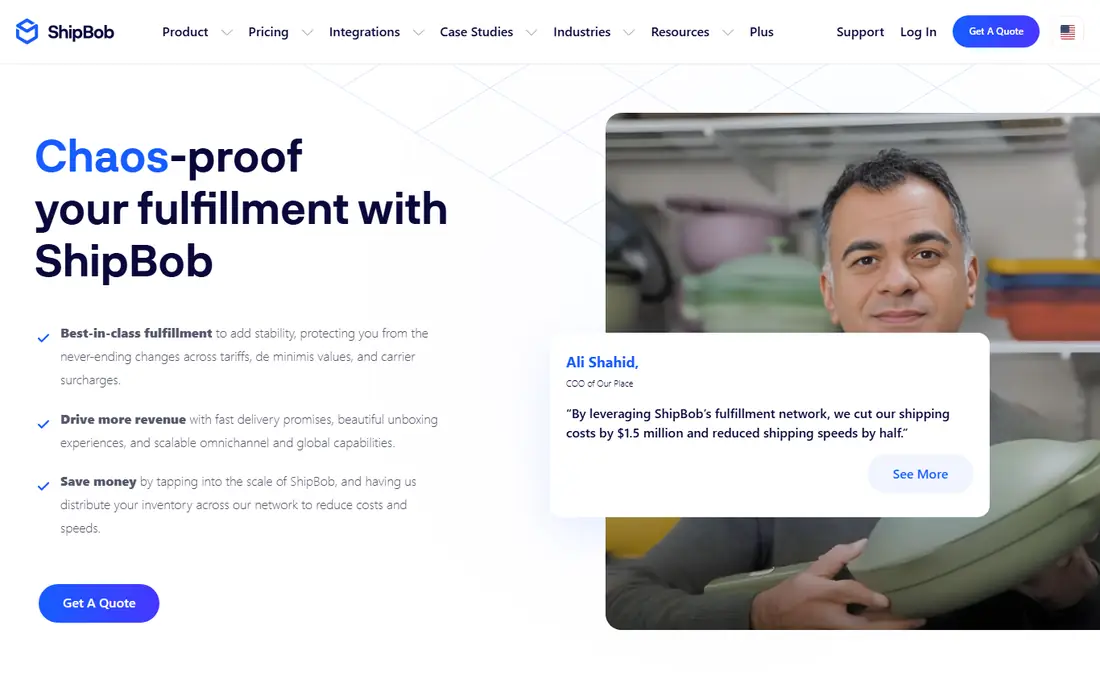
ShipBob is the default shortlist pick for lightweight direct-to-consumer brands. Its network covers 20 or more US warehouses plus international sites, which lets brands place inventory near customers for two-day delivery. Software is a real strength: inventory, orders and tracking sync with Shopify, BigCommerce and major marketplaces.
Pricing is itemized and quote-based, with receiving, storage and fulfillment billed separately, and comparison guides report a postage markup in the 15 to 30 percent range. That means ship-heavy brands should model ShipBob against rivals using real order data, not headline rates. Implementation also carries a fee starting near $975 in published comparisons. For brands that value software and national reach, ShipBob remains hard to beat.
What we like- Wide warehouse network
- Strong Shopify integration
- Two-day national coverage
Watch out for- Itemized pricing can surprise
- Postage markup reported at 15 to 30 percent
Starting price$250 per month minimum
Free planNo
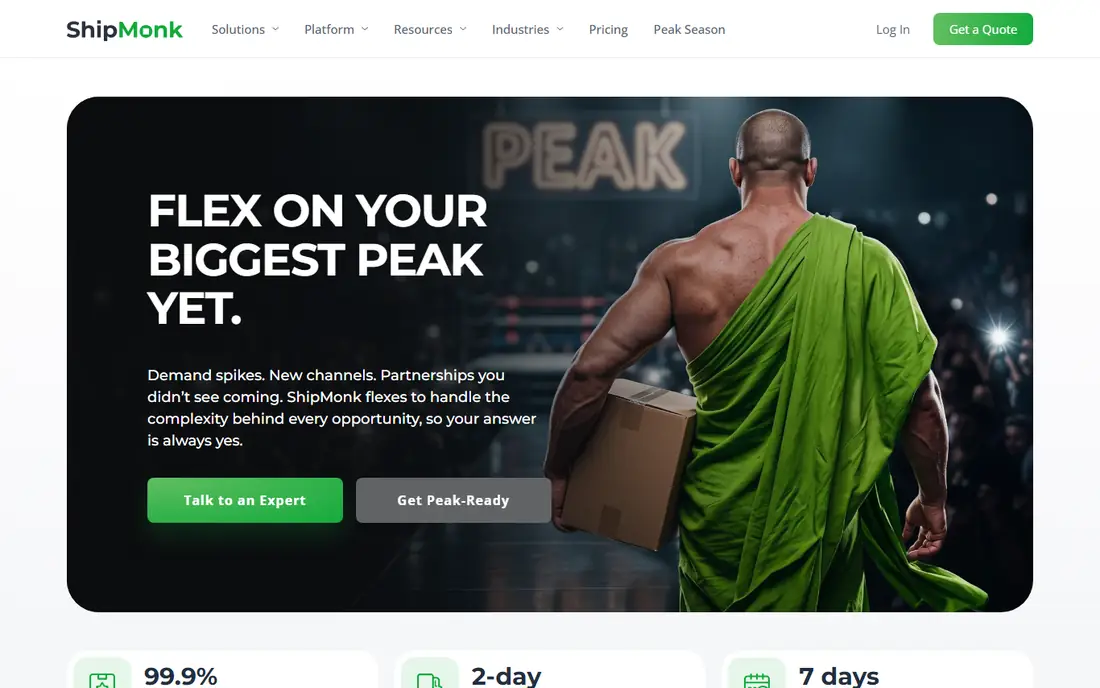
ShipMonk owns its fulfillment centers across the US, Canada, Mexico, the UK and Czech Republic, giving it direct control over operations. It charges no setup fee, inbound receiving is free when shipment guidelines are met, and storage runs near $25 per pallet per month. Pick and pack starts near $2.50 for the first item plus $0.50 per additional item, which favors single-item or small-basket orders.
Kitting and batch workflows are a standout, which is why subscription box brands favor ShipMonk. Public reviews are polarized, with billing errors and slow exits mentioned in negative reports, so read the contract on exit terms and billing disputes before signing. For startups and subscription brands, the low minimum and kitting strength make ShipMonk a strong first call.
What we like- Low minimums
- No setup fee
- Strong kitting and bundling workflows
Watch out for- Billing complaints appear in reviews
- Exits can be slow
Starting priceSee website (custom quote)
Free planNo
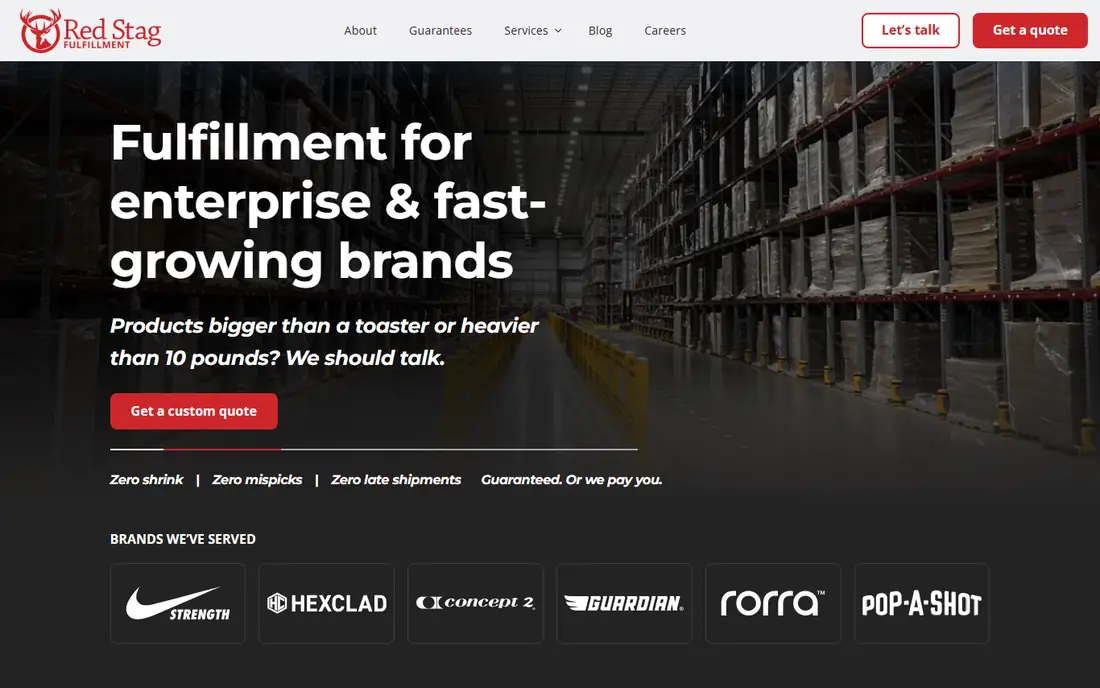
Red Stag focuses on products most 3PLs dislike: heavy, bulky or high-value goods weighing 5 pounds or more. Its warehouses in Tennessee and Utah are set up for oversized handling, and it backs shipments with an inventory accuracy guarantee that few rivals offer. Brands selling furniture, fitness equipment or expensive electronics get handling matched to the product.
The network is small, with two US sites, so lightweight brands chasing the fastest national delivery may prefer ShipBob or Stord. Pricing is custom and volume-based. For heavy or valuable catalogs, Red Stag accuracy and handling usually matter more than node count.
What we like- Accuracy guarantee
- Built for items over 5 pounds
- Careful handling
Watch out for- Only two US warehouses
- Less suited to lightweight high-volume DTC
Starting priceSee website (custom quote)
Free planNo
Stord sells a connected suite covering warehousing, inventory, order management and transport, aimed at tech-first brands selling across channels. Its US network plus EU and UK nodes suits brands expanding internationally without managing separate providers per region. Amazon FBA prep is available within the broader suite.
Pricing is custom by volume and service mix, with no published per-order rate, so small brands cannot easily compare it without a sales conversation. Brands past the startup stage that want one system across channels get the most from Stord. Early-stage sellers may find ShipMonk or Simpl easier to start with.
What we like- Modern software suite
- Omnichannel coverage
- US plus EU and UK nodes
Watch out for- Quote-only pricing
- Less proven for very small brands
Starting price$5,000 per month minimum fulfillment spend
Free planNo
Flexport combines freight forwarding with fulfillment, which suits importers that want ocean or air freight and US warehousing from one provider. Its network came partly through the Deliverr acquisition, and Flexport Prep covers Amazon FBA needs. For brands importing containers and selling across channels, one throat to choke has real appeal.
The $5,000 monthly minimum fulfillment spend since January 2026 puts Flexport out of reach for small brands. Domestic-only sellers also gain little from the freight side. Importers at scale, or brands planning to become importers, should shortlist Flexport beside Stord.
What we like- Freight and fulfillment under one provider
- FBA prep available
- Global reach
Watch out for- High minimum spend
- Overkill for domestic-only brands
#6Easyship
Best for: International and multi-carrier shipping4.4/5 on
G2 (182 reviews, checked Oct 2026)
Visit easyship.com
Starting priceSee website
Free planNo
Easyship is strongest for international and multi-carrier shipping, letting sellers compare carrier rates and manage cross-border duties and taxes in one dashboard. Its global fulfillment network suits brands selling into many countries without building local warehouses. For a store whose main problem is expensive or confusing international shipping, Easyship addresses the exact pain.
It is less of a traditional full-service 3PL than ShipBob or ShipMonk, and fulfillment depth varies by partner location. Brands that need heavy kitting, custom packaging or dedicated account teams should check what the assigned site actually offers. Cross-border sellers should still put Easyship on the shortlist.
What we like- Multi-carrier rate shopping
- Global network
- Good for cross-border sellers
Watch out for- Less of a full-service 3PL
- Fulfillment depth varies by partner site
Starting price$7 per order (pick, packaging and postage included)
Free planNo
Simpl offers flat-rate pricing starting at $7 per order, covering three picks, postage and packaging, with storage billed by space used. That simplicity appeals to founder-led brands tired of itemized bills. Orders received before noon Central ship the same day in nearly all cases, and Simpl charges no Q4 surcharge and no peak markups.
The trade-offs are a single Austin warehouse, which limits two-day reach compared with multi-node networks, and a $750 monthly account minimum billed pay-the-difference. Brands shipping nationwide from one node should test delivery times to far zones. For brands past self-fulfillment that want predictable costs, Simpl is a compelling option.
What we like- Flat-rate pricing
- Same-day shipping cutoff
- No peak surcharges
Watch out for- Single Austin warehouse
- $750 per month account minimum
Starting priceSee website (per-unit fulfillment plus storage fees)
Free planNo
Fulfillment by Amazon, or FBA, stores products in Amazon warehouses and handles picking, packing, shipping and customer service for Amazon orders. The prize is Prime eligibility and access to Amazon built-in traffic, which can lift conversion sharply for Amazon-first sellers. The network is vast, and multi-channel fulfillment can also serve orders from other channels.
Control is the cost. Packaging, inserts and the unboxing experience follow Amazon rules, and the business depends on Amazon policies and fees, including storage fees that rise in peak season. Brands selling mainly on their own site should prefer ShipBob or ShipMonk. Brands whose sales live on Amazon should treat FBA as the default.
What we like- Prime eligibility
- Built-in Amazon traffic
- Huge warehouse network
Watch out for- Amazon-centric
- Less control over packaging and customer experience
How we chose
We compared 2026 comparison guides, provider pricing pages and public reviews for each company, favoring providers with a clear specialty rather than a generic promise. Published per-order rates are rare in this industry, so where a provider quotes only custom pricing we wrote See website instead of inventing a number. We weighed warehouse footprint, minimums, onboarding, integrations, specialty handling and contract terms, and we left out providers that duplicate another entry without a distinct strength.
Questions to ask before you sign
Ask for a full landed-cost quote on your real order mix: receiving, storage by unit type, pick and pack per item count, packaging materials, postage with any markup, returns handling and special project rates. Get the monthly minimum in writing, including whether it is pay-the-difference or a hard spend, and ask what happens in months below it.
Check the exit terms with the same care. Ask how long an exit takes, what data and inventory reports you receive, and whether billing continues during the transition, since slow exits appear in negative reviews for several providers. Visit or video-tour the warehouse that will actually hold your stock, confirm cutoffs for same-day shipping, and test the software integration with a small batch before moving full inventory.
Contract terms that matter most
Confirm who pays for misshipments and lost stock, and whether accuracy guarantees carry credits. Ask how storage is measured across the year, since a pallet rate that looks cheap in January can grow quickly when holiday inventory builds up in autumn. Clarify storage billing units, since pallet, shelf and bin rates differ widely, and ask about peak-season surcharges. Finally, confirm support coverage: a named contact beats a ticket queue when a launch-day shipment goes wrong.
Frequently asked questions
How much does a 3PL cost per order?
For standard products, 2026 guides put all-in cost near $3 to $6 per order plus storage and receiving, but the real figure depends on weight, item count, packaging and shipping zones. Always request a quote modeled on your actual orders.
Do 3PLs have minimum order volumes?
Many do. ShipMonk lists a $250 monthly minimum, Simpl lists $750, and Flexport lists $5,000 in monthly fulfillment spend. Others set minimums during the sales process based on volume, so ask early.
Is ShipBob or ShipMonk cheaper?
It depends on the order mix. ShipMonk usually wins on storage and setup, while ShipBob wins on software and national two-day reach. Ship-heavy, low-storage brands often come out ahead with ShipMonk once postage markups are weighed.
Can a 3PL handle Amazon FBA prep?
Yes, several here offer it, including ShipBob, ShipMonk, Stord and Flexport. Confirm prep requirements, labeling and turnaround with the specific warehouse before committing.
How long does onboarding take?
Timelines vary from days to weeks. Simpl advertises 5 to 7 days with no onboarding fee, while ShipBob charges an implementation fee and other providers set timelines during sales. Ask for a written onboarding plan with dates.
Should a small brand use a 3PL at all?
If packing boxes eats time better spent on product and marketing, or if shipping speed is losing sales, a 3PL pays for itself. Brands under a few dozen orders a month may still do better self-fulfilling until volume grows.
Sources we checked (8)
- https://warehousingcosts.com/guides/best-3pl-companies
- https://amzprep.com/best-3pl-ecommerce/
- https://www.simplfulfillment.com/best-3pl-for-small-business
- https://www.shipbob.com/pricing/
- https://www.shipmonk.com/pricing
- https://redstagfulfillment.com
- https://www.stord.com
- https://www.flexport.com
Is your product missing or out of date?
We review this list regularly. Vendors can request a listing, send updated pricing or ask about featured placement.

Shihab Mia · Founder, Rankite
Shihab has 5+ years in B2B and SaaS SEO. He writes Rankite's software buying guides from pricing pages, documentation and public user reviews. More about Shihab.