How we make this list: we compare pricing pages, product documentation and public user reviews. Ratings come from G2, Capterra or Trustpilot, with the date we checked them.
Key takeaways
- GitBook is the closest Archbee replacement for product docs, with Git sync, drift detection, and an AI assistant for readers.
- Mintlify leads for developer docs that must serve AI agents as well as humans, with self-updating content and strong scale.
- Confluence and Notion fit internal knowledge bases, while ReadMe specializes in API documentation with interactive references.
- Docusaurus is the free open-source option for teams comfortable hosting docs from Markdown and React.
- Every vendor now pitches agent-ready docs, so verify that AI answers stay grounded in verified, current content before relying on them.
Quick comparison
| Tool | Best for | Starting price | Free plan |
|---|
 GitBook | Product documentation | See website | See website |
 Confluence | Internal knowledge base | See website | See website |
 Docusaurus | Open-source docs sites | Free | Yes |
 ReadMe | API documentation | See website | See website |
 Notion | Team workspace | See website | Yes |
 Slite | Self-maintaining knowledge base | See website | See website |
 Document360 | Customer knowledge base | See website | See website |
 Mintlify | Agent-ready developer docs | See website | See website |
Is your product missing or out of date?
We review this list regularly. Vendors can request a listing, send updated pricing or ask about featured placement.
The best Archbee alternatives
#1GitBook
Best for: Product documentation4.7/5 on
G2 (207 reviews, checked Oct 2026)
Visit gitbook.com
Starting priceSee website
Free planSee website
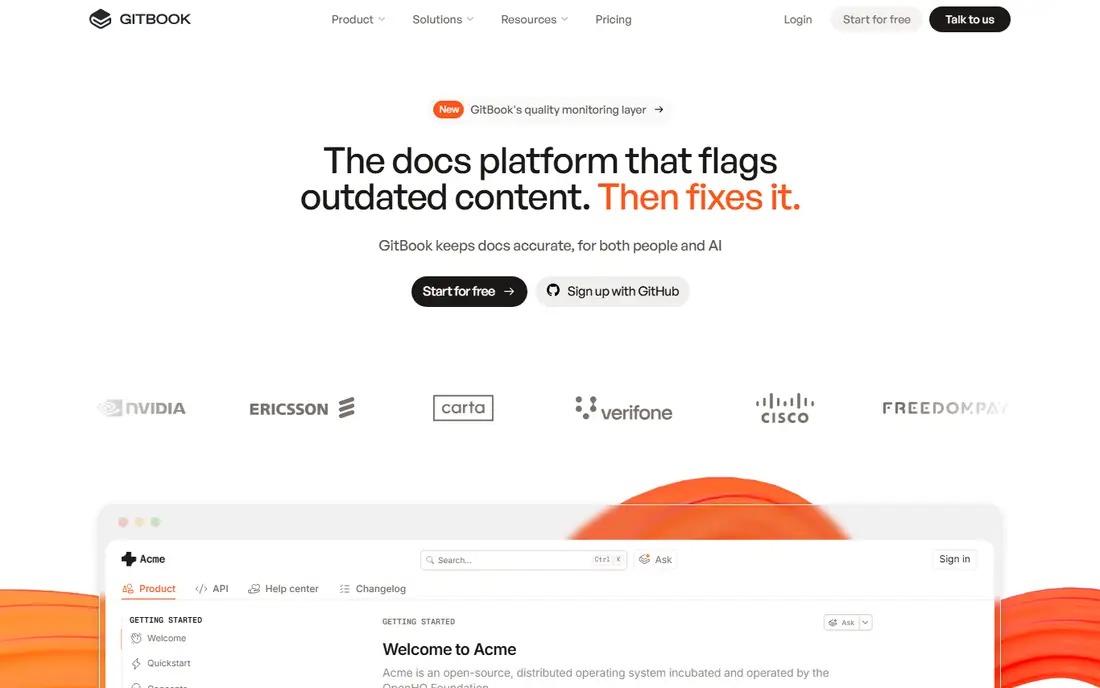
GitBook now calls itself the knowledge layer for AI, and its homepage explains why that matters: when your product changes, docs do not update automatically, and agents turn small docs errors into big problems. GitBook answers with Git sync, a drift scanner that queues outdated content for review, an AI assistant users can ask directly, and analytics showing where readers and agents get stuck.
For teams replacing Archbee, GitBook is the most direct match: polished public and private docs, strong versioning, and enterprise controls including SOC 2, ISO 27001, GDPR compliance, and SAML SSO. The main cost is pricing opacity for larger deployments, so get a quote once your seat and site counts are clear.
What we like- Git sync lets teams branch, review, and merge docs like code
- Drift detection flags content that no longer matches the product
- AI assistant answers from your docs
Watch out for- Pricing is quote-led for larger teams
- Enterprise features such as SSO and tiered permissions sit on higher tiers
#2Confluence
Best for: Internal knowledge base4.1/5 on
G2 (4,368 reviews, checked Oct 2026)
Visit atlassian.com
Starting priceSee website
Free planSee website
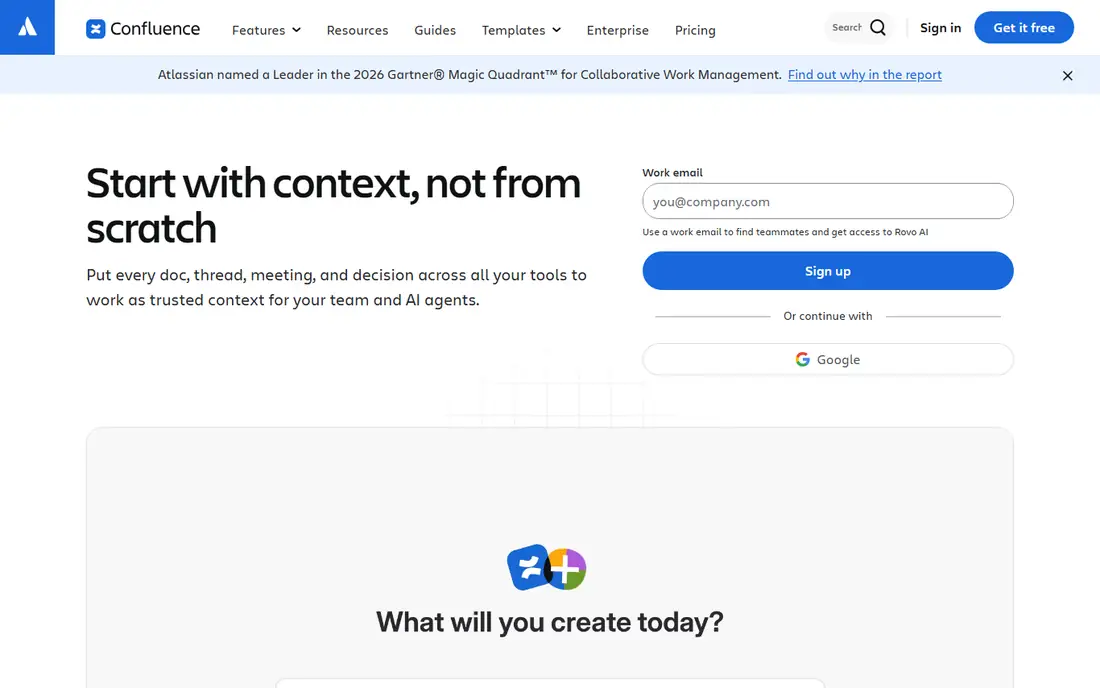
Confluence describes itself as the AI workspace that works with you, one place for ideas, docs, knowledge, and human plus AI teammates. Its homepage highlights Rovo AI for drafting, summarizing, and finding answers, content types from live docs to whiteboards and databases, and a Teamwork Graph linking teams, work, and goals.
If your Archbee use case was internal knowledge rather than public product docs, Confluence is the enterprise default, especially for Jira shops. For customer-facing documentation, its publishing and theming feel weaker than GitBook or Mintlify, so match the tool to the audience.
What we like- One workspace for ideas, docs, and knowledge with Rovo AI
- Live docs, whiteboards, databases, pages, videos, and slides
- Deep Jira integration
Watch out for- Public-facing docs are not its strength
- Atlassian ecosystem lock-in grows with usage
Starting priceFree
Free planYes
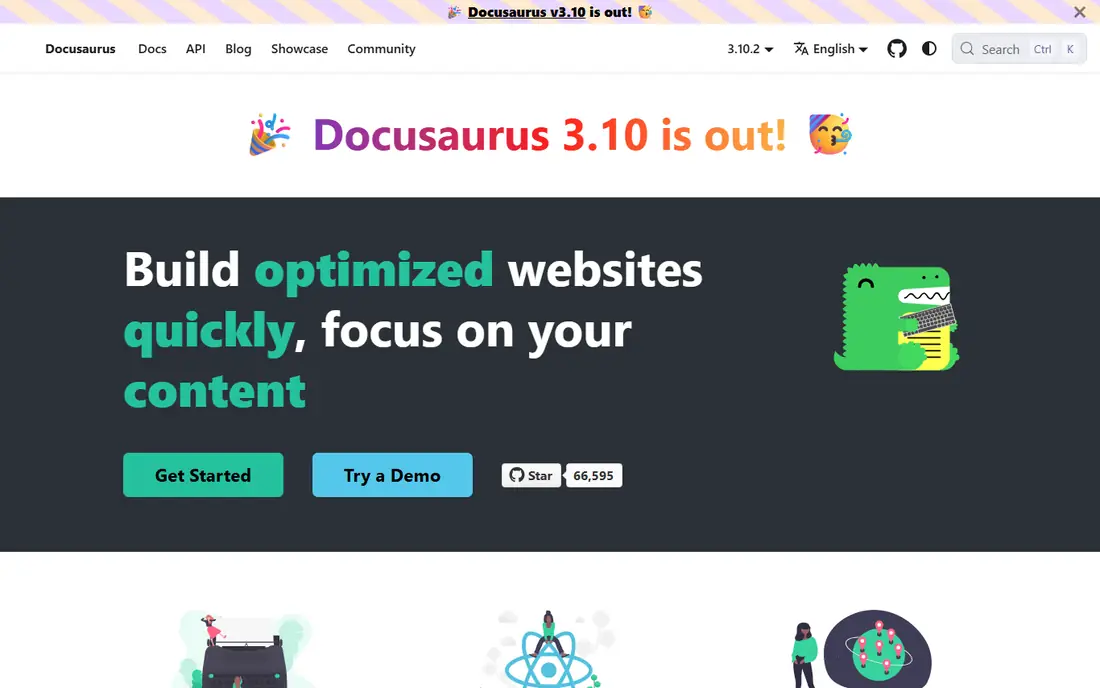
Docusaurus lets teams build optimized documentation websites quickly and focus on content, writing docs and blog posts in MDX that compile to static HTML. Its homepage lists the practical strengths: React-based customization, localization out of the box, document versioning tied to product releases, and content search powered by Algolia.
For engineering teams that already live in Git, Docusaurus is the free, durable choice, and its showcase includes major open-source projects. The trade-off is ownership: hosting, theming, search setup, and maintenance fall on your team, and non-technical writers will miss a hosted editor.
What we like- Fully open source and free
- Write docs in MDX with React components
- Built-in versioning, localization, and Algolia search
Watch out for- Self-hosted and developer-operated
- No hosted editor or built-in analytics for non-technical teams
#4ReadMe
Best for: API documentation4.5/5 on
G2 (46 reviews, checked Oct 2026)
Visit readme.com
Starting priceSee website
Free planSee website
ReadMe builds documentation for agents as well as developers, and its homepage shows the full stack: a WYSIWYG editor, interactive API explorers from OpenAPI specs, reusable content components, an AI linter enforcing style guides, and an AI writer that drafts doc updates from pull requests onto review branches. It also offers an MCP server so agents can read and write docs from tools such as Claude Code and Cursor.
If your docs are primarily API references, ReadMe is the strongest choice here, with the best interactive explorer and developer experience tooling. For broader product guides and internal knowledge, GitBook or Document360 cover more ground.
What we like- Interactive API references generated from OpenAPI specs
- Bi-directional GitHub and GitLab sync
- AI writer drafts updates from pull requests
Watch out for- API-focused, so general product docs feel secondary
- Pricing scales with projects and enterprise features
#5Notion
Best for: Team workspace4.6/5 on
G2 (13,834 reviews, checked Oct 2026)
Visit notion.so
Starting priceSee website
Free planYes
Notion calls itself the AI workspace that works for you, and its homepage backs that with scale: 100 million users, over 50 percent of YC companies, and 62 percent of the Fortune 100. Its current pitch centers on AI agents that triage feedback, resolve tickets, and automate reporting, plus AI search that returns answers with citations across your apps.
For teams that already run on Notion, using it for docs keeps everything in one system of record at no extra cost, and its free tier makes starting easy. Dedicated docs platforms still beat it on public site design, versioning, and API reference features, so treat Notion as a workspace-first choice, not a docs-first one.
What we like- Huge adoption with 100 million users and a free tier
- AI search with citations and agents that automate busywork
- Flexible pages, databases, and wikis
Watch out for- Public docs publishing is basic compared with dedicated docs platforms
- Performance can lag on very large workspaces
Starting priceSee website
Free planSee website
Slite describes itself as the self-maintaining AI knowledge base, and its homepage explains the core loop: its agent watches your tools, spots when reality moves, drafts the fix, and routes it to the right expert for approval in seconds. Verified knowledge ranks first in search, every answer carries citations, and the same engine is exposed via MCP for Claude, ChatGPT, and Cursor.
For internal knowledge bases that go stale, Slite's maintenance model is genuinely different from static wikis, and its compliance story suits regulated teams. It is less suited to public product documentation, where GitBook and Mintlify lead, but for keeping internal truth current, it is a strong Archbee alternative.
What we like- AI agent detects knowledge drift across Slack, Linear, GitHub, and your codebase and drafts fixes for human approval
- Permission-aware cited search
- SOC 2, HIPAA, and GDPR with EU hosting
Watch out for- Smaller ecosystem than Confluence or Notion
- Public docs are not its focus
Starting priceSee website
Free planSee website
Document360 calls itself AI knowledge base software for documentation, built for teams creating smarter knowledge base experiences with AI at the core. Its homepage emphasizes fast migration, enterprise-grade security with SOC 2 and ISO 27001, and measurable outcomes, including customers reporting higher docs traffic and fewer support tickets.
For customer-facing knowledge bases and support portals, Document360 is a proven, well-reviewed choice with strong analytics for refining content strategy. Smaller teams may find its 100-plus features more than they need, but support-led organizations will use the depth.
What we like- 100-plus features for authoring, search, security, and self-service
- G2 Leader with 4.7 out of 5 from 1,400-plus reviews
- 60-plus integrations including Slack, Zendesk, and Salesforce
Watch out for- Feature breadth can overwhelm small teams
- AI and MCP readiness is newer than GitBook's or Mintlify's
#8Mintlify
Best for: Agent-ready developer docs4.6/5 on
G2 (19 reviews, checked Oct 2026)
Visit mintlify.com
Starting priceSee website
Free planSee website
Mintlify calls itself the documentation platform for agents, and its homepage leads with scale: self-updating documentation for startups, enterprises, and agents, with agent-native architecture, access controls, and integrations across your existing setup. Its customer quotes span Coinbase, Vercel, HubSpot, Zapier, and Axiom, with praise for speed, delight, and AI chat answer quality.
For developer docs that must serve both human readers and AI agents, Mintlify is the current leader, and its self-updating model reduces the maintenance burden that kills most docs sites. Internal knowledge teams should compare it with Slite or Confluence, but for public developer documentation, Mintlify is hard to beat.
What we like- Self-updating documentation platform built for the agent web
- 300 million-plus visitors and 2 billion-plus agents in the past year
- 99.99 percent uptime claimed
Watch out for- Developer-docs focus means internal wiki features are thinner
- Pricing is quote-led
How we chose
We compared documentation platforms on vendor homepages, weighing public docs quality, internal knowledge features, API reference support, versioning and Git workflows, AI and agent readiness, and hosting models. We favored platforms with live homepages and current offerings, and we included both hosted and open-source options because Archbee buyers range from startups to enterprises.
What to check before you commit
Start with your audience. Public product docs need polished publishing, search, and versioning, which GitBook and Mintlify do best. Internal knowledge needs maintenance and search, which Slite and Confluence prioritize. API docs need interactive references, which ReadMe does best. One tool rarely wins all three.
Next, test the AI story on your own content. Every vendor now claims agent-ready docs, but the quality gap shows in stale content handling: GitBook's drift detection and Slite's maintenance agent address the real problem, while others mostly add a chatbot. Ask each finalist how outdated content gets flagged and fixed, not just how it gets answered.
Finally, plan migration honestly. Docs migrations fail on links, redirects, and permissions more than on content. Check import tooling, redirect support, and access controls early, and pilot with one docs section before moving everything. Also confirm that search, analytics, and feedback channels survive the move, since readers rely on finding answers fast and reporting gaps when docs fall short. A short pilot with real readers will surface broken links and missing permissions before the full launch.
Frequently asked questions
What is the best Archbee alternative overall?
GitBook for product documentation and Mintlify for developer docs. For internal knowledge, Confluence or Slite lead, while ReadMe leads for API references. The best pick depends on whether your audience is customers, developers, or your own team.
Is there a free Archbee alternative?
Yes. Docusaurus is fully open source and free to self-host, and Notion offers a free tier. Both require more setup or compromise on docs-specific features compared with paid platforms, but both are viable starting points.
Which alternative is best for API documentation?
ReadMe, with interactive API explorers generated from OpenAPI specs, Git sync, and an AI writer that drafts updates from pull requests. Mintlify also serves API docs well, especially for agent consumption.
Can Confluence replace Archbee for public docs?
Partially. Confluence excels at internal knowledge but its public publishing and theming lag dedicated docs platforms. For customer-facing docs, choose GitBook, Mintlify, or Document360 instead.
Which tool keeps docs from going stale?
GitBook's drift detection and Slite's self-maintaining agent directly address stale docs by flagging or drafting fixes when products change. Both require human approval, which keeps accuracy under team control.
Do these tools support AI agents reading docs?
Yes, all of them now pitch agent readiness, with Mintlify, GitBook, ReadMe, and Slite offering MCP servers or agent-specific features. Verify that agent answers cite verified sources rather than generating plausible text.
Sources we checked (8)
- https://www.gitbook.com
- https://www.atlassian.com/software/confluence
- https://docusaurus.io
- https://readme.com
- https://www.notion.so
- https://slite.com
- https://www.document360.com
- https://mintlify.com
Is your product missing or out of date?
We review this list regularly. Vendors can request a listing, send updated pricing or ask about featured placement.

Shihab Mia · Founder, Rankite
Shihab has 5+ years in B2B and SaaS SEO. He writes Rankite's software buying guides from pricing pages, documentation and public user reviews. More about Shihab.