How we make this list: we compare pricing pages, product documentation and public user reviews. Ratings come from G2, Capterra or Trustpilot, with the date we checked them.
Key takeaways
- Hiring in-house gives the most control but the slowest start and the highest fixed cost, so it suits companies with steady, long-term product work.
- Toptal, Turing, and Andela offer vetted engineers faster than traditional hiring, with different screening depth and pricing models.
- Upwork works for small, well-defined projects, but it needs strong project management from your side.
- Thoughtworks and DevSquad suit companies that want a full team or a consultancy rather than individual hires.
- OutSystems and other low-code tools let non-developers ship simple apps, but they fit a narrower range of products than custom code.
Quick comparison
| Tool | Best for | Starting price | Free plan |
|---|
 In-house hiring | companies with steady, long-term product work | See website | No |
 Toptal | senior freelancers for critical work | See website | No |
 Turing | scaling remote engineering teams | See website | No |
 Upwork | small, well-defined projects | See website | Yes |
 Andela | vetted global engineers for product teams | See website | No |
 Thoughtworks | consultancy-led delivery and transformation | See website | No |
 DevSquad | startups that want a full product team | See website | No |
 OutSystems | building apps fast with low-code tools | See website | Yes |
Is your product missing or out of date?
We review this list regularly. Vendors can request a listing, send updated pricing or ask about featured placement.
The best alternatives to nearshore software development outsourcing
#1
In-house hiring
Best for: companies with steady, long-term product work
Visit linkedin.com
Starting priceSee website
Free planNo
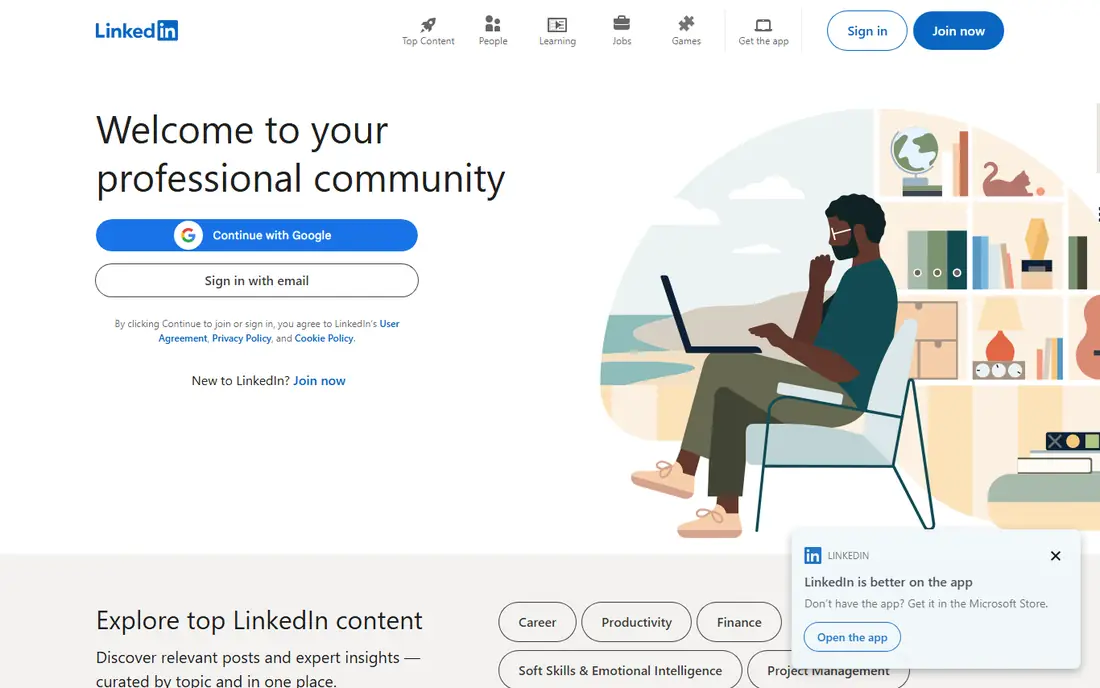
Hiring your own engineers is the most direct alternative to outsourcing. Your team owns the roadmap, the code, and the product knowledge, and there is no vendor margin on top of salaries. Over years, that knowledge compounds: engineers who built version one make better decisions on version three, and turnover hurts less when knowledge is shared across a team rather than held by a vendor.
The costs are real. Recruiting takes months in competitive markets, salaries and benefits are fixed even when work slows, and a bad hire is expensive to reverse. In-house hiring suits companies with steady product work that will last years, not a three-month project. If your roadmap is stable and your budget supports it, in-house is the highest-control option on this list.
What we like- Full control and loyalty
- Deep product knowledge
- No vendor margin
Watch out for- Slowest to staff
- High fixed cost
- Hiring risk in tight markets
#2Toptal
Best for: senior freelancers for critical work4.7/5 on
G2 (270 reviews, checked Oct 2026)
Visit toptal.com
Starting priceSee website
Free planNo
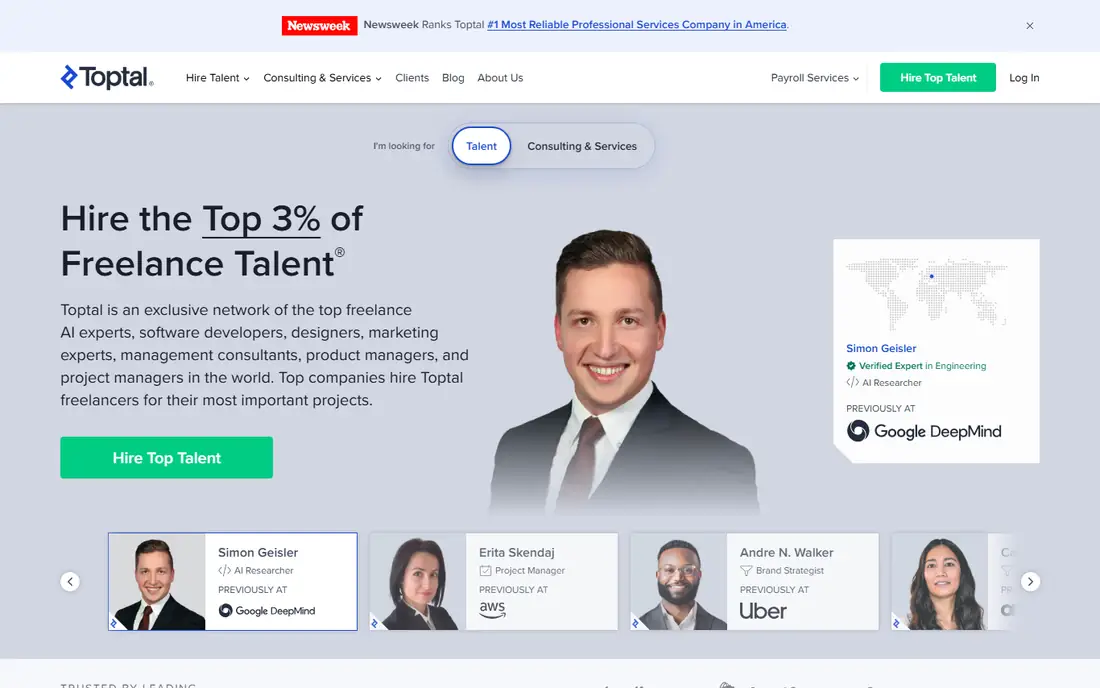
Toptal runs a strict screening process and accepts only a small share of applicants, which is its main selling point. A company that needs a senior engineer, designer, or finance expert can usually start within days, and the talent tends to be strong enough for work that affects revenue. That speed matters when a nearshore vendor would take weeks to staff a team.
The trade-off is price: Toptal rates sit above general freelance marketplaces, and the model fits individual hires better than a fifty-person team. There is also a matching fee structure to understand before starting. For a critical role or a short, high-stakes project, Toptal is one of the safest freelance routes. For bulk hiring, Turing or Andela may fit better.
What we like- Strict screening
- Fast matching
- Senior talent only
Watch out for- Premium rates
- Not built for large teams
Starting priceSee website
Free planNo
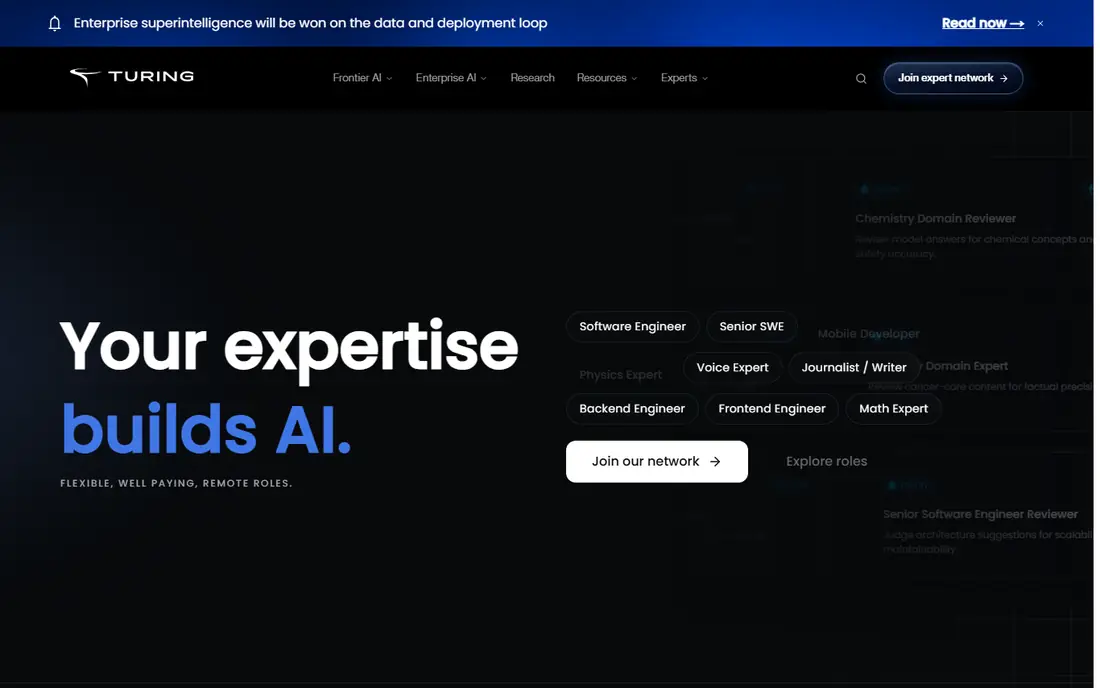
Turing uses AI-assisted matching to place remote engineers from a large global pool, and it handles payroll, compliance, and time-zone coordination. That makes it practical for a company that needs five or ten engineers quickly without building a recruiting function. The platform covers a wide range of skills, from front-end to data engineering.
The matching process is faster than traditional hiring but gives you less direct control over selection than Toptal, and quality can vary by match. A company should interview candidates itself rather than accepting the first match. For scaling a remote team fast, Turing is a strong alternative to a nearshore vendor, with the added benefit of engineers who work as part of your team rather than a vendor's.
What we like- Large vetted talent pool
- AI-assisted matching
- Handles payroll and compliance
Watch out for- Less control over individual selection
- Quality varies by match
#4Upwork
Best for: small, well-defined projects4.5/5 on
G2 (3,234 reviews, checked Oct 2026)
Visit upwork.com
Starting priceSee website
Free planYes
Upwork is the largest freelance marketplace, and it works best for small, well-defined projects: a landing page, a bug fix, a short design task. You post the job, review proposals, and pay hourly or per project, with escrow protection on fixed-price work. The talent pool is enormous, which means you can find almost any skill quickly.
Quality varies widely, so the buyer must screen carefully, check past work, and start with a small paid test task. Project management falls on you: freelancers on Upwork do not come with a delivery manager. For ongoing product development, a dedicated team model usually works better. For one-off work, Upwork is the cheapest and fastest option here.
What we like- Huge talent pool
- Flexible hourly or fixed pricing
- Fast for small jobs
Watch out for- Quality varies widely
- Needs strong management from the buyer
#5Andela
Best for: vetted global engineers for product teams4.7/5 on
G2 (1,536 reviews, checked Oct 2026)
Visit andela.com
Starting priceSee website
Free planNo
Andela connects companies with vetted engineers, particularly from Africa and Latin America, and supports them as part of the client team. The company screens for technical skill and communication, and it provides ongoing support for both the engineer and the client. That model sits between a marketplace and a vendor: you get dedicated people without managing a vendor team.
Engagements usually suit companies that need engineers for months rather than days, so tiny projects are not the best fit. Andela also emphasizes career growth for its engineers, which can help retention compared with short-term contracting. For a company that wants dedicated remote engineers with support behind them, Andela is a solid alternative to nearshore outsourcing.
What we like- Vetted engineers
- Strong in emerging markets
- Team support
Watch out for- Minimum engagements
- Less suited to tiny projects
Starting priceSee website
Free planNo
Thoughtworks is a technology consultancy that builds software with clients rather than simply supplying staff. Its teams bring strong engineering practices, such as test-driven development and continuous delivery, and they often help a client modernize both its product and its internal practices. That makes Thoughtworks a good fit when the problem is not just capacity but how the work gets done.
The model is project-based and premium-priced, so it is not a cheap staff substitute. A company that needs ten extra hands for routine work will find better value elsewhere. A company that needs a new platform built well, or an engineering culture improved, will get more from Thoughtworks than from a nearshore vendor focused on headcount.
What we like- Senior consultants
- Strong engineering practices
- Transformation experience
Watch out for- Premium pricing
- Project-based, not staff augmentation
Starting priceSee website
Free planNo
DevSquad offers a full product team, including developers, a designer, and a product manager, for a monthly fee. That package suits a startup or a small company that has an idea and a budget but no engineering team of its own. The team works on one product at a time, which keeps focus high compared with an agency juggling many clients.
Monthly pricing makes costs predictable, and the product manager role fills a gap that many founders feel most. The trade-off is control: you guide the team but do not manage each hire directly, and the model is not built for enterprise-scale programs. For a company launching a first product without hiring, DevSquad is a practical alternative to a nearshore vendor.
What we like- Complete team in one package
- Product-focused
- Monthly pricing
Watch out for- Less control than in-house
- Not ideal for enterprise scale
#8OutSystems
Best for: building apps fast with low-code tools4.5/5 on
G2 (1,810 reviews, checked Oct 2026)
Visit outsystems.com
Starting priceSee website
Free planYes
OutSystems is a low-code platform that lets teams build web and mobile apps visually, with far less hand-written code than a traditional stack. For standard business apps such as portals, internal tools, and customer apps, delivery can be much faster than custom development, and business users can take part in building. The platform includes governance, security, and deployment tools for enterprise use.
The limits matter: highly custom products, unusual performance needs, or deep integrations may not fit low-code well, and moving off the platform later is hard. OutSystems offers a free version for personal use and learning. For a company whose app is mostly forms, workflows, and dashboards, low-code can remove the need for an outsourced team entirely. For a novel product, custom code still wins.
What we like- Fast delivery for standard apps
- Visual development
- Enterprise governance
Watch out for- Limited for highly custom products
- Platform lock-in risk
How we chose
We compared these options on speed to start, cost structure, control, quality of talent or output, and fit for different company sizes. We checked vendor pages and public comparison guides, and where pricing was not published we wrote See website instead of guessing. We kept the list to options a real company can use today, and we left out vendors that only offer nearshore outsourcing itself, since the topic asks for alternatives to that model.
How to choose between hiring, freelancing, and low-code
Start with the duration of the work. A project that lasts three months favors freelancers or a product team, while a product that will live for years favors in-house hiring. Next, judge how much control you need: in-house gives the most, marketplaces give the least, and dedicated remote teams sit in between. A company in a regulated industry may also need the compliance and security controls that larger platforms provide.
Then run the cost math honestly. Compare salary plus benefits and recruiting costs for in-house roles against freelancer rates and agency fees over a full year, not just a month. Include management time: a marketplace hire that needs daily direction costs more than the hourly rate suggests. Finally, test before committing: start a freelancer with a small task, pilot low-code with one internal app, or run a consultancy on a bounded project. A short trial reveals more than any sales call.
Frequently asked questions
What is nearshore software development outsourcing?
Nearshore outsourcing means hiring a development vendor in a nearby country, usually in a close time zone, to build software for you. Companies choose it for lower costs than local hiring and easier collaboration than far-offshore vendors. The alternatives here replace that vendor model with hiring, freelancers, consultancies, or low-code tools.
Is hiring in-house cheaper than outsourcing?
Over several years, in-house can be cheaper per engineer because there is no vendor margin, but the first year is usually more expensive once recruiting, benefits, and ramp-up time are counted. Outsourcing looks cheaper month to month but adds vendor margin and management overhead. Compare total cost over the real life of the project.
Which option is fastest to start?
Upwork and Toptal are fastest for individual hires, often within days. Turing and Andela take longer but can staff a team in weeks. In-house hiring is slowest, often taking months for senior roles. Low-code can be fastest of all for a simple app, since one person can start building immediately.
Do freelance platforms handle payroll and compliance?
Some do and some do not. Turing and Andela handle payroll and compliance for their engineers, while Upwork leaves more of that work to the buyer. Check the platform terms before starting, especially for international hires where tax and labor rules differ.
When does low-code make sense instead of hiring developers?
Low-code makes sense for standard business apps such as portals, approval workflows, and internal tools, where speed matters more than custom design. It makes less sense for consumer products with novel interactions, heavy data processing, or strict performance needs, where custom code is still the better choice.
Can I combine these options?
Yes, and many companies do. A common mix is an in-house core team for the product, freelancers for specialist tasks, and low-code for internal tools. The key is to keep ownership of the core product in-house while using outside help for work that is bounded and well-defined.
Sources we checked (8)
- https://www.linkedin.com
- https://www.toptal.com
- https://www.turing.com
- https://www.upwork.com
- https://www.andela.com
- https://www.thoughtworks.com
- https://devsquad.com
- https://www.outsystems.com
Is your product missing or out of date?
We review this list regularly. Vendors can request a listing, send updated pricing or ask about featured placement.

Shihab Mia · Founder, Rankite
Shihab has 5+ years in B2B and SaaS SEO. He writes Rankite's software buying guides from pricing pages, documentation and public user reviews. More about Shihab.