How we make this list: we compare pricing pages, product documentation and public user reviews. Ratings come from G2, Capterra or Trustpilot, with the date we checked them.
Who has the best internet service
AT&T Fiber is the best internet service for most households in 2026, with symmetrical speeds from 300 Mbps to 5 Gbps, unlimited data and no promotional price jump. Verizon Fios is the best alternative where AT&T Fiber is unavailable, with similar fiber speeds and a strong reliability record. Where neither fiber network reaches, Xfinity or Spectrum cable are the picks.
Every household asks the same question when the bill arrives or the video call freezes: who has the best internet service. No single provider wins everywhere. Fiber beats cable on upload speed and price stability, cable reaches far more homes, and 5G home internet fills the gaps where neither wired network is available. The best choice depends on which networks reach your address and what the price becomes after the first year.
This guide compares eight major US providers on speed, price, data caps, contracts and availability. Prices are third-party reported and checked 14 November 2026 unless the vendor publishes them directly. Where sources disagree, both figures are shown and the conflict is flagged.
Key takeaways
- Fiber is the best internet service where it is available, with upload speeds matching download speeds and no price jump after a promo period.
- Promo prices rise sharply after 12 months on most cable plans, so always ask for the standard rate before you sign up.
- T-Mobile 5G Home Internet is the best contract-free option where fiber and cable do not reach, with flat pricing and no data caps.
- Availability decides everything. Most homes can only choose between two or three providers in this guide, so check your exact address first.
- Cox no longer sells internet under its own brand, so Optimum takes the eighth spot here.
How we picked
We compared vendor pricing pages and independent comparison guides published in October and November 2026, including CableTV.com, Reviews.org, HighSpeedInternet.com and Allconnect. We judged each provider on speed, starting price, data caps, contract terms, equipment fees and availability. Prices below are third-party reported and checked 14 November 2026 unless the vendor publishes them directly. Where sources disagree, we show both figures and flag the conflict instead of picking one silently.
Comparison table
| Tool | Best for | Starting price | Free plan |
| Xfinity | Widest cable availability | $45 per month | No |
| Spectrum | Cable with no data caps | $30 per month for 1 year | No |
| AT&T Internet | Best overall fiber value | $50 per month | No |
| Verizon Fios | Fiber reliability and gaming | $49.99 per month | No |
| T-Mobile Home Internet | Contract-free 5G value | $50 per month | No |
| Optimum | Price lock and Northeast cable and fiber | $35 per month for 12 months | No |
| Quantum Fiber (CenturyLink) | Simple fiber pricing with no promo jump | $50 per month | No |
| Frontier | Low-cost fiber with flat rates | $44.99 per month | No |
Which internet provider is fastest
Among the eight providers here, fiber posts the highest real-world speeds. AT&T Fiber reaches 5 Gbps, Quantum Fiber reaches 8 Gbps in some markets, and Frontier reaches 7 Gbps. Cable is close on downloads, with Xfinity reaching 2,000 Mbps and Spectrum up to 7,000 Mbps in select markets, but cable uploads lag far behind fiber. T-Mobile 5G Home Internet is the slowest option here, topping out near 498 Mbps.
A 300 Mbps plan handles streaming, video calls and browsing for most households, and the jump from 500 Mbps to 1 Gbps is rarely noticeable in daily use. Upload speed matters more than most shoppers expect. Fiber gives you the same speed up and down, which helps video calls, cloud backups and gaming, while cable uploads are often 20 to 35 Mbps on a gigabit plan. Check the upload speed before you buy, not just the headline download number.
How much does home internet cost
Home internet in the US typically costs between $30 and $70 per month for a standard plan, with gigabit plans running $60 to $90 per month. The cheapest starting prices in this guide are Spectrum at $30 per month for the first year and Optimum at $35 per month for 12 months. Fiber plans start at $44.99 per month with Frontier, $49.99 per month with Verizon Fios, and $50 per month with AT&T Fiber and Quantum Fiber.
The starting price is rarely the price you pay in year two. Cable promo rates often rise by $20 to $30 per month after 12 months. Spectrum Internet 100 costs $30 per month for the first year and $50 per month after that, while Optimum raises prices by up to $15 per month each year after the promo period until the standard rate is reached. Fiber providers are steadier, with no introductory rates at AT&T Fiber and Quantum Fiber and flat rates at Frontier.
Does the best internet service depend on where you live
Yes, more than any other factor. Most US homes have only two or three wired providers to choose from, and fiber is available to only part of the country. AT&T Fiber serves 21 states, Verizon Fios serves nine states in the Northeast, and Quantum Fiber serves the old CenturyLink footprint in the West and Midwest. Xfinity is the most widely available provider here, with cable in 41 states. Spectrum now serves 45 states after absorbing Cox.
Availability can change from one street to the next, and even from one building to another. A provider may offer gigabit fiber on one side of a road and only DSL or nothing on the other. Rural homes often have only one wired option, if any, and 5G home internet from T-Mobile becomes the realistic choice there. Always enter your exact address on the provider site before comparing plans.
Cable, fiber or 5G home internet: which type should you choose
Fiber is the best choice when it is available at your address. It gives symmetrical upload and download speeds, unlimited data, low latency for gaming, and stable pricing with no promo jump. AT&T Fiber, Verizon Fios, Quantum Fiber and Frontier are all fiber-first providers in this guide, and any of them is a strong pick if they serve your home.
Cable is the best choice for most homes that cannot get fiber. Xfinity, Spectrum and Optimum run on cable networks that reach far more addresses, with download speeds up to 1 or 2 Gbps in most areas. The trade-offs are slower uploads, promo prices that rise after a year, and data caps on some networks. Spectrum has no data caps, unlike Xfinity, whose plans carry a 1.25 TB monthly cap in most markets.
5G home internet is the best choice when wired options are weak or absent. T-Mobile Home Internet needs no installation visit, no contract and no equipment fee, and it works anywhere with a decent T-Mobile signal. Speeds vary with signal strength, so it suits light to moderate households better than heavy gamers. Pick the technology that fits your address first, then compare providers within that technology.
Quick comparison
| Tool | Best for | Starting price | Free plan |
|---|
 Xfinity | Widest cable availability across the US | $45 per month (third-party reported; other sources list $40 or $35 per month, so the starting price is disputed) | No (Internet Essentials low-income plan costs $9.95 per month for 50 Mbps) |
 Spectrum | Cable with no data caps and no contracts | $30 per month for 1 year (third-party reported; the 500 Mbps tier is listed at $40 or $50 per month, so that price is disputed) | No (Spectrum Internet Assist low-income plan costs $15 per month) |
 AT&T Internet | Best overall fiber value with stable pricing | $50 per month for 300 Mbps fiber (third-party reported; other sources list $35 or about $55 per month, so the starting price is disputed) | No (AT&T Access low-income plan starts at $30 per month for qualifying households) |
 Verizon Fios | Fiber reliability, gaming and low latency | $49.99 per month for 300 Mbps (third-party reported; some sources list a $34.99 per month promo rate, so the starting price is disputed) | No |
 T-Mobile Home Internet | Contract-free 5G value where wired options are weak | $50 per month flat rate (third-party reported; some sources list $35 per month with autopay and a voice line, so the price is disputed) | No |
 Optimum | Price lock and Northeast cable and fiber | $35 per month for 12 months for 300 Mbps (third-party reported; other sources list $40 per month, so the starting price is disputed) | No |
 Quantum Fiber (CenturyLink) | Simple fiber pricing with no promo jump | $50 per month for 500 Mbps with bank-account autopay (third-party reported; $55 per month without the autopay discount) | No |
 Frontier | Low-cost fiber with flat rates | $44.99 per month for Fiber 500 with autopay (third-party reported; other sources list $49.99 per month flat, so the starting price is disputed) | No |
Is your product missing or out of date?
We review this list regularly. Vendors can request a listing, send updated pricing or ask about featured placement.
The 8 providers with the best internet service
Starting price$45 per month (third-party reported; other sources list $40 or $35 per month, so the starting price is disputed)
Free planNo (Internet Essentials low-income plan costs $9.95 per month for 50 Mbps)
Xfinity, from Comcast, is the most widely available provider here, with cable in 41 states and plans from $45 to $100 per month. Most plans carry a 1.25 TB monthly data cap with overage fees, and equipment rental adds to the bill unless you supply your own modem. Xfinity suits households that need widely available cable and can live with the cap.
What we like- Largest cable footprint here, speeds up to 2,000 Mbps, no-contract options, five-year price guarantee on some plans
Watch out for- 1.25 TB data cap in most markets, with overage charges, and promo prices rise after the first year
Starting price$30 per month for 1 year (third-party reported; the 500 Mbps tier is listed at $40 or $50 per month, so that price is disputed)
Free planNo (Spectrum Internet Assist low-income plan costs $15 per month)
Spectrum is the consumer brand of Charter Communications, and after buying Cox in August 2026 it became the largest telecom provider in the US, serving 45 states. Internet 100 costs $30 per month for the first year. Every plan includes unlimited data and a free modem. The downsides are the $10 router rental and the price rise after year one, with Internet 100 rising to $50 per month.
What we like- No data caps, no annual contracts, free modem included, largest provider footprint after absorbing Cox
Watch out for- Router rental costs $10 per month, and the price rises after the 12-month promo period
#3
AT&T Internet
Best for: Best overall fiber value with stable pricing
Visit att.com
Starting price$50 per month for 300 Mbps fiber (third-party reported; other sources list $35 or about $55 per month, so the starting price is disputed)
Free planNo (AT&T Access low-income plan starts at $30 per month for qualifying households)
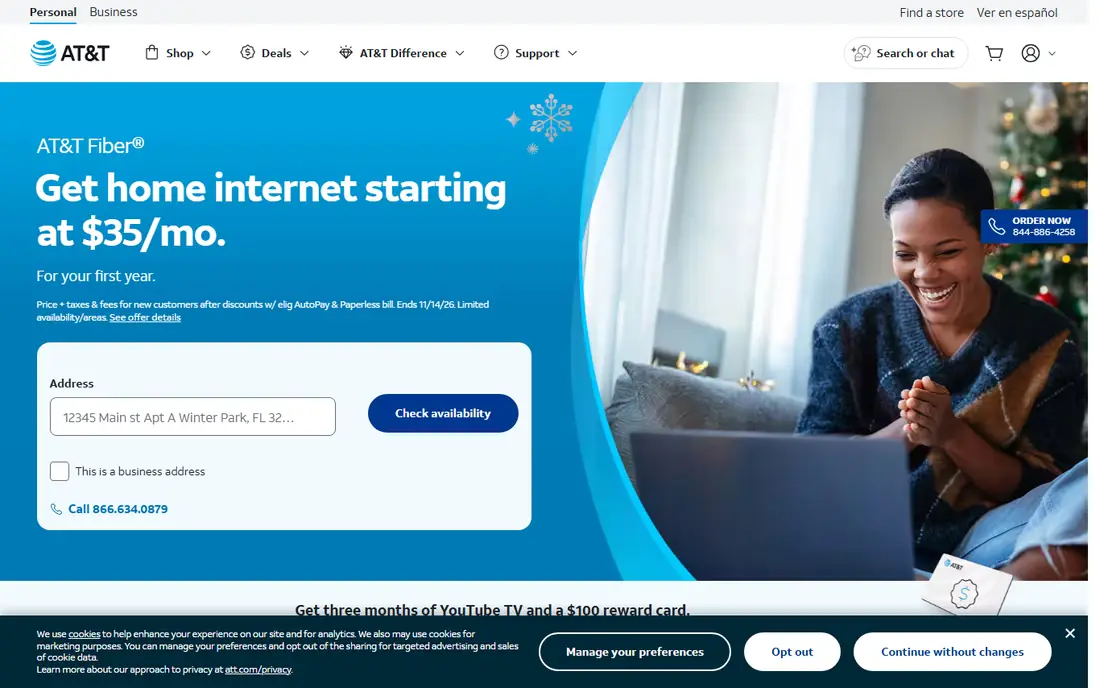
AT&T Fiber is the top pick in this guide for households it reaches. Plans run from $50 to $125 per month with speeds from 300 Mbps to 5,000 Mbps, and upload speeds match download speeds. There is no data cap, equipment is included, and the price does not jump after an introductory period. AT&T Fiber serves 21 states, and many homes inside those states still cannot get fiber and are offered DSL instead.
What we like- Symmetrical fiber speeds up to 5 Gbps, unlimited data, no promotional price jump, equipment included
Watch out for- Fiber is available in only 21 states, so many addresses can only get slower AT&T DSL
Starting price$49.99 per month for 300 Mbps (third-party reported; some sources list a $34.99 per month promo rate, so the starting price is disputed)
Free planNo
Verizon Fios is the best alternative to AT&T Fiber and the strongest pick for gamers. Plans run from $49.99 to $109.99 per month with speeds from 300 Mbps to 2,300 Mbps, and uploads match downloads. There is no data cap and no annual contract. The network is small, covering nine states in the Northeast and Mid-Atlantic, so most of the country cannot get it. Verizon also owns Frontier now, since January 2026.
What we like- Symmetrical fiber speeds up to 2,300 Mbps, unlimited data, no annual contract, strong reliability record and low latency
Watch out for- Available in only nine states, and the best prices often require a Verizon mobile bundle
#5
T-Mobile Home Internet
Best for: Contract-free 5G value where wired options are weak
Visit t-mobile.com
Starting price$50 per month flat rate (third-party reported; some sources list $35 per month with autopay and a voice line, so the price is disputed)
Free planNo
T-Mobile 5G Home Internet is the best pick for homes where fiber and cable are weak or absent. Plans run from $35 to $80 per month depending on the tier and whether you bundle a mobile line, with equipment included and no annual contract. There are no data caps and no installation visit. Speeds reach up to 498 Mbps but vary with signal strength and congestion, so weak-signal homes may see far less.
What we like- No annual contract, no data caps, equipment included, self-install in minutes, five-year price guarantee on some plans
Watch out for- Speeds vary with signal strength, topping out near 498 Mbps, with higher latency than fiber
Starting price$35 per month for 12 months for 300 Mbps (third-party reported; other sources list $40 per month, so the starting price is disputed)
Free planNo
Optimum takes the eighth spot because Cox no longer sells internet under its own brand. Charter bought Cox in August 2026, and Cox areas moved to Spectrum plans in September 2026. Optimum sells cable and fiber in 21 states. Plans start at $35 per month for 12 months for 300 Mbps. There are no data caps and no annual contract, with a five-year price lock on some plans.
What we like- No data caps, no annual contract, price lock up to five years, fiber up to 8 Gbps in select markets
Watch out for- Prices rise up to $15 per month each year after the promo, and coverage is concentrated in 21 states
Starting price$50 per month for 500 Mbps with bank-account autopay (third-party reported; $55 per month without the autopay discount)
Free planNo
Quantum Fiber is the fiber arm of the old CenturyLink network, and AT&T completed its purchase of the business on 2 February 2026. Plans are simple: $50 per month for 500 Mbps, the same $50 per month for 940 Mbps, and $70 per month for 2 Gig. There is no contract, data is unlimited, and installation and Wi-Fi equipment are included. The $50 rate requires bank-account autopay; without it the rate is $55 per month.
What we like- Symmetrical fiber speeds, no contracts, no data caps, no introductory rate, free installation and included Wi-Fi equipment
Watch out for- Available in only about 10 to 16 states, and the advertised rate requires bank-account autopay
Starting price$44.99 per month for Fiber 500 with autopay (third-party reported; other sources list $49.99 per month flat, so the starting price is disputed)
Free planNo
Frontier runs a fiber network across 25 states, with fiber deployment in 15 of them, and Verizon completed its acquisition of Frontier in January 2026. Fiber plans start at $29.99 per month for Fiber 200 and $44.99 per month for Fiber 500 with autopay, with higher tiers up to 7 Gig. Upload speeds match download speeds, data is unlimited, and there is no annual contract on fiber plans. Frontier advertises flat-rate pricing.
What we like- Symmetrical fiber speeds to 7 Gbps, unlimited data, no annual contract, free eero router on some tiers
Watch out for- Fiber is available in only 15 of 25 states, and advertised prices require bank-account autopay
Frequently asked questions
What is the best internet service for most households
AT&T Fiber is the best internet service for most households that can get it, because it offers symmetrical speeds from 300 Mbps to 5 Gbps, unlimited data, included equipment and no promotional price jump. Verizon Fios is the best alternative in the Northeast and Mid-Atlantic, with similar fiber speeds and a strong reliability record. Where neither fiber network reaches, Xfinity or Spectrum cable are the practical picks.
How much should I pay for home internet
Most households should expect to pay $30 to $70 per month for a standard home internet plan, with gigabit plans running $60 to $90 per month. Budget plans start at $30 per month with Spectrum and $35 per month with Optimum, while fiber starts at $44.99 per month with Frontier and about $50 per month with Verizon Fios, AT&T Fiber and Quantum Fiber. Always ask for the price after the promo period, since cable rates often rise after 12 months.
Does the best internet service depend on where I live
Yes. Most homes can only choose between two or three wired providers, and fiber reaches only part of the country. Xfinity serves 41 states and Spectrum serves 45 states after absorbing Cox, while Verizon Fios serves nine states and AT&T Fiber serves 21 states. Availability can change from one street to the next, so enter your exact address on the provider site before comparing plans.
Is fiber better than cable internet
Fiber is better than cable for most households that can get it. Fiber gives equal upload and download speeds, lower latency for gaming and video calls, unlimited data and stable pricing with no promo jump. Cable matches fiber on download speed in many areas but uploads are far slower, often 20 to 35 Mbps on a gigabit plan. Cable is still a good pick where fiber is unavailable, especially Spectrum, which has no data caps.
Can I get good internet without a contract or data cap
Yes. Spectrum, T-Mobile Home Internet, Quantum Fiber and Frontier fiber plans have no annual contract and no data caps. Verizon Fios also has no annual contract and no data cap. Xfinity offers no-contract options but most plans carry a 1.25 TB monthly data cap, so heavy users should check the cap before signing up. Optimum has no annual contract and no data cap, but its price rises each year after the promo period.
Sources we checked (15)
- https://www.xfinity.com
- https://www.spectrum.com
- https://www.att.com/internet/
- https://www.verizon.com/home/internet/
- https://www.t-mobile.com/home-internet
- https://www.optimum.com
- https://www.quantumfiber.com
- https://www.frontier.com
- https://www.cabletv.com/ranking/best-internet-providers
- https://www.reviews.org/internet-service/best-internet-deals/
- https://www.highspeedinternet.com/providers/quantum-fiber/internet
- https://www.allconnect.com/providers/frontier-communications/internet
- https://www.cabletv.com/spectrum
- https://shophighspeed.com/providers/cox/
- https://www.highspeedinternet.com/resources/verizon-vs-optimum
Is your product missing or out of date?
We review this list regularly. Vendors can request a listing, send updated pricing or ask about featured placement.

Shihab Mia · Founder, Rankite
Shihab has 5+ years in B2B and SaaS SEO. He writes Rankite's software buying guides from pricing pages, documentation and public user reviews. More about Shihab.