How we make this list: we compare pricing pages, product documentation and public user reviews. Ratings come from G2, Capterra or Trustpilot, with the date we checked them.
Key takeaways
- Microsoft is the largest software company in the world, and its subscription products, Microsoft 365 and Azure services, sit inside nearly every enterprise.
- Salesforce is the biggest pure SaaS company, with reported revenue of about $41.5 billion, built on its CRM platform.
- Adobe, SAP, and Intuit each own a category: creative software, enterprise resource planning, and small business finance.
- ServiceNow and Workday lead workflow and human capital software for large organisations.
- These are companies, not single products, so this guide compares what each is known for rather than plan prices. Product pricing sits on each company site.
Quick comparison
| Tool | Best for | Starting price | Free plan |
|---|
 Microsoft | Productivity and cloud for every size of company | See website | No |
 Salesforce | Customer relationship management | See website | No |
 Adobe | Creative and marketing software | See website | No |
 SAP | Enterprise resource planning for large firms | See website | No |
 Intuit | Small business accounting and tax | See website | No |
 ServiceNow | IT and enterprise workflow automation | See website | No |
 Shopify | Commerce for independent sellers | See website | No |
 Workday | Human capital and finance for enterprises | See website | No |
Is your product missing or out of date?
We review this list regularly. Vendors can request a listing, send updated pricing or ask about featured placement.
The best software as a service companies
#1Microsoft
Best for: Productivity and cloud for every size of company4.6/5 on
G2 (11 reviews, checked Oct 2026)
Visit microsoft.com
Starting priceSee website
Free planNo
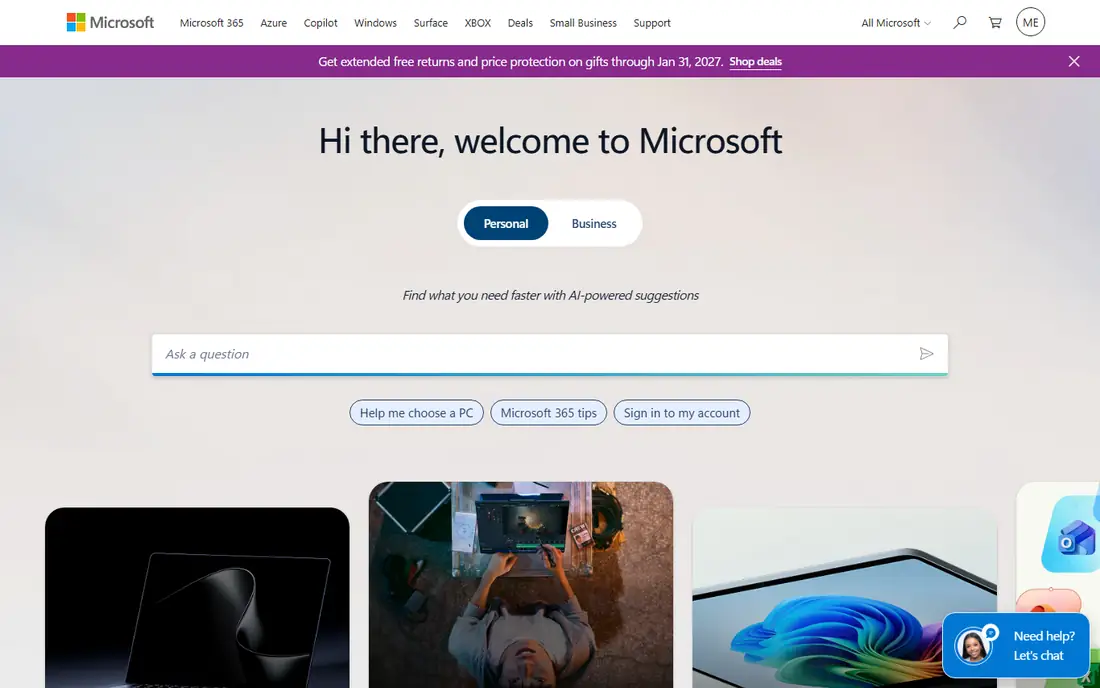
Microsoft turned the world's most installed office software into a subscription and never looked back. Microsoft 365 covers documents, email, meetings, and storage for companies from two people to two hundred thousand, and the same account system reaches Dynamics for business applications and a long list of cloud services. Its cloud segment reports quarterly revenue that dwarfs most rivals' annual totals.
The honest criticism is complexity. Microsoft sells hundreds of products under shifting names and licence bundles, and even its partners argue about the optimal plan mix. None of that changes the centre of gravity. If a company runs on subscriptions, Microsoft is collecting several of them.
What we like- Microsoft 365 is the default office suite for business
- Teams, SharePoint, and Dynamics extend the same subscription
- Azure gives its SaaS products a global platform
- Unmatched partner and support network
Watch out for- Licensing is famously complicated
- Product range is wide but uneven in depth
- Prices rise steadily across renewals
- Some tools overlap and confuse buyers
#2Salesforce
Best for: Customer relationship management4.4/5 on
G2 (27,566 reviews, checked Oct 2026)
Visit salesforce.com
Starting priceSee website
Free planNo
Salesforce is the largest company built purely on SaaS. Founded in 1999 on the idea that business software should run like a website, it now sells the leading CRM platform plus service, marketing, commerce, and analytics products, and owns Slack and Tableau. Reported revenue of about $41.5 billion makes it the biggest pure subscription software firm on this list.
Its moat is the ecosystem. Thousands of apps and consultants build on Salesforce, which makes it sticky and makes implementations vary in quality. Buyers should budget for setup help, not just licences. For customer data at enterprise scale, Salesforce remains the reference point every rival answers to.
What we like- The defining CRM platform, with about $41.5 billion reported revenue
- Sales, service, and marketing clouds on one data model
- Huge app marketplace and partner bench
- Slack and Tableau extend the platform
Watch out for- Pricing stacks up across clouds and add ons
- Implementation quality depends on partners
- Smaller firms can find it heavy
- AI features add new pricing questions
Starting priceSee website
Free planNo
Adobe converted the creative industry's core tools, Photoshop, Illustrator, Premiere Pro, and Acrobat, into subscriptions, and Creative Cloud is now the default toolkit for design and media work. Its second business, Experience Cloud, sells analytics and marketing automation to large brands. Reported revenue of about $23.8 billion makes Adobe one of the largest SaaS companies in the world.
Adobe's current argument is about AI inside the workflow, with its Firefly models pitched as commercially safer than rivals because of training data choices. The split personality is the thing to understand: creative subscriptions are bought per seat on a web page, while the marketing platform is an enterprise negotiation.
What we like- Creative Cloud owns design, photo, and video workflows
- Acrobat and PDF are the document standard
- Experience Cloud serves enterprise marketing teams
- Reported revenue about $23.8 billion
Watch out for- Subscription only model still irks some long time users
- Creative and marketing sides serve different buyers
- Enterprise marketing products are priced by quote
- AI image tools raise rights questions for commercial work
#4
SAP
Best for: Enterprise resource planning for large firms
Visit sap.com
Starting priceSee website
Free planNo
SAP is the German giant behind the systems that run much of the world's manufacturing, logistics, and finance back offices. Its ERP software tracks orders, inventory, money, and people for many of the largest companies on earth, and its cloud business, reported at about 21 billion euros for 2025, has become the centre of the company as customers leave older on premises systems.
An SAP program is a serious undertaking, measured in years and run by consulting partners. In return, a global firm gets processes proven across its industry. SAP is not software a small company buys on a card, and it does not pretend to be. On enterprise gravity, it stands with Microsoft at the top of this list.
What we like- The reference ERP for large manufacturers and global firms
- Cloud revenue of about 21 billion euros in 2025 reporting
- Deep industry specific process coverage
- Huge global partner network
Watch out for- Programs are long and expensive
- The product range is hard for outsiders to read
- Migration deadlines push buyers' timelines
- Suits large companies far more than small ones
Starting priceSee website
Free planNo
Intuit owns the money software of small business America. QuickBooks handles the books for millions of small firms, TurboTax files their owners' taxes, Credit Karma watches consumer credit, and Mailchimp sends the marketing email. Reported revenue of about $21.5 billion shows how far a small business focus can scale.
The products sell on simplicity and on the accountant network that recommends QuickBooks by default. The friction is price: steady increases and tier changes have pushed some long time users to shop around. For the typical small business buyer, though, Intuit is still the first name in the category and the one its competitors must displace.
What we like- QuickBooks is the default accounting app for US small business
- TurboTax leads consumer tax filing
- Mailchimp adds marketing to the finance stack
- Reported revenue about $21.5 billion
Watch out for- QuickBooks prices rise and push some users to rivals
- Consumer tax rules and pricing draw public criticism
- Products are North America first
- Mailchimp pricing tiers confuse some buyers
Starting priceSee website
Free planNo
ServiceNow started as the system IT departments use to track tickets and incidents, then became the platform large companies use to route almost any internal request: a laptop, an onboarding, a facilities fix, a customer case. Reported revenue of about $13.3 billion, with growth rates most older software firms envy, reflects how far workflow has spread inside the enterprise.
ServiceNow's current pitch is AI agents doing routine work inside those workflows, and its installed base gives it a distribution advantage. The catch is the usual one: licences are negotiated, implementations need specialists, and the bill grows with every module. For large organisations standardising how work gets done, ServiceNow is the company to beat.
What we like- The standard platform for IT service management
- Workflow tools now reach HR, customer service, and operations
- Reported revenue about $13.3 billion and still growing fast
- Strong renewal rates show deep enterprise roots
Watch out for- Enterprise pricing with little public transparency
- Needs skilled administrators to shine
- Module sprawl can inflate contracts
- Less relevant below enterprise size
#7Shopify
Best for: Commerce for independent sellers4.4/5 on
G2 (5,144 reviews, checked Oct 2026)
Visit shopify.com
Starting priceSee website
Free planNo
Shopify is the SaaS company behind a large share of independent online retail. A seller subscribes, picks a theme, connects payments, and trades, without running servers or hiring developers. Reported revenue of about $11.6 billion, much of it from payment processing on top of subscriptions, shows how much commerce runs through it.
Its strength is the complete package: store, checkout, payments, shipping tools, and an app store for everything else. The honest watch out is the stack of small costs, apps and transaction fees that grow with the store. For anyone starting or running an online business, Shopify is the benchmark platform in its class.
What we like- The default platform for starting an online store
- Hosting, payments, and checkout in one subscription
- App store covers almost any extra feature
- Reported revenue about $11.6 billion
Watch out for- Transaction and app costs add to the headline plan price
- Large enterprise needs sit in a separate tier
- Discount and tax edge cases can need apps
- Leaving means rebuilding your store
#8Workday
Best for: Human capital and finance for enterprises4.2/5 on
G2 (2,449 reviews, checked Oct 2026)
Visit workday.com
Starting priceSee website
Free planNo
Workday built the cloud replacement for the HR systems large companies used to run themselves. Hiring, payroll, time, benefits, and workforce planning live on one platform, and its finance products extend the same model to accounting and planning. Reported revenue of about $9.6 billion makes it the smallest company here, still a giant by any normal standard.
Workday sells to enterprises and prices like it, with long evaluations and partner led implementations. Its claim is a single, current record for every employee and every dollar, updated in real time rather than reconciled between systems. For a large employer replacing legacy HR software, Workday is usually the first or second name in the room.
What we like- Leading cloud platform for HR and payroll at large firms
- Finance module grows from the same data model
- One system for the whole employee record
- Reported revenue about $9.6 billion
Watch out for- Enterprise sales and implementation cycles
- Pricing is fully negotiated
- Finance side is younger than its HR side
- Overkill for companies under a few hundred staff
How we chose
We ranked SaaS companies by reported revenue from company filings and reputable industry roundups, checked in October 2026, and by category leadership: whether the company defines the software category it sells. That is why specialists such as Intuit and Workday stand beside generalists such as Microsoft and SAP. We left out companies whose main business is infrastructure, devices, or marketplaces rather than subscription software, and fast growing newcomers whose revenue is still a fraction of these firms. Every company here sells software by subscription as its core business and reports revenue in the billions.
What to look for in a SaaS company
For buyers, the practical lesson of this list is stability. A SaaS product holds your data and runs a process you depend on, so the vendor's health is part of the product. Companies of this scale rarely vanish, publish audited results, and maintain large support and security teams. When you choose between a giant and a newcomer, you are often choosing between that stability and a sharper fit or a lower price.
Look at the whole contract, not the seat price. Enterprise SaaS bills grow through modules, add ons, AI features priced by use, and renewal increases, and recent industry surveys show most IT leaders have been surprised by AI related charges. Ask what the third year costs, what leaving would involve, and which of your data you can export in a usable form. The top companies here earn their position by being hard to replace. Make sure that is working for you, not against you, before you sign.
Frequently asked questions
What is the largest SaaS company?
By revenue from subscription software, Microsoft is the largest software company overall and its cloud and productivity subscriptions lead the SaaS field. Among companies built purely on SaaS, Salesforce is the biggest, with reported revenue of about $41.5 billion. The wider SaaS market is worth roughly $488 billion in 2026 by industry estimates.
What does SaaS mean?
Software as a service is software delivered over the internet on a subscription. The vendor hosts it, updates it, and keeps it secure, and customers use it through a browser or app instead of installing and maintaining it themselves. Email, accounting, CRM, and HR systems are common examples. The model replaced one time licences for most business software.
Why are these companies' prices not listed?
At company level there is no single price. Each firm sells many products, from per seat subscriptions a small team can buy online to enterprise platforms priced by negotiation. This guide therefore marks price as See website and describes what each company sells. Product level prices sit on each company's site, and our product specific guides cover them.
Which SaaS companies serve small businesses best?
Intuit and Shopify are built around small and independent businesses: QuickBooks for the books and Shopify for selling. Microsoft 365 also fits small teams that want email, documents, and meetings in one subscription. The enterprise firms here, SAP, ServiceNow, and Workday, mainly serve large organisations and price accordingly.
Sources we checked (0)
Is your product missing or out of date?
We review this list regularly. Vendors can request a listing, send updated pricing or ask about featured placement.

Shihab Mia · Founder, Rankite
Shihab has 5+ years in B2B and SaaS SEO. He writes Rankite's software buying guides from pricing pages, documentation and public user reviews. More about Shihab.