How we make this list: we compare pricing pages, product documentation and public user reviews. Rankite is independent; if a vendor ever pays for a featured spot, that listing is clearly labeled Partner.
Key takeaways
- Claim denials cost US providers hundreds of billions a year in rework and lost revenue; the best revenue cycle management software prevents denials before submission instead of chasing them after.
- athenahealth, Tebra, CareCloud, and Veradigm bundle RCM with EHR and practice management, which suits independent practices that want one vendor.
- Waystar, FinThrive, Experian Health, and R1 focus on the revenue cycle itself and integrate with the EHR you already run.
- Nobody in this category publishes simple pricing; every vendor on this list quotes based on provider count, claim volume, and scope, so plan for a sales process.
- Match the tool to your size: independent practices need turnkey billing help, while health systems need denial analytics and contract management at scale.
Quick comparison
| Tool | Best for | Starting price | Free plan |
|---|
 athenahealth athenahealth | independent practices that want EHR, billing, and RCM in one cloud platform | See website | No |
 Waystar Waystar | providers of any size that want AI across the whole revenue cycle | See website | No |
 FinThrive FinThrive | hospitals and health systems focused on denial prevention | See website | No |
 Experian Health Experian Health | providers that want data-driven patient access and claims tools | See website | No |
 R1 RCM R1 RCM | health systems that want to outsource the revenue cycle, not just buy software | See website | No |
 CareCloud CareCloud | small to mid-size practices that want EHR and RCM from one vendor | See website | No |
 Tebra Tebra | independent practices that want billing plus patient growth in one login | See website | No |
 Veradigm Veradigm | independent practices that want a managed RCM service with proven results | See website | No |
Is your product missing or out of date?
We review this list regularly. Vendors can request a listing, send updated pricing or ask about featured placement.
The best revenue cycle management software
#1
athenahealth
Best for: independent practices that want EHR, billing, and RCM in one cloud platform
Visit athenahealth.com
Starting priceSee website
Free planNo
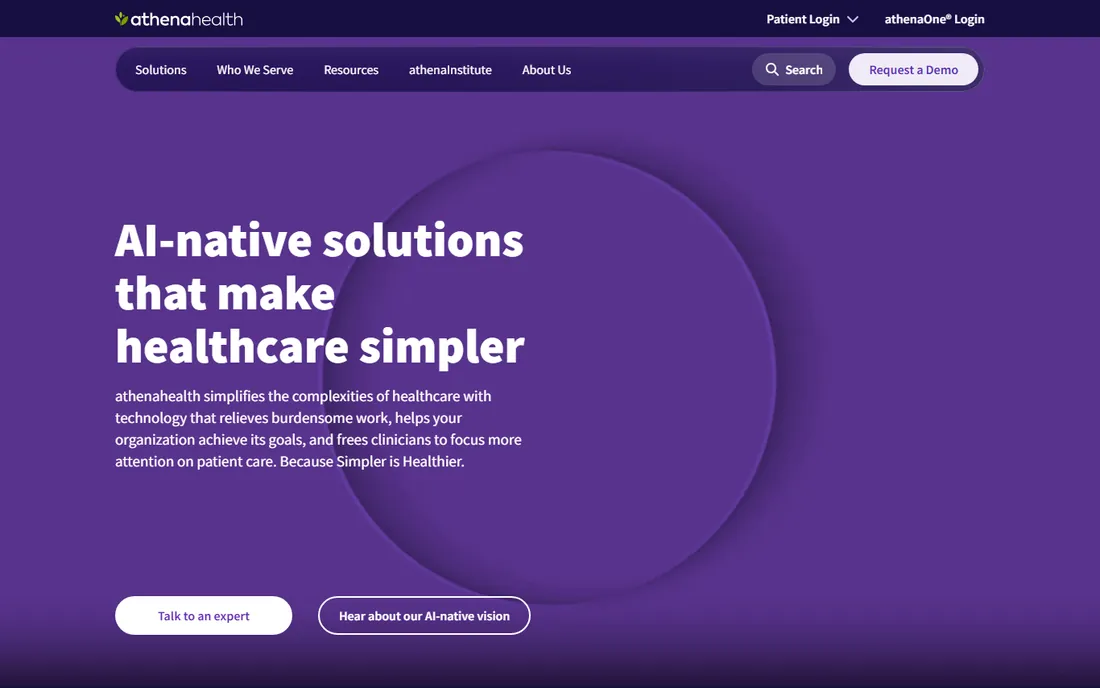
athenahealth's pitch is that revenue cycle management works best when it is not a separate product. The athenaOne platform runs your EHR, scheduling, billing, and claims on one cloud system, with a billing rules engine that scrubs claims against payer rules before submission. The company says practices that switch often see collections rise by a few percentage points, which is the entire margin for many independent practices.
What distinguishes athenahealth from the pure-play RCM vendors is the network effect: because so many practices run on the same platform, the company can benchmark your denial rates, days in A/R, and collection performance against similar practices and push fixes network-wide when a payer changes a rule. The catch is commitment. You are buying the whole platform, not a bolt-on, so the sales process is long, pricing is quoted, and migration is a project. For an independent practice tired of juggling an EHR plus a billing service, though, the single-vendor model is exactly the point.
What we like- AthenaOne bundles EHR, practice management, and revenue cycle with a 30,000-plus-rule billing engine
- Network benchmarking compares your financial performance against peers
- Best in KLAS recognition for independent physician practice suites
Watch out for- Quote-based pricing with no public tiers
- Switching EHRs to get the RCM is a major migration
- Some practices report the percentage-of-collections model gets expensive as revenue grows
#2
Waystar
Best for: providers of any size that want AI across the whole revenue cycle
Visit waystar.com
Starting priceSee website
Free planNo

Waystar went public in 2024 and has been consolidating the RCM space ever since, including a major AI acquisition. The platform covers the full cycle: verify insurance and get prior authorizations up front, submit and track claims, predict and fight denials, and collect from patients with self-service payment tools. Its AI layer, branded AltitudeAI, automates the repetitive decision points that used to eat staff hours.
The strength for buyers is integration depth: Waystar plugs into the major EHRs rather than replacing them, so a hospital or large practice can keep its clinical systems and fix the financial plumbing. Pricing combines subscription with claim-volume tiers, and third-party benchmarks put entry costs around $11,000 a year before implementation. That is real money, but the company's pitch is that recovered revenue pays for it, and its client retention suggests many buyers agree.
What we like- End-to-end platform covering financial clearance, claims, denials, and patient payments
- AltitudeAI automation woven through eligibility, authorizations, and denial workflows
- Serves around a million providers, so payer behavior data is deep
Watch out for- Pricing is quote-based and implementations can run into five figures
- The platform's breadth means a long evaluation
- Smaller practices may find it more than they need
#3
FinThrive
Best for: hospitals and health systems focused on denial prevention
Visit finthrive.com
Starting priceSee website
Free planNo
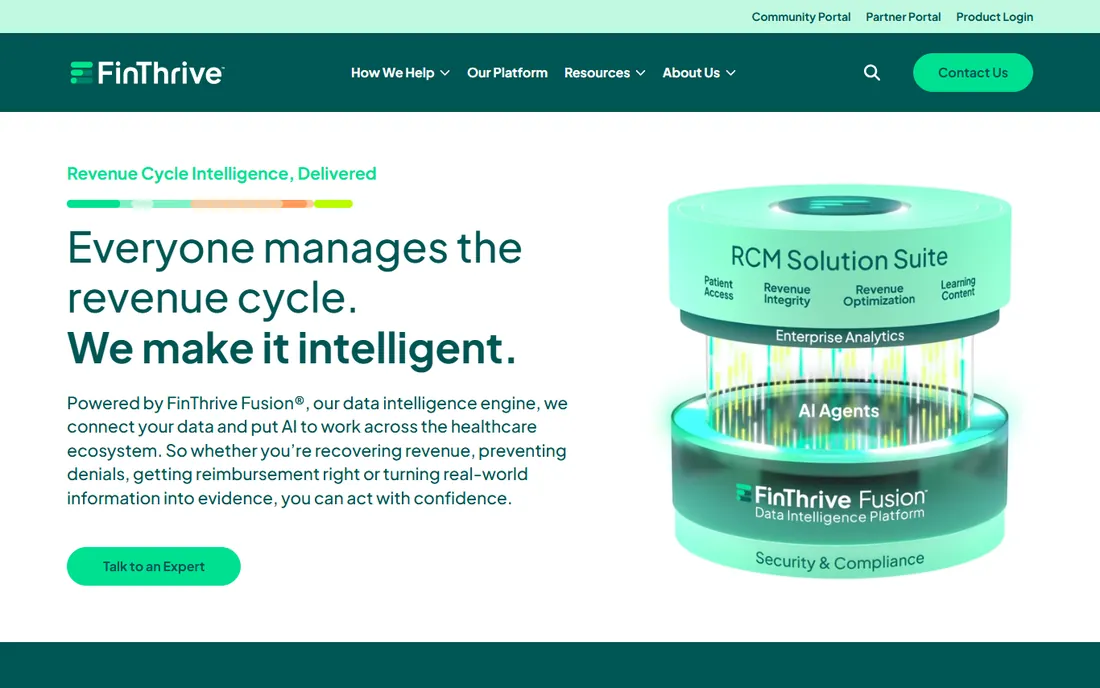
FinThrive positions itself as the intelligence layer for the revenue cycle rather than just another claims tool. Its pitch centers on prediction: machine learning trained on the company's clearinghouse data predicts which claims will deny and why, so staff fix problems before submission instead of working denials after. The Insurance Discover product continuously searches for patient coverage across the care journey, recovering revenue from encounters that would otherwise be written off.
The platform is modular, which matters for buyers who do not want to rip out everything: you can start with patient access or charge integrity and add claims management and contract modeling later. FinThrive claims three out of five US hospitals use its solutions, which gives its denial predictions a large training set. The honest catch is that this is enterprise software with enterprise sales; independent practices will find the process heavy, but health systems fighting denial rates get the tool built for their problem.
What we like- Predictive analytics trained on clearinghouse data flag denials before they happen
- Insurance Discover finds hidden patient coverage other tools miss
- Modular platform lets you buy patient access, charge integrity, or claims separately
Watch out for- Enterprise-oriented pricing and sales process
- The full platform is a lot to implement at once
- Best value comes at health-system scale
#4
Experian Health
Best for: providers that want data-driven patient access and claims tools
Visit experian.com
Starting priceSee website
Free planNo
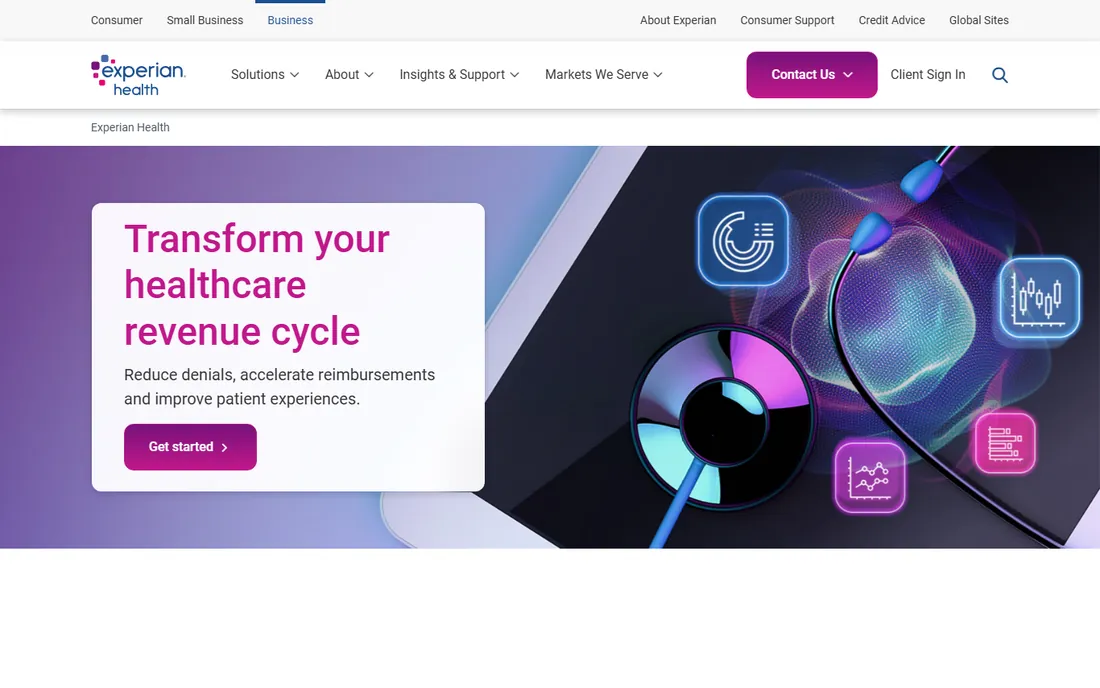
Experian Health is the healthcare arm of the data company, and it brings that data heritage to the revenue cycle. The product set covers patient access (eligibility verification, coverage discovery, estimates), claims management with automated scrubbing, and collections optimization, all connected through a clearinghouse with thousands of payer connections. Its AI Advantage modules predict denials and triage the denials that do occur so staff work the highest-value ones first.
The company reports its customers average a 4 percent denial rate against a 10-plus percent industry average, which is the kind of number that gets a CFO's attention. Because Experian Health integrates with existing EHRs rather than replacing them, it fits providers that like their clinical systems but need the financial side fixed. The main friction is branding: more than one buyer has started the conversation confused about what the credit bureau has to do with medical billing. The products are legitimate; the name just needs explaining.
What we like- Best in KLAS rankings in claims management and clearinghouse categories
- AI Advantage modules for predictive denials and denial triage
- Deep payer connections with 175M+ claims processed annually per the vendor
Watch out for- The Experian brand confuses buyers who associate it with consumer credit
- Pricing is quote-based
- Works best as a complement to an existing EHR rather than a standalone platform
#5
R1 RCM
Best for: health systems that want to outsource the revenue cycle, not just buy software
Visit r1rcm.com
Starting priceSee website
Free planNo
R1 is the biggest name in outsourced revenue cycle management, and it belongs on this list because most health systems choosing R1 are choosing it instead of buying RCM software. The model combines technology (automation, AI agents, analytics) with tens of thousands of RCM specialists who run the revenue cycle as a managed service. After its $8.9 billion take-private deal, R1 has been investing heavily in AI-driven automation aimed at real-time claim adjudication.
This is the right choice when the problem is not the tool but the operation: chronic staffing shortages, denial rates that never improve, A/R days that never fall. R1 takes over the function and is accountable for the outcomes. The trade-off is exactly what you would expect from outsourcing: long contracts, deep integration into your operations, and less direct control. For a 500-bed health system, that trade is often worth it. For a ten-provider practice, it is not on the menu.
What we like- End-to-end managed RCM with 30,000 staff plus automation, not just a software license
- Best in KLAS across multiple RCM categories for 2026
- Handles 270M+ payer transactions a year, giving it unmatched operational data
Watch out for- Outsourcing model means a deep, long-term partnership, not a quick software purchase
- Priced for health systems, not small practices
- You cede day-to-day control of billing operations
#6
CareCloud
Best for: small to mid-size practices that want EHR and RCM from one vendor
Visit carecloud.com
Starting priceSee website
Free planNo
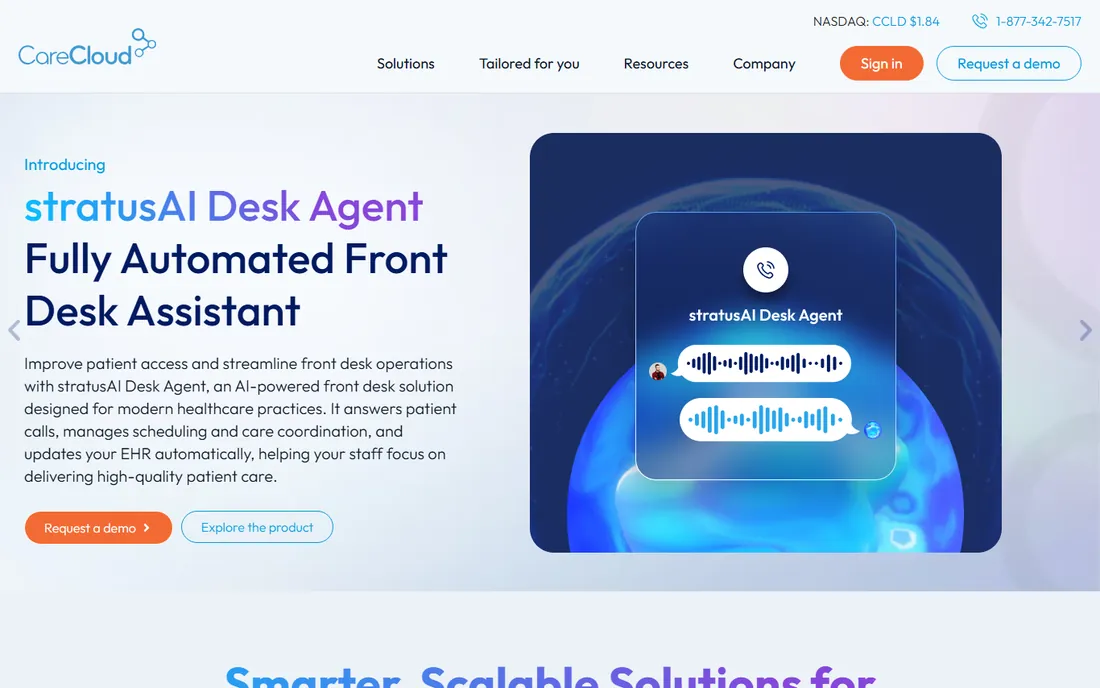
CareCloud is one of the few vendors in this category that publishes starting prices, which already makes evaluation easier. The platform bundles EHR, practice management, and revenue cycle tools, with tiered plans: Central for the software, Complete for more, and Concierge for full-service RCM where CareCloud's team runs your billing for a percentage of collections. That ladder lets a practice start with software and graduate to outsourcing without changing vendors.
The AI features (branded cirrusAI) handle documentation assistance, billing automation, and even appeal letters, which targets the exact administrative burden small practices complain about. The honest caveats from user reviews: support can be inconsistent, and the platform has a learning curve for staff coming from simpler systems. For a practice that wants one throat to choke for both clinical and financial software, with a visible path from DIY billing to full outsourcing, CareCloud's structure is appealing.
What we like- Tiered pricing with published starting points (Central from $349/month per the vendor's materials)
- Concierge tier offers full RCM outsourcing at 3 to 7 percent of collections
- AI tools for documentation and billing baked into the platform
Watch out for- Pricing details beyond the starting tiers require a sales conversation
- Support responsiveness draws mixed reviews
- Implementation can be involved for complex multi-specialty practices
#7
Tebra
Best for: independent practices that want billing plus patient growth in one login
Visit tebra.com
Starting priceSee website
Free planNo

Tebra (the merged Kareo and PatientPop) sells the independent practice on a bigger idea than billing: run the clinical side, the revenue cycle, and the patient acquisition side from one platform. The billing engine handles claim scrubbing, real-time eligibility, denial management, and payment posting, while the same login manages online scheduling, reminders, reviews, and marketing. For a practice owner who is also the de facto CFO and CMO, that consolidation has real appeal.
The Practice Management tier's published $150 a month starting price makes budgeting easier than with most competitors, though the full EHR+ platform is quote-based. User reviews are genuinely mixed: many praise the all-in-one convenience, while others flag support wait times, setup delays for insurance enrollments, and surprise fees for add-ons like data exports. Go in with eyes open, negotiate the contract line by line, and Tebra can be the value pick for an independent practice.
What we like- EHR+ platform connects clinical, billing, scheduling, and reputation management
- Practice Management tier starts at a published $150/month
- Deep insurance connectivity with thousands of payers for enrollments and claims
Watch out for- Full pricing requires a quote and some users report unexpected add-on fees
- Billing and insurance enrollment setup can take longer than expected
- Performance complaints surface in user reviews
#8
Veradigm
Best for: independent practices that want a managed RCM service with proven results
Visit veradigm.com
Starting priceSee website
Free planNo
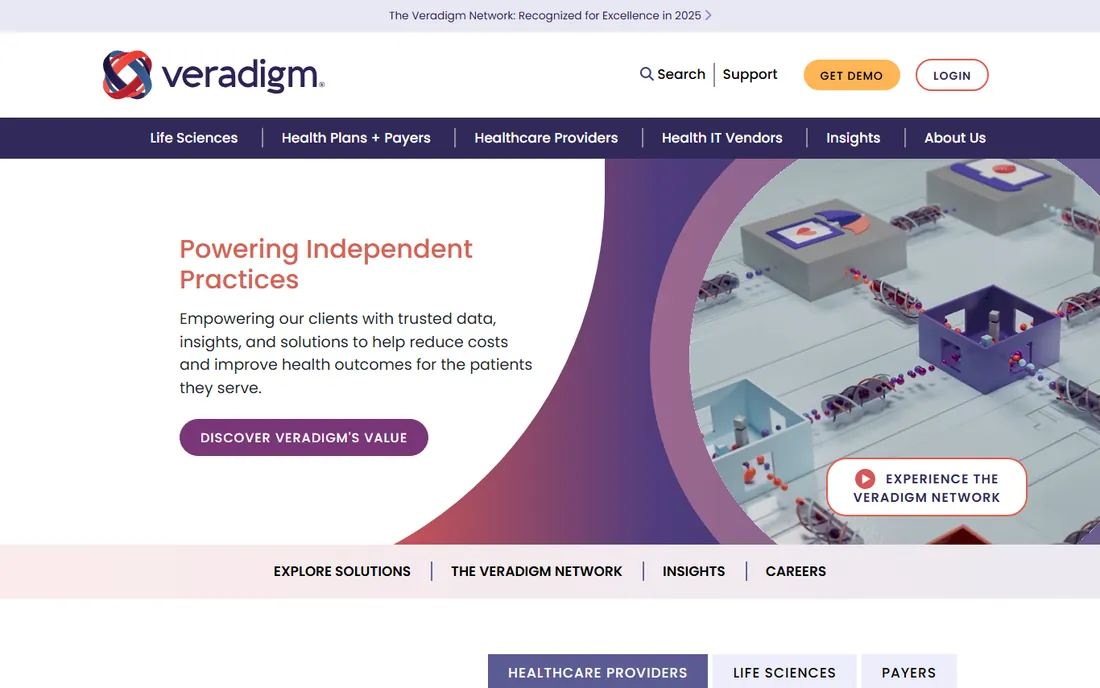
Veradigm (formerly Allscripts' practice business) offers Revenue Cycle Services as a managed service: their billing experts run your coding, claims, payer communication, and denial management while the technology integrates with the EHR you already use. The company publishes outcome metrics, including a 98 percent first-pass clean claims rate and 3 to 5 percent average revenue improvement in the first year, which gives buyers concrete numbers to hold them to.
The model suits independent practices that have concluded billing is not their core competence. Instead of hiring, training, and retaining billing staff through every turnover cycle, the practice outsources the function to a team that does it at scale, with AI tools that surface denial trends and payment shifts early. The trade-off is the standard services bargain: you gain expertise and consistency, you lose direct control, and the pricing is a negotiated agreement rather than a price list. For practices where billing turnover is the chronic problem, that bargain is usually worth taking.
What we like- End-to-end managed revenue cycle services with published outcomes (98% first-pass clean claims rate, 99% net collections per the vendor)
- AI-enabled analytics layered onto the service
- Integrates with your existing EHR rather than replacing it
Watch out for- It is a services engagement, not software you operate yourself
- Quote-based pricing
- Best suited to practices ready to hand off billing operations
How we chose
We focused on vendors that US healthcare providers actually evaluate for revenue cycle management, drawn from KLAS rankings, G2 and Capterra healthcare categories, and industry coverage. We verified each vendor's official website directly, reviewed product documentation for claims, denial management, eligibility, and contract management capabilities, and read public user reviews and healthcare finance community discussions for recurring themes on implementation, support, and results. We included both software platforms and managed RCM services because buyers in this category genuinely choose between them. Pricing in this industry is almost never published, so where vendors publish starting points we cite them and otherwise say so plainly. We did not test any product hands-on.
Buying RCM software without getting burned
Revenue cycle purchases go wrong in predictable ways. The contract is long, the implementation touches every department, and the vendor's incentives do not automatically align with yours. A few rules keep you out of trouble.
Demand outcome language in the contract
Vendors will show you impressive metrics: clean claim rates, denial reductions, collection lifts. Ask which of those numbers appear in the contract as commitments, and what happens if they miss. A vendor confident in its results will tie fees to performance. A vendor selling software licenses will change the subject. For managed services especially, the contract should name the KPIs, the measurement method, and the remedy.
Price the total engagement, not the license
The quote is the beginning of the cost, not the end. Add implementation and EDI enrollment fees, clearinghouse transaction costs, training, and the internal staff time your team will spend on the project for six months. For percentage-of-collections models, model what the fee costs at your current revenue and at 20 percent growth; a 5 percent fee that looks cheap today gets expensive as you grow. Ask every vendor for three reference customers at your size and call all three.
Plan the EHR question first
Half the products on this list replace your EHR; the other half integrate with it. That is the first decision, and it dwarfs the rest. If your clinicians like their EHR, shortlist the integrators (Waystar, FinThrive, Experian Health, Veradigm's services). If your EHR is part of the problem, consider the platform replacements (athenahealth, CareCloud, Tebra). Do not let a great RCM demo talk you into an EHR migration you did not plan for.
Why denials are the metric that matters most
Ask any RCM vendor for their headline metric and you will hear about clean claim rates and collection lifts. Ask their customers what actually changed their finances and the answer is usually denials. A denied claim costs roughly $25 to $118 to rework depending on whose study you believe, and most practices never appeal a large share of denials at all. The money is not lost in dramatic write-offs; it leaks in thousands of small unworked denials.
That is why the most important product question is not "what is your clean claim rate" but "what happens before the claim goes out." Scrubbing engines, predictive denial models, and eligibility verification at scheduling are worth more than any appeal workflow, because a claim that never denies needs no appeal. When you demo these tools, bring five of your most common denial codes and ask the vendor to show you exactly where each one gets caught. The good ones will show you. The rest will show you a dashboard.
The second-order effect matters too: every denial your staff works is staff time not spent on the next claim. Practices that cut denial rates in half often find their existing billing team can handle growth without hiring, which is where the real ROI hides. Buy the tool that prevents denials and the staffing math takes care of itself.
Frequently asked questions
What is the best revenue cycle management software for small practices?
For small practices, the all-in-one platforms usually win: athenahealth, Tebra, and CareCloud bundle RCM with the EHR and practice management, so there is one vendor and one login. If you like your current EHR, add a specialist like Experian Health for claims and eligibility or outsource to Veradigm's managed services. Avoid enterprise platforms built for health systems; you will pay for scale you do not have.
How much does revenue cycle management software cost?
Almost no vendor publishes pricing, which tells you something about the category. Expect a sales process with quotes based on provider count, claim volume, and scope. Published starting points are rare: CareCloud lists tiers from $349 a month and Tebra Practice Management from $150 a month. Full-service RCM outsourcing typically runs 3 to 7 percent of collections. Always model the total engagement including implementation, not just the license.
What is the difference between RCM software and medical billing services?
RCM software is a tool your staff operates: it scrubs claims, manages denials, and reports on performance, but your team does the work. Medical billing services (like R1 or Veradigm RCS) take over the work itself, with their staff running your billing operations. Software gives you control; services give you expertise and staffing relief. Many organizations start with software and move to services when turnover or denial rates defeat the in-house team.
How do I reduce claim denials?
Prevent them before submission. Verify eligibility at scheduling, scrub claims against payer rules before they go out, and use predictive tools to flag likely denials. Track denial reasons by code and fix the root causes: most practices find a handful of denial codes explain most of their rework. Appeal what slips through quickly, because timely appeals recover far more than old ones.
Should a practice outsource its revenue cycle?
Outsource when billing is a chronic problem rather than a tooling problem: constant staff turnover, denial rates that never improve, A/R days stuck above 40. Keep it in-house when you have a stable, competent billing team and just need better software. The middle path, a vendor's billing experts working inside your systems, suits practices that want help without a full handoff.
What is a clean claim rate and why does it matter?
The clean claim rate is the percentage of claims accepted by payers on first submission without errors or rework. Industry averages hover in the mid-90s, and each percentage point below that represents staff time spent fixing and resubmitting. Vendors like Veradigm publish rates around 98 percent. It matters because clean claims get paid in days; dirty claims get paid in months, if at all.
Sources we checked (8)
- https://athenahealth.com/
- https://waystar.com/
- https://finthrive.com/
- https://www.experian.com/healthcare
- https://r1rcm.com/
- https://carecloud.com/
- https://www.tebra.com/
- https://veradigm.com/
Is your product missing or out of date?
We review this list regularly. Vendors can request a listing, send updated pricing or ask about featured placement.

Shihab Mia · Founder, Rankite
Shihab has spent more than a decade helping SaaS and e-commerce brands grow through search. He writes Rankite's software buying guides from pricing pages, documentation and public user reviews. More about Shihab.