How we make this list: we compare pricing pages, product documentation and public user reviews. Ratings come from G2, Capterra or Trustpilot, with the date we checked them.
Key takeaways
- Symantec, Forcepoint, Trellix, Digital Guardian and Proofpoint are the classic DLP vendors, each covering endpoint, network and cloud channels.
- Microsoft Purview DLP is the natural fit for Microsoft 365 organizations, at $12 per user per month paid yearly on top of an E3 plan.
- Zscaler, Netskope One, Cato Networks and Prisma SASE converge networking and security, with DLP built into the platform rather than bolted on.
- Almost every vendor in this category prices by quote. Expect annual per-user contracts and a real procurement process.
- The practical divide is architecture. Agent-based DLP watches the endpoint deeply, while SASE platforms inspect traffic in the cloud.
Quick comparison
Is your product missing or out of date?
We review this list regularly. Vendors can request a listing, send updated pricing or ask about featured placement.
The best data loss prevention software and unified SASE
Starting priceSee website
Free planNo
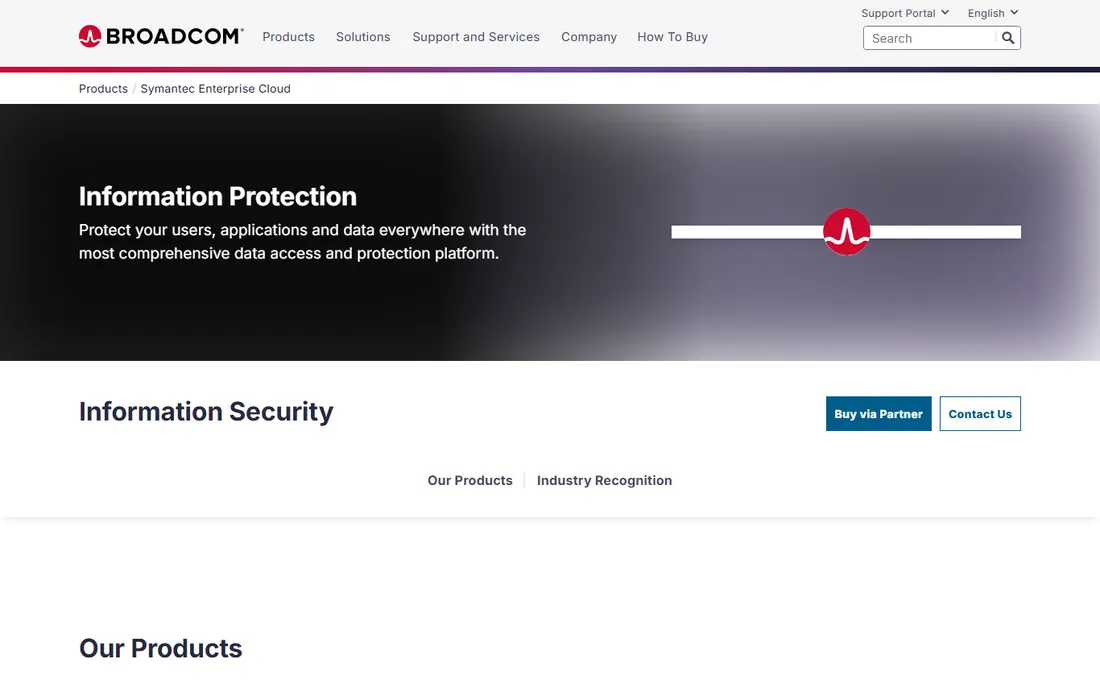
Symantec DLP is the incumbent. Broadcom's enterprise security division sells it as part of a large information protection portfolio, and it remains the product other DLP tools are measured against. It covers data at rest, in motion and in use across endpoints, network and cloud, with content inspection from pattern matching to exact data matching and fingerprinting.
The strength is coverage depth. Few products inspect as many channels and file types with as much policy granularity. The weakness is operational weight. Deployments are projects, not purchases, and tuning policies to avoid false positives takes dedicated staff. Pricing is quote based and aimed at large enterprises. If you already run Symantec endpoint products, the integration argument is strong. For mid-size companies, the complexity may outweigh the capability.
What we like- Broadest DLP coverage in the industry, deep content inspection, huge policy library
Watch out for- Complex to deploy and tune
- Pricing requires enterprise negotiation
Starting price$12 per user/month (paid yearly)
Free planFree trial
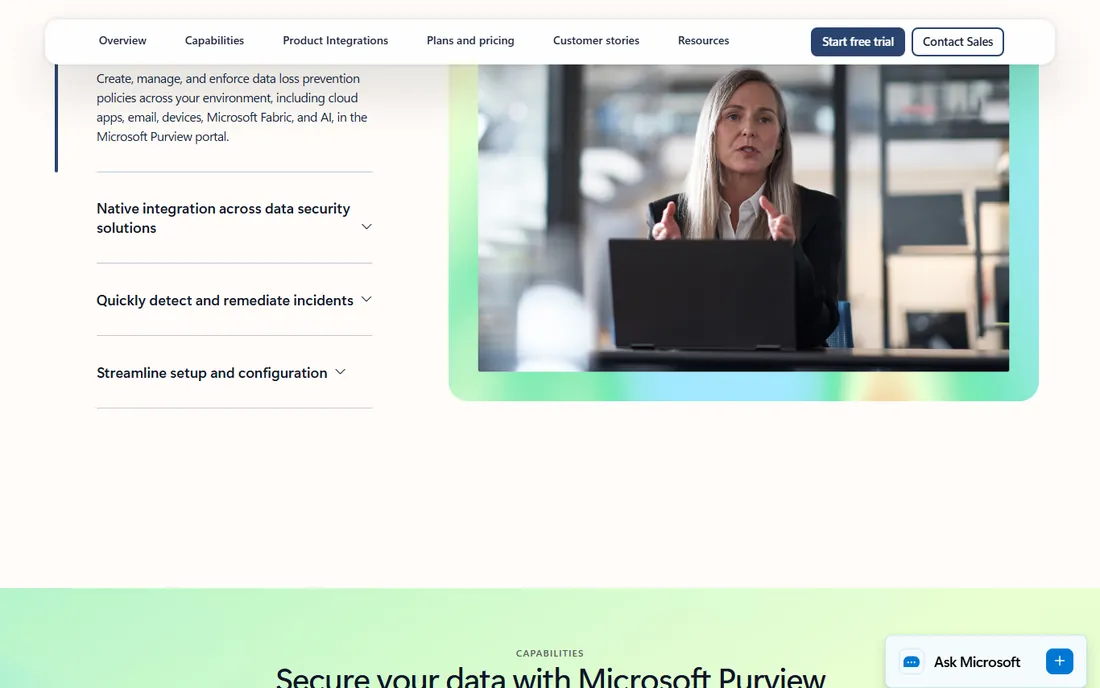
Microsoft Purview DLP is the path of least resistance for Microsoft 365 shops. It prevents data loss across Exchange, SharePoint, OneDrive, Teams, endpoints and even generative AI applications, all managed from the same compliance portal. The 2026 story leans hard into AI, with protection for Microsoft 365 Copilot data and adaptive policies based on user risk.
Pricing is published, which is rare in this category. The Purview Suite costs $12 per user per month paid yearly, and it requires Microsoft 365 E3 or Office 365 E3 plus Enterprise Mobility and Security E3 underneath. A free trial is available. The honest limitation is scope. Purview is excellent inside the Microsoft world and thinner outside it.
What we like- Native to Microsoft 365 and Copilot, published per-user pricing, unified compliance suite
Watch out for- Requires M365 E3 underneath
- Weaker outside the Microsoft ecosystem
Starting priceSee website
Free planNo
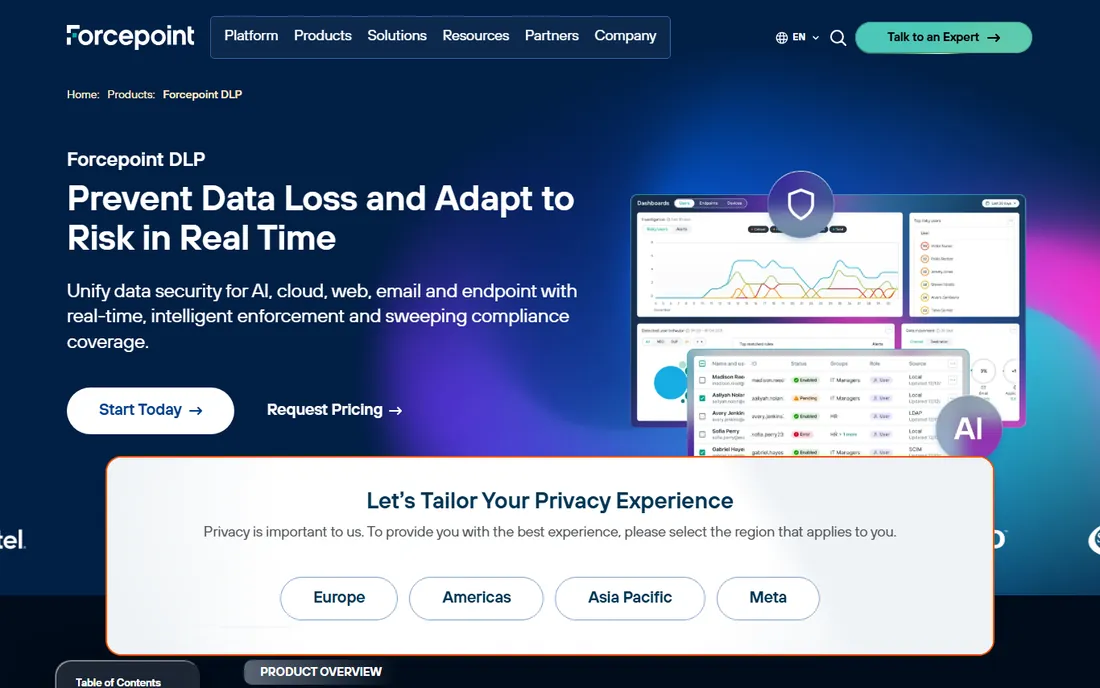
Forcepoint built its DLP around one idea. The same policy engine should cover endpoint, network and cloud, instead of running three separate DLP systems. That unified approach shows in the product, with consistent classifiers, incident views and risk scoring across web, email, endpoint and cloud channels, including SaaS and generative AI environments.
The 2026 product uses AI to discover and classify structured and unstructured data, with enforcement that adapts to user behavior to cut false positives. Real-time user coaching warns an employee before they violate policy, which reduces helpdesk tickets. Pricing is quote based with no public numbers. Forcepoint makes the most sense as part of a broader data security purchase.
What we like- One policy engine for endpoint, network and cloud
- Strong analytics
- GenAI coverage
Watch out for- Enterprise sales process
- Best value when bought as a suite
Starting priceSee website
Free planNo
Trellix DLP comes from the McAfee enterprise lineage, now operating as an independent company focused on what it calls living security. The product family covers the classic DLP vectors. Endpoint Complete finds and classifies data on Windows and macOS with user coaching, Discover inventories sensitive data across networks and storage, and Network Monitor and Prevent handle data in motion.
The endpoint story is the strongest part. Device control, content-aware policies and a single console for deployment and event tracking give administrators real visibility from the keyboard to the cloud. For cloud data repositories, Trellix partners with Skyhigh Security rather than building it all in-house. Pricing is quote based.
What we like- Strong endpoint coverage with device control, single management console, compliance reporting
Watch out for- Cloud story depends on the Skyhigh partnership
- Suite pricing is opaque
Starting priceSee website
Free planNo
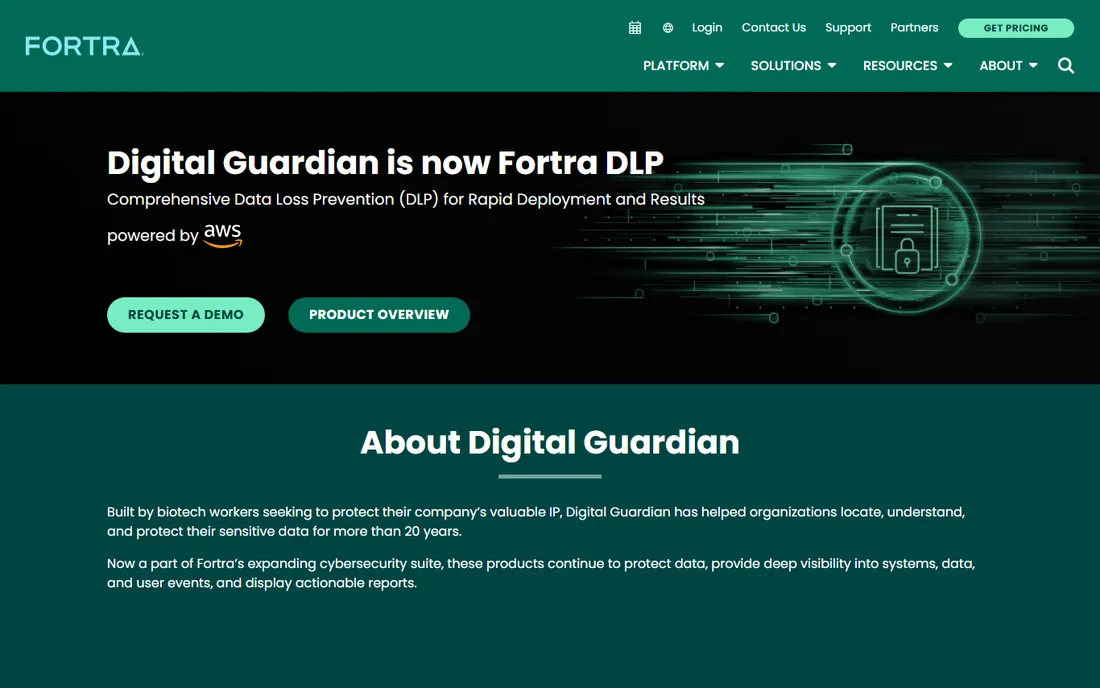
Digital Guardian started in biotech, protecting intellectual property, and that DNA still shows. Now part of Fortra's cybersecurity suite, it focuses on where sensitive data lives and what happens to it. The endpoint agent records system, user and data events whether the device is on the corporate network or not, which gives unusually deep visibility into how IP moves.
The product line covers endpoint DLP, network DLP, cloud data protection, data discovery and classification, plus analytics and reporting through its cloud ARC platform. A managed service option exists for teams that do not want to run DLP themselves. Pricing is quote based.
What we like- Deep endpoint visibility, built for intellectual property protection, managed service option
Watch out for- Now part of Fortra, so the roadmap follows the parent
- Enterprise pricing
Starting priceSee website
Free planNo
Its Enterprise DLP watches how users handle data across email, cloud, endpoints and AI applications from a unified Data Security Workbench console. The pitch is that most data loss is caused by people, whether careless, compromised or malicious, so the controls should follow the person, not the device.
The 2026 product includes more than 110 AI classifiers and autonomous custom classification that learns an organization's sensitive content with large language models. The cloud-native architecture deploys quickly and scales without infrastructure work. Pricing is quote based and sits at the premium end. Organizations already using Proofpoint for email security get the strongest integration story, since the DLP shares detection engines and policy context.
What we like- Unified console across email, cloud, endpoint and AI apps
- Strong AI classification
Watch out for- Premium pricing
- Email-centric heritage shows in packaging
Starting priceSee website
Free planNo
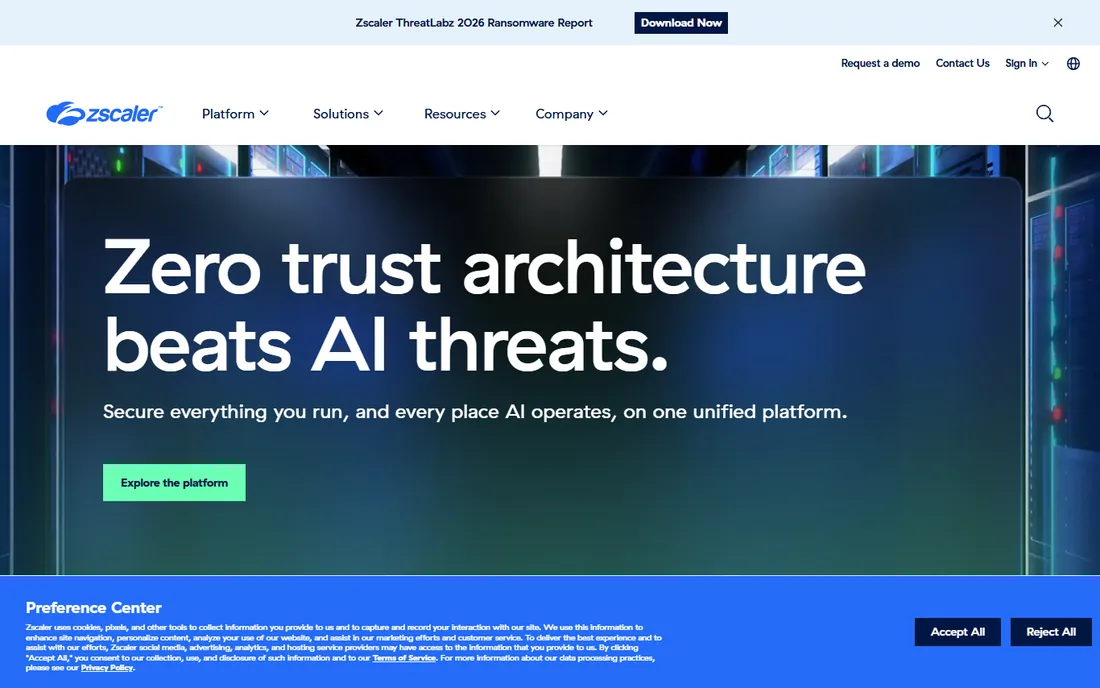
Zscaler is the zero trust poster child, and its DLP rides on the Zero Trust Exchange. Instead of agents on every endpoint doing the heavy lifting, traffic is inspected inline in Zscaler's cloud as users reach the internet, SaaS apps and private applications. Data protection policies apply consistently whether the user is in the office or on a home network.
The platform secures over 750 billion transactions a day according to the company, and more than half of the Fortune 500 use it. DLP here is part of a bigger SSE and SASE story that includes secure web gateway, CASB, firewall as a service and zero trust network access. Pricing is quote based and usually bundled.
What we like- DLP inspection inline on the Zero Trust Exchange, massive scale, no hardware
Watch out for- Cloud-only architecture
- Pricing is quote based and bundle dependent
Starting priceSee website
Free planNo
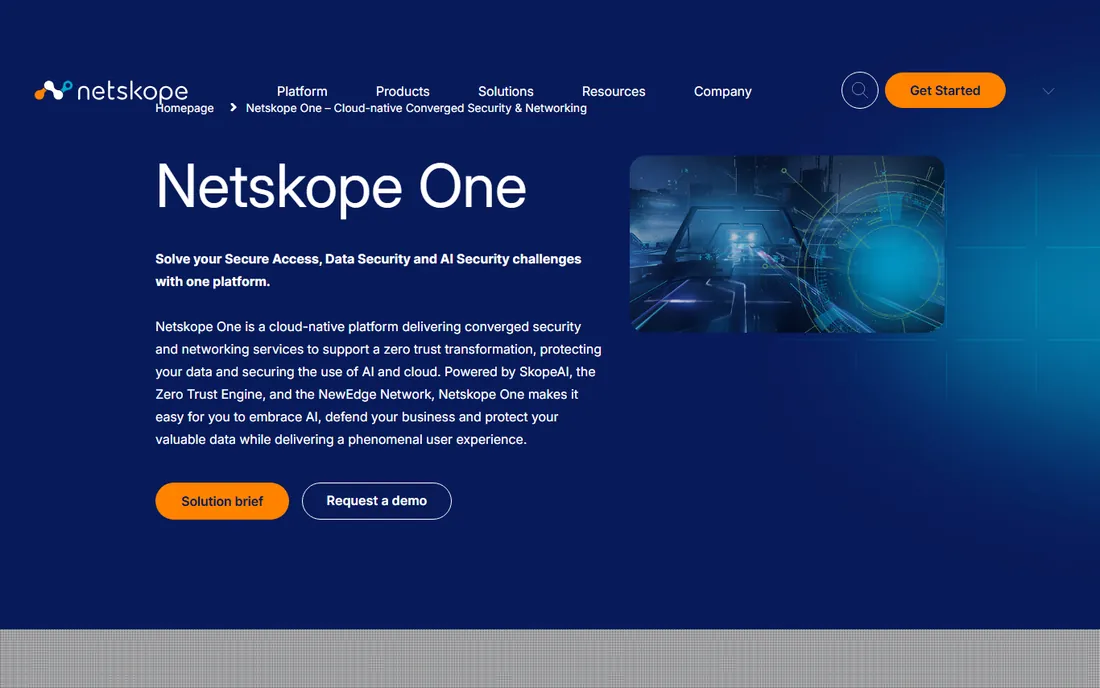
Netskope One is the converged platform for teams that want SASE, SSE and data security from one vendor. The pitch is consolidation. One Zero Trust engine, one client on the endpoint, one console for policy, and one private cloud network called NewEdge underneath. DLP is built into that fabric rather than added as a module, with cloud-delivered inspection powered by thousands of data classifiers.
The 2026 platform adds AI security capabilities for governing public and private AI use, which matters as employees paste sensitive data into chatbots. Netskope is a leader in the Gartner Magic Quadrant for both SASE Platforms and SSE. Pricing is quote based. The evaluation will be long because the platform is broad, touching networking, security and data protection.
What we like- One engine, client and console for SASE and DLP
- Strong AI security story
Watch out for- Broad platform means long evaluations
- Quote-based pricing
Starting priceSee website
Free planNo
Cato Networks sells the simplest story in SASE. One vendor, one global cloud, one policy engine covering networking and security. For IT teams drowning in point products, that simplicity is the entire value proposition.
The SASE Cloud converges SD-WAN, firewall as a service, secure web gateway, zero trust network access, CASB and DLP into one service with a single-pass engine. Deployment is famously fast for the category, with new sites and users onboarded in hours. Cato was named a leader in the 2026 Gartner Magic Quadrant for SASE Platforms for the third year running. Pricing is quote based. The honest tradeoff is depth. Cato's DLP is competent but not as granular as the dedicated DLP vendors, so data-centric organizations should compare policy capabilities closely.
What we like- True single-vendor SASE with one policy engine, fast deployment, predictable model
Watch out for- Less granular DLP than the dedicated DLP vendors
- Smaller partner ecosystem
Starting priceSee website
Free planNo
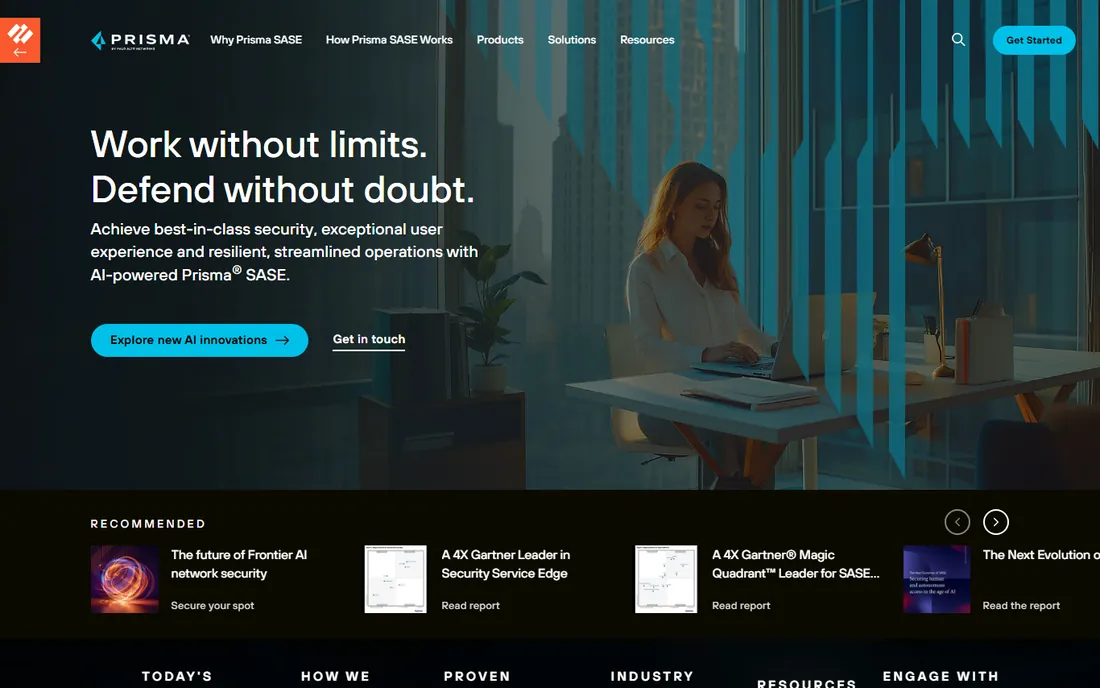
Prisma SASE is Palo Alto Networks' answer for enterprises that already live in its ecosystem. It combines SD-WAN, cloud-delivered security services, zero trust network access and digital experience management into what the company calls the industry's most comprehensive SASE solution. Data protection, including DLP, runs as part of the unified policy set.
The 2026 positioning leans on AI, with Precision AI used across threat prevention and data security, and a SASE-native secure browser for unmanaged devices. Customer stories span manufacturing, retail and global supply chains. Pricing is quote based and sits at the premium end. The value compounds inside the Palo Alto stack, where shared telemetry and policy make the whole greater than the parts. As a standalone purchase against best-of-breed competitors, the premium is harder to justify.
What we like- Comprehensive SASE with AI-powered security, deep integration with Palo Alto stack
Watch out for- Premium pricing
- Strongest case requires buying into the ecosystem
How we chose
We opened every vendor homepage and read the current product pages, solution briefs and documentation. Prices come from the vendors' own pricing pages. Microsoft publishes its Purview Suite price, and we verified the current $12 per user per month figure on microsoft.com. Every other vendor in this category prices by quote, so we say so rather than repeating third-party estimates. We checked analyst recognition, including Gartner Magic Quadrant placements, against the vendors' own announcements. We left out discontinued products and pure-play tools that do not cover the DLP or SASE scope. No vendor paid for placement and we did not claim hands-on testing.
DLP or SASE: which one do you actually need?
The two solve overlapping problems from opposite directions, and many buyers confuse them. DLP asks where sensitive data is and stops it from leaving. SASE asks how users and devices connect, and secures the path. In practice, modern products blur the line, but the starting question still matters.
Choose a DLP-first product when your problem is data-centric. You handle regulated data, intellectual property or customer records, and your biggest fear is that data walking out through email, USB drives or cloud uploads. Symantec, Forcepoint, Trellix, Digital Guardian and Proofpoint are built for this. They watch the endpoint deeply, classify content precisely and give compliance teams the reports auditors ask for.
Choose a SASE-first platform when your problem is architecture. Your users are everywhere, your apps are in the cloud, and backhauling traffic through a data center security stack is slow and expensive. Zscaler, Netskope One, Cato and Prisma SASE replace that model with cloud-delivered security close to the user, and DLP comes along as part of the package.
Many organizations end up with both. A SASE platform secures the connection, and an endpoint DLP agent watches data at rest on the laptop. That is a legitimate design, not a failure. What you should avoid is buying two products that do the same job and discovering the overlap during deployment.
What to verify before signing a DLP or SASE contract
Start with a proof of concept on your own traffic, not a vendor demo. DLP lives or dies on false positive rates, and you will only learn yours by running real data through the policies.
Confirm the pricing model in writing
Only Microsoft publishes a price here. Everyone else quotes. Get the per-user annual cost, the minimum seat count, and what happens at renewal. Ask specifically about add-ons, because features like cloud DLP, endpoint DLP and CASB are often licensed separately even when they share a console.
Test the channels you actually use
A DLP product that is excellent on Windows endpoints and email may be thin on macOS, mobile or Google Workspace. List every channel your sensitive data touches, then test each one. For SASE, test from the locations your users actually work, including home networks and international offices, and measure the latency impact.
Ask about the AI data problem
Employees are pasting sensitive content into public AI tools today. Ask each vendor exactly how they discover AI app usage, what they can inspect in prompts and responses, and whether the controls work on unmanaged devices. The answers vary widely, and this is now a standard evaluation criterion.
Plan the policy tuning effort
DLP is not set and forget. Budget staff time for the first 90 days of policy tuning, and ask the vendor what onboarding help is included. Products with user coaching features reduce the helpdesk load because employees correct themselves before violating policy.
Check data residency and privacy
DLP systems see your most sensitive data by design. Ask where inspection happens, where logs are stored, and whether the vendor offers regional data residency. Proofpoint and Microsoft both document multi-region options. Get the answers in the contract, not just the sales deck.
Frequently asked questions
What is data loss prevention software?
Data loss prevention software monitors where sensitive data lives and how it moves, then blocks, quarantines or encrypts it when policies are violated. It covers data at rest on storage, data in motion across networks and email, and data in use on endpoints like copy and paste or USB transfers.
What is SASE and how does it relate to DLP?
SASE, or secure access service edge, converges networking and security into a cloud-delivered service. It includes components like secure web gateway, firewall as a service and zero trust network access. DLP is often built into SASE platforms, so one product can secure both the connection and the data traveling over it.
Can one platform replace separate DLP and network security tools?
Sometimes. Converged platforms combine SASE and DLP in one service, which reduces vendor sprawl. But dedicated DLP vendors still offer deeper content inspection and endpoint control. The right answer depends on whether your primary risk is the network path or the data itself.
How much does DLP software cost?
Almost every vendor prices by quote on annual per-user contracts. The one published price in this guide is Microsoft Purview at $12 per user per month paid yearly, plus the required Microsoft 365 E3 underneath. For the rest, expect enterprise pricing that varies with seat count, modules and region. Always get competing quotes.
Does DLP work for remote and hybrid teams?
Yes, and this is now the standard use case. Endpoint agents from vendors like Trellix and Digital Guardian protect laptops off the corporate network, while SASE platforms inspect traffic wherever the user connects. During evaluation, test specifically from home networks and unmanaged devices, since that is where gaps usually appear.
Will DLP slow down my employees?
It can if it is badly tuned. Poorly written policies generate false positives that block legitimate work and flood the helpdesk. Well-tuned DLP with user coaching adds little friction, because employees get a warning and a chance to justify their action. Budget time for the first months of tuning, because that is what separates a smooth deployment from a painful one.
Sources we checked (10)
- https://www.broadcom.com/products/cybersecurity/information-protection
- https://www.microsoft.com/en-us/security/business/information-protection/microsoft-purview-data-loss-prevention
- https://www.forcepoint.com/product/dlp-data-loss-prevention
- https://trellix.com/products/dlp/
- https://www.fortra.com/product-lines/digital-guardian
- https://www.proofpoint.com/us/resources/data-sheets/enterprise-data-loss-prevention
- https://www.zscaler.com/
- https://www.netskope.com/netskope-one
- https://catonetworks.com/
- https://www.paloaltonetworks.com/sase
Is your product missing or out of date?
We review this list regularly. Vendors can request a listing, send updated pricing or ask about featured placement.

Shihab Mia · Founder, Rankite
Shihab has 5+ years in B2B and SaaS SEO. He writes Rankite's software buying guides from pricing pages, documentation and public user reviews. More about Shihab.
 Symantec DLP
 Microsoft Purview DLP
 Forcepoint DLP
 Trellix DLP
 Digital Guardian
 Proofpoint Enterprise DLP
 Zscaler
 Netskope One
 Cato Networks
 Prisma SASE