How we make this list: we compare pricing pages, product documentation and public user reviews. Ratings come from G2, Capterra or Trustpilot, with the date we checked them.
Key takeaways
- Testing tools split into frameworks you run yourself, like Playwright and Selenium, clouds that run tests for you, like BrowserStack and Sauce Labs, and management tools like TestRail.
- Playwright is free for everything Cypress charges for, including parallelization, trace viewing and test analytics, which makes it the value pick for new projects.
- Selenium remains the most widely used framework thanks to multi-language support and maturity, but running Selenium Grid at scale costs real operations effort.
- Test management is a separate purchase from automation: frameworks run tests, while TestRail and similar tools plan, organize and report them.
Quick comparison
| Tool | Best for | Starting price | Free plan |
|---|
 Playwright | Modern cross-browser automation | $0 | Yes (MIT licence) |
 Selenium | Multi-language browser automation | $0 | Yes (Apache 2.0 licence) |
 Cypress | JavaScript-first web testing | $0 | Yes (open-source runner) |
 BrowserStack | Cloud browsers and real devices | $59 per month (Automate, billed annually) | Free trial |
 TestRail | Test case management | See website | Free trial |
 Appium | Mobile automation | $0 | Yes (open source) |
 Katalon | All-in-one test automation | See website | Free trial |
 JMeter | Performance and load testing | $0 | Yes (open source) |
 Robot Framework | Keyword-driven automation | $0 | Yes (open source) |
 Sauce Labs | Enterprise cloud testing | $39 per month | Free trial |
Is your product missing or out of date?
We review this list regularly. Vendors can request a listing, send updated pricing or ask about featured placement.
#1Playwright
Best for: Modern cross-browser automation4.8/5 on
G2 (14 reviews, checked Oct 2026)
Visit playwright.dev
Starting price$0
Free planYes (MIT licence)
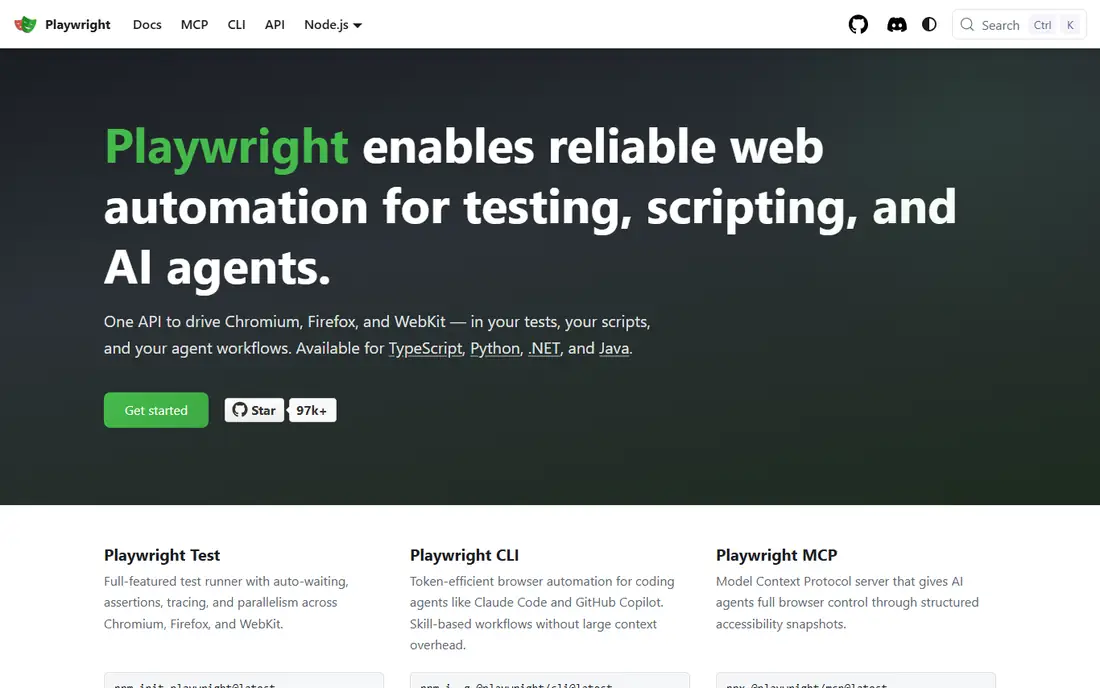
Playwright leads new-project choices in 2026 for a simple reason: it includes for free everything rivals charge for. Parallel execution, trace viewing for debugging, code generation for scaffolding, and test analytics through the HTML reporter all ship in the open-source tool. It automates Chromium, Firefox and WebKit with one API, and its auto-waiting design produces fewer flaky tests than older frameworks.
The gap is collaboration: there is no hosted cloud dashboard with team features, so teams rely on CI artifacts and the HTML report. For many teams that is enough, and the zero license cost means the budget goes to infrastructure instead. Playwright fits new web projects, JavaScript and TypeScript teams, and any team that wants modern automation without a subscription.
What we like- Free parallelization, trace viewer and codegen
- Multi-browser support
- Built-in test analytics via HTML reporter
Watch out for- No hosted cloud dashboard with team collaboration
- Newer ecosystem than Selenium
#2Selenium
Best for: Multi-language browser automation4.5/5 on
G2 (27 reviews, checked Oct 2026)
Visit selenium.dev
Starting price$0
Free planYes (Apache 2.0 licence)
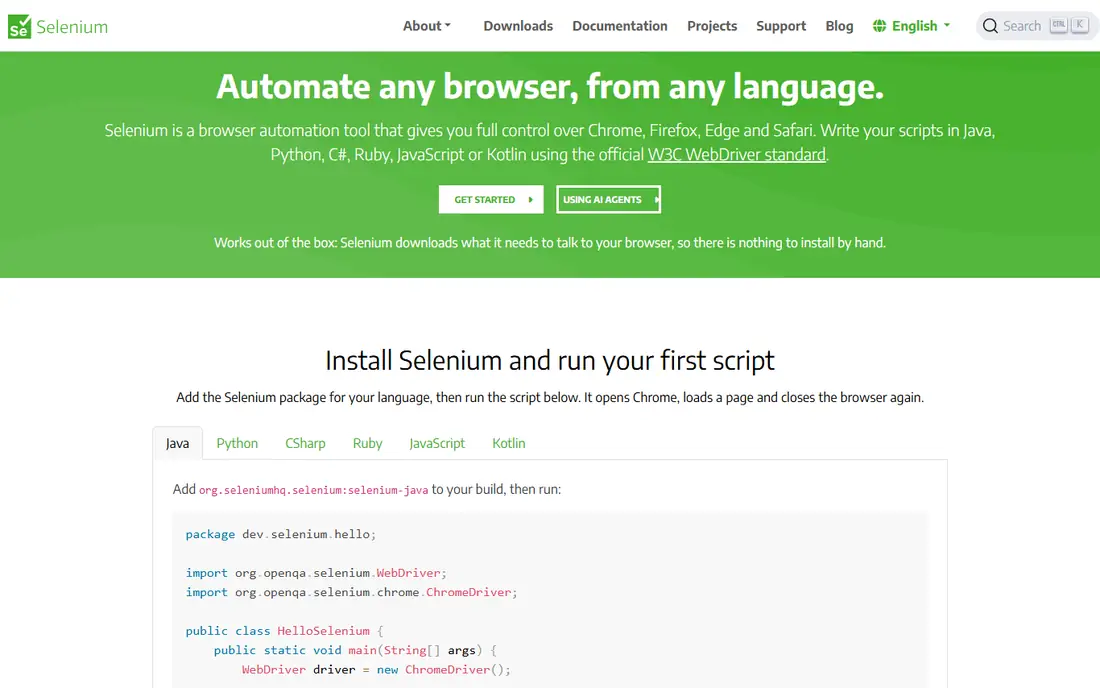
Selenium remains the most widely used browser automation framework, and its strengths are maturity and language choice: Java, Python, C#, Ruby and JavaScript teams can all use it, and decades of guides, drivers and integrations exist. Selenium Grid distributes tests across machines and browsers, and cloud providers like BrowserStack and Sauce Labs run Selenium suites without local infrastructure.
The cost is operational. Someone must maintain Grid nodes, handle browser version updates and debug infrastructure failures, and comparisons put a 20-person QA team on Selenium plus BrowserStack near $600 per month. Selenium fits teams with existing suites, legacy infrastructure or language requirements Playwright does not cover, and any team that values the largest ecosystem over the newest API.
What we like- Most widely used framework
- Multi-language support
- Huge community and grid ecosystem
Watch out for- Grid infrastructure at scale costs operations effort
- More setup than Playwright
#3Cypress
Best for: JavaScript-first web testing4.7/5 on
G2 (107 reviews, checked Oct 2026)
Visit cypress.io
Starting price$0
Free planYes (open-source runner)
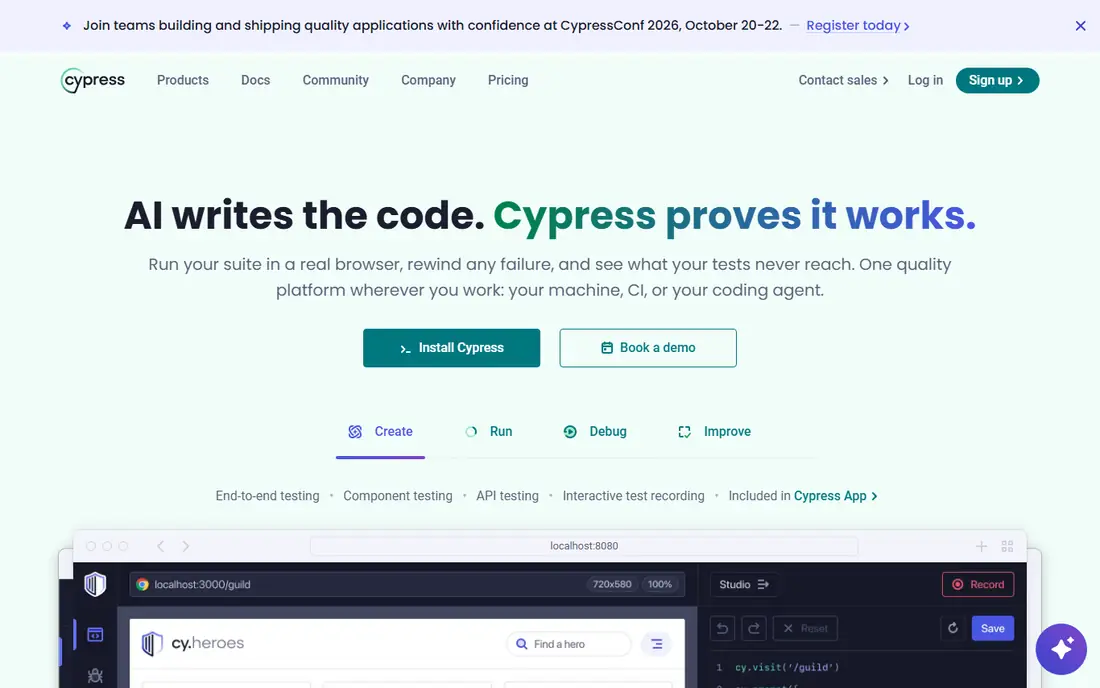
Cypress wins JavaScript-first teams on developer experience: tests run in the browser with time-travel debugging, readable commands and fast feedback. The open-source runner is free, and the Cloud Team plan costs $67 per month on annual billing with 120,000 test results per year, while Business at $267 per month adds unlimited results and fuller analytics.
That paywall is the trade. Parallelization, flake detection depth and team analytics live in Cypress Cloud, while Playwright includes them free. Cypress fits JavaScript and TypeScript teams that value its debugging experience and already live in its ecosystem, and that can justify the cloud subscription as the team grows.
What we like- Excellent developer experience
- Time-travel debugging
- Easy setup for JavaScript teams
Watch out for- Paid cloud dashboard for parallelization and analytics
- Limited multi-browser scope versus Playwright
#4BrowserStack
Best for: Cloud browsers and real devices4.4/5 on
G2 (3,361 reviews, checked Oct 2026)
Visit browserstack.com
Starting price$59 per month (Automate, billed annually)
Free planFree trial
BrowserStack removes the need to maintain browser and device infrastructure. Automate runs Selenium, Playwright, Cypress and Nightwatch suites across more than 3,500 desktop and mobile browser and OS combinations, with a local tunnel for staging apps behind a firewall. Failed runs return video, screenshots and unified logs instead of a bare stack trace.
Pricing starts at $59 per month on annual billing for Automate, while the Desktop and Mobile plan starts at $175 per month, and parallels multiply the bill. BrowserStack fits teams that need real Safari and macOS coverage without a Mac fleet, broad device coverage, or a cloud grid for existing Selenium and Playwright suites.
What we like- More than 3,500 browser and OS combinations
- Real devices
- Video, screenshots and unified logs per run
Watch out for- Costs scale with parallels
- Desktop and mobile plan starts at $175 per month
#5TestRail
Best for: Test case management4.4/5 on
G2 (611 reviews, checked Oct 2026)
Visit testrail.com
Starting priceSee website
Free planFree trial
TestRail is the test management layer, not an automation runner: it organizes test cases, plans runs, tracks results and reports coverage across manual and automated testing. More than 70 integrations connect it to Jira, CI tools and automation frameworks, and both cloud and on-premises Server deployments exist. Established QA teams value its custom fields and reporting depth.
Pricing varies across guides, from around $35 per user per month in one comparison to $37 for Professional and $74 for Enterprise per seat in another, so this article marks it "See website" pending a live check. TestRail fits teams that need structured test management at scale, and it pairs with any automation framework in this list.
What we like- Deep test case organization
- More than 70 integrations
- Cloud and on-premises deployment
Watch out for- Pricing varies across guides
- It manages tests rather than running them
#6Appium
Best for: Mobile automation4.4/5 on
G2 (63 reviews, checked Oct 2026)
Visit appium.io
Starting price$0
Free planYes (open source)
Appium is the open-source standard for mobile automation, driving iOS and Android apps on real devices, simulators and emulators from one API. It works with Java, JavaScript, Python, Ruby and .NET, and it runs on device clouds like BrowserStack and Sauce Labs as well as local labs. Teams testing native, hybrid and mobile web apps can use one framework for all three.
The cost is setup and device management: Appium itself is free, but real devices, simulators and cloud parallels are not, and flaky mobile tests need care. Appium fits teams that need full-control cross-platform mobile automation and are willing to invest in the harness around it.
What we like- Cross-platform mobile automation
- Works with real devices and emulators
- Multi-language support
Watch out for- Setup takes effort
- Real-device execution needs a cloud or a device lab
#7Katalon
Best for: All-in-one test automation4.4/5 on
G2 (226 reviews, checked Oct 2026)
Visit katalon.com
Starting priceSee website
Free planFree trial
Katalon bundles web, mobile, API and desktop testing into one platform with both scripted and low-code test creation, plus AI-assisted features. That breadth suits teams that want one vendor for every testing lane instead of stitching frameworks together, and its recorders help testers who do not code full-time contribute real tests.
Pricing is not published as a simple entry rate in the sources checked, so this article marks it "See website". Katalon fits QA teams that value an all-in-one platform and low-code creation over the flexibility of pure code frameworks like Playwright or Selenium.
What we like- Web, mobile, API and desktop testing in one platform
- Low-code options
- AI features
Watch out for- Pricing not published as a simple entry rate
- Heavier than single-purpose frameworks
Starting price$0
Free planYes (open source)
Apache JMeter is the free standard for performance and load testing: it simulates many users against web apps, APIs and services, measures response times and throughput, and reports where performance breaks under load. Its plugin ecosystem extends it to many protocols, and it runs in CI pipelines alongside functional suites.
JMeter does not replace functional UI testing, and its interface feels dated next to modern tools. It fits any team that needs to prove an app holds up under traffic, and it costs nothing beyond the machines that generate the load. Run it before launch, not after users find the bottleneck.
What we like- Free performance and load testing
- Mature plugin ecosystem
- Scriptable and CI-friendly
Watch out for- Interface feels dated
- Not a functional UI testing tool
Starting price$0
Free planYes (open source)
Robot Framework uses keyword-driven test cases that read almost like plain language, which makes tests accessible to testers, analysts and business stakeholders who do not write code daily. Libraries cover web, API, mobile and desktop testing, and tests can mix keywords with Python or Java code where logic gets complex.
The trade is expressiveness: deeply programmatic test logic fits code frameworks better, and the ecosystem is smaller than Selenium or Playwright. Robot Framework fits acceptance testing, teams with mixed technical skills, and organizations that want readable tests as living documentation.
What we like- Readable keyword-driven tests
- Multi-language libraries
- Strong fit for acceptance testing
Watch out for- Less suited to complex programming logic
- Ecosystem smaller than Selenium or Playwright
#10Sauce Labs
Best for: Enterprise cloud testing4.3/5 on
G2 (185 reviews, checked Oct 2026)
Visit saucelabs.com
Starting price$39 per month
Free planFree trial
Sauce Labs is the enterprise cloud testing platform, running tests across real and virtual browsers and thousands of real devices, with CI/CD integration and analytics built for large QA organizations. Cross-browser testing starts around $39 per month in one comparison, while the Real Device Cloud runs around $199 per month and enterprise execution is custom.
That spread is the point: Sauce Labs prices by lane, so buyers should price the exact combination they need rather than the headline rate. It fits enterprises that need broad cloud coverage, strong analytics and vendor support, and that already run Selenium, Appium, Espresso or XCUITest suites.
What we like- Real and virtual browsers and devices
- Strong CI/CD integration
- Enterprise analytics
Watch out for- Real-device cloud costs far more than entry cross-browser rates
- Enterprise tiers are custom
How we chose
We compared tools on the testing lane each covers, pricing transparency, free tier quality and the limits reviewers cite most often. Sources included vendor pages and independent comparisons checked in October 2026, including a Playwright versus Cypress versus Selenium pricing comparison and a test management comparison. Where prices conflicted across guides, the article says "See website" instead of picking one figure. We did not claim hands-on testing.
What to check before you sign
Start by naming the lane you need: web automation, mobile automation, performance, or test management. A team that buys a management tool expecting it to run tests, or a cloud platform expecting it to write tests, wastes the subscription. Most teams need one framework, one execution cloud or grid, and one management tool, not three of each.
Next, run a real suite through a trial and measure flakiness, debugging time and the bill at your parallel count. Playwright and Selenium are free at the tool level, but infrastructure and cloud parallels set the real cost. For Cypress, price the Cloud plan your team size actually needs, since the free runner alone lacks team analytics.
Finally, keep tests maintainable from day one. Use page objects or equivalent patterns, isolate test data, and delete flaky tests instead of rerunning them until they pass. A test suite nobody trusts gets ignored, and an ignored suite costs more than no suite at all.
Frequently asked questions
What is the best software testing tool overall?
There is no single winner, because testing has several lanes. Playwright leads for new web automation, Selenium leads for multi-language maturity, BrowserStack and Sauce Labs lead for cloud execution, and TestRail leads for test management. Pick by lane, then by budget.
Is there a free software testing tool?
Yes. Playwright, Selenium, Appium, JMeter and Robot Framework are all free and open source, and Cypress offers a free open-source runner. Paid costs appear for cloud execution, dashboards and management, not for the frameworks themselves.
Is Playwright better than Selenium?
For new projects, usually yes: Playwright offers better reliability, built-in parallelization, native multi-browser support and a richer API at zero cost. Selenium remains relevant for existing suites, legacy infrastructure and language requirements Playwright does not cover.
What is the difference between TestRail and Cypress?
Cypress runs automated web tests, while TestRail manages test cases, plans runs and reports results across manual and automated testing. They complement each other: Cypress executes, TestRail organizes.
How much does cloud testing cost?
BrowserStack Automate starts around $59 per month on annual billing, Sauce Labs cross-browser testing around $39 per month, and real-device clouds around $175 to $199 per month per parallel. Costs scale with parallels, so price your actual concurrency.
Do I need test management software?
Small teams can track tests in spreadsheets or issue trackers, but growing teams need structured cases, run history and coverage reporting. TestRail and similar tools pay off when manual and automated testing must be planned and reported together.
Sources we checked (4)
- https://techsy.io/en/blog/playwright-vs-cypress-vs-selenium
- https://tuskr.app/article/browserstack-test-management-alternatives
- https://www.pcloudy.com/blogs/software-testing-tools/
- https://www.itechguides.com/products/sauce-labs-cross-browser-testing/alternatives/
Is your product missing or out of date?
We review this list regularly. Vendors can request a listing, send updated pricing or ask about featured placement.

Shihab Mia · Founder, Rankite
Shihab has 5+ years in B2B and SaaS SEO. He writes Rankite's software buying guides from pricing pages, documentation and public user reviews. More about Shihab.