How we make this list: we compare pricing pages, product documentation and public user reviews. Ratings come from G2, Capterra or Trustpilot, with the date we checked them.
Key takeaways
- TestProject was discontinued on March 31, 2023, so any team still on it needs a supported replacement now.
- Katalon and mabl are the closest replacements for teams that want low-code test creation with web, mobile, and API coverage.
- Cypress and Playwright suit developer-led teams that prefer code-based testing and open source tooling.
- Tricentis Tosca and Testim are the natural path for enterprises already in the Tricentis family.
- Selenium and BrowserStack cover the free and cloud-execution ends of the range, and they pair well together.
Quick comparison
| Tool | Best for | Starting price | Free plan |
|---|
 Katalon | teams that want one platform for web, mobile, API, and desktop | See website | Yes |
 Tricentis Tosca | enterprises with large, complex test suites | See website | No |
 Tricentis Testim | AI-assisted web test automation | See website | Free trial |
 mabl | cloud-native teams that want low maintenance | See website | Free trial |
 Cypress | developer-led web testing | See website | Yes |
 Playwright | cross-browser automation in several languages | See website | Yes |
 Selenium | free, standard browser automation | See website | Yes |
 BrowserStack | testing on real devices and browsers in the cloud | See website | Free trial |
Is your product missing or out of date?
We review this list regularly. Vendors can request a listing, send updated pricing or ask about featured placement.
The best testproject alternatives
#1Katalon
Best for: teams that want one platform for web, mobile, API, and desktop4.4/5 on
G2 (226 reviews, checked Oct 2026)
Visit katalon.com
Starting priceSee website
Free planYes
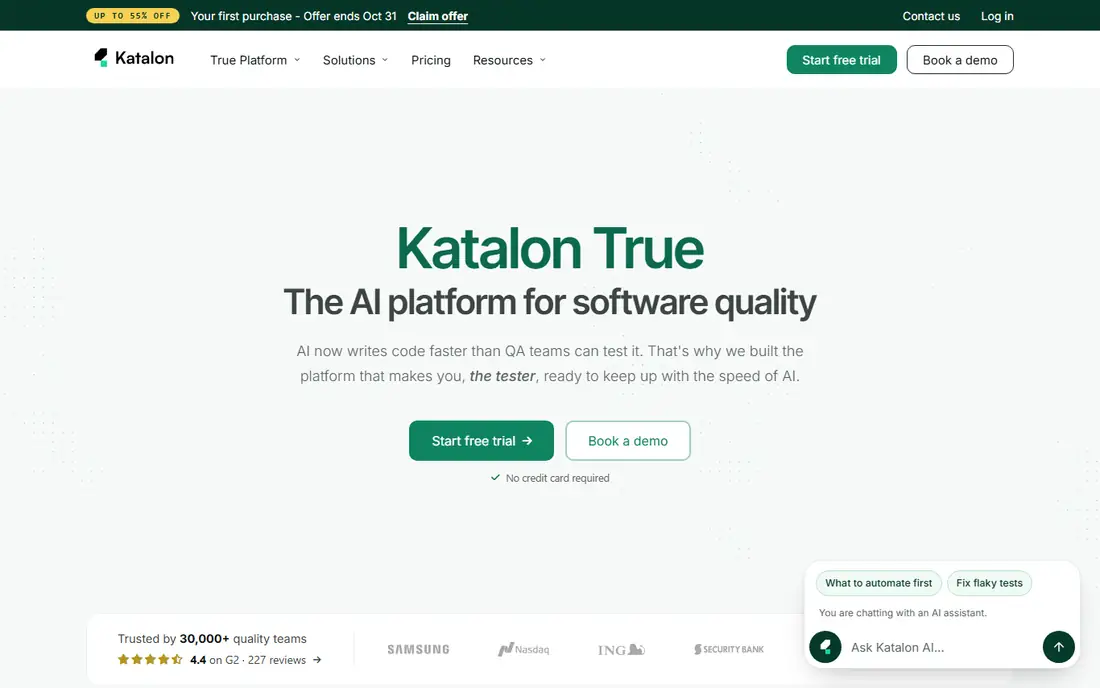
Katalon is the most direct replacement for TestProject because it covers the same ground: web, mobile, API, and desktop testing in one platform, with both recording and scripting. Testers without deep coding skills can record tests, while engineers can drop into Groovy scripting when a test needs custom logic. That mix is what made TestProject popular, and Katalon carries it further.
The platform includes test management, reporting, and integrations with CI tools, so a team can run tests on every build. A free version lets a small team start without a purchase order. The limits are familiar for all-in-one tools: paid plans rise with team size, and a tiny project with ten tests may find Katalon heavier than a code-only framework.
What we like- Low-code recording plus scripting
- Wide coverage
- Free version available
Watch out for- Paid plans climb with team size
- Heavyweight for tiny projects
#2Tricentis Tosca
Best for: enterprises with large, complex test suites4.3/5 on
G2 (76 reviews, checked Oct 2026)
Visit tricentis.com
Starting priceSee website
Free planNo

Tricentis Tosca is the enterprise tool that Tricentis pointed TestProject users toward when it shut the free platform down. It uses model-based testing, where testers build a model of the application and generate test cases from it, which reduces maintenance when the application changes. That approach pays off for large suites that would otherwise break on every release.
Tosca integrates with SAP, Salesforce, and other enterprise systems, and it supports API, mobile, and end-to-end testing. Support is available around the clock on business days for enterprise customers. The cost is the main barrier, and the learning curve is real: a team should budget training time. For a large enterprise already using Tricentis products, Tosca is the natural home.
What we like- Model-based testing
- Strong enterprise integrations
- Long track record
Watch out for- Enterprise pricing
- Steep learning curve for new teams
#3Tricentis Testim
Best for: AI-assisted web test automation4.5/5 on
G2 (54 reviews, checked Oct 2026)
Visit testim.io
Starting priceSee website
Free planFree trial
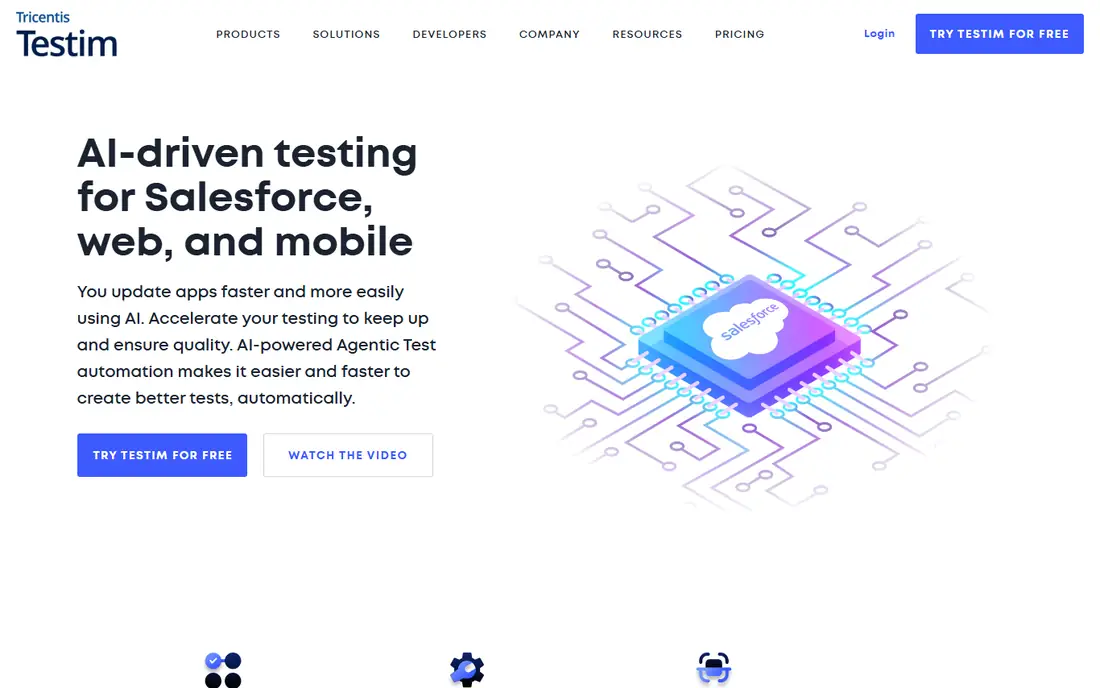
Testim, also from Tricentis, focuses on web test automation with AI-assisted authoring and self-healing tests. When an application changes, Testim adapts locators instead of failing every test, which cuts the maintenance burden that kills many automation efforts. Tests can be recorded in a browser and then edited with code when needed.
The platform integrates with CI pipelines and popular test runners, so tests run on every commit. Reporting shows failures with screenshots and network details, which speeds up debugging. Testim is web-focused, so mobile teams need a second tool, and pricing can be high for small teams. For a web team that wants low maintenance, it is a strong pick.
What we like- AI self-healing tests
- Fast authoring
- Good CI integration
Watch out for- Web-focused
- Pricing can be high for small teams
#4mabl
Best for: cloud-native teams that want low maintenance4.4/5 on
G2 (40 reviews, checked Oct 2026)
Visit mabl.com
Starting priceSee website
Free planFree trial
mabl is a cloud-native test automation platform that emphasizes low maintenance. Its tests heal themselves when the application changes, and it includes visual checks, API testing, and performance insights in the same run. A team can start with recorded tests and add JavaScript steps where needed, which suits mixed teams of testers and developers.
Setup with CI tools is quick, and the cloud runner removes the need to maintain test infrastructure. mabl also tracks performance trends, so a team can spot a slow page before users complain. The trade-off is control: a team that wants full code-level control will prefer Playwright or Cypress. Pricing is quote-based for larger usage, so small teams should confirm costs during a trial.
What we like- Auto-healing tests
- Built-in performance checks
- Easy CI setup
Watch out for- Less control than code frameworks
- Pricing is quote-based for larger use
#5Cypress
Best for: developer-led web testing4.7/5 on
G2 (107 reviews, checked Oct 2026)
Visit cypress.io
Starting priceSee website
Free planYes
Cypress is the developer favorite for web testing. Tests run in the browser alongside the application, which gives fast feedback and excellent debugging: time travel, screenshots, and network stubbing are built in. The JavaScript and TypeScript API is clean, and the community is large, so answers to common problems are easy to find.
Cypress offers a free open source runner and a paid cloud dashboard for parallel runs and test analytics. The limits are known: multi-tab flows and native mobile apps are not its strengths, and teams outside JavaScript need another tool. For a web team that writes code, Cypress delivers the fastest feedback loop on this list.
What we like- Fast feedback
- Great debugging
- Large community
Watch out for- Limited multi-tab and mobile app support
- JavaScript only
#6Playwright
Best for: cross-browser automation in several languages4.8/5 on
G2 (14 reviews, checked Oct 2026)
Visit playwright.dev
Starting priceSee website
Free planYes
Playwright, from Microsoft, is a free open source framework for browser automation across Chromium, Firefox, and WebKit. It supports JavaScript, Python, Java, and .NET, and it includes auto-waiting, network interception, and tracing that makes failures easy to diagnose. Tests run fast in parallel, and the tool handles modern web apps well.
Because Playwright is code-only, it needs engineers to write and maintain tests. There is a code generator that records actions into code, but the workflow is still code-first. For a team with engineering capacity, Playwright is the most capable free option here, and it pairs well with BrowserStack for real-device runs. For a non-coding QA team, Katalon or mabl will be easier.
What we like- Free and open source
- All major browsers
- Auto-waiting and tracing
Watch out for- Code-only, no recorder-first workflow
- Needs engineering time
#7Selenium
Best for: free, standard browser automation4.5/5 on
G2 (27 reviews, checked Oct 2026)
Visit selenium.dev
Starting priceSee website
Free planYes
Selenium is the foundation that TestProject itself was built on, and it remains the standard for browser automation. It is free, open source, and supports every major programming language and browser. The ecosystem is enormous: grid setups, cloud runners, frameworks, and community knowledge built over two decades.
The cost of that freedom is maintenance. Selenium gives you the automation engine but not reporting, self-healing, or test management, so a team builds those pieces itself or buys them from another vendor. For a team with strong engineering skills and a tight budget, Selenium is still a solid choice. For a team that wants a complete product, Katalon or mabl will save time.
What we like- Free and open source
- Every major language
- Huge ecosystem
Watch out for- More setup and maintenance
- No built-in reporting or healing
#8BrowserStack
Best for: testing on real devices and browsers in the cloud4.4/5 on
G2 (3,361 reviews, checked Oct 2026)
Visit browserstack.com
Starting priceSee website
Free planFree trial
BrowserStack is not a test authoring tool but a cloud platform for running tests on real devices and browsers. Teams use it with Selenium, Playwright, Cypress, or Appium to cover device and browser combinations they cannot maintain locally. That makes it a natural companion to the code frameworks on this list rather than a direct replacement for TestProject alone.
The device cloud is large, covering current and older phones, tablets, and desktop browsers, and the platform integrates with CI pipelines. Pricing is usage-based, so costs scale with test volume. A team moving from TestProject should pair BrowserStack with an authoring tool: Playwright or Selenium for code teams, Katalon or mabl for low-code teams.
What we like- Huge real device cloud
- No local infrastructure
- Integrates with frameworks
Watch out for- Usage-based pricing
- Not a test authoring tool on its own
How we chose
We compared these tools on coverage of web, mobile, and API testing, authoring style, maintenance burden, pricing, and fit for different team sizes. We checked vendor pages and public comparison guides, and where pricing was not published we wrote See website instead of guessing. We kept the list to tools that a real team can use today, and we left out tools that have shut down, including TestProject itself.
How to migrate off TestProject without losing coverage
Start by listing what your TestProject suite actually covers: web flows, mobile flows, API tests, and scheduled runs. That inventory decides the replacement, because a web-only team and a mobile-heavy team need different tools. Export your test cases and any recorded steps before the old account data becomes unreachable, and keep the old suite running in parallel while you rebuild the highest-value tests first.
Next, pick the authoring style that matches your team. A QA team without coders should move to Katalon or mabl, while a developer-led team will move faster with Cypress or Playwright. Rebuild the critical user journeys first, such as login, checkout, and payment, and run them in CI before migrating the long tail of edge-case tests. Expect the rebuild to take weeks for a large suite, and treat it as a chance to delete tests that no longer match the product.
Finally, decide on execution. If you test on many devices or browsers, add BrowserStack or a similar cloud runner. If your tests only run on desktop Chrome, a local CI runner is enough. Measure the new suite on flakiness for a month: a replacement that fails randomly will erode trust faster than a slower but stable suite.
Frequently asked questions
Why did TestProject shut down?
Tricentis announced in November 2022 that TestProject would end, with new accounts disabled and existing accounts deactivated on March 31, 2023. The company focused on its commercial tools Tosca and Testim instead of the free platform.
What is the closest free replacement for TestProject?
Katalon offers a free version with low-code recording, while Playwright and Selenium are free open source frameworks for code-based teams. Katalon is closest for non-coders, while Playwright is closest for developers who want full control.
Can I import my TestProject tests into another tool?
There is no direct import path, so most teams rebuild their key tests in the new tool. Recorded steps and test case lists can guide the rebuild, but expect manual work, especially for tests that relied on TestProject-specific features.
Do I need separate tools for mobile testing?
If you test native mobile apps, yes. Cypress and Testim are web-focused, while Katalon, Tosca, and BrowserStack with Appium cover mobile. Check mobile coverage before committing, because it is the most common gap in a migration.
Is Selenium still worth using in 2026?
Yes, for teams with engineering capacity. Selenium remains the standard browser automation engine, and it pairs well with cloud runners. Teams that want built-in reporting and self-healing will prefer Katalon, mabl, or Testim.
How much does a TestProject replacement cost?
Costs range from free for Playwright and Selenium to quote-based enterprise pricing for Tosca. Katalon, mabl, and Testim sit in between, with trials available. Budget for the plan that covers your test volume and team size, not just the headline price.
Sources we checked (8)
- https://katalon.com
- https://www.tricentis.com
- https://www.testim.io
- https://www.mabl.com
- https://www.cypress.io
- https://playwright.dev
- https://www.selenium.dev
- https://www.browserstack.com
Is your product missing or out of date?
We review this list regularly. Vendors can request a listing, send updated pricing or ask about featured placement.

Shihab Mia · Founder, Rankite
Shihab has 5+ years in B2B and SaaS SEO. He writes Rankite's software buying guides from pricing pages, documentation and public user reviews. More about Shihab.