How we make this list: we compare pricing pages, product documentation and public user reviews. Ratings come from G2, Capterra or Trustpilot, with the date we checked them.
Key takeaways
- OpenTofu is the best free alternative, with full HCL and state compatibility under the MPL 2.0 license and no license cost.
- Spacelift is the best governed platform alternative, with multi IaC support, OPA policy, drift detection, and per worker pricing.
- Scalr is the best value managed alternative, with the simplest public pricing at $0.99 per run on Business and no charges for users or environments.
- Env0 is the best per apply alternative for unpredictable pipelines, with a free tier of 250 runs per month and per apply or environment pricing.
- Pulumi Cloud is the best alternative for teams that prefer real programming languages, with Essentials team plans from $40 per month.
Quick comparison
| Tool | Best for | Starting price | Free plan |
|---|
 OpenTofu | Free open source provisioning | Free | Yes |
 Spacelift | Governed multi IaC platform | Free | Yes |
 Env0 | Per apply pricing | Free | Yes |
 Scalr | Predictable per run pricing | Free | Yes |
 Pulumi Cloud | Programming language IaC | Free | Yes |
 Atlantis | Free pull request automation | Free | Yes |
 Crossplane | Kubernetes native control planes | Free | Yes |
 AWS CDK | AWS only estates | Free | Yes |
Is your product missing or out of date?
We review this list regularly. Vendors can request a listing, send updated pricing or ask about featured placement.
Starting priceFree
Free planYes
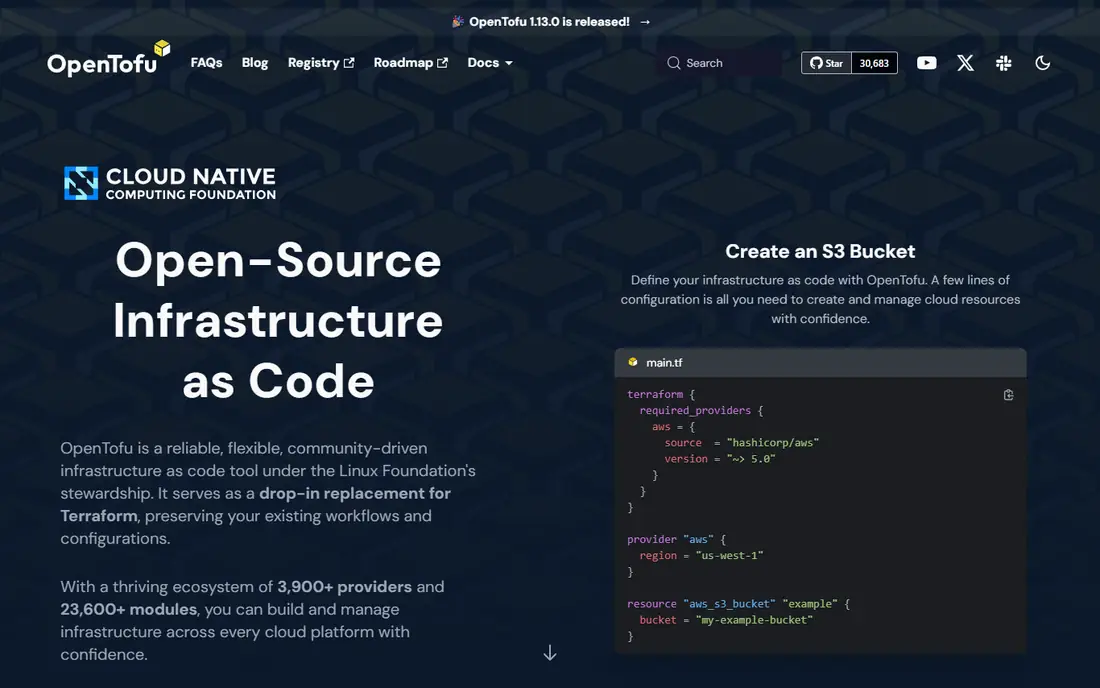
OpenTofu is the best free alternative, a community fork of Terraform under the MPL 2.0 license that keeps full HCL and state compatibility. Teams with existing HCL modules can switch binaries with minimal changes, and the same state format, backends, and provider registry concepts carry over. For a team that wants to avoid Business Source License restrictions, OpenTofu removes the licensing risk entirely.
There is no native policy as code, so teams replace Sentinel with OPA or Rego, and drift detection comes from third party platforms rather than the binary itself. For a team that runs infrastructure from CI or a managed platform anyway, OpenTofu is the cheapest and most portable foundation.
What we like- Fully open source under MPL 2.0
- Full HCL and state compatibility with Terraform
- Same provider and backend options
Watch out for- No native policy as code, use OPA or Rego instead
- No native drift detection
- Enterprise support comes from third parties
Starting priceFree
Free planYes
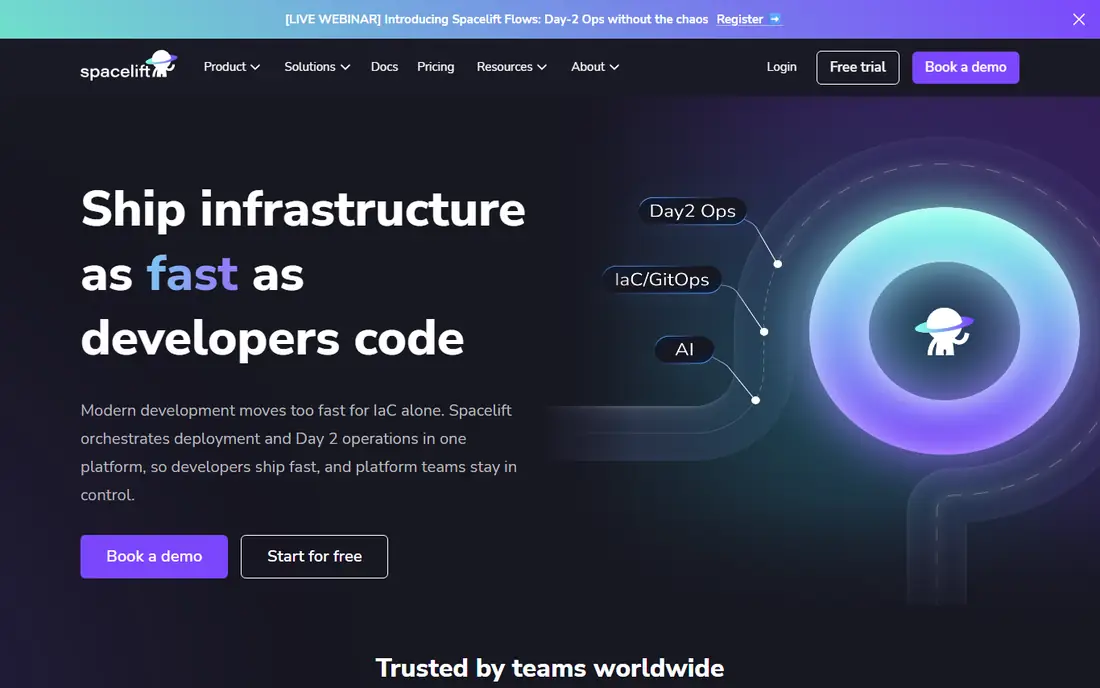
Spacelift is the best governed platform alternative, running Terraform, OpenTofu, Terragrunt, Pulumi, CloudFormation, Kubernetes, and Ansible from one control plane with OPA policy as code, drift detection, and dependency tooling. It is the deepest policy and governance platform among the alternatives, with self hosted workers or a fully self hosted control plane available. The free plan covers 2 users with 2 public workers, including state management, remote operations, and version control integration.
The first paid tier, Starter+, starts near $20,000 per year, which is a steep jump for small estates, and paid pricing is quote based. For a platform team that needs governance across several IaC tools, Spacelift is the most complete platform here.
What we like- Multi IaC support: Terraform, OpenTofu, Pulumi, CloudFormation, Kubernetes, Ansible
- OPA policy
- Drift detection
- Dependency tooling
Watch out for- First paid tier Starter+ starts near $20,000 per year, a steep jump for small estates
- Paid pricing is quote based
Starting priceFree
Free planYes
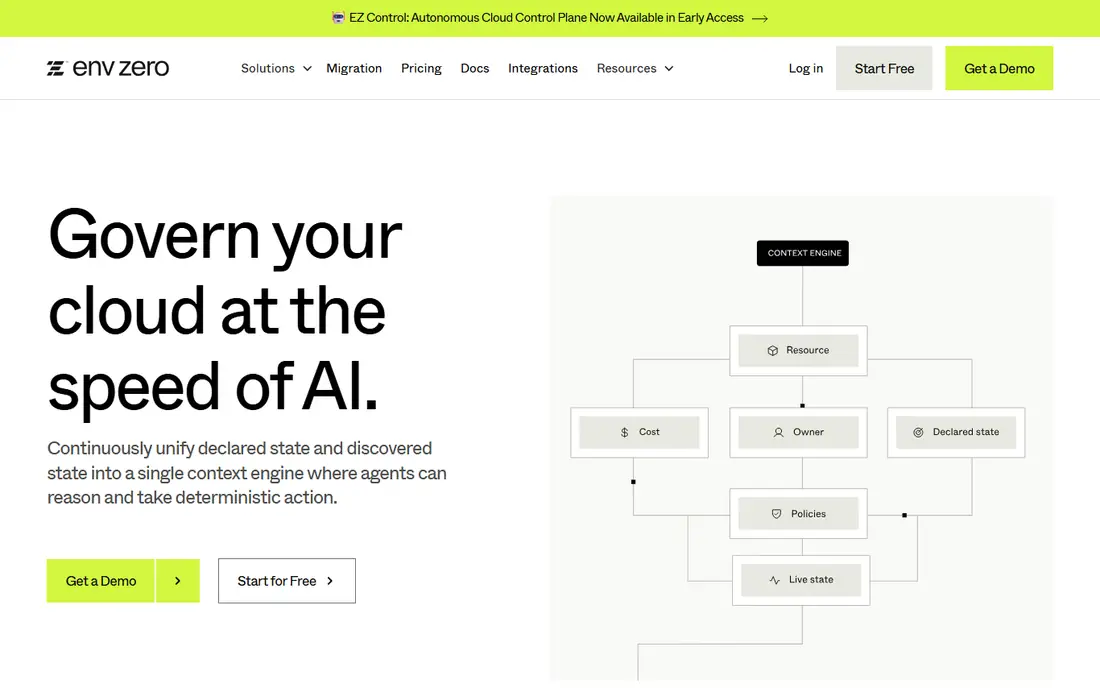
Env0 is the best per apply alternative for unpredictable pipelines, with a free tier of 250 runs per month and 30 environments, and custom pricing per successful apply or environment beyond that. Per apply metering fits teams whose pipeline volume varies month to month, since quiet months cost less than flat tier platforms. It supports Terraform, OpenTofu, Terragrunt, Pulumi, CloudFormation, Kubernetes, and Ansible, with OPA policy as code.
Paid pricing is quote only, so there is no public math to model, and the control plane is SaaS only with self hosted agents rather than a fully self hosted option. For a team with variable apply volume that wants governance without a flat tier commitment, env0 is a strong fit.
What we like- Multi IaC support including Terraform, OpenTofu, and Pulumi
- OPA policy
- Per apply or environment pricing
- Free tier of 250 runs per month
Watch out for- Paid pricing is quote only, so no public math
- No fully self hosted control plane, only self hosted agents
Starting priceFree
Free planYes
Scalr is the best value managed alternative, with the simplest public pricing on the market: a free tier of 50 runs per month, Business at $0.99 per run, and no charges for users, environments, or resources under management. A team running 100 runs per month pays about $99, which is easy to model and easy to explain to finance. It supports Terraform, OpenTofu, and Terragrunt as a drop in Terraform Cloud replacement, with OPA and Checkov policy and self hosted agents.
The free tier covers only 50 runs per month, and Enterprise starts from 20,000 runs per year. For a Terraform or OpenTofu team that wants a managed platform with transparent pricing, Scalr is the best value here.
What we like- Simplest public pricing: Business at $0.99 per run
- No charges for users, environments, or managed resources
- OPA and Checkov policy
Watch out for- Free tier covers only 50 runs per month
- Enterprise starts from 20,000 runs per year
- Smaller ecosystem than Spacelift
Starting priceFree
Free planYes
Pulumi Cloud is the best alternative for teams that prefer real programming languages, letting engineers define infrastructure in TypeScript, Python, Go, C#, or Java instead of HCL. That suits software teams that want tests, loops, and shared libraries in their infrastructure code. The individual tier is free, Essentials team plans start from $40 per month, and Enterprise pricing runs near $400 per month for 2,000 resources plus $0.20 per additional resource.
The provider ecosystem is smaller than Terraform's, and per resource pricing grows with estate size. For a software team that thinks in code rather than configuration, Pulumi is the most natural alternative.
What we like- Real programming languages instead of HCL
- Individual tier free
- Essentials team plans from $40 per month
- State and policy included
Watch out for- Smaller provider ecosystem than Terraform
- Per resource pricing grows with estate size
- Learning curve for HCL teams
Starting priceFree
Free planYes
Atlantis is the best free pull request automation alternative, running Terraform and OpenTofu plans and applies from pull request comments. It pioneered the pull request workflow that managed platforms later copied, and it suits a single team with zero budget that already runs CI. You supply the hosting, and policy, role based access, and audit logging are DIY projects rather than built in features.
For a small team that wants Terraform automation without any platform fee, Atlantis is the cheapest option. For a team that needs governance, pair it with OPA or graduate to Spacelift, env0, or Scalr.
What we like- Completely free and open source
- Pull request driven Terraform automation
- Works with Terraform, OpenTofu, and Terragrunt
Watch out for- Self host only, you pay for hosting
- No native policy as code
- Governance, RBAC, and audit are DIY projects
Starting priceFree
Free planYes
Crossplane is the best alternative for Kubernetes native teams, turning infrastructure into Kubernetes resources managed by a control plane, with compositions that let platform teams offer self service APIs to developers. It is fully open source under Apache 2.0, and Upbound offers a managed option from $1,000 per month for teams that want support.
Crossplane needs Kubernetes expertise and is a different model from Terraform, not a drop in replacement, with a smaller provider catalog. For a platform team building internal developer platforms on Kubernetes, Crossplane is the most Kubernetes native choice.
What we like- Fully open source under Apache 2.0
- Kubernetes native control planes
- Compositions for platform APIs
- Upbound managed option from $1,000 per month
Watch out for- Kubernetes expertise required
- Different model from Terraform, not a drop in replacement
- Smaller provider catalog
Starting priceFree
Free planYes
AWS CDK is the best alternative for AWS only estates, letting engineers define AWS infrastructure in TypeScript, Python, Go, Java, or C# and deploy through CloudFormation. It is largely free, with costs only for the AWS resources it creates, and it covers AWS services more deeply than any multi cloud tool. For a team standardized on AWS, CDK removes the need for a separate IaC platform fee entirely.
It is AWS only, so multi cloud teams need another tool, and it couples you to CloudFormation. For an AWS only estate, CDK is the cheapest and most AWS native option here.
What we like- Real programming languages for AWS infrastructure
- Largely free, you pay only for AWS resources
- Deep AWS service coverage
Watch out for- AWS only, no multi cloud
- Couples you to CloudFormation
- Not a Terraform Cloud replacement for multi cloud teams
How we chose
We compared Terraform Cloud alternatives using published October 2026 pricing, license terms, IaC support, policy as code, drift detection, and self hosting options, drawing on vendor pages and independent infrastructure comparisons. Each tool had to manage infrastructure as code with state handling and remote or automated runs. We weighted pricing transparency, governance depth, and migration ease from Terraform, and we left out pure CI tools that only run pipelines without IaC state management. Prices change, so confirm the current rate before signing.
Start with license and portability. A team with HCL modules worth keeping, or a team that might be acquired into a different cloud estate, should stay with a portable tool: OpenTofu plus a managed platform, or a multi IaC platform like Spacelift or env0. A team building fresh on AWS can choose CDK, and a team building on Kubernetes can choose Crossplane.
Next, model cost at your real scale, not the free tier. Per resource tools are nearly free at small scale and start biting above 500 resources. Per run tools like Scalr are easy to model from apply frequency. Per worker tools like Spacelift are priced by concurrency, so cost tracks team size rather than resource count. A team managing 3,000 resources pays very different bills on each model, so run the math for your estate before committing.
Finally, decide how much governance you need. A single team with a small estate can run Atlantis or CI with OpenTofu and add policy later. A platform team serving many teams needs OPA policy, drift detection, audit logs, and role based access from day one, which points to Spacelift, env0, or Scalr. Test a real workspace migration, including state, variables, and policies, before moving a production estate.
Frequently asked questions
Is OpenTofu a drop in replacement for Terraform?
Largely yes. OpenTofu keeps full HCL and state compatibility with Terraform, so existing modules and state files carry over. Policy as code and drift detection need third party tools, since OpenTofu has no native Sentinel or drift features.
Why did teams leave Terraform Cloud?
The main reasons are the Business Source License 1.1 change in August 2023, per resource pricing that grows with infrastructure inventory, and a need for multi IaC support beyond Terraform alone. Teams that trust the vendor relationship and stay small often remain on the free tier.
What is the cheapest Terraform Cloud alternative?
OpenTofu with an S3 backend costs only cents for storage, and Atlantis is free to self host. Among managed platforms, Scalr's per run pricing is usually the lowest for Terraform and OpenTofu teams, with a free tier of 50 runs per month.
Do I need a managed platform, or is CI enough?
CI with OpenTofu is enough for a small team with a simple estate, but it lacks built in policy, drift detection, audit logs, and state locking safeguards. A managed platform adds those controls, which matter more as team size and estate size grow.
How does per run pricing compare with per resource pricing?
Per run pricing charges for applies, so cost tracks deployment frequency. Per resource pricing charges for infrastructure under management, so cost tracks estate size. A team that deploys rarely but manages many resources pays less on per run pricing, while a team that deploys constantly may pay less on per resource pricing.
Can I migrate state from Terraform Cloud to another platform?
Yes, in most cases, by moving state files to the new platform's backend and reconfiguring workspaces. Test the migration on a non production workspace first, since variables, policies, and run triggers differ between platforms.
Sources we checked (0)
Is your product missing or out of date?
We review this list regularly. Vendors can request a listing, send updated pricing or ask about featured placement.

Shihab Mia · Founder, Rankite
Shihab has 5+ years in B2B and SaaS SEO. He writes Rankite's software buying guides from pricing pages, documentation and public user reviews. More about Shihab.