How we make this list: we compare pricing pages, product documentation and public user reviews. Ratings come from G2, Capterra or Trustpilot, with the date we checked them.
Key takeaways
- The best Terraform alternatives in 2026 split between provisioning engines, configuration tools, Kubernetes control planes, and orchestration platforms, and these layers do not directly compete.
- OpenTofu leads as the open source drop-in replacement, while Pulumi leads for teams that want real programming languages instead of HCL.
- Ansible leads for configuration management, CloudFormation leads for AWS-only estates, and Crossplane leads for Kubernetes-native control planes.
- Terragrunt leads for organizing many Terraform-style environments, while Spacelift and env0 lead for governing IaC runs with policy as code.
- This guide lists alternatives only. Terraform itself is not listed, since the question is what to use instead of it.
Quick comparison
| Tool | Best for | Starting price | Free plan |
|---|
 OpenTofu | Open source drop-in replacement | Free | Yes |
 Pulumi | Real programming languages | $40 per month | Yes |
 Ansible | Configuration management | Free | Yes |
 AWS CloudFormation | AWS-only estates | Free | Yes |
 Crossplane | Kubernetes-native control planes | Free | Yes |
 Terragrunt | Organizing many environments | Free | Yes |
 Spacelift | Governing IaC runs | See website | Free trial |
 env0 | Governing IaC at speed | See website | Free trial |
Is your product missing or out of date?
We review this list regularly. Vendors can request a listing, send updated pricing or ask about featured placement.
Starting priceFree
Free planYes
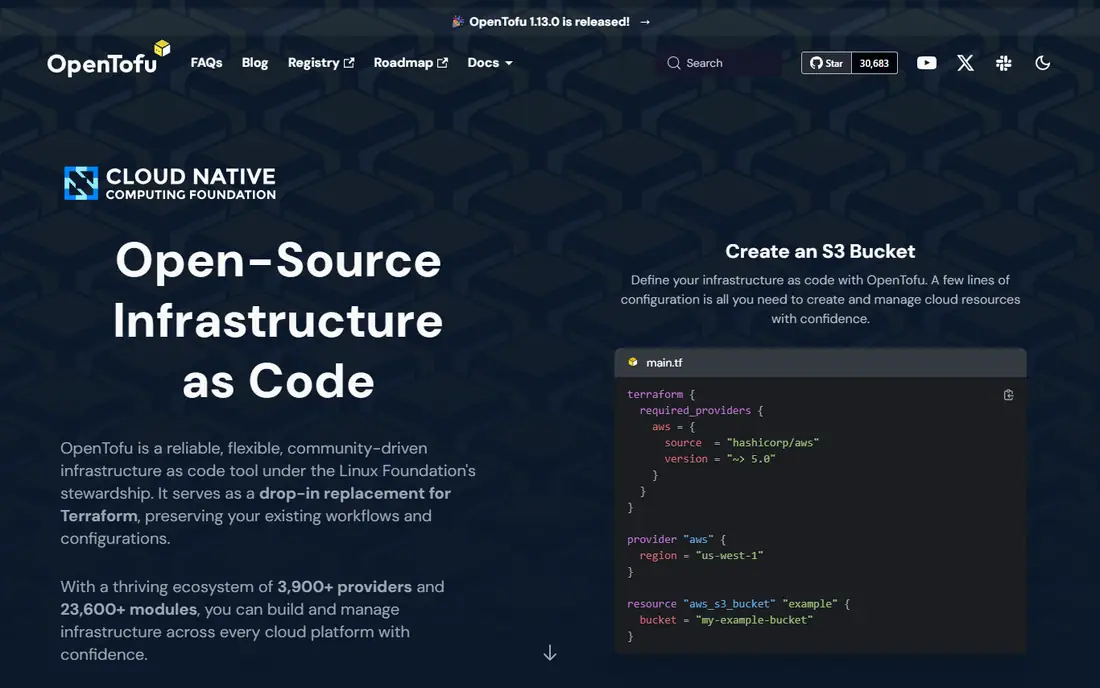
OpenTofu is the tool most teams should start with for new infrastructure-as-code projects in 2026. It exists because HashiCorp relicensed Terraform from MPL 2.0 to BSL 1.1 in August 2023, and a coalition of companies forked it under the Linux Foundation. Existing configuration files, modules, and providers work without modification in most cases, so migration means renaming the binary and updating state backend configuration.
Where OpenTofu pulls ahead is native state encryption, using AES-GCM, AWS KMS, GCP KMS, or HashiCorp Vault without external tooling or wrapper scripts. Roughly half of Spacelift deployments now use OpenTofu, and the number keeps climbing. For a team that wants Terraform-style provisioning under a fully open source license, OpenTofu is the default choice.
What we like- Drop-in replacement for most Terraform code
- MPL 2.0 license
- Native state encryption
Watch out for- Newer ecosystem than Terraform
- Some Terraform Cloud features need separate tooling
- Community governance is still maturing
#2Pulumi
Best for: Real programming languages4.8/5 on
G2 (25 reviews, checked Oct 2026)
Visit pulumi.com
Starting price$40 per month
Free planYes
Pulumi suits teams that want infrastructure as software rather than configuration. Developers write infrastructure in TypeScript, Python, Go, or other real languages, which brings loops, functions, testing, and code reuse that HCL handles awkwardly. Multi-cloud support covers AWS, Azure, GCP, and Kubernetes from one codebase.
The trade is ecosystem and cost. The module ecosystem is smaller than the Terraform Registry, which indexes over 7,000 providers and 24,000 modules, and paid Pulumi Cloud plans start near 40 dollars per month. For a software team that treats infrastructure as code in the full sense, Pulumi leads.
What we like- Real languages such as TypeScript, Python, and Go
- Strong testing and reuse
- Multi-cloud support
Watch out for- Paid plans start near 40 dollars per month
- Smaller module ecosystem than Terraform
- Learning curve for IaC newcomers
#3Ansible
Best for: Configuration management4.6/5 on
G2 (377 reviews, checked Oct 2026)
Visit ansible.com
Starting priceFree
Free planYes
Ansible suits configuration management and orchestration rather than provisioning. It configures servers, deploys applications, and enforces desired state on existing machines without agents, and its module library covers nearly every system task. Teams often pair Ansible with a provisioning engine, using one to create machines and the other to configure them.
The limits are scope. Ansible is not a provisioning engine by design, so it does not reconcile cloud resources the way Terraform does, and large runs need tuning. For a team that needs to keep server fleets consistent after provisioning, Ansible is the dominant pick.
What we like- Agentless and simple to start
- Dominant for configuration management
- Huge module library
Watch out for- Not a provisioning engine by design
- State handling differs from Terraform
- Large runs need tuning
Starting priceFree
Free planYes
AWS CloudFormation suits teams committed to AWS. As the native infrastructure-as-code service for AWS, it covers AWS services deeply, integrates with AWS tooling and permissions, and costs little beyond the resources it creates. The AWS CDK adds real-language support on top of CloudFormation for developers who prefer code over templates.
The trade is lock-in and verbosity. CloudFormation is AWS-only, so multi-cloud estates need another tool, and templates run verbose compared with HCL. For an AWS-only team that wants native integration and no extra vendor, CloudFormation fits.
What we like- Native AWS integration
- Largely free apart from resource charges
- Deep AWS service coverage
Watch out for- AWS-only, so no multi-cloud
- Templates are verbose
- Change sets need care
Starting priceFree
Free planYes
Crossplane suits platform engineering teams building on Kubernetes. It turns cloud resources into Kubernetes objects, so developers request infrastructure through the same API they use for applications, and platform teams govern it with Kubernetes-native controls. As a CNCF graduated project, it carries strong open source credibility.
The limits are prerequisites. Crossplane needs Kubernetes expertise, so teams without it face a steep learning curve, and managed Upbound offerings start near 1,000 dollars per month. For a Kubernetes-native platform team, Crossplane is the control plane pick.
What we like- Kubernetes-native control plane
- CNCF graduated project
- Self-service for developers
Watch out for- Kubernetes expertise required
- Learning curve for non-Kubernetes teams
- Managed Upbound starts near 1,000 dollars per month
Starting priceFree
Free planYes
Terragrunt suits teams with many environments to organize. It wraps Terraform-style engines with DRY configuration, so shared settings live once and each environment inherits them, which cuts duplication across dozens of stacks. It works with both Terraform and OpenTofu, so it survives an engine switch.
The trade is layering. Terragrunt adds a layer over the engine, which newcomers must learn, and it is not a standalone provisioning engine by itself. For a team drowning in duplicated environment configuration, Terragrunt is the organizing pick.
What we like- Keeps many environments organized
- DRY configuration
- Works with Terraform and OpenTofu
Watch out for- Adds a layer over the engine
- Learning curve for newcomers
- Not a standalone provisioning engine
Starting priceSee website
Free planFree trial
Spacelift suits teams that need to govern IaC runs at scale. It supports Terraform, OpenTofu, Terragrunt, Pulumi, CloudFormation, Kubernetes, and Ansible, and uses OPA policy as code to control which resources teams can create, what parameters they can use, and how many approvals a deployment needs. Self-hosted workers or a fully self-hosted control plane cover strict environments.
The limits are price clarity and complexity. Published pricing is limited, so the starting price here is written as See website, and the platform suits larger teams more than solo developers. For a team that needs governance over infrastructure changes, Spacelift leads.
What we like- Multi-IaC support
- OPA policy as code
- Self-hosted workers or full self-host
Watch out for- Pricing is not fully published
- Platform complexity suits larger teams
- Setup takes planning
Starting priceSee website
Free planFree trial
env0 suits teams that want to govern infrastructure changes at speed. It supports Terraform, OpenTofu, Terragrunt, Pulumi, CloudFormation, Kubernetes, and Ansible, uses OPA policy as code, and prices per apply or environment with unlimited users, which suits teams with many collaborators. Self-hosted agents cover private networking needs.
The trade is hosting and pricing model. env0 offers a SaaS control plane with self-hosted agents but no full self-host option, and per-apply pricing needs modeling against run volume. For a team that wants governance with unlimited collaborators, env0 fits.
What we like- Multi-IaC support
- OPA policy as code
- Per-apply or per-environment pricing
Watch out for- No full self-host option
- Pricing is per apply or environment
- Smaller community than Spacelift
How we chose
We ranked tools by provisioning depth, language choice, cloud coverage, policy support, and fit for small or large teams. We favored open source engines for new projects, since license clarity matters after the Terraform relicensing, and we gave extra weight to multi-IaC orchestration platforms for teams that already run several engines. We separated layers honestly, since a provisioning engine, a control plane, an orchestration layer, and a configuration tool solve different problems.
We also weighed pricing honesty. Where pricing is published, such as Pulumi near 40 dollars per month, we used it, and where it is not, such as Spacelift and env0, we wrote See website, so readers get pricing in writing before comparing.
Buying guide
Start by naming the layer you need. New multi-cloud provisioning suits OpenTofu, software teams suit Pulumi, AWS-only estates suit CloudFormation, Kubernetes platforms suit Crossplane, and configuration after provisioning suits Ansible. Governance over existing IaC suits Spacelift or env0, and many-environment sprawl suits Terragrunt.
Next, test the migration on one stack. Move a non-production environment to the finalist, measure plan and apply time, state handling, and policy behavior, and confirm that providers and modules work unmodified. A tool that looks clean in a demo but breaks your modules costs more than a slightly less elegant one that works.
Finally, plan state and policy before scale. Decide where state lives, how it is encrypted, who can apply to production, and which policies block risky changes. State files bloat and become operationally heavy at scale, so every new environment multiplies the surface you must maintain, and governance set early prevents costly retrofits later.
Frequently asked questions
What is the best Terraform alternative?
OpenTofu leads for open source drop-in replacement, Pulumi leads for real programming languages, and Spacelift leads for governance. The best pick follows cloud strategy, team skills, and governance needs.
Is Terraform itself listed here?
No. This guide lists alternatives only, so Terraform is not listed as its own alternative. The comparison covers what to use instead of it.
What is the difference between Terraform and Terraform Cloud?
Terraform is the open source provisioning engine, while Terraform Cloud is the hosted service for runs, state, and collaboration, now under IBM. Alternatives here replace one or both, so check which layer you need.
Why did OpenTofu fork from Terraform?
HashiCorp relicensed Terraform from MPL 2.0 to the Business Source License 1.1 in August 2023, and a coalition of companies forked it under the Linux Foundation as OpenTofu under MPL 2.0.
Which alternative suits Kubernetes teams?
Crossplane suits Kubernetes-native platform teams, while Spacelift and env0 govern Kubernetes alongside other IaC tools. Pure Kubernetes teams should weigh Crossplane first.
Sources we checked (0)
Is your product missing or out of date?
We review this list regularly. Vendors can request a listing, send updated pricing or ask about featured placement.

Shihab Mia · Founder, Rankite
Shihab has 5+ years in B2B and SaaS SEO. He writes Rankite's software buying guides from pricing pages, documentation and public user reviews. More about Shihab.