How we make this list: we compare pricing pages, product documentation and public user reviews. Ratings come from G2, Capterra or Trustpilot, with the date we checked them.
Key takeaways
- PostgreSQL is the default step up when an app outgrows a single file: real concurrency, rich SQL, and a huge extension ecosystem, free.
- DuckDB is the analytical twin. It keeps SQLite's embedded shape and answers scans and aggregations far faster.
- Turso keeps SQLite itself and fixes the hosting problem, with edge replicas and a free tier of 500 databases.
- ObjectBox and Couchbase Lite are the mobile answers, built for on device data with sync rather than a file you manage by hand.
- MySQL and MariaDB remain the safe server choices when your team and hosting already speak them.
Quick comparison
| Tool | Best for | Starting price | Free plan |
|---|
 PostgreSQL | Server apps that outgrew one file | Free | Yes |
 DuckDB | Embedded analytics and data files | Free | Yes |
 Turso | Hosted SQLite at the edge | Free | Yes |
 MySQL | The familiar server database | Free | Yes |
 MariaDB | MySQL shops that want open governance | Free | Yes |
 MongoDB | Document shaped application data | Free | Yes |
 Couchbase Lite | Mobile apps with offline sync | Free | Yes |
 ObjectBox | Fast on device object storage | Free | Yes |
Is your product missing or out of date?
We review this list regularly. Vendors can request a listing, send updated pricing or ask about featured placement.
The best SQLite alternatives
#1PostgreSQL
Best for: Server apps that outgrew one file4.4/5 on
G2 (682 reviews, checked Oct 2026)
Visit postgresql.org
Starting priceFree
Free planYes
PostgreSQL is where most SQLite graduates land. It removes the single writer ceiling, adds the SQL features analysts expect, and runs the same on a laptop, a server, or a hosted service from any cloud. If your app gained users, a second process, or a reporting workload, this is the standard answer.
The trade off is operations. A server database is a thing you maintain, patch, and back up, where a SQLite file asked for none of that. PostgreSQL fits web backends, SaaS products, and any app whose data outgrew one file and one writer.
What we like- True multi writer concurrency
- Deep SQL with window functions, CTEs, and JSONB
- Extensions such as PostGIS and pgvector
- Free and open source with decades of production history
Watch out for- A server to run, secure, and back up
- Heavier than an embedded file for small tools
- Tuning rewards experience
Starting priceFree
Free planYes
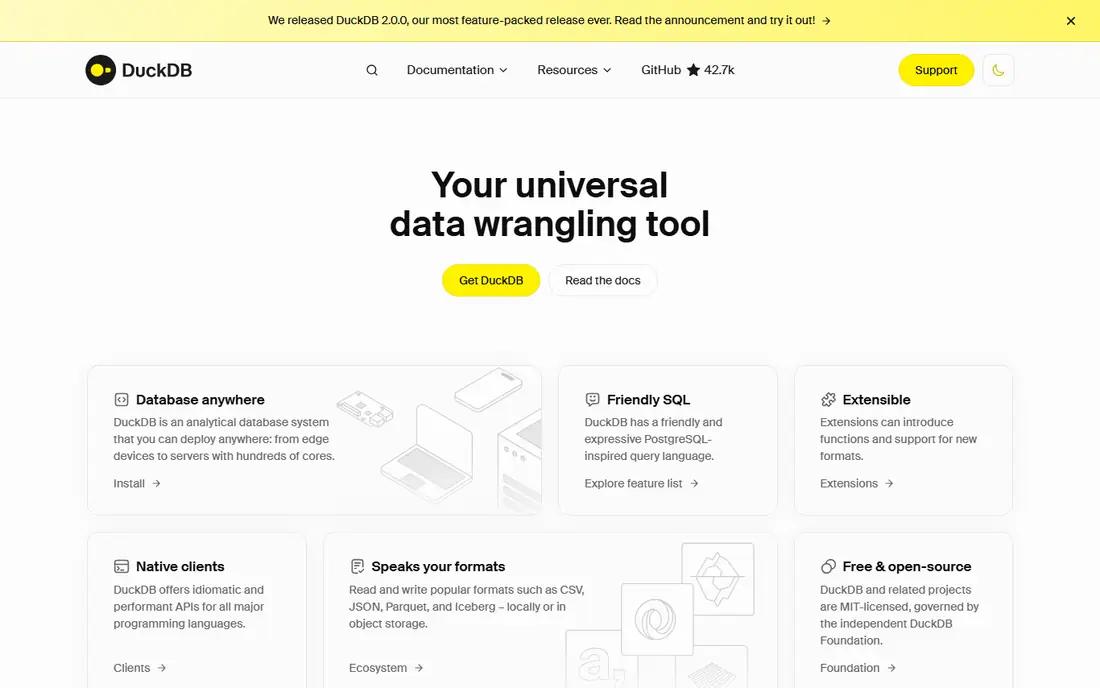
DuckDB is the analytical mirror image of SQLite. Same embedded shape, opposite workload: it is built to scan millions of rows and aggregate them, where SQLite is built to fetch and update one row at a time. Benchmarks put its scan advantage in the hundreds of times on the right queries, and it reads the data files analysts already have.
The trade off is transactional work. DuckDB is the wrong home for an app's live writes. DuckDB fits notebooks, data pipelines, embedded reporting, and as a sidecar that analyses the very SQLite file your app writes to. MotherDuck offers a hosted path when you outgrow the laptop.
What we like- Columnar engine scans and aggregates far faster than row stores
- Reads Parquet, CSV, and JSON files directly
- Embeds in process like SQLite, with no server
- Can attach to a SQLite file for analytics on live app data
Watch out for- Point lookups and row writes are far slower than SQLite
- Single writer design remains
- Younger ecosystem than PostgreSQL
Starting priceFree
Free planYes
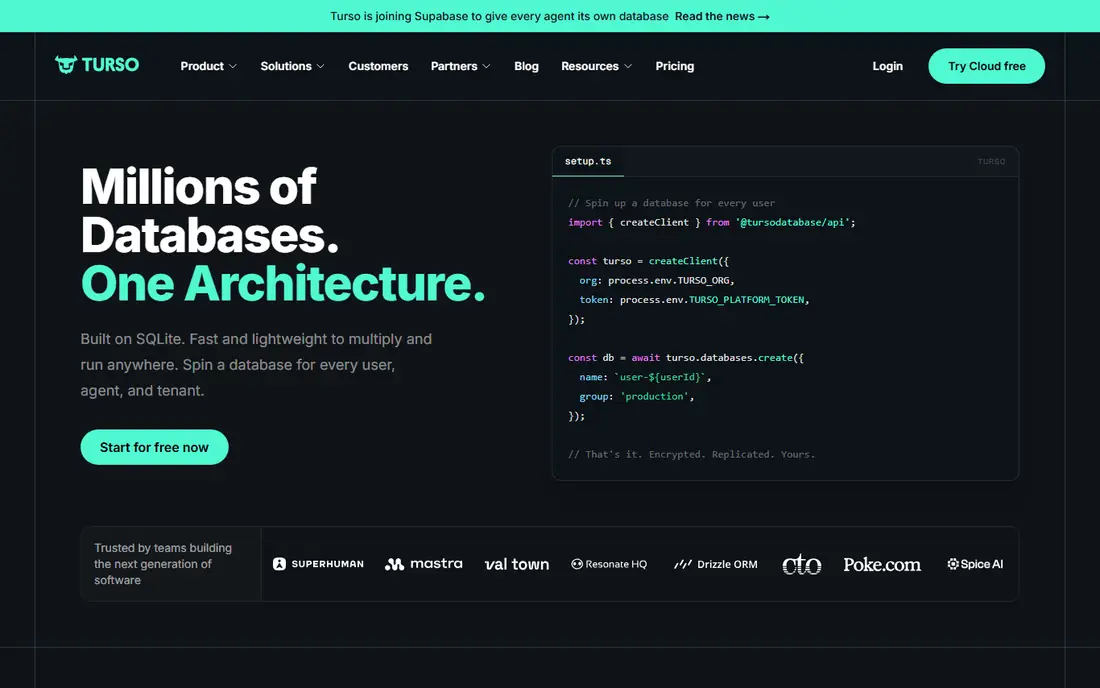
Turso answers a narrow question: how do I host SQLite like a real backend. Its edge replicas serve reads near your users, embedded replicas can sit inside your app and sync, and paid plans start at $29 per month after a generous free tier. For teams whose problem was deployment rather than SQL, nothing else here is as direct.
The trade off is maturity and the write model. SQLite's single writer limit travels with it, and a fork always carries some divergence risk. Turso fits read heavy, globally spread apps, edge deployments, and SaaS products that want a database per tenant.
What we like- Built on libSQL, an open source SQLite fork, so your SQL carries over
- Embedded replicas put reads close to users worldwide
- Free tier with 500 databases and 9GB storage
- Per tenant databases suit multi tenant SaaS
Watch out for- Still single writer at heart, so write heavy workloads strain it
- Fork semantics differ from stock SQLite in places
- ORM and tooling support is thinner than PostgreSQL
#4MySQL
Best for: The familiar server database4.4/5 on
G2 (1,685 reviews, checked Oct 2026)
Visit mysql.com
Starting priceFree
Free planYes
MySQL is the incumbent server database of the web. If your move away from SQLite is really a move to shared hosting, a LAMP stack, or a team that already runs MySQL everywhere, familiarity is a feature. The Community edition is free, and every hosting panel on earth speaks it.
The trade off is ceiling. PostgreSQL offers more SQL depth and a cleaner extension story, and Oracle's ownership shapes the licence conversation for embedded commercial use. MySQL fits conventional web applications and teams standardising on what they already run.
What we like- The database most hosts and developers already know
- Huge hosting and tooling ecosystem
- Replication and clustering options for scale
- Free Community edition under the GPL
Watch out for- Feature set trails PostgreSQL in analytics and extensibility
- Dual licensing under Oracle can complicate commercial embedding
- Two storage engines of history to understand
#5MariaDB
Best for: MySQL shops that want open governance4.4/5 on
G2 (226 reviews, checked Oct 2026)
Visit mariadb.org
Starting priceFree
Free planYes
MariaDB began as the community fork of MySQL and remains the choice for teams that want that ecosystem under open governance. It runs the same workloads, speaks to the same drivers, and adds options such as a columnar engine for analytical tables.
The trade off is divergence. A decade apart means some MySQL features and behaviours differ, and the name carries less instant recognition with new hires. MariaDB fits open source first organisations and hosting environments where it is already the default.
What we like- Drop in origins from MySQL with compatible tooling
- Developed in the open by a foundation
- Columnar storage option for analytics
- Used by large hosting providers as their default
Watch out for- Compatibility with newer MySQL features has drifted in places
- Smaller mindshare than MySQL itself
- Enterprise support is a separate purchase
#6MongoDB
Best for: Document shaped application data4.5/5 on
G2 (554 reviews, checked Oct 2026)
Visit mongodb.com
Starting priceFree
Free planYes
MongoDB is the alternative for data that never fit tables. If your SQLite schema is full of JSON blobs and wide sparse tables, documents are probably the honest model. The Community server is free, and Atlas runs it for you with a free tier to start.
The trade off is the relational core. Reporting, integrity constraints, and cross entity questions take more work than in PostgreSQL. MongoDB fits content, catalog, and event data, and products whose shape changes faster than a schema migration cycle tolerates.
What we like- Documents match application objects without an mapping layer
- Flexible schema helps fast changing products
- Atlas offers a managed cloud with a free tier
- Horizontal scaling is a designed feature, not an afterthought
Watch out for- Relational questions need joins MongoDB was not built for
- Flexible schema can become no schema discipline
- Transactions exist but are not the centre of the design
Starting priceFree
Free planYes
Couchbase Lite replaces the SQLite file a mobile app would otherwise hand roll sync around. Data lives on the device in an embedded store, works offline, and syncs to Couchbase Server through its gateway when a connection appears. For apps in planes, warehouses, and rural coverage, that is the whole product.
The trade off is the backend commitment. The elegant sync story needs Couchbase's server side, which is real infrastructure. Couchbase Lite fits mobile products where offline work and multi device sync are core requirements, not nice extras.
What we like- Embedded database for iOS, Android, and desktop apps
- Sync through Couchbase Sync Gateway keeps devices and cloud in step
- Offline first design suits field and travel apps
- Free community edition
Watch out for- Full sync stack needs Couchbase Server, which adds infrastructure
- Smaller developer community than SQLite
- Enterprise features sit behind commercial licensing
Starting priceFree
Free planYes
ObjectBox takes the mobile argument further: skip SQL entirely. Your app stores its objects as objects, queries run against them directly, and the engine is tuned for phones and embedded devices, including vector search for on device AI. The core database is free, with sync sold separately.
The trade off is a new mental model and a smaller world. Help, hires, and tooling are all thinner than the SQL names above. ObjectBox fits mobile and IoT apps where local speed matters most and the data is naturally object shaped.
What we like- Stores objects directly, with no SQL or mapping layer
- Very fast benchmarks on mobile and IoT workloads
- Vector search built in for on device AI features
- Sync product available for device to cloud
Watch out for- NoSQL object model is a bigger change than swapping SQL engines
- Smaller ecosystem and community
- Sync and some features are paid products
How we chose
We compared the databases developers name most when they move off SQLite, using project and vendor documentation for architecture, licensing, and current pricing. Everything here is free to start, so we weighted workload fit: write concurrency, analytics speed, hosting shape, and mobile sync. We flagged where a familiar name hides a real trade, such as DuckDB's write limits and MongoDB's relational gaps. We did not claim hands on testing or run our own benchmarks, and benchmark figures quoted are from the sources listed.
How to choose your SQLite alternative
Name the pressure that is pushing you off SQLite, because each pressure has a different answer. Many writers and a server backend point to PostgreSQL, or MySQL and MariaDB where that is the house standard. Slow reports over big files point to DuckDB, possibly beside SQLite rather than instead of it. Hosting and global latency point to Turso. Phones that must work offline and sync point to Couchbase Lite or ObjectBox. Data that fights the table shape points to MongoDB.
Resist migrating on fashion. SQLite handles more than its reputation suggests, including busy production apps with one writer and careful design. Move when a measured limit hurts: lock waits, report runtimes, or a sync feature you keep rebuilding by hand. Then the alternative picks itself.
Frequently asked questions
When has an app really outgrown SQLite?
The honest signals are concurrent writers queuing on the database lock, reports that scan the whole file and slow the app, a second server that needs the same data, or sync logic you keep rebuilding. High read traffic alone is not a signal; SQLite reads scale well, and many busy sites run on it for years.
Can DuckDB and SQLite work together?
Yes, and it is a common pattern. The app keeps writing to SQLite, and DuckDB attaches to that same file through its SQLite extension to run analytical queries, or reads exported Parquet files. You get transactional safety and fast analytics without a migration, at the cost of running two engines.
Is Turso really SQLite?
Turso is built on libSQL, an open source fork of SQLite, and it speaks SQLite SQL and reads SQLite shaped data. It adds server hosting, edge replicas, and embedded replicas that sync. It is best understood as SQLite with a distribution layer, with the caveat that a fork can drift from upstream over time.
Which alternative is best for a mobile app?
If the app must sync, Couchbase Lite, because sync is the product, or ObjectBox if local speed and an object model suit the data. If the app is local only, SQLite itself is usually still the right answer, which is why it ships inside both mobile operating systems.
Which alternative should a small web app pick?
PostgreSQL, in most cases. It is free, every host and framework supports it, and its SQL depth means you will not migrate again when reports and features grow. Pick MySQL or MariaDB instead when your hosting or your team is already built on them; familiarity is worth real money at small scale.
Sources we checked (0)
Is your product missing or out of date?
We review this list regularly. Vendors can request a listing, send updated pricing or ask about featured placement.

Shihab Mia · Founder, Rankite
Shihab has 5+ years in B2B and SaaS SEO. He writes Rankite's software buying guides from pricing pages, documentation and public user reviews. More about Shihab.