How we make this list: we compare pricing pages, product documentation and public user reviews. Ratings come from G2, Capterra or Trustpilot, with the date we checked them.
Key takeaways
- Apache Solr is free and powerful, but its operations burden and Java stack push teams toward lighter or managed options.
- OpenSearch is the closest enterprise replacement, with an Apache-2.0 licence and Elasticsearch-compatible APIs.
- Meilisearch and Typesense suit product and site search with typo tolerance and simple APIs, free to self-host.
- Algolia is the premium managed option for e-commerce search, with AI ranking and merchandising built in.
- Manticore, Vespa, and ZincSearch cover specialized needs: SQL-style queries, real-time big data, and lightweight single-binary search.
Quick comparison
| Tool | Best for | Starting price | Free plan |
|---|
 Elasticsearch | Enterprise search and analytics | See website | Yes |
 OpenSearch | Open source enterprise search | $0 self-hosted | Yes |
 Meilisearch | Fast product and site search | $0 self-hosted | Yes |
 Typesense | Developer-friendly search API | $0 self-hosted | Yes |
 Algolia | Managed e-commerce search | $0 free plan | Yes |
 Manticore Search | SQL-style high-performance search | $0 self-hosted | Yes |
 Vespa | Real-time big data search | $0 self-hosted | Yes |
 ZincSearch | Lightweight single-binary search | $0 self-hosted | Yes |
Is your product missing or out of date?
We review this list regularly. Vendors can request a listing, send updated pricing or ask about featured placement.
The best Solr alternatives
Starting priceSee website
Free planYes
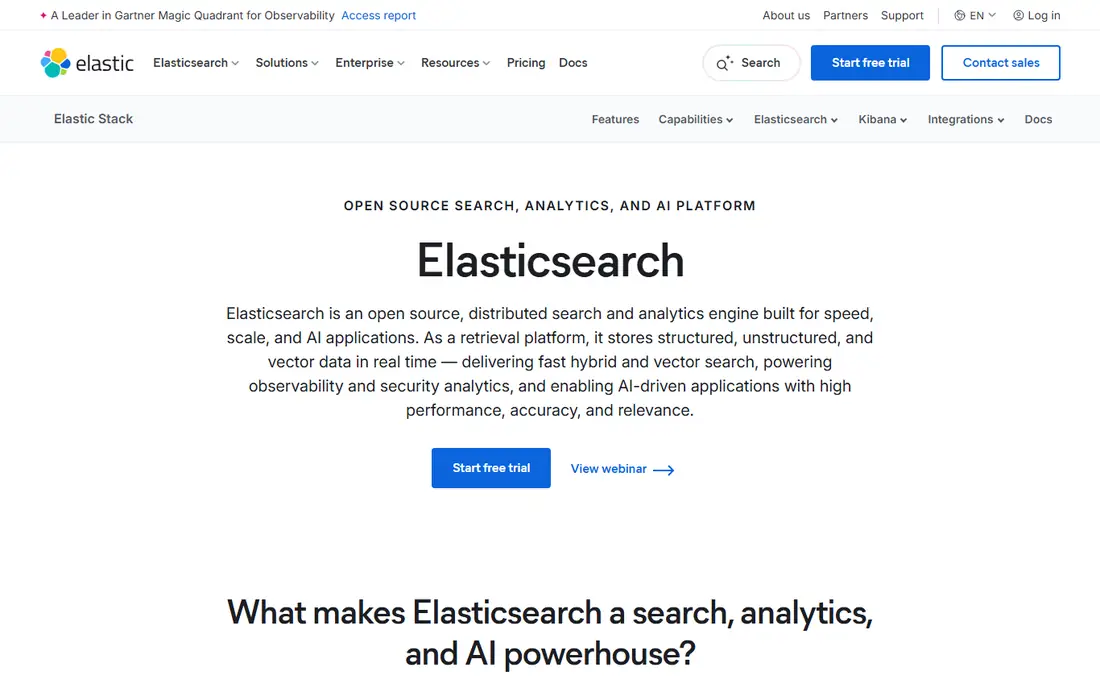
Elasticsearch shares Solr's Lucene foundation but pairs search with a much larger ecosystem for logs, metrics, and security analytics. It offers advanced text analysis, BM25 ranking, fuzzy matching, vector search with kNN, and machine learning inference APIs. Teams that already run the Elastic Stack get search, observability, and dashboards in one platform.
The licence is the main caveat. Elasticsearch is available under SSPL, Elastic Licence 2.0, or AGPL, not a permissive Apache licence, so teams with strict licence policies should review terms. Operations are also heavy: clusters need tuning, upgrades, and monitoring. Managed Elastic Cloud pricing starts near $95 per month in published comparisons, with usage-based growth. For enterprise search plus analytics, Elasticsearch remains the most capable option here.
What we like- Deepest ecosystem for search plus observability
- Strong analyzers and vector search
- Huge community
Watch out for- Licence is SSPL or Elastic Licence, not Apache
- Operations are heavy
- Managed pricing adds up
#2OpenSearch
Best for: Open source enterprise search4.4/5 on
G2 (15 reviews, checked Oct 2026)
Visit opensearch.org
Starting price$0 self-hosted
Free planYes
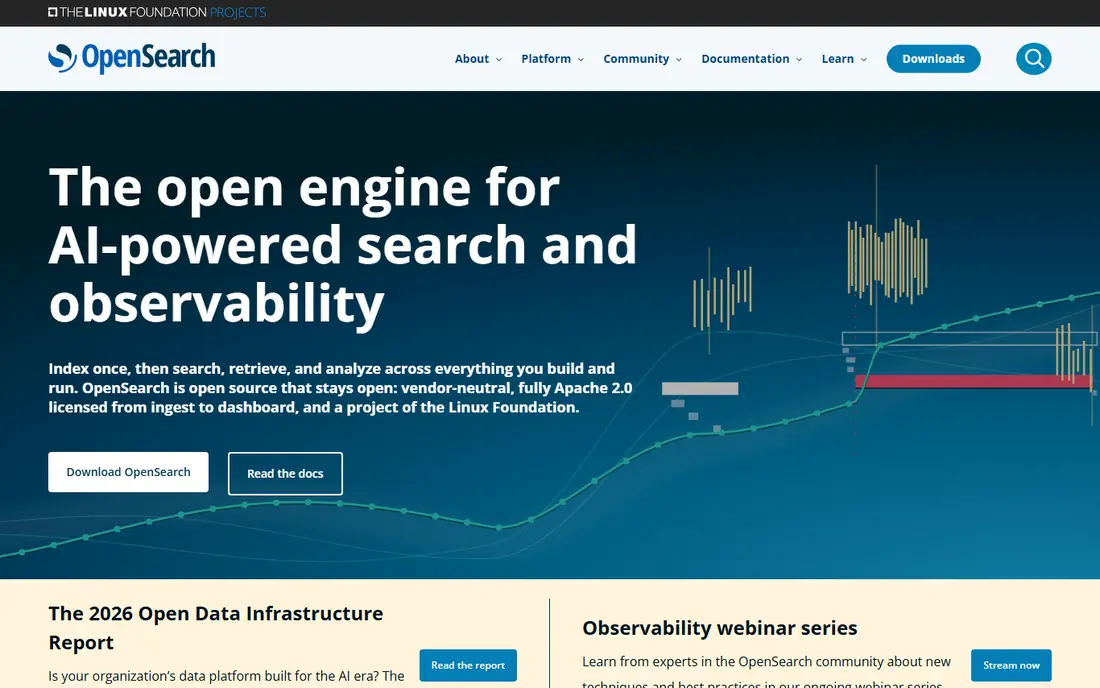
OpenSearch began as a fork of Elasticsearch and is now the leading Apache-2.0 search engine for enterprises that want open source without licence worry. It keeps Elasticsearch-compatible APIs, which eases migration for Elastic users, and adds dashboards, security analytics, observability, and machine learning plugins. Like Solr, it is built on Lucene, so ranking and analysis concepts transfer.
Migration from Solr is still moderate work, since query APIs and configuration differ even with the shared Lucene base. Self-hosting is free, with managed options on AWS and other providers priced by instance hours. For teams leaving Solr for licence or ecosystem reasons, OpenSearch is the closest enterprise-grade replacement with a clean open source licence and broad plugin support.
What we like- Apache-2.0 licence
- Elasticsearch-compatible APIs
- Dashboards and ML plugins included
Watch out for- Migration from Solr still needs API work
- Managed AWS pricing varies
- Smaller ecosystem than Elastic
Starting price$0 self-hosted
Free planYes

Meilisearch is built for product and site search where relevance and speed matter more than log analytics. It offers typo tolerance, faceting, filtering, and instant search with a simple JSON API, and it indexes quickly for small to mid-sized catalogs. The community edition is MIT-licensed and free to self-host, with managed cloud plans starting near $30 per month in published comparisons.
The limits show at scale. Horizontal sharding sits in the Enterprise edition, and vector search is more basic than Elasticsearch or OpenSearch. Analytics and merchandising are also thinner than Algolia. For product and site search where relevance and speed matter more than log analytics, Meilisearch is one of the easiest Solr alternatives to adopt quickly.
What we like- MIT community licence
- Typo tolerance out of the box
- Fast setup and indexing
Watch out for- Horizontal sharding needs Enterprise edition
- Vector search is basic
- Smaller analytics story
Starting price$0 self-hosted
Free planYes
Typesense is a typo-tolerant search engine with a simple JSON API that developers pick up fast. It handles faceting, filtering, grouping, and hybrid search, with built-in embeddings for semantic queries. The open source core is GPL-3.0 and free to self-host, with managed cloud pricing based on resources rather than per-query fees, starting near $7 per month in published comparisons.
The architecture needs care. Typesense keeps much of its index in memory, so plan RAM at roughly twice your index size to avoid crashes. Machine learning features are limited compared with Algolia or Elasticsearch. For developer-facing search at high query volume without per-search fees, Typesense is a strong and affordable pick.
What we like- GPL-3.0 open source core
- Typo tolerance and faceting
- No per-query fees when self-hosted
Watch out for- In-memory design needs RAM headroom
- ML features are limited
- Clustering is cloud-led
#5Algolia
Best for: Managed e-commerce search4.5/5 on
G2 (454 reviews, checked Oct 2026)
Visit algolia.com
Starting price$0 free plan
Free planYes
Algolia is the premium managed option for e-commerce and site search. It delivers fast hosted search with NeuralSearch AI ranking, merchandising tools, personalization, analytics, and A/B testing, all without running servers. The free Build plan suits trials and small projects, with pay-as-you-go pricing as usage grows.
Cost is the catch. Published cost models put 1 million searches per month near $500, against roughly $16 per month for a self-hosted engine on a small server. There is no self-hosting option, so teams trade control for convenience. For revenue-critical store search where ranking quality and uptime matter most, Algolia earns its price. For internal or low-budget search, self-hosted options cost far less over time, reliably today.
What we like- Fully managed SaaS
- AI ranking and merchandising
- Analytics and A/B testing built in
Watch out for- Proprietary and usage-priced
- Costs rise fast with query volume
- No self-hosting option
Starting price$0 self-hosted
Free planYes
Manticore Search is a high-performance open source engine that speaks SQL, which appeals to teams that think in tables and queries rather than JSON DSLs. It supports full-text search, faceting, geospatial queries, and vector search, with multithreaded execution for speed. Self-hosting is free, and the engine suits catalogs, logs, and real-time data.
The community is smaller than Elasticsearch or Meilisearch, and managed hosting options are fewer. Tooling and documentation are functional rather than polished. For teams that want SQL-style search with strong performance and no licence fees, Manticore is a capable and underrated Solr alternative.
What we like- Free and open source
- SQL syntax developers know
- Multithreaded with vector search
Watch out for- Smaller community than leaders
- Fewer managed options
- Tooling is less polished
Starting price$0 self-hosted
Free planYes
Vespa is built for real-time big data: search, recommendations, and ranking over very large datasets with continuous writes. It supports vector search, machine learning ranking, and custom ranking functions, and it is used for large-scale serving workloads. The open source edition is free to self-host, with paid managed hosting for teams that prefer not to operate clusters.
Operations are complex, and the learning curve is steep compared with Meilisearch or Typesense. Small catalogs do not need Vespa's scale. For teams serving recommendations or search over billions of items with real-time updates, Vespa is one of the few open source engines built for that job.
What we like- Free and open source
- Real-time writes and ranking
- Built for very large data
Watch out for- Complex to operate
- Learning curve is steep
- Overkill for small catalogs
Starting price$0 self-hosted
Free planYes
ZincSearch is a lightweight search engine distributed as a single binary with no dependencies. It offers schema-less indexing, full-text search, and Elasticsearch API compatibility, which makes it easy to try as a drop-in for simple use cases. Self-hosting is free, and setup takes minutes.
The feature set is smaller than the leaders, and it is less proven at very large scale. The community is also small, so support comes mostly from documentation and issues. ZincSearch fits side projects, internal tools, and lightweight log search where simplicity beats feature depth. For production enterprise search, OpenSearch or Elasticsearch will be safer.
What we like- Free and open source
- Single binary with no dependencies
- Elasticsearch API compatible
Watch out for- Smaller feature set
- Less proven at large scale
- Community is small
How we chose
We compared published licences, deployment options, and pricing for each engine, plus recent Solr alternative guides that rank these tools on migration effort and use case. A tool made this list only if it covers at least one core Solr job: full-text search, faceting, or analytics at a meaningful scale. Prices marked "See website" reflect managed or usage-based pricing that varies by deployment, so confirm on the vendor page before budgeting. Licence notes matter here, since Elasticsearch is not Apache-licensed while OpenSearch, Meilisearch community, and Manticore are open source.
What to check before you switch
Start with your query patterns, not the engine list. Solr sites often rely on specific analyzers, facets, and geospatial queries that do not map one-to-one to simpler engines. Inventory your queries, ranking rules, and index size before choosing, and keep a list of must-have behaviors for testing. Next, decide between managed and self-hosted. Managed search removes operations but charges per query or record, while self-hosted engines cost only server time but need upkeep.
Also test relevance early. Index a sample of real documents, run real user queries, and compare top results across engines. Typo tolerance, ranking, and faceting differences show up fast in real data and rarely in feature tables, so a small relevance test saves a painful migration later. Finally, plan the migration in stages. Run the new engine beside Solr, dual-write or reindex in the background, and switch traffic only after relevance and performance are proven in production-like tests.
Frequently asked questions
Is Solr still a good choice?
Yes, for teams that already run it well. Solr remains free, powerful, and proven at enterprise scale. Teams switch mainly for lighter operations, managed hosting, simpler APIs, or licence preferences, not because Solr stopped working.
Which Solr alternative is easiest to migrate to?
OpenSearch is closest for enterprise teams, since it shares the Lucene foundation and offers compatible APIs for Elastic-style queries. Meilisearch and Typesense are easier to set up but need a full rebuild of queries and ranking, since their architecture differs entirely.
What is the cheapest Solr alternative?
Self-hosted engines cost only server time: OpenSearch, Meilisearch, Typesense, Manticore, Vespa, and ZincSearch are all free to self-host. For managed search, Typesense Cloud and Meilisearch Cloud start low, while Algolia costs more but includes ranking and merchandising.
Do these tools support vector search?
Yes, most do. Elasticsearch, OpenSearch, Typesense, Meilisearch, Manticore, and Vespa all support vector or hybrid search to varying degrees. Check the depth of each implementation, since basic vector support differs from full neural ranking.
Is Elasticsearch open source?
Elasticsearch is source-available under SSPL, Elastic Licence 2.0, or AGPL, depending on version and use. It is not Apache-licensed. Teams that need a permissive open source licence should choose OpenSearch instead.
Can I run search without a dedicated engine?
For small catalogs, yes. Database full-text search in Postgres or MySQL can cover simple needs without another service. Once typo tolerance, faceting, ranking control, or scale matter, a dedicated engine on this list will serve better.
Sources we checked (8)
- https://www.elastic.co/elasticsearch
- https://opensearch.org
- https://www.meilisearch.com/pricing
- https://typesense.org
- https://www.algolia.com/pricing
- https://manticoresearch.com
- https://vespa.ai
- https://zincsearch.com
Is your product missing or out of date?
We review this list regularly. Vendors can request a listing, send updated pricing or ask about featured placement.

Shihab Mia · Founder, Rankite
Shihab has 5+ years in B2B and SaaS SEO. He writes Rankite's software buying guides from pricing pages, documentation and public user reviews. More about Shihab.