How we make this list: we compare pricing pages, product documentation and public user reviews. Ratings come from G2, Capterra or Trustpilot, with the date we checked them.
Key takeaways
- Survicate, Delighted, and SatisMeter are the closest direct replacements for Refiner, with in-product NPS, CSAT, and CES surveys.
- Typeform and SurveyMonkey suit longer research surveys and market research, where design and question variety matter more than in-product triggers.
- Hotjar and Sprig add context to feedback, with session data, heatmaps, and product research tools alongside surveys.
- Qualtrics suits enterprises that need research depth, governance, and large-scale experience management across many teams.
Quick comparison
| Tool | Best for | Starting price | Free plan |
|---|
 Survicate | In-product NPS and feedback | See website | Free trial |
 Delighted | Simple NPS and CSAT | See website | Free trial |
 SatisMeter | NPS tracking over time | See website | Free trial |
 Typeform | Conversational surveys | See website | Yes |
 SurveyMonkey | General survey research | See website | Yes |
 Hotjar | Feedback plus behavior data | See website | Yes |
 Sprig | Product research surveys | See website | Free trial |
 Qualtrics | Enterprise experience management | See website | Free trial |
Is your product missing or out of date?
We review this list regularly. Vendors can request a listing, send updated pricing or ask about featured placement.
The best Refiner alternatives for product feedback
Refiner helps product teams run in-product surveys, including NPS, CSAT, and CES, and trigger them based on user behavior. Teams that look for an alternative usually want a different price, a simpler setup, deeper research features, or a tool that also shows what users did before they answered. The tools below split into three groups: direct in-product survey tools, general survey platforms, and product research tools that pair surveys with behavior data. Start with where the survey should appear, and who should see the results.
#1Survicate
Best for: In-product NPS and feedback4.6/5 on
G2 (214 reviews, checked Oct 2026)
Visit survicate.com
Starting priceSee website
Free planFree trial
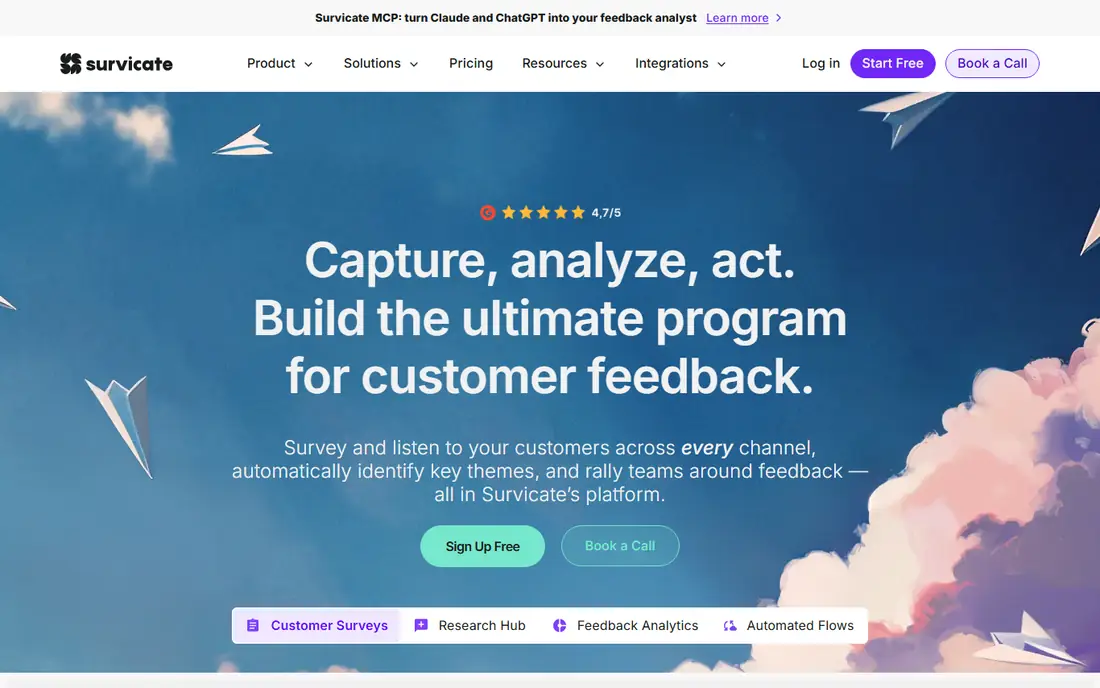
Survicate is one of the closest matches to Refiner for product teams. Surveys can appear inside a web app or mobile app, in email, or through a link, and they can trigger based on user actions, traits, or segments. A team can run NPS after onboarding, CSAT after a support interaction, and a short feature survey for users who tried a new release. Responses flow to dashboards, and integrations send feedback to tools such as HubSpot, Salesforce, Intercom, and Slack.
The builder is visual, with templates for NPS, CSAT, CES, and product-market fit surveys, so a team can launch a first survey without design help. Analysis covers trends over time, segment breakdowns, and response exports, though deeper text analysis sits on higher tiers. Survicate fits SaaS teams that want in-product feedback with targeting and CRM connections. Teams that only need email NPS may find Delighted simpler.
What we like- In-app, web, email, and link surveys in one tool
- Targeting by user traits and events
- Integrations with CRMs and analytics tools
Watch out for- Advanced analysis needs a higher tier
- Pricing depends on survey volume and features
Starting priceSee website
Free planFree trial
Delighted, from Qualtrics, focuses on doing a few survey types well. A team can send NPS by email, show a short survey on a website, or share a link, and track scores over time with simple trend reports. Setup takes minutes: pick a survey type, write a question, add a follow-up prompt, and choose who receives it. That simplicity suits teams that want a reliable NPS program without learning a full research platform.
The trade-off is depth. In-product targeting, complex branching, and advanced segmentation are thinner than in Survicate or Sprig. Design customization is also limited, which keeps surveys clean but less branded. Delighted fits small and mid-size teams that need a steady NPS or CSAT program, with clear reporting for managers. Product teams that need behavior-based triggers inside an app should compare Survicate first.
What we like- Very simple NPS, CSAT, and CES setup
- Email, web, and link distribution
- Clear trend reporting
Watch out for- Less in-product targeting depth than Survicate or Refiner
- Customization options are limited
Starting priceSee website
Free planFree trial
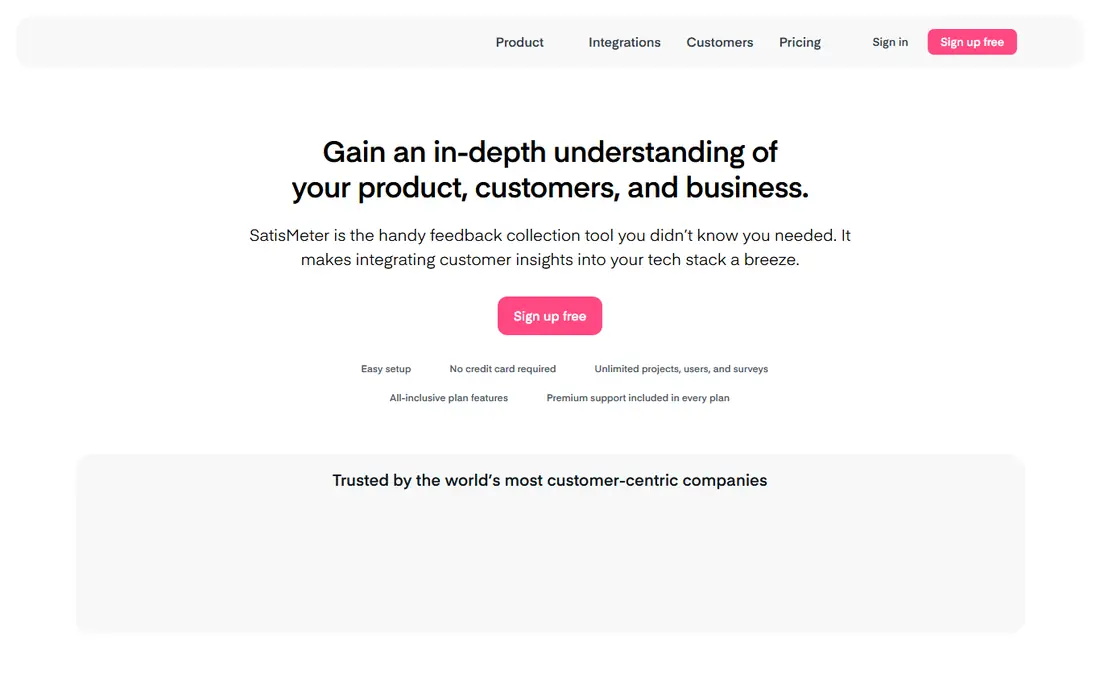
SatisMeter specializes in NPS, with in-app widgets and email surveys that track how loyalty changes over time. Teams can segment scores by plan, region, or user trait, and follow up with promoters for reviews or referrals, and with detractors for support outreach. Integrations connect responses to support tools and CRMs, so a low score can trigger a ticket or a task for the account team. That closed-loop workflow is the main value, beyond the score itself.
Survey variety is narrower than Typeform or SurveyMonkey, because SatisMeter focuses on NPS and short feedback rather than long research questionnaires. Design options are also basic, which keeps surveys fast but less distinctive. SatisMeter fits SaaS teams that want a focused NPS system with trend tracking and follow-up. Teams that need many survey types should look at Survicate or Qualtrics instead.
What we like- In-app and email NPS with simple setup
- Trend and segment reporting
- Integrations with support and CRM tools
Watch out for- Survey types are narrower than general platforms
- Design options are basic
#4Typeform
Best for: Conversational surveys4.5/5 on
G2 (1,014 reviews, checked Oct 2026)
Visit typeform.com
Starting priceSee website
Free planYes
Typeform builds surveys that feel like a conversation, with one question at a time, clean design, and logic that adapts the next question based on answers. That format suits customer research, onboarding questionnaires, market surveys, and feedback forms where completion rate matters. Question types cover multiple choice, rating scales, open text, file upload, and payment in some plans, and results can flow to spreadsheets, CRMs, and analytics tools.
Typeform is less focused on in-product triggers than Refiner, Survicate, or Sprig. It works well through links, embeds, and email, but behavior-based in-app targeting needs more setup or a third-party tool. Pricing also scales with monthly responses, so high-volume survey programs should model costs from real response counts. Typeform fits teams that prioritize survey experience and research depth over in-product targeting.
What we like- Clean, conversational survey design
- Wide question types and logic
- Strong brand customization
Watch out for- In-product targeting is weaker than dedicated feedback tools
- Pricing rises with response volume
Starting priceSee website
Free planYes
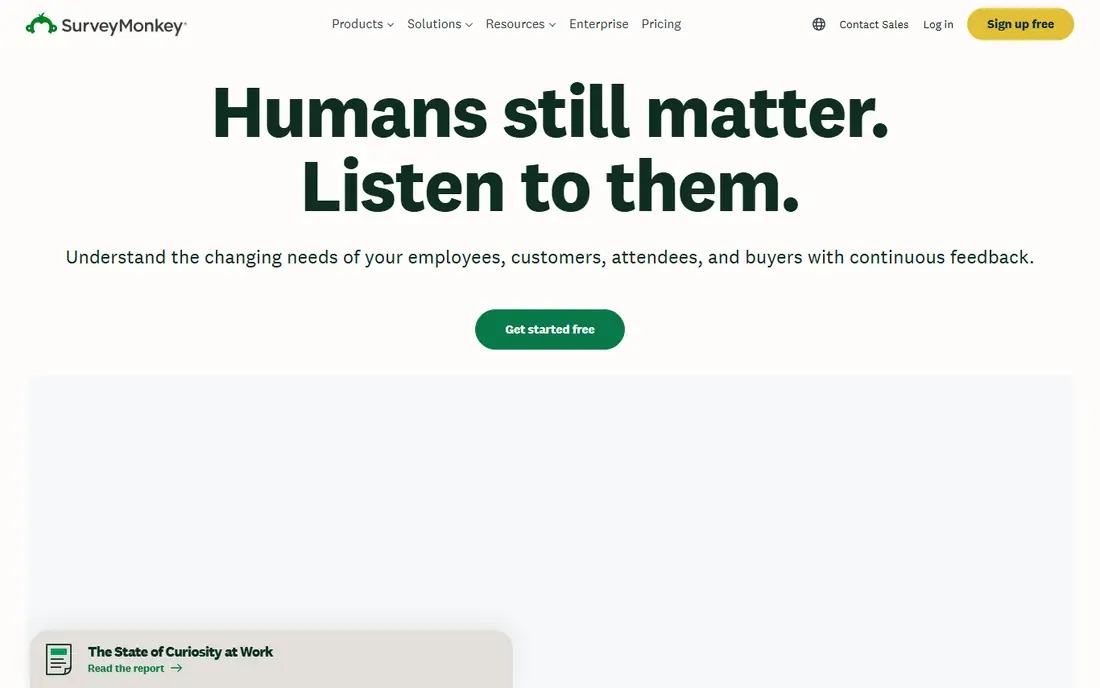
SurveyMonkey is the general survey platform most respondents already know. It offers templates for customer satisfaction, market research, employee feedback, and product testing, with question types, logic, and analysis tools that cover most research needs. Teams can send surveys by email, link, or embed, collect responses at scale, and analyze results with filters, cross-tabs, and exports. That breadth makes it a safe pick for mixed research work.
For product teams, the gap is in-product delivery. SurveyMonkey works best for email and link surveys, while Refiner-style in-app triggers need other tools. The interface also feels more like a research platform than a product feedback tool, which can slow small product teams. SurveyMonkey fits teams that run many kinds of surveys, from customers to employees to market research, and want one platform for all of them.
What we like- Huge template and question library
- Strong analysis and reporting
- Widely known by respondents
Watch out for- In-product surveys are not the core strength
- Interface can feel dated for product teams
#6Hotjar
Best for: Feedback plus behavior data4.3/5 on
G2 (345 reviews, checked Oct 2026)
Visit hotjar.com
Starting priceSee website
Free planYes
Hotjar pairs surveys with behavior tools, which helps teams understand not only what users say, but what they did. Heatmaps show where visitors click and scroll, session recordings show real journeys through a site, and on-site surveys and feedback widgets collect reactions in context. A team can see a low survey score, then watch recordings from similar visitors to find the page or step that caused frustration. That combination is hard to get from a survey tool alone.
Hotjar focuses on websites, so mobile app feedback is weaker than Survicate or Sprig. Survey logic and targeting are also simpler than dedicated feedback platforms. Hotjar fits marketing and product teams that optimize websites and want feedback tied to behavior. Teams that need deep in-app NPS for a SaaS product should pair Hotjar with a dedicated survey tool, or choose Survicate instead.
What we like- Surveys plus heatmaps and session recordings
- Feedback widgets on websites
- Free plan for small sites
Watch out for- Focus is websites, not mobile apps
- Survey targeting is simpler than dedicated feedback tools
Starting priceSee website
Free planFree trial
Sprig, formerly UserLeap, is built for product teams that want to learn from users inside the product. Surveys can trigger based on product events, such as completing onboarding or using a feature, and results connect to product usage data. Teams can also test concepts and prototypes, run longer research studies, and use AI-assisted analysis to group open-text feedback into themes. That mix suits teams that run continuous product research, not only a quarterly NPS check.
Sprig pricing reflects a product research platform, so small teams with a single NPS survey may find it more than they need. Setup also works best when product analytics and survey targeting are aligned, which takes planning. Sprig fits SaaS product teams that want in-product research tied to real usage. Teams that only need NPS tracking will find Delighted or SatisMeter simpler and cheaper.
What we like- In-product surveys tied to product usage
- AI-assisted analysis of open feedback
- Concept and prototype testing features
Watch out for- Pricing is aimed at product teams, not casual survey users
- Setup needs product and analytics alignment
Starting priceSee website
Free planFree trial
Qualtrics covers customer experience, employee experience, product experience, and market research in one enterprise platform. Survey logic is deep, with branching, randomization, conjoint analysis, and advanced reporting, and governance features support large organizations with many teams and strict security needs. Text analysis can group open feedback at scale, and dashboards serve executives, managers, and frontline teams with different views.
That depth comes with enterprise pricing and a learning curve. Small teams that need one NPS survey will find Qualtrics heavy and expensive. Qualtrics fits large companies that run many experience programs, need governance, and want one platform for customer, employee, and product research. Smaller teams should start with Survicate, Delighted, or Typeform, and move to Qualtrics only when scale and governance demand it.
What we like- Deep research, survey logic, and analytics
- Enterprise governance and security
- Customer, employee, and product experience in one platform
Watch out for- Enterprise pricing and complexity
- Overkill for a single NPS survey
How we chose
We compared vendor documentation, pricing pages, and public reviews on G2, Capterra, and Reddit, focusing on survey types, in-product delivery, targeting, integrations, analysis, and fit for product, marketing, and research teams. Each tool here exists today and offers a real survey or feedback product a US reader can buy or trial. Where a price could not be confirmed at the time of writing, the entry reads See website, because survey pricing often depends on responses, users, and features. We did not run hands-on survey tests, and the order reflects closeness to Refiner, research depth, and behavior context rather than a lab score.
Running feedback that actually changes decisions
A survey score alone rarely changes a product. What changes decisions is a clear owner, a follow-up step, and a link between feedback and behavior. Before launching a survey, decide who will read results, how often, and what action follows a low score or a repeated complaint. Without that plan, surveys collect data that no one acts on, and response rates fall over time.
Trigger surveys at the right moment
Ask about onboarding right after onboarding, not three weeks later. Ask about a feature after a user tries it, not on first login. Behavior-based triggers in Survicate, Sprig, and SatisMeter help with timing, while email surveys work better for overall satisfaction. A well-timed short survey usually beats a long survey sent at a random time.
Keep surveys short and specific
One clear question plus one open follow-up often gives more useful feedback than twenty generic questions. Long surveys lower completion rates and attract only the most motivated users, which skews results. If you need depth, split research into short in-product surveys and longer email studies, rather than forcing everything into one form.
Close the loop with respondents
Tell users what changed because of their feedback, through release notes, emails, or in-product messages. Close the loop with detractors individually when a score triggers a support follow-up. Teams that close the loop see higher response rates over time, because users learn that feedback leads to action.
Frequently asked questions
What is the closest alternative to Refiner?
Survicate is the closest direct alternative for most product teams, with in-product NPS, CSAT, and CES surveys plus behavior-based targeting. Delighted and SatisMeter are also close for NPS-focused programs, with simpler setup. The best pick depends on whether you need deep targeting or a simple score tracker.
Can I run NPS surveys without a product team?
Yes. Delighted and SatisMeter offer simple NPS setup by email or with a basic in-app widget, without deep engineering work. Typeform and SurveyMonkey also work through links and email. In-product targeting in Survicate and Sprig needs more setup, but their templates and docs help non-technical teams get started.
Which tool is best for in-app surveys?
Survicate and Sprig are the strongest in-app options in this list, with targeting based on user traits and product events. SatisMeter also offers in-app NPS widgets. If your app is mobile-first, check mobile SDK support and targeting for your exact platform before choosing, because web and mobile features can differ.
Do these tools integrate with CRMs and support tools?
Most do. Survicate, Delighted, SatisMeter, and Qualtrics connect with CRMs, support tools, and Slack, so feedback can trigger tickets, tasks, or account notes. Check the integration list for your exact CRM and support tool, because depth varies: some integrations sync scores only, while others sync full responses and traits.
How many responses do I need for reliable NPS?
NPS becomes more stable with more responses, and small samples swing widely from month to month. For a small product, track trends over several months rather than reacting to a single month. For larger products, segment by plan or cohort, and use open-text feedback to explain score changes, rather than relying on the number alone.
Is there a free Refiner alternative?
Typeform, SurveyMonkey, and Hotjar offer free plans, though with limits on responses, surveys, or features. Dedicated in-product tools in this list use free trials rather than permanent free plans. For a no-cost start, a free plan from Typeform or Hotjar can test survey design, before moving to a dedicated feedback tool.
Sources we checked (8)
- https://survicate.com/pricing/
- https://delighted.com/pricing
- https://www.satismeter.com/pricing/
- https://www.typeform.com/pricing/
- https://www.surveymonkey.com/pricing/
- https://www.hotjar.com/pricing/
- https://sprig.com/pricing/
- https://www.qualtrics.com/pricing/
Is your product missing or out of date?
We review this list regularly. Vendors can request a listing, send updated pricing or ask about featured placement.

Shihab Mia · Founder, Rankite
Shihab has 5+ years in B2B and SaaS SEO. He writes Rankite's software buying guides from pricing pages, documentation and public user reviews. More about Shihab.