How we make this list: we compare pricing pages, product documentation and public user reviews. Ratings come from G2, Capterra or Trustpilot, with the date we checked them.
Key takeaways
- Red Hat OpenShift is the closest enterprise-grade replacement, with managed and self-managed editions across every major cloud.
- Portainer is the simplest multi-cluster console, covering Kubernetes, Docker, Swarm, and Podman from one install.
- Kubermatic and Spectro Cloud specialize in running thousands of clusters from declarative profiles, including edge and air-gapped sites.
- Lens is a developer desktop tool, not a fleet manager, so pair it with a platform rather than replacing Rancher with it alone.
- Several vendors have pivoted toward AI infrastructure, so check that their Kubernetes management story still fits your fleet before buying.
Quick comparison
| Tool | Best for | Starting price | Free plan |
|---|
 Red Hat OpenShift | Enterprise platform | See website | See website |
 Portainer | Simple multi-cluster console | See website | Yes |
 Lens | Developer Kubernetes IDE | See website | See website |
 Rafay | AI infrastructure orchestration | See website | See website |
 Spectro Cloud | Large fleets and edge | See website | See website |
 Komodor | Agentic operations | See website | See website |
 Kubermatic | Multi-cloud automation | See website | See website |
 VMware Tanzu Platform | App platform and PaaS | See website | See website |
Is your product missing or out of date?
We review this list regularly. Vendors can request a listing, send updated pricing or ask about featured placement.
The best Rancher alternatives
#1Red Hat OpenShift
Best for: Enterprise platform4.5/5 on
G2 (306 reviews, checked Oct 2026)
Visit redhat.com
Starting priceSee website
Free planSee website
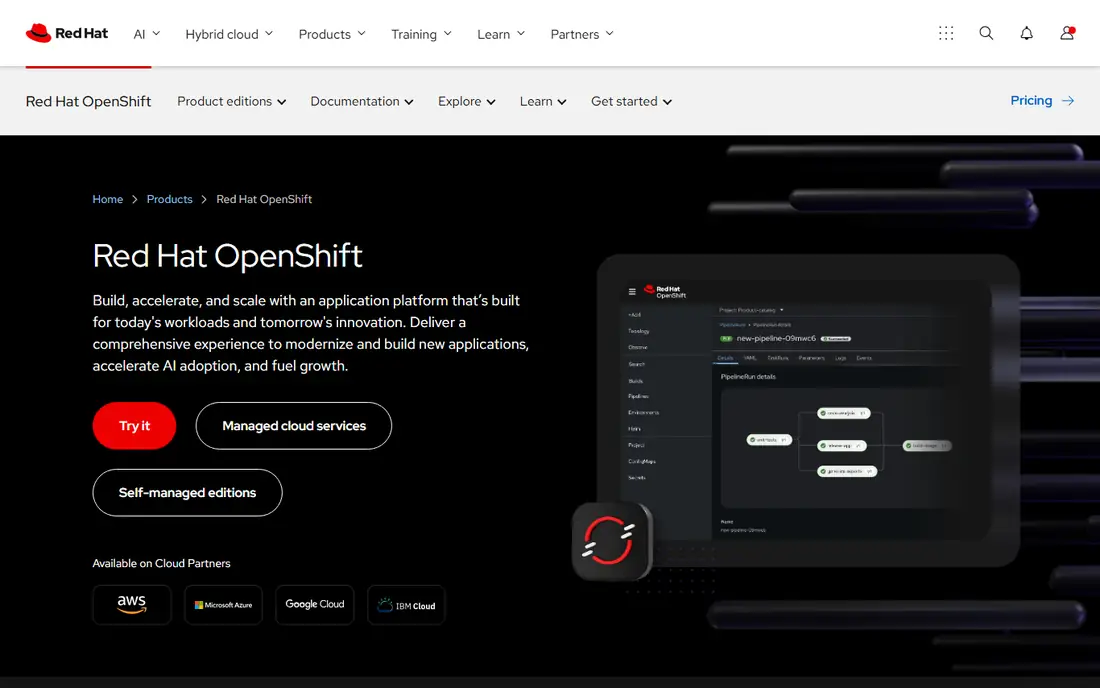
OpenShift describes itself as an application platform built for today's workloads and tomorrow's innovation, with Kubernetes at its core. Its homepage lays out the choice clearly: managed cloud services on partner clouds, or self-managed editions that build on each other, from Kubernetes Engine up to Platform Plus with advanced multicluster security. It also covers AI model lifecycle management and VM migration in the same platform.
For teams replacing Rancher at enterprise scale, OpenShift is the safest bet, with the deepest support organization and the broadest cloud coverage. The trade-off is weight: small teams will find OpenShift more platform than they need, and pricing is enterprise territory. If your fleet is large and regulated, that weight is the point.
What we like- Single platform for app modernization, AI workloads, and VM migration
- Managed services on AWS, Azure, and IBM Cloud
- 2026 Gartner Leader
Watch out for- Enterprise pricing and Red Hat ecosystem commitment
- Heavier than Rancher for small fleets
#2Portainer
Best for: Simple multi-cluster console4.8/5 on
G2 (297 reviews, checked Oct 2026)
Visit portainer.io
Starting priceSee website
Free planYes
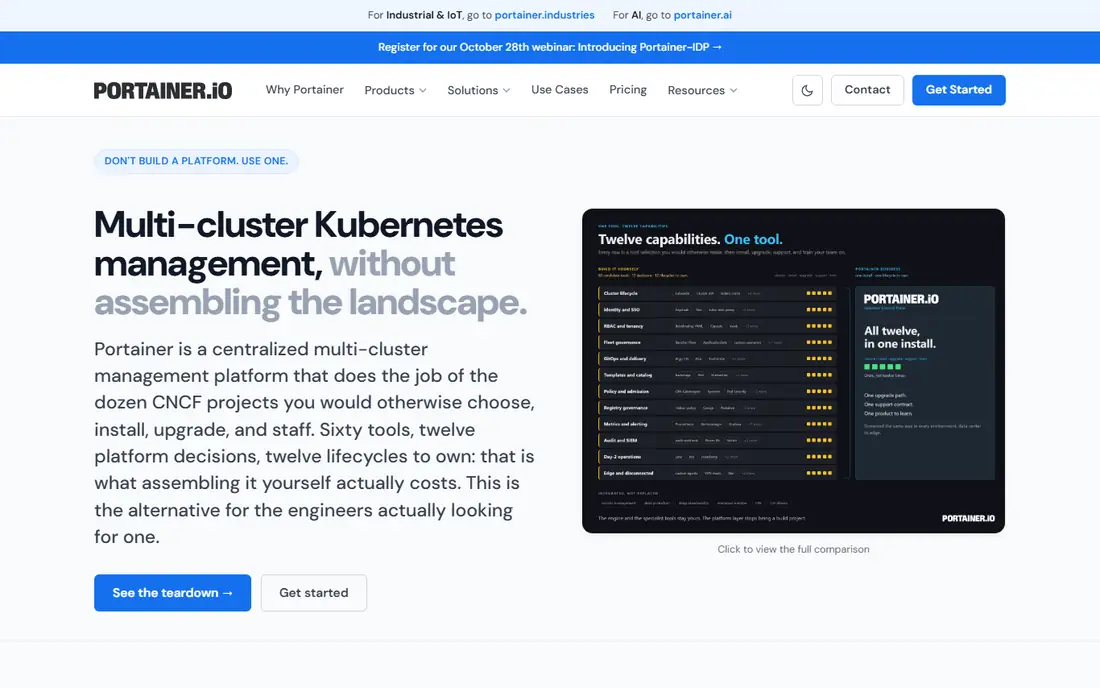
Portainer pitches itself as the alternative to assembling a dozen CNCF projects yourself, and its homepage is refreshingly blunt about it: one product, one owner, one console governing every cluster from one to three thousand edge nodes. It covers multi-cluster fleet management, a centralized GitOps engine on the Portainer server, self-service with RBAC guardrails, and first-class Docker, Swarm, and Podman support alongside Kubernetes.
For small and mid-size teams, Portainer is the most direct Rancher replacement in spirit: simple, centralized, and fast to deploy, with 3 nodes free to start. Larger platform teams may miss Rancher's deeper provisioning automation, but for day-to-day cluster operations, Portainer's simplicity is a genuine advantage.
What we like- One console for Kubernetes, Docker, Swarm, and Podman
- Centralized GitOps without per-cluster controllers
- 3 nodes free
Watch out for- Less depth than full platform suites for complex provisioning
- Enterprise features sit on the paid Business Edition
Starting priceSee website
Free planSee website
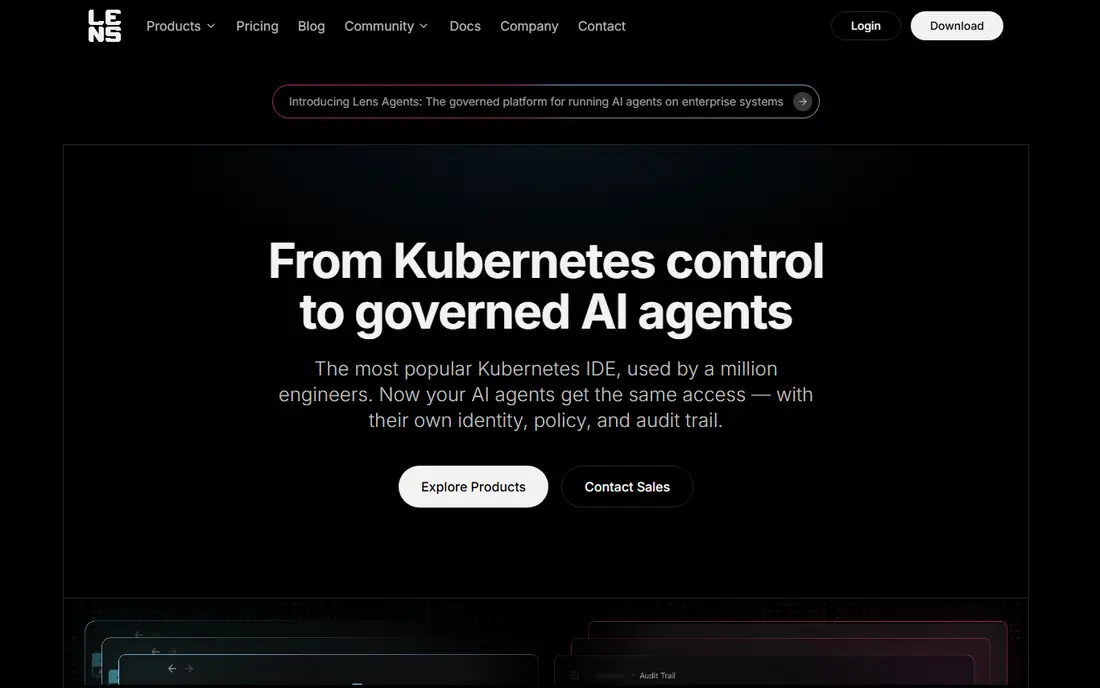
Lens calls itself the IDE for everything but code, and its homepage backs the claim with scale: more than 1 million developers rely on it daily. It runs locally with your credentials, respects RBAC, and needs no backend or cloud service, with a built-in AI smart terminal that connects your coding agent to full cluster context. Its newer Lens Agents product gives AI agents governed access with their own identity, policy, and audit trail.
Be honest about what Lens replaces: developer experience, not platform management. It is the best tool for engineers who live inside clusters all day, and it pairs well with any platform on this list, but it will not provision clusters, enforce fleet policy, or replace Rancher's central management on its own.
What we like- Most popular Kubernetes IDE, used by over 1 million engineers
- Local, RBAC-respecting, no backend required
- New governed AI agent access
Watch out for- A desktop IDE, not a fleet management platform
- Does not provision or lifecycle-manage clusters like Rancher
Starting priceSee website
Free planSee website
Rafay now calls itself the AI infrastructure orchestration platform, and its homepage shows how far the pivot has gone: neoclouds, sovereign AI clouds, telcos, and enterprises turning GPU infrastructure into self-service, governed AI cloud services. Kubernetes management remains part of that story, with fleet management across public cloud, private cloud, and on-prem, standardized cluster profiles, and GPU-aware governance.
If your Kubernetes work increasingly serves AI workloads, Rafay fits the direction of travel, with multi-tenancy, quotas, and chargeback built in. If you run plain application clusters with no GPU or AI angle, verify that Rafay's current packaging still prices and supports that use case, since its marketing now leads with AI clouds.
What we like- Multi-tenant governance across GPU, Kubernetes, SLURM, bare metal, and VMs
- Self-service portals and metering
- Strong neocloud and sovereign-cloud story
Watch out for- Current positioning skews toward AI clouds, so pure Kubernetes buyers should verify fleet features
- Enterprise-oriented pricing
Starting priceSee website
Free planSee website
Spectro Cloud describes itself as an AI infrastructure management platform, and its homepage leads with the operating-model pitch: one platform, one operating model for VMs, containers, and AI together, with consistent policy, access, and compliance everywhere. Its proof points are striking, including tens of thousands of clusters in production and one customer patching 100 clusters in four hours with zero downtime.
For organizations running fleets at scale, especially edge locations or regulated environments, Spectro Cloud is purpose-built, with disconnected and air-gapped support that few rivals match. Smaller teams will find it heavier and pricier than Portainer or Lens, so match the tool to fleet size.
What we like- Declarative profiles run thousands of clusters, VMs, and edge sites from one operating model
- Air-gapped and classified support with FIPS 140-3 and FedRAMP Moderate
- Proven at extreme scale
Watch out for- Enterprise-focused and quote-led
- More platform than small teams need
Starting priceSee website
Free planSee website
Komodor now calls itself the agentic operations platform for production, and its homepage makes the repositioning clear: pre-built agentic workflows for AI SRE, cost optimization, and AI software operations, with agents that inherit shared governance, scoped permissions, and full audit trails. Its Kubernetes heritage shows in features such as predictive pod placement, auto-rightsizing, and troubleshooting that correlates signals across complex Kubernetes environments.
Komodor is best understood as a complement to a management platform rather than a Rancher replacement: it excels at operating production clusters, cutting incident time, and reclaiming cloud spend. If your gap is operations and reliability rather than provisioning, Komodor is strong, but pair it with a platform that actually runs the fleet.
What we like- Agentic SRE workflows with alert intelligence, incident management, and full RCA in minutes
- Governed agents with audit trails
- Cost optimization for Kubernetes and cloud
Watch out for- Now an agentic operations platform, not a cluster provisioner
- Does not replace Rancher's fleet management functions
Starting priceSee website
Free planSee website
Kubermatic positions its Kubernetes Platform as the next-generation way to automate thousands of clusters across multi-cloud, on-prem, and edge, claiming 6,000-plus user clusters from a single master cluster, 85 percent less management time, and 20 times more efficient resource use. Its portfolio extends beyond clusters into load balancers, virtualization, a developer platform, secrets management, and an AI platform for GPU infrastructure.
For service providers and enterprises running large multi-cloud fleets, Kubermatic's density story is compelling, and its 2026 Gartner recognition helps procurement. Smaller teams should check whether its enterprise packaging fits their scale, but for fleet automation at volume, it is one of the closest functional matches to Rancher.
What we like- Automates thousands of clusters from one master cluster with 6,000-plus user clusters claimed
- Named in the 2026 Gartner Magic Quadrant for Container Management
- Open-source roots with enterprise editions
Watch out for- Enterprise-oriented packaging
- Smaller community than OpenShift or Rancher
Starting priceSee website
Free planSee website
Tanzu Platform describes itself as a pre-engineered, AI-ready private cloud platform-as-a-service for mission-critical applications, and its homepage now leads with agentic AI: a secure app platform for agents, a self-service marketplace for AI models and MCP servers, and automated container builds with continuous compliance. Its roots remain in developer experience, with frictionless onboarding to production and baked-in Spring patterns.
Tanzu fits enterprises that want a governed developer platform rather than raw cluster tooling, especially Java and Spring shops. Teams seeking a direct Rancher equivalent should note the scope difference: Tanzu is a PaaS layer above the infrastructure, so it complements rather than replaces cluster management in many architectures. Licensing under Broadcom also deserves a fresh quote.
What we like- Pre-engineered private cloud PaaS with code-to-deployment pipelines
- Strong Spring and Java support
- Automated security, patching, and CVE remediation fleet-wide
Watch out for- Current positioning centers on agentic AI and PaaS, not raw Kubernetes management
- Broadcom-era licensing needs careful review
How we chose
We compared Kubernetes management tools on vendor homepages, weighing fleet provisioning, multi-cluster governance, developer experience, edge and air-gapped support, and current positioning. We included both direct platform replacements and adjacent tools such as Lens and Komodor, and we flagged where vendors have pivoted toward AI infrastructure so buyers can judge fit honestly.
What to check before you commit
Start by separating provisioning from operations. Rancher did both, and few replacements do both equally well: OpenShift, Kubermatic, and Spectro Cloud provision and govern fleets, while Lens improves daily operations and Komodor improves incident response. Many teams end up pairing one platform with one operations tool.
Next, test multi-cluster behavior at your real scale. A console that feels fast with three clusters may behave differently with three hundred, and edge or air-gapped sites add constraints that only some vendors support. Run a pilot with your actual cluster count, network topology, and compliance requirements before committing.
Finally, check the vendor's current direction. Several tools on this list now lead with AI infrastructure or agentic platforms, which is fine if your roadmap matches, but a mismatch means paying for features you will not use while the Kubernetes features you need get less attention. Ask each finalist how their Kubernetes management roadmap looks for the next two years.
Frequently asked questions
What is the best direct Rancher alternative?
Red Hat OpenShift for enterprise fleets, and Portainer for smaller teams that want a simple central console. Kubermatic and Spectro Cloud are the strongest picks for very large multi-cloud or edge fleets.
Is there a free Rancher alternative?
Portainer offers 3 nodes free, and Lens has a free tier for individual developers. Kubermatic has open-source components, but its full platform is enterprise-packaged, so check which edition covers your needs.
Can Lens replace Rancher?
No, not alone. Lens is a desktop IDE for operating clusters, while Rancher provisions and manages fleets centrally. Use Lens alongside a platform such as OpenShift, Portainer, or Kubermatic for the best combination.
Which alternative is best for edge Kubernetes?
Spectro Cloud, with declarative profiles, two-node high-availability designs, and air-gapped support proven at tens of thousands of sites. Kubermatic also targets edge fleets with strong automation.
Does OpenShift work on any cloud?
Yes, with managed services on AWS, Azure, and IBM Cloud, plus self-managed editions on supported infrastructure of your choice. That flexibility is one of its main advantages over single-cloud managed Kubernetes services.
What happened to Rancher?
Rancher remains available as part of SUSE, but many teams evaluate alternatives for pricing, support, or roadmap reasons. The tools here cover the same core job, multi-cluster Kubernetes management, with different strengths in scale, simplicity, and developer experience.
Sources we checked (8)
- https://www.redhat.com/en/technologies/cloud-computing/openshift
- https://www.portainer.io
- https://k8slens.dev
- https://rafay.co
- https://www.spectrocloud.com
- https://komodor.com
- https://www.kubermatic.com
- https://tanzu.vmware.com
Is your product missing or out of date?
We review this list regularly. Vendors can request a listing, send updated pricing or ask about featured placement.

Shihab Mia · Founder, Rankite
Shihab has 5+ years in B2B and SaaS SEO. He writes Rankite's software buying guides from pricing pages, documentation and public user reviews. More about Shihab.