How we make this list: we compare pricing pages, product documentation and public user reviews. Ratings come from G2, Capterra or Trustpilot, with the date we checked them.
Key takeaways
- Kyverno is the closest OPA replacement for Kubernetes, with YAML and CEL policies, mutation, generation, and image verification.
- Cerbos and Permit lead for application authorization, with purpose-built policy languages, audit logs, and agent-aware controls.
- OpenFGA, AuthZed, and Topaz cover relationship-based access control inspired by Google Zanzibar, at different levels of managed service.
- Casbin is the free library option for embedding authorization directly in application code across many languages.
- Ory Keto fits teams already using Ory for identity, keeping authorization inside the same IAM platform.
Quick comparison
| Tool | Best for | Starting price | Free plan |
|---|
 Kyverno | Kubernetes policy | Free | Yes |
 Cerbos | Application authorization | See website | See website |
 Casbin | Embedded library | Free | Yes |
 OpenFGA | Zanzibar-style ReBAC | Free | Yes |
 Topaz | Cloud-native authorization | Free | Yes |
 Permit.io | Managed authorization | See website | See website |
 AuthZed | Enterprise authorization | See website | See website |
 Ory Keto | Ory identity stacks | See website | See website |
Is your product missing or out of date?
We review this list regularly. Vendors can request a listing, send updated pricing or ask about featured placement.
The best Open Policy Agent alternatives
Starting priceFree
Free planYes
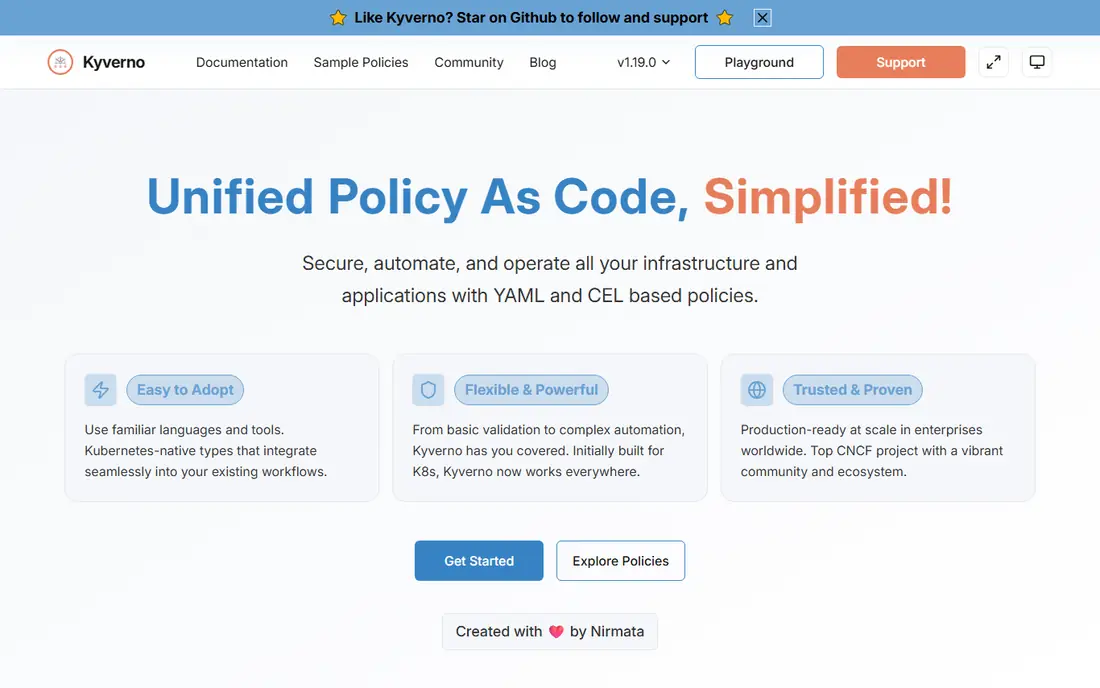
Kyverno calls itself the industry's leading policy engine, and its homepage comparison with OPA is instructive: Kyverno policies use YAML and CEL, while OPA uses Rego, and Kyverno adds Kubernetes resource mutation, generation, cleanup, image verification with Sigstore Cosign and Notary, runtime controls, and policy exceptions. It is a CNCF Graduated project, which signals maturity and governance.
For teams using OPA mainly for Kubernetes admission control, Kyverno is the most direct replacement, with an easier adoption curve since policies extend native Kubernetes types. For non-Kubernetes authorization, choose a purpose-built authorization tool from this list instead.
What we like- CNCF Graduated project used by 1,000-plus organizations in production
- YAML and CEL policies that extend Kubernetes types
- Mutation, generation, cleanup, and image verification that OPA lacks natively
Watch out for- Kubernetes-focused, so general application authorization needs another tool
- YAML policy sprawl at very large scale
Starting priceSee website
Free planSee website
Cerbos describes itself as authorization for enterprise software and AI, and its homepage frames the current problem well: AI agents blur identity lines and over-permissioned access creates risk, so every decision needs a policy check with a kill switch. Its platform combines Cerbos Hub for policy authoring, testing, versioning, and distribution, a stateless PDP with sub-millisecond decisions, and SDKs for JS, Python, Go, Rust, Java, and .NET.
For application teams replacing OPA's general-purpose engine with a purpose-built authorization layer, Cerbos is the strongest pick, with readable policies security teams can review and audit logs that satisfy FedRAMP, SOC 2, ISO 27001, HIPAA, PCI DSS, and GDPR. Its generic-engine comparison is honest about the trade-off: you gain authorization semantics and lifecycle tooling at the cost of a narrower engine.
What we like- Purpose-built YAML policies for RBAC, ABAC, ReBAC, and PBAC
- Sub-millisecond decisions from a stateless PDP
- Audit-ready logs with policy version lineage
- Strong AI agent authorization story
Watch out for- Managed Hub features are commercial
- Self-hosted PDP still requires integration work
Starting priceFree
Free planYes
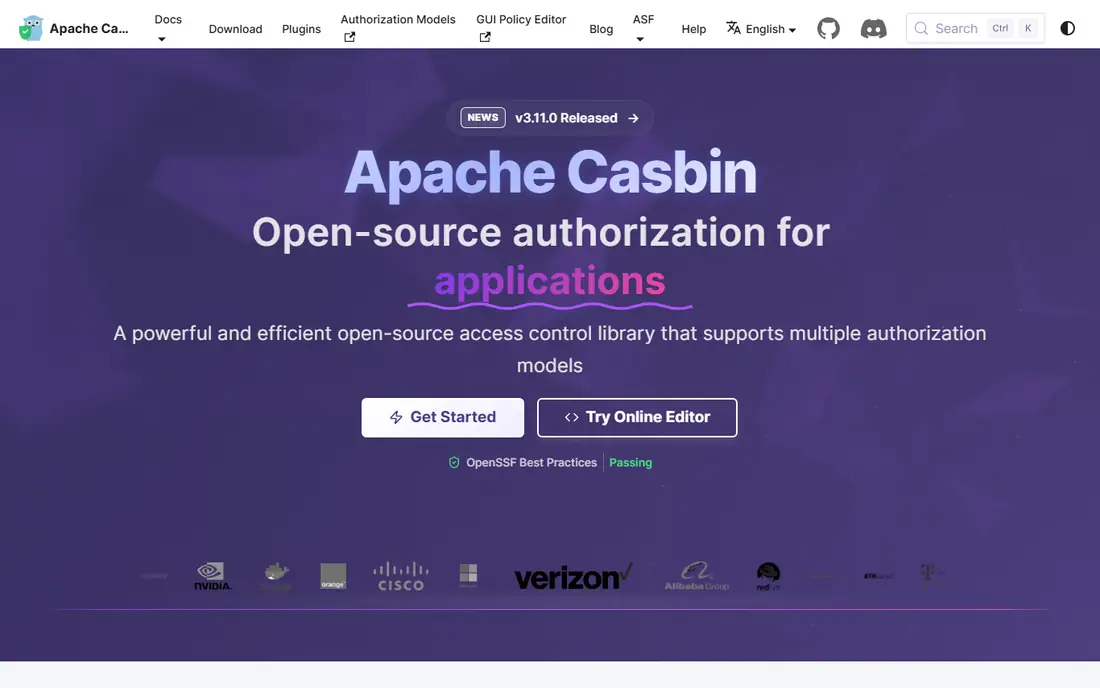
Apache Casbin, now incubating at Apache, describes itself as an open-source access control and authorization library for ACL, RBAC, and ABAC. Its homepage explains the model: CONF files define access control models based on the PERM metamodel, policies store in memory, files, or databases through adapters for MySQL, Postgres, Oracle, MongoDB, Redis, Cassandra, and AWS S3, and all language implementations share the same API and behavior.
For teams that want authorization embedded in code without a separate service, Casbin is the free, flexible choice, and its multi-language support suits polyglot stacks. The cost is operational: you own deployment, scaling, and audit infrastructure, unlike managed platforms such as Permit or AuthZed.
What we like- Open-source library with implementations in Go, Java, PHP, Node.js, Python, .NET, Rust, and more
- PERM metamodel supports ACL, RBAC, ABAC, and ReBAC from config files
- Dozens of storage adapters
Watch out for- Library, not a service, so you operate hosting, scaling, and auditing yourself
- No managed control plane
Starting priceFree
Free planYes
OpenFGA describes itself as fine-grained authorization, and its homepage makes starting trivial: one Docker command runs the engine locally on ports 8080, 8081, and 3000. Its features explain the appeal: a modeling language powerful enough for engineers but friendly enough for other stakeholders, SDKs for popular languages, millisecond authorization checks, and an open RFC process and governance model inviting community contribution.
For teams building Google Drive-style sharing, where relationships between users, groups, and documents drive access, OpenFGA is the best open-source OPA alternative. Enterprises needing managed hosting and support should look at AuthZed, which commercializes the same Zanzibar approach, or Okta FGA, the managed OpenFGA service.
What we like- Open-source, CNCF-incubating fine-grained authorization engine inspired by Google Zanzibar
- Models RBAC, ABAC, and ReBAC in one language
- Millisecond checks that scale from startups to global platforms
Watch out for- Self-hosted open-source project, so managed features and support require a commercial provider
- Modeling language has a learning curve
Starting priceFree
Free planYes
Topaz calls itself cloud-native authorization, and its homepage lays out the design: fine-grained models that grow with your application, policy extracted from code into its own artifact, and policies built into immutable, signed OCI images. It deploys right next to your application for fast decisions with local data, storing users, groups, objects, and relationships in an embedded database optimized for object-graph queries.
For cloud-native teams that want OPA-style policy as code with Zanzibar-style relationship checks in one system, Topaz is a compelling open-source alternative. Its smaller community means fewer examples and integrations than OPA, so evaluate support and documentation depth during a trial.
What we like- Fine-grained authorization that evolves from multi-tenant RBAC to ABAC and ReBAC
- Policies as signed OCI images for a secure supply chain
- Real-time decisions with local data in an embedded database
Watch out for- Smaller community than OPA or OpenFGA
- Cloud-native deployment model suits container teams best
Starting priceSee website
Free planSee website
Permit describes itself as runtime access control for the AI era, and its homepage explains why authorization deserves infrastructure: roles tables calcify, if statements cannot be audited, and AI agents need the same policy as users. Its platform offers a policy decision point running OPA or Cedar in your VPC, updated by OPAL, with a no-code editor, embedded approval UIs, and every decision logged, explained, and forwardable to your SIEM. Its MCP gateway applies the same policies to agent tool calls.
For teams that want OPA's power without operating it, Permit is the managed path, and its agent-aware features suit AI-era workloads. Note that Permit builds on OPA rather than replacing its engine, so teams with strict no-OPA requirements should choose a different engine.
What we like- Full authorization plane with policy UI, GitOps, local PDPs, and audit logs
- RBAC, ABAC, and ReBAC in one check API
- Built on OPA, Cedar, and OPAL with an MCP gateway for AI agents
Watch out for- Managed service pricing is quote-led
- Teams wanting pure open source should use its underlying engines directly
Starting priceSee website
Free planSee website
AuthZed calls itself the authorization platform for AI and modern applications, and its homepage states the value plainly: define permissions once and enforce them everywhere, adapt to changing requirements without rewriting code, and deliver consistent access control at global scale. Its platform supports collaboration, governance, and query use cases from one system, with customers including OpenAI cited for buying instead of building authorization.
For enterprises needing a proven, scalable authorization service, AuthZed is a strong OPA alternative, commercializing the SpiceDB Zanzibar-style engine. Smaller teams may find its enterprise packaging heavier than OpenFGA's open-source engine, so match the choice to scale and support needs.
What we like- Authorization platform for AI and modern applications with unified permissions, flexible configuration language, and strong consistency guarantees
- Global scale and performance for enterprise workloads
Watch out for- Enterprise-oriented and quote-led
- Homepage is high-level, so technical evaluation needs docs and a trial
Starting priceSee website
Free planSee website
Ory describes itself as identity security for the agentic era, covering the complete agent security lifecycle from building and deploying AI agents to observing and enforcing their actions. Its platform offers customer identity, B2B identity with SSO and SCIM, and AI agent identity, with flexible deployment from self-hosted open source to the fully managed Ory Network. Keto is Ory's authorization component within that stack, providing the permissions layer alongside Ory's identity services.
For teams already using Ory for identity, Keto is the natural OPA alternative, keeping authentication and authorization in one API-first platform. Standalone authorization buyers may prefer a dedicated tool such as Cerbos or OpenFGA, but Ory shops will benefit from the integrated stack.
What we like- Authorization service within Ory's API-first IAM platform, alongside customer, B2B, and agent identity
- Self-hosted open-source or fully managed Ory Network options
- 3.3 billion identities managed on the platform
Watch out for- Homepage listed is Ory's general IAM page, not a Keto-specific page
- Best value comes inside the full Ory stack rather than standalone
How we chose
We compared authorization tools on vendor homepages, weighing policy languages, Kubernetes support, relationship-based models, deployment options, audit capabilities, and AI agent support. We favored tools with live homepages and current offerings, and we included both open-source engines and managed platforms because OPA buyers range from platform teams to product teams.
What to check before you commit
Start with your authorization model. Kubernetes admission control points to Kyverno. Application RBAC and ABAC point to Cerbos or Permit. Relationship-based sharing points to OpenFGA, AuthZed, or Topaz. Embedded library use points to Casbin. Matching the model first avoids forcing a general engine into a specialized job.
Next, test policy authoring with your real rules. Rego, YAML, CEL, and Zanzibar-style modeling languages differ in readability, testability, and team adoption, and the best engine on paper can fail if your team cannot write and review policies confidently. Pilot with ten real policies, including edge cases and delegation rules, before committing.
Finally, check audit and agent requirements. Every decision should be logged with policy version lineage for compliance, and AI agents need the same policy enforcement as users, not a second system. Confirm that your finalist handles agent delegation, scoped permissions, and intent checks, since agent authorization is now a core requirement.
Frequently asked questions
What is the best Open Policy Agent alternative overall?
Kyverno for Kubernetes policy, Cerbos for application authorization, and OpenFGA for relationship-based access control. For a managed service, Permit and AuthZed lead, while Casbin leads for embedded libraries.
Is there a free Open Policy Agent alternative?
Yes. Kyverno, Casbin, OpenFGA, and Topaz are open source and free to self-host. Managed control planes and support for these engines are commercial, so budget accordingly for enterprise use.
Which alternative is best for Kubernetes?
Kyverno, a CNCF Graduated project with YAML and CEL policies, mutation, generation, cleanup, and image verification. It is purpose-built for Kubernetes, while OPA's Kubernetes support requires more custom work.
Which alternative is best for AI agent authorization?
Cerbos and Permit lead, with agent-specific features such as delegation, scoped permissions, and policy enforcement at MCP gateways. Both treat agents as first-class subjects under the same policy as users.
What is Zanzibar-style authorization?
Google's Zanzibar model stores relationships between users, groups, and objects, then answers access questions by traversing that graph. OpenFGA, AuthZed, and Topaz implement this model, making it ideal for Drive-style sharing and complex permission graphs.
Can I migrate OPA policies to these tools?
Partially. Rego policies do not translate automatically to YAML, CEL, or Zanzibar models, so plan a rewrite of key policies during migration. Tools built on OPA, such as Permit, ease the transition by reusing the OPA engine under a managed plane.
Sources we checked (8)
- https://kyverno.io
- https://www.cerbos.dev
- https://casbin.org
- https://openfga.dev
- https://www.topaz.sh
- https://www.permit.io
- https://authzed.com
- https://www.ory.sh
Is your product missing or out of date?
We review this list regularly. Vendors can request a listing, send updated pricing or ask about featured placement.

Shihab Mia · Founder, Rankite
Shihab has 5+ years in B2B and SaaS SEO. He writes Rankite's software buying guides from pricing pages, documentation and public user reviews. More about Shihab.