How we make this list: we compare pricing pages, product documentation and public user reviews. Ratings come from G2, Capterra or Trustpilot, with the date we checked them.

Key takeaways
- pnpm is the best npm alternative for most teams, with installs up to 69 times faster on warm caches and one copy of every file on disk.
- Bun is the fastest all-in-one option, combining runtime, package manager, test runner, and bundler in a single binary.
- Deno is the most secure option, with access denied by default and built-in TypeScript, linting, testing, and package management.
- Verdaccio is the best free private registry, with MIT-licensed self-hosting in one command.
Quick comparison
| Tool | Best for | Starting price | Free plan |
|---|
 Yarn | Stable, reproducible monorepo workflows | $0 | Yes |
 pnpm | Fast, disk-efficient installs and monorepos | $0 | Yes |
 Bun | All-in-one runtime, package manager, and bundler | $0 | Yes |
 Deno | Secure, TypeScript-first JavaScript development | $0 | Yes |
 JSPM | Browser-native ES module management | $0 | Yes |
 GitHub Packages | Private packages inside GitHub workflows | See website | Yes |
 Verdaccio | Self-hosted private npm registry | $0 | Yes |
 JFrog Artifactory | Enterprise artifact and supply-chain management | See website | Free trial |
Is your product missing or out of date?
We review this list regularly. Vendors can request a listing, send updated pricing or ask about featured placement.
The best npm alternatives
Starting price$0
Free planYes

Yarn doubles as a package manager and project manager, built for simple projects and industry monorepos alike. Workspaces let you split a project into sub-components, and its stability promise means installs stay reproducible over time. The project is fully independent open source, with its contributor community defining the roadmap, and documentation is a stated priority at every release.
Yarn 4 is the current line, with older 3.6 documentation still available. For teams that value stability and workspace maturity over raw install speed, Yarn is the safest npm alternative.
What we like- First package manager built around workspaces
- Installs that work today keep working the same way in the future
- Fully independent open-source project with no company owner
Watch out for- Slower than pnpm and Bun on large installs
- Plugin system adds learning curve
- Smaller ecosystem of hosted services than npm
#2
pnpm
Best for: Fast, disk-efficient installs and monorepos
Visit pnpm.io
Starting price$0
Free planYes

pnpm is the best npm alternative for most JavaScript teams. Its content-addressable store keeps one copy of every file and hard-links it into each project's node_modules, so 100 projects using the same dependency cost one copy on disk. Resolution, fetching, and linking happen in parallel, and benchmarks on a real project show 8.2 times faster installs overall, with warm re-runs up to 69 times faster than npm.
First-class monorepo support includes the workspace protocol, filtering, and a single lockfile. Catalogs define a version once and reference it everywhere, patching fixes bugs without waiting for upstream, and install scripts only run for packages you approve, which cuts a major supply-chain attack path. It is a drop-in replacement: your package.json works as-is. For speed, disk savings, and security, pnpm is the top pick.
What we like- Up to 69 times faster than npm on warm installs
- One copy of every file on disk, shared across projects
- Strict by default, so code cannot import undeclared dependencies
- Catalogs, patching, and build-script approval
Watch out for- Symlinked node_modules can surprise tools that expect flat layouts
- Some legacy packages need configuration
- Ecosystem still smaller than npm's
#3
Bun
Best for: All-in-one runtime, package manager, and bundler
Visit bun.sh
Starting price$0
Free planYes
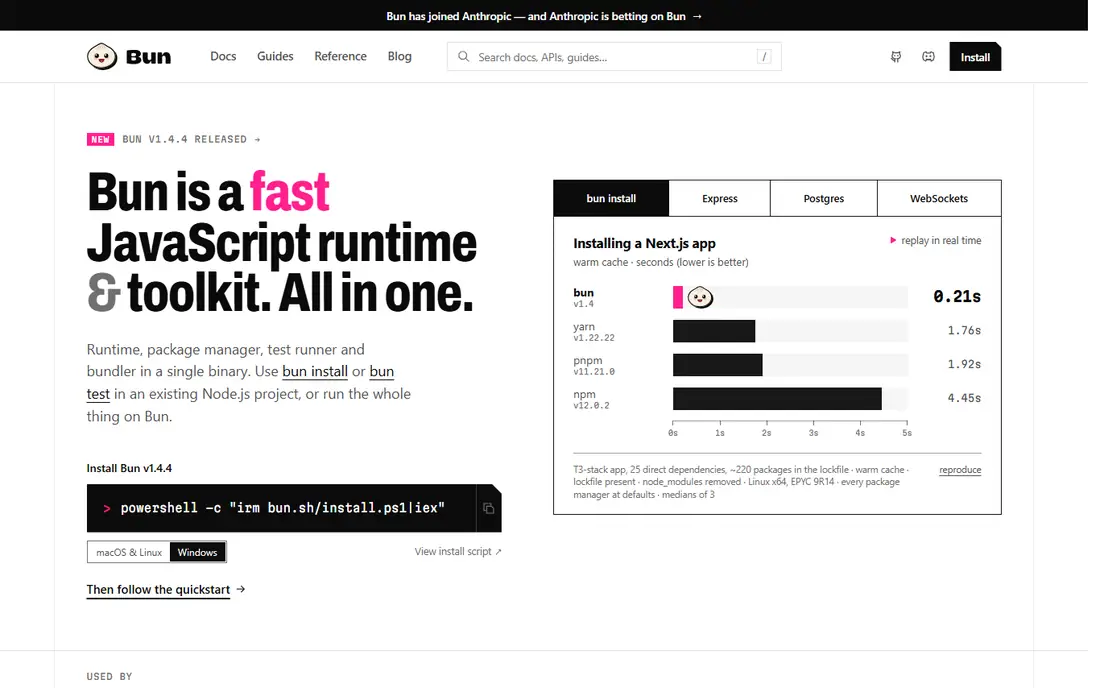
Bun is a fast all-in-one JavaScript runtime where install, develop, run, test, and ship use the same tool. The latest release, v1.4.4 from October 2026, adds a Prettier-compatible formatter, faster project checking, and many install fixes. Benchmarks on a Next.js app show the fastest installs across cold cache, warm cache, CI, and no-op scenarios, with warm-cache install memory of 12 MB against 698 MB for npm.
Production users include Claude Code, shipped to millions of developers as a Bun executable, and Midjourney, which pushes image notifications through Bun's WebSocket server. For teams that want one binary for the whole workflow, Bun is the best npm alternative.
What we like- Runtime, package manager, test runner, and bundler in one binary
- Fastest installs in Bun's own benchmarks
- Very low memory use
- Bun install drops into existing Node projects without a runtime switch
Watch out for- Newer ecosystem than Node with some edge-case gaps
- Node compatibility is strong but not absolute
- Production track record is shorter than npm's
#4
Deno
Best for: Secure, TypeScript-first JavaScript development
Visit deno.com
Starting price$0
Free planYes
Deno is a fast, open-source, fully Node-compatible runtime with TypeScript and everything else baked in. Zero-setup TypeScript and npm support mean no tsc, no ts-node, no bundler, and no config in the way. It reads npm, Yarn, and pnpm lockfiles, pulls from npm and JSR with one command, and resolves from a global cache instead of per-project node_modules. Benchmarks show 598 ms warm installs against 3,852 ms for npm.
Security is the real differentiator: filesystem, network, and environment access are blocked by default and opened on purpose, postinstall scripts are off by default, and deno audit finds and fixes vulnerable dependencies with a minimum-age option. For teams that want npm compatibility with stronger defaults, Deno is the best alternative.
What we like- Fully Node-compatible with TypeScript built in
- Npm and JSR packages from one command with a single integrity file
- Access denied by default with granular permissions
- Faster installs than npm in Deno's benchmarks
Watch out for- Smaller ecosystem than Node
- Some npm packages still need compatibility work
- Deno Deploy hosting is optional and paid at scale
Starting price$0
Free planYes
JSPM is the ES module package manager and CDN built around import maps, the web standard for mapping bare specifiers to URLs. Instead of bundling everything for Node, it lets browsers resolve packages natively, which suits projects that ship modern ES modules directly to the browser without a build step.
The homepage extract is thin, showing only the title and tagline, so this listing rests on domain confirmation and the project's established profile. For browser-first projects that want standards-based module loading, JSPM is a useful npm complement.
What we like- Standards-based import map package management
- ES module CDN for browser delivery
- Works without a build step for modern browsers
Watch out for- Homepage content is thin, so this listing rests on domain and title confirmation
- Browser-focused, so not a Node workflow replacement
- Smaller community than pnpm or Yarn
#6
GitHub Packages
Best for: Private packages inside GitHub workflows
Visit github.com
Starting priceSee website
Free planYes
GitHub Packages is the secure package registry built into GitHub, storing and managing code and packages with GitHub credentials and integrating into workflows through APIs and webhooks. Paired with Actions, it simplifies package management with version updates, fast distribution through a global CDN, and dependency resolution using the existing GITHUB_TOKEN.
One flag: the packages page fetch resolved to GitHub Actions page content, though the page itself confirms GitHub Packages as a secure registry with CDN distribution, so the listing rests on that confirmation. For teams already on GitHub, keeping packages beside code and CI is the simplest private-registry path.
What we like- Secure registry integrated with GitHub credentials
- Pairs with Actions for build, test, and publish
- Fast downloads through a global CDN
- Free for public repositories
Watch out for- Fetch resolved to Actions page content, though Packages references are confirmed on the page
- Npm support sits inside a broader multi-format registry
- Private storage limits apply on free plans
Starting price$0
Free planYes
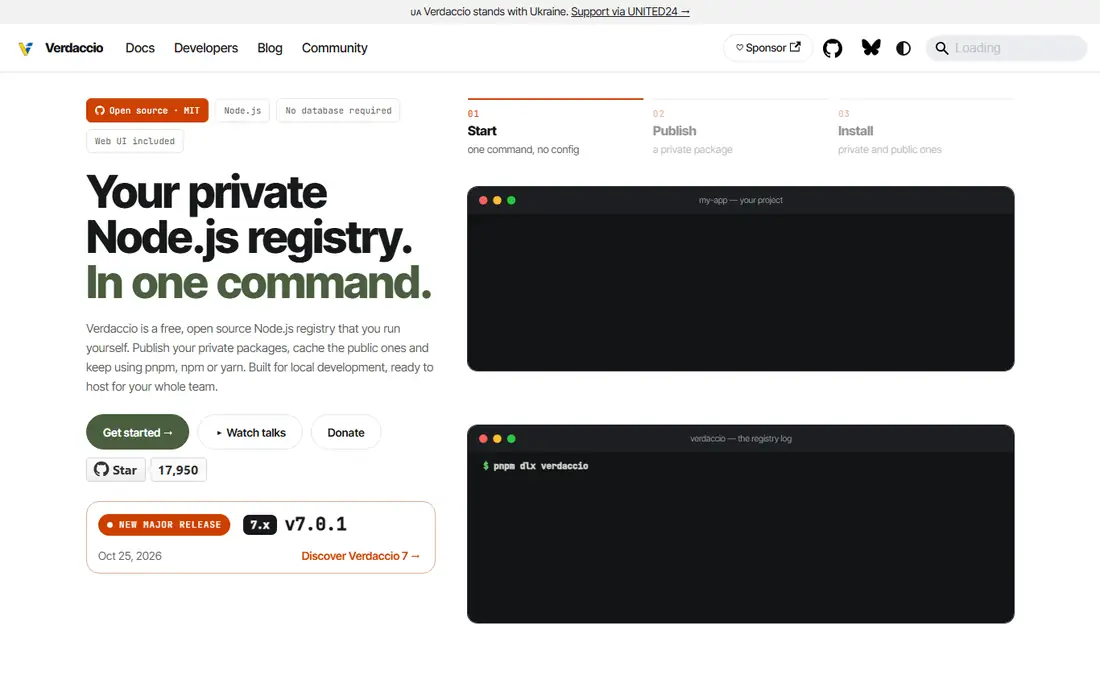
Verdaccio is a free, open-source Node.js registry that you run yourself. Publish private packages, cache public ones, and keep using pnpm, npm, or Yarn. One registry sits in front of everything you install: private packages come from your own storage, public packages are fetched once from npmjs.org and cached, and every next install comes from cache, faster and still available when the public registry has a bad day.
It starts with one command and no config, supports htpasswd or plugin authentication, S3 or Google Cloud storage, and runs anywhere via Docker or Kubernetes. For teams that want a private registry without a vendor bill, Verdaccio is the best npm alternative.
What we like- Free and MIT licensed
- One command to start with no database
- Proxies npmjs.org and caches downloads
- Docker image and Helm chart for hosting
- 98 plugins for auth, storage, and middleware
Watch out for- Community supported rather than vendor supported
- Scaling and high availability are your responsibility
- Web interface is functional rather than polished
#8
JFrog Artifactory
Best for: Enterprise artifact and supply-chain management
Visit jfrog.com
Starting priceSee website
Free planFree trial

JFrog Artifactory is the universal artifact management platform that serves as the system of record for everything in a software supply chain, from binaries, packages, and containers to AI and ML models and agent assets. It supports npm alongside Maven, PyPI, Docker, Helm, NuGet, Debian, RPM, and Terraform, with dependency proxying and caching, governance and lifecycle management, and release integrity through attestations.
It integrates with Jenkins, GitHub Actions, and Azure DevOps, and its FAQ confirms npm publish and install work through repository configuration. For enterprises that need one governed source of truth for all artifact types, Artifactory is the strongest npm alternative.
What we like- Universal repository manager supporting npm plus Maven, PyPI, Docker, Helm, and more
- Trusted by over 6,500 DevOps teams and over 80 percent of the Fortune 100
- Caching close to consumption points speeds CI
- 99.99 percent uptime SLA on Premium Availability
Watch out for- Pricing is not shown on the homepage
- Enterprise scope is heavy for small teams
- Free access is trial-based
How we chose
We compared each tool on install speed, disk use, monorepo support, security defaults, registry features, and pricing transparency. Every homepage above was opened to confirm it loads and belongs to the product, except JSPM and GitHub Packages, whose thin or redirected extracts are flagged in their sections. Prices come from vendor pages where shown; where the homepage did not display pricing, the field reads "See website" rather than a guessed figure. npm itself was excluded as the product being replaced.
What to check before you switch
Start with your goal. Faster installs and disk savings point to pnpm or Bun. Security defaults point to Deno or pnpm's script approval. A private registry points to Verdaccio for self-hosting, GitHub Packages for GitHub teams, or Artifactory for enterprises. Browser-native delivery points to JSPM.
Next, test with your real project: run install, test, and build on a copy, and check that lockfiles, workspaces, and CI caching behave. Watch for tools that assume a flat node_modules layout, since pnpm's strict symlinks can surface hidden dependency bugs. Finally, confirm registry compatibility if you publish: private scopes, access tokens, and provenance settings differ across registries.
Frequently asked questions
Can I switch from npm without changing package.json?
Yes, for pnpm, Yarn, Bun, and Deno. All four read package.json directly, and pnpm, Bun, and Deno can read or generate their own lockfiles from it.
Which alternative is fastest?
Bun claims the fastest installs in its own benchmarks, with pnpm close behind and up to 69 times faster than npm on warm caches. Real results depend on project size, cache state, and hardware.
What is the best free option?
pnpm, Yarn, Bun, Deno, JSPM, and Verdaccio are all free and open source. GitHub Packages is free for public repositories, and Artifactory offers a free trial.
Do these tools work with the npm registry?
Yes. Yarn, pnpm, Bun, Deno, and JSPM all install from the npm registry, and Verdaccio, GitHub Packages, and Artifactory can proxy or mirror it.
Which alternative is best for monorepos?
pnpm is the best monorepo pick, with first-class workspace support, filtering, catalogs, and a single lockfile. Yarn workspaces are the most mature alternative.
Is Deno a replacement for Node.js?
Deno is a Node-compatible runtime, not just a package manager, so it can replace Node for many projects while still running npm packages. Teams that only want a faster installer should pick pnpm or Bun instead.
Sources we checked (8)
- https://yarnpkg.com
- https://pnpm.io
- https://bun.sh
- https://deno.com
- https://jspm.org
- https://github.com/features/packages
- https://verdaccio.org
- https://jfrog.com/artifactory/
Is your product missing or out of date?
We review this list regularly. Vendors can request a listing, send updated pricing or ask about featured placement.

Shihab Mia · Founder, Rankite
Shihab has 5+ years in B2B and SaaS SEO. He writes Rankite's software buying guides from pricing pages, documentation and public user reviews. More about Shihab.