How we make this list: we compare pricing pages, product documentation and public user reviews. Ratings come from G2, Capterra or Trustpilot, with the date we checked them.
Key takeaways
- NGINX is the most widely used general-purpose web server and reverse proxy, so alternatives win on a specific job, not on general capability.
- Caddy is the easiest replacement, with automatic HTTPS built in and a small config file, while Traefik wins for Docker and Kubernetes where services change constantly.
- HAProxy leads on dedicated load balancing with L4 and L7 control, and Envoy leads on cloud-native service mesh traffic management.
- All eight tools here are free and open source at base, with LiteSpeed and Kong offering paid commercial editions for enterprise features.
Quick comparison
| Tool | Best for | Starting price | Free plan |
|---|
 Apache HTTP Server | Traditional hosting and PHP | Free, open source | Yes |
 Caddy | Simple setup and automatic HTTPS | Free, open source | Yes |
 Traefik | Containers and Kubernetes | Free, open source | Yes |
 HAProxy | Dedicated load balancing | Free, open source | Yes |
 Envoy | Service mesh traffic | Free, open source | Yes |
 LiteSpeed | Hosting and PHP performance | Free, open source | Yes |
 OpenResty | Lua-powered web platform | Free, open source | Yes |
 Kong Gateway | API-centric gateways | Free, open source | Yes |
Is your product missing or out of date?
We review this list regularly. Vendors can request a listing, send updated pricing or ask about featured placement.
The best nginx alternatives
Starting priceFree, open source
Free planYes
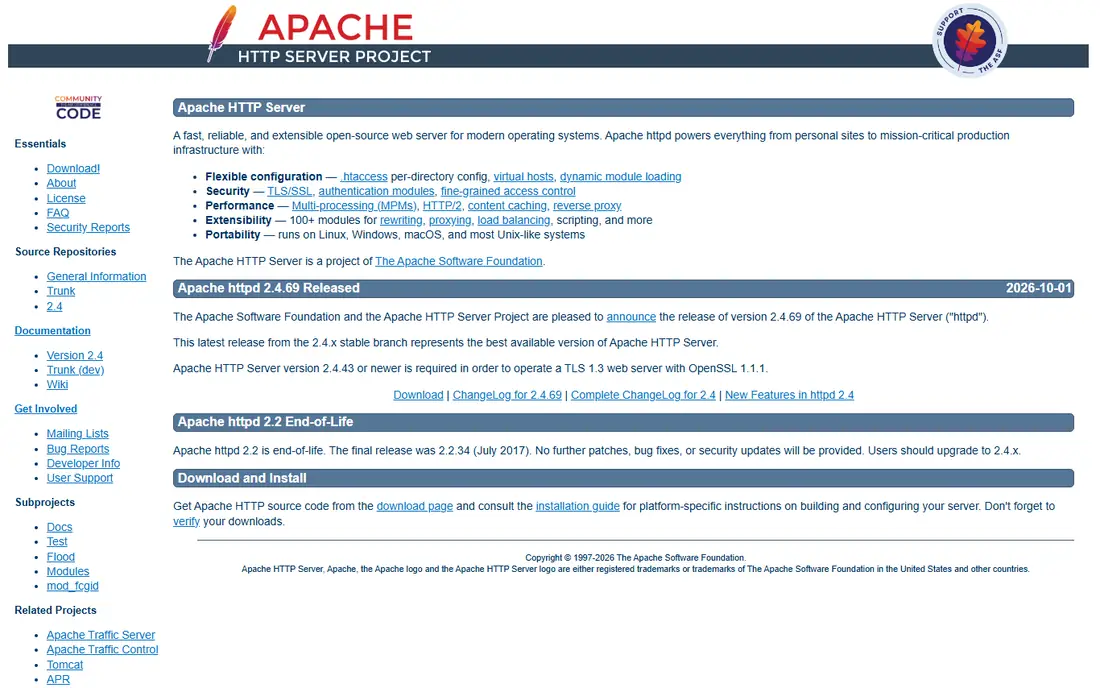
Apache HTTP Server is the mature, modular web server for traditional hosting, PHP applications, shared hosting, and legacy workloads, with .htaccess support where enabled. It pairs with PHP-FPM and WordPress in the classic stack, and its module ecosystem covers nearly every hosting need. Apache 2.4.64 from 2025 fixed eight CVEs covering HTTP/2 memory handling, SSL/TLS configuration, proxy protocol, and header manipulation.
Memory use runs moderate to high, and directory-level configuration can add operational complexity. Apache fits teams that rely on Apache modules, existing Apache conventions, or per-directory rules, rather than teams chasing maximum static-content throughput.
What we like- Very large community
- Huge module ecosystem
- Per-directory .htaccess rules
- Mature and proven
Watch out for- Moderate to high memory use
- Directory-level config adds complexity
- Performance trails NGINX on static content
Starting priceFree, open source
Free planYes

Caddy is the modern web server noted for simple configuration and automatic HTTPS provisioning, making it the easiest NGINX replacement for self-hosted apps, Docker deployments, and small infrastructure. Automatic TLS certificate management is built in, so HTTPS just works without manual certificate handling, and the config file stays small. Setup ease rates excellent in 2026 comparisons, versus moderate for NGINX.
Configuration and operational assumptions differ from NGINX, and production tuning knobs are fewer. Caddy fits simple apps where you want HTTPS to just work, and teams that value small configs over maximum tuning depth.
What we like- Automatic HTTPS built in
- Small config file
- Low config complexity
- Excellent ease of setup
Watch out for- Configuration assumptions differ from NGINX
- Smaller ecosystem
- Fewer production tuning knobs
Starting priceFree, open source
Free planYes

Traefik is the container-aware router with automatic service discovery, designed for dynamic routing in container environments where services start and stop constantly. It discovers Docker and Kubernetes services automatically, so routing follows service information without manual config rewrites, and it includes a visual monitoring dashboard. Traefik was born from the frustration of rewriting config files every time a container starts or stops.
Provider setup, labels, and routing rules introduce a learning curve. Traefik fits Docker-heavy setups and Kubernetes ingress, where it is often the better fit than NGINX, while NGINX remains better for static content at scale.
What we like- Automatic service discovery
- Docker and Kubernetes native
- Visual monitoring dashboard
- Automatic HTTPS
Watch out for- Provider setup and labels add a learning curve
- Routing rules need care
- Smaller static-serving focus
Starting priceFree, open source
Free planYes
HAProxy is the specialized proxy and load balancer for high availability, TCP and HTTP traffic distribution, health checks, and failover. It operates at both TCP (L4) and HTTP (L7) levels, with explicit control over traffic distribution that general web servers lack. HAProxy 3.3 from November 2025 changed default load balancing to random Power-of-Two for superior fairness, added automatic CPU core binding for 64-plus cores, and expanded ACME support with Data Plane API certificate auto-storage.
HAProxy is more specialized than a basic website setup, and config complexity runs high. HAProxy fits mission-critical systems where traffic distribution, health checks, or explicit L4 and L7 control are the main need.
What we like- Very high performance
- Advanced load balancing
- Health checks and failover
- L4 and L7 control
Watch out for- More specialized than a basic website setup
- Config complexity is high
- HTTPS handling is manual
Starting priceFree, open source
Free planYes
Envoy is the cloud-native proxy for microservices, with advanced traffic management, observability, and service mesh architectures, usually encountered alongside Istio. Native support covers circuit breaking, distributed rate limiting, and gRPC load balancing, which general web servers cannot reach. It suits platform teams building service meshes with sidecar proxies across Kubernetes.
Configuration complexity and operational overhead sit in a different league from NGINX, and it requires platform knowledge plus surrounding infrastructure. Envoy fits platform teams where proxying is part of a larger cloud-native platform, not solo developers serving a website.
What we like- Cloud-native proxy
- Circuit breaking
- Distributed rate limiting
- GRPC load balancing
- Deep observability
Watch out for- Configuration complexity in a different league
- Needs platform knowledge
- Heavy operational overhead
Starting priceFree, open source
Free planYes
LiteSpeed is the hosting-focused web server with excellent performance, rated six times Apache in one 2026 comparison matrix, with very low memory use and native HTTP/3 support. LiteSpeed 6.3.3 from 2025 added HTTP/2 aggressive bot blocking, improved Redis control panel support, and selective anti-DDoS configuration, while the commercial version supports Kubernetes through LiteSpeed Containers. OpenLiteSpeed 1.8.4 added Linux Namespace Containers, asynchronous I/O, QUIC v2, and hCAPTCHA bot protection.
Commercial editions add licensing, and existing NGINX or Apache rules need translation. LiteSpeed fits hosting providers and PHP applications where hosting integrations or application compatibility matter, with OpenLiteSpeed as the free path.
What we like- Excellent performance, rated 6x Apache in one matrix
- Very low memory use
- Native HTTP/3
- Built-in anti-DDoS
Watch out for- Commercial editions add licensing
- Check edition capabilities
- Existing rules need translation
Starting priceFree, open source
Free planYes
OpenResty builds on NGINX core with Lua scripting, turning the web server into a full web platform for dynamic application logic at the edge. It suits API gateways, dynamic routing, and edge logic that plain NGINX config cannot express, while keeping NGINX performance characteristics. Teams that need programmable request handling without a separate application tier benefit most.
Lua skills are required, and edge logic adds debugging complexity versus plain config. OpenResty fits engineering teams that want NGINX performance plus programmability, and that can staff Lua development.
What we like- NGINX core plus Lua scripting
- Dynamic application logic at the edge
- Strong for APIs and gateways
- Free
Watch out for- Lua skills required
- Smaller community than NGINX
- Edge logic adds debugging complexity
Starting priceFree, open source
Free planYes
Kong Gateway is the API-centric gateway with a plugin architecture, suited to cloud-native API systems where authentication, rate limiting, transformation, and observability run as plugins. It covers the gateway layer that NGINX users often build by hand, with a plugin catalog that extends functionality without custom code. Mid-market and enterprise API teams benefit most.
API focus means static serving is secondary, and enterprise features are paid. Kong fits API-centric systems that need gateway plugins and API management, rather than simple static websites.
What we like- Plugin architecture
- API-centric design
- Cloud-native
- Strong for API management
Watch out for- API focus over static serving
- Enterprise features are paid
- Setup effort for small sites
How we chose
We compared these tools on setup ease, performance, memory use, HTTP/3 support, automatic HTTPS, config complexity, community size, container fit, and cost, using 2026 web server comparisons as the source. Capability overlap is the point: all four main tools do load balancing, reverse proxying, and TLS termination, so design emphasis drives the choice, not capability ceiling. We favored tools with clear strengths for a workload type, since matching the tool to the workload matters more than popularity.
We also separated four buyer types. Simple setups should shortlist Caddy, container setups should shortlist Traefik, load-balancing setups should shortlist HAProxy, and platform setups should shortlist Envoy. Traditional hosting should shortlist Apache and LiteSpeed, while API teams should shortlist Kong and OpenResty. The right pick follows workload emphasis, not benchmark scores alone.
What to check before you switch web servers
Match the tool to the workload first
Choosing an NGINX alternative starts with the job you need done: Apache when you rely on Apache modules or .htaccess rules, Caddy when you want straightforward reverse proxying with automatic HTTPS, Traefik when container services change frequently, HAProxy when traffic distribution is the main need, and Envoy when proxying is part of a larger platform. A tool working in its natural mode beats a stretched tool every time.
Test TLS and HTTP/3 on your real traffic
Use TLS 1.3 exclusively for new deployments, since it offers faster handshakes and stronger encryption, and disable TLS 1.0, 1.1, and SSL 2.0 and 3.0 entirely. Require AES-256-GCM or ECDHE with RSA and AES, enable forward secrecy, and disable RC4, 3DES, DES, and MD5 ciphers. Test HTTP/3 support on your real traffic, since support varies from native to experimental across these tools.
Measure performance on your workload, not benchmarks
The right choice depends on application requirements, platform compatibility, security, operational complexity, and measured performance rather than popularity alone. Benchmarks favor different tools for static content, dynamic APIs, and load balancing, so run your own traffic patterns through finalists before committing. A tool that wins a static benchmark may lose on your API workload.
Frequently asked questions
Is NGINX still the best reverse proxy for most web apps?
Yes, for most web apps NGINX remains the best choice because it is fast, proven, and widely documented. Alternatives win on specific jobs: Caddy for simplicity, Traefik for Docker, HAProxy for load balancing, and Envoy for service mesh. Switch only when one of those jobs dominates your workload.
Which NGINX alternative is easiest to set up?
Caddy is usually the easiest, because automatic HTTPS is built in and the config file is small. NGINX is still approachable, but you will write more config for certificates, upstreams, and redirects. Traefik is also easy for Docker setups, since it discovers services automatically.
Can HAProxy replace NGINX as a web server?
HAProxy can work as a reverse proxy, but it is more specialized than a basic website setup, focusing on load balancing and high availability. It fits edge proxy and load balancer roles better than static content serving, where NGINX, Caddy, or Apache serve better.
What is the best NGINX alternative for Kubernetes?
Traefik is the best fit for Kubernetes ingress, with automatic service discovery and container-native routing. Envoy suits service mesh use inside Kubernetes, while NGINX Ingress remains a solid general choice. Pick Traefik for dynamic routing and Envoy for mesh traffic management.
Is LiteSpeed really faster than Apache?
One 2026 comparison matrix rates LiteSpeed performance as excellent and six times Apache, with very low memory use versus moderate to high for Apache. Real gains depend on workload, caching, and PHP setup, so measure on your own traffic before committing to a hosting migration.
Sources we checked (13)
- https://httpd.apache.org
- https://caddyserver.com
- https://traefik.io
- https://www.haproxy.org
- https://www.envoyproxy.io
- https://www.litespeedtech.com
- https://openresty.org
- https://konghq.com
- https://dev.to/__3381495fd2b/choosing-an-nginx-alternative-starts-with-the-job-you-need-done-31fp
- https://copyprogramming.com/howto/alternate-of-nginx-server
- https://www.brittocj.com/blog/web-servers-2026/
- https://sliplane.io/blog/top-5-reverse-proxies-which-one-should-you-choose
- https://www.devopsschool.com/blog/top-10-reverse-proxy-tools-features-pros-cons-comparison/
Is your product missing or out of date?
We review this list regularly. Vendors can request a listing, send updated pricing or ask about featured placement.

Shihab Mia · Founder, Rankite
Shihab has 5+ years in B2B and SaaS SEO. He writes Rankite's software buying guides from pricing pages, documentation and public user reviews. More about Shihab.