How we make this list: we compare pricing pages, product documentation and public user reviews. Ratings come from G2, Capterra or Trustpilot, with the date we checked them.
Key takeaways
- Burp Suite Professional remains the standard for hands-on manual testing, with published pricing near $449 to $499 per user per year.
- OWASP ZAP is the best free starting point for automated scanning, with no paid tier from the project itself.
- Acunetix suits enterprises that need deep automated web scanning with proof-based verification and lower false positives.
- StackHawk is the best developer-first option, with CI pipeline scanning from $10 per user per month.
- Beagle Security suits teams that want managed web and API testing from $99 per month, with concurrent-test pricing.
Quick comparison
Is your product missing or out of date?
We review this list regularly. Vendors can request a listing, send updated pricing or ask about featured placement.
The best Netsparker alternatives
Starting price$499 per user per year
Free planFree trial
Burp Suite Professional remains the standard for hands-on manual testing, and every serious penetration tester knows it. The proxy, repeater, intruder and scanner combine into one workflow: intercept a request, modify it, replay it, and automate variations, all from the same tool. Extensions from the BApp Store add everything from authentication helpers to custom scan checks, which is why Burp adapts to unusual applications that automated scanners handle poorly.
Published pricing varies across guides, with figures from $449 to $499 per user per year, so confirm the current rate on PortSwigger's pricing page. Burp's scanner needs driving: you set scope, handle authentication and review results carefully, unlike a set-and-forget automated scanner. For a team doing manual penetration testing, Burp Suite is not optional, it is the baseline.
What we like- Standard tool for manual testing
- Most flexible proxy and repeater
- Large extension library
Watch out for- Scanning needs manual driving
- Published prices vary between $449 and $499

#2OWASP ZAP
Best for: Free automated scanning4.7/5 on
G2 (14 reviews, checked Oct 2026)
Visit zaproxy.org
Starting price$0
Free planYes
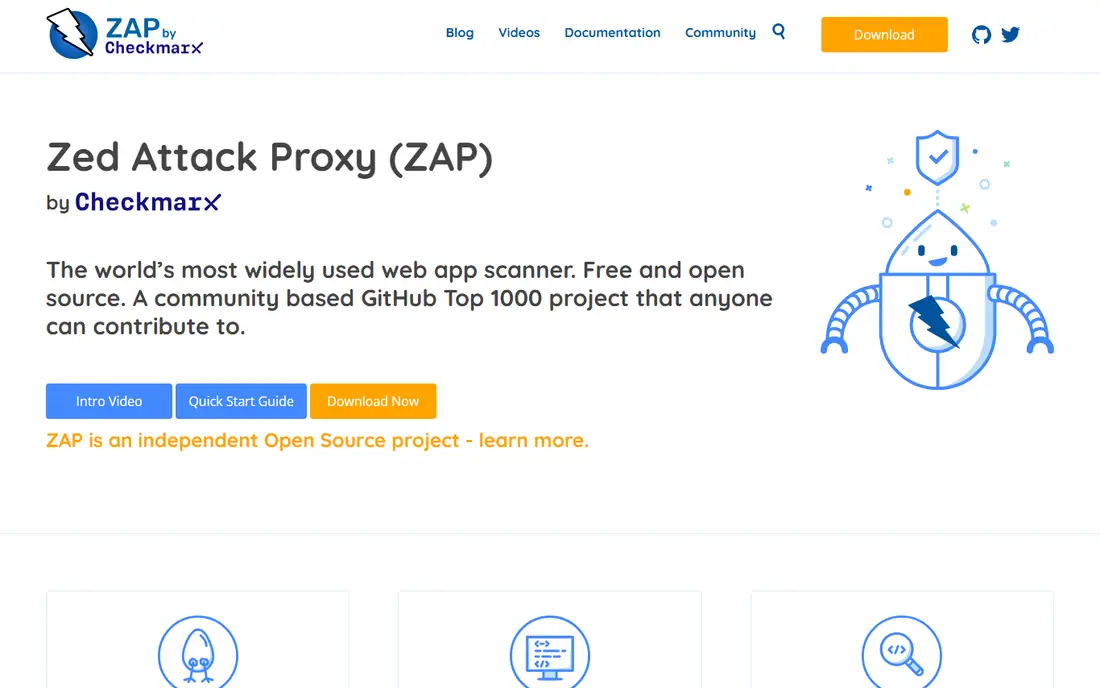
OWASP ZAP is the best free starting point for automated scanning, with no paid tier from the project itself. It crawls sites, runs active scans for common flaws such as cross-site scripting and SQL injection, and integrates with CI pipelines through its automation framework. For a small team or a student learning web security, ZAP costs nothing and teaches the fundamentals of dynamic testing.
ZAP is the slowest and noisiest of the major scanners, so teams spend more time filtering false positives than with Acunetix or Invicti. It also needs more configuration for authenticated scans and modern JavaScript-heavy applications. For a team with no budget, ZAP is the right first scanner, and its findings pair well with manual review in Burp Suite.
What we like- Completely free and open source
- Good automation options
- Active community
Watch out for- Slowest and noisiest of the major scanners
- More false positives to filter

#3Acunetix
Best for: Deep automated web scanning4.1/5 on
G2 (105 reviews, checked Oct 2026)
Visit acunetix.com
Starting priceSee website
Free planFree trial
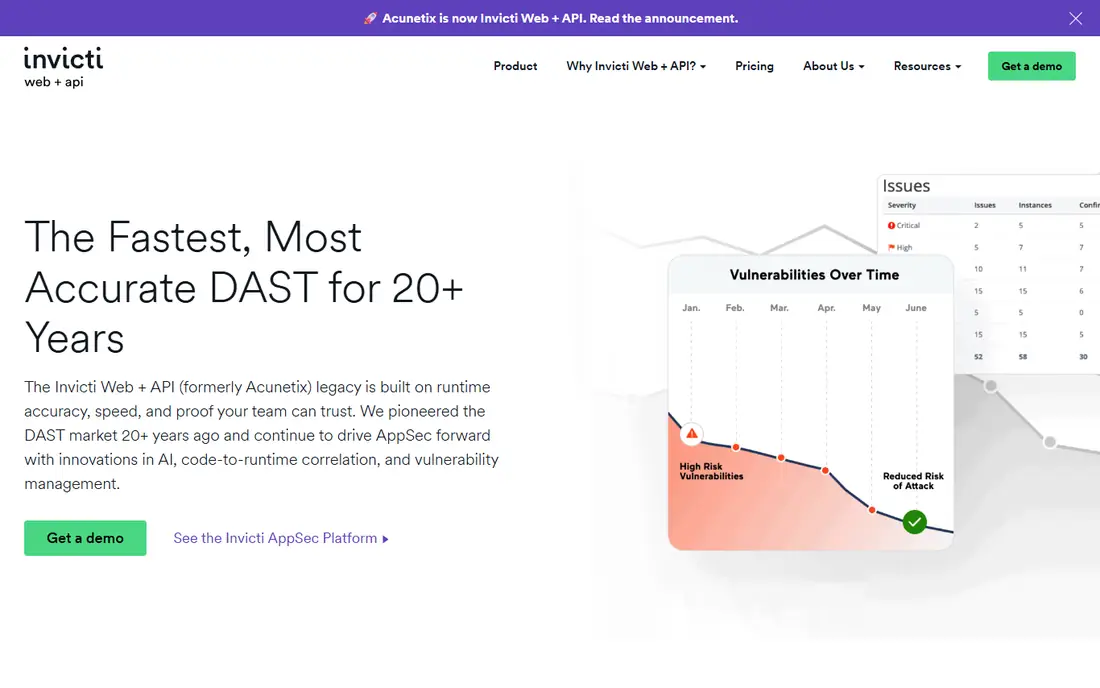
Acunetix, now part of Invicti, suits enterprises that need deep automated web scanning with proof-based verification. Its crawler handles JavaScript-heavy sites, its scanner tests thousands of checks across web applications and APIs, and its proof-based approach confirms exploitable flaws to cut false positives. That verification is what separates enterprise scanners from free tools: a report with fewer false alarms saves developer time.
Pricing is quote-only, and reviewers cite high cost and restrictive licensing as trade-offs, especially for small organizations. Acunetix is also the product most directly comparable to Netsparker, since both now sit under Invicti. For an enterprise that needs broad automated coverage with clean reports, Acunetix remains a top choice.
What we like- Deep automated coverage
- Proof-based verification
- Lower false positives
Watch out for- Quote-only pricing
- High cost and restrictive licensing for small teams

#4StackHawk
Best for: Developer-first CI scanning4.6/5 on
G2 (68 reviews, checked Oct 2026)
Visit stackhawk.com
Starting price$10 per user per month
Free planFree trial
StackHawk is the best DAST tool for cloud-native teams, with CI and CD integration and API scanning built for modern pipelines. Pricing starts near $10 per person per month, with unlimited apps and no per-app or per-scan charges, which makes budgeting simple for teams with many services. Scans run inside the pipeline, so developers get findings on pull requests rather than in a separate security report weeks later.
StackHawk has less depth than Acunetix for complex enterprise applications, and its focus on pipelines means teams that want scheduled enterprise scans may need a second tool. For a development team that wants security testing inside its existing workflow, StackHawk's developer-first design is the best fit.
What we like- CI and CD integration
- API scanning
- Per-person pricing with unlimited apps
Watch out for- Less depth than Acunetix for complex enterprise apps
- Newer than legacy scanners

#5Bright Security
Best for: Developer-led DAST in pipelines4.7/5 on
G2 (29 reviews, checked Oct 2026)
Visit brightsec.com
Starting priceSee website
Free planFree trial
Bright Security suits teams that want developer-led dynamic testing inside their pipelines, with AI-powered test generation that adapts to each application's structure. Rather than running a fixed checklist of payloads, Bright learns the application's flows and generates tests for business logic issues that static checklists miss. Pipeline integration keeps findings close to the code that caused them.
Pricing is quote-only, and the platform is newer than Acunetix or Burp Suite, so its track record at very large scale is shorter. For a team that wants modern, developer-friendly DAST with AI-assisted test generation, Bright Security is the most forward-looking option on this list.
What we like- Developer-led DAST
- AI-powered testing
- Strong pipeline integration
Watch out for- Quote-only pricing
- Newer platform with a smaller track record
Starting price$99 per month
Free planFree trial
Beagle Security is a web and API penetration testing platform built to reduce the friction of legacy DAST tools. Context-aware testing, AI-based login flows and business logic testing reflect real attack behavior rather than just running payload lists. Its concurrent-test pricing lets organizations add unlimited applications and environments under the same plan, which is more predictable than per-target licensing.
Reports go beyond static vulnerability lists, with remediation guidance specific to the technology stack, which helps developers fix issues faster. The brand is smaller than Acunetix, and the managed model suits teams that want guidance rather than raw tooling. For a modern development team or managed security provider that needs deep coverage without per-target licensing, Beagle Security is a strong contender.
What we like- Concurrent-test pricing with unlimited apps
- AI-based login flows
- Remediation guidance
Watch out for- Smaller brand than Acunetix
- Managed model suits some teams less

#7Qualys WAS
Best for: Qualys platform users4.5/5 on
G2 (21 reviews, checked Oct 2026)
Visit qualys.com
Starting priceSee website
Free planFree trial
Qualys Web Application Scanning fits teams already using Qualys for vulnerability management, since it shares the same cloud platform, asset inventory and reporting as Qualys VMDR. Continuous cloud-based scanning keeps web application findings alongside infrastructure findings, so security teams manage one backlog instead of two. That unified view is the main reason to choose Qualys WAS over a standalone scanner.
Pricing is quote-only, and the value is strongest inside the Qualys platform, so teams without Qualys elsewhere get less benefit. For an organization already standardized on Qualys, adding WAS is the most coherent way to cover web applications.
What we like- Continuous cloud-based scanning
- Integrates with Qualys VMDR
- Strong reporting
Watch out for- Quote-only pricing
- Best value only inside the Qualys platform

#8Rapid7 InsightAppSec
Best for: Rapid7 platform users3.9/5 on
G2 (10 reviews, checked Oct 2026)
Visit rapid7.com
Starting priceSee website
Free planFree trial
Rapid7 InsightAppSec suits teams already running Rapid7's Insight platform, since it connects web application findings with InsightVM infrastructure data to show attack chains across both layers. Cloud-based scanning handles modern applications, and the shared dashboard keeps application and infrastructure risk in one place. That integration is the main reason to choose InsightAppSec over a standalone tool.
Pricing is quote-only, and as with Qualys WAS, the value is strongest inside its own platform. For a Rapid7 shop that wants web application coverage without adding another vendor, InsightAppSec is the natural choice.
What we like- Cloud-based scanning
- Integrates with InsightVM
- Attack-chain visibility
Watch out for- Quote-only pricing
- Best value only inside the Rapid7 platform
How we chose
We compared web security tools on scan depth, false positive rates, manual testing support, pipeline integration and pricing transparency. We used vendor pricing pages and recent comparison guides for rates, and we favored tools with published prices where available. We did not claim hands-on testing. Instead we weighed what each tool finds, how it fits developer workflows, and what it costs per user or per month, so security teams can match a tool to their testing maturity.
Automated scanning versus manual testing
Automated scanners find common flaws fast, but they miss logic flaws and multi-step issues that manual testing catches, so mature teams use both. A scanner will find an unpatched library or a reflected cross-site scripting flaw in minutes, while a human tester finds a broken access control rule that lets one user view another user's data, which no payload list covers.
Budget accordingly: start with a free or low-cost scanner such as ZAP or StackHawk for continuous coverage, then add Burp Suite Professional for manual testing of critical applications. Schedule full manual penetration tests at least annually for internet-facing applications, and after any major feature release that changes authentication or payment flows. A scanner alone is not a penetration test, and a manual test alone does not catch regressions between releases. Track remediation time as well as findings count, since a scanner that produces reports no one fixes adds risk rather than reducing it.
Frequently asked questions
Is Netsparker still available?
Netsparker is now Invicti. The product was rebranded under the Invicti name, so buyers looking for Netsparker should evaluate Invicti itself or the alternatives on this list, which cover the same dynamic scanning use case.
What is the best free web application scanner?
OWASP ZAP is the best free scanner, with no paid tier from the project. It covers crawling, active scanning and pipeline automation, though it produces more false positives than commercial tools such as Acunetix.
Do I need manual testing if I run an automated scanner?
Yes, for critical applications. Automated scanners miss business logic flaws, broken access controls and multi-step issues that only a human tester finds. Mature teams run automated scanning continuously and manual penetration tests at least annually.
How is DAST pricing usually structured?
DAST pricing falls into three camps: free, per-seat or per-contributor, and quote-based. Per-seat tools such as StackHawk charge per person with unlimited apps, while enterprise tools such as Acunetix and Qualys WAS quote by targets, users or scan volume.
Which scanner is best for CI pipelines?
StackHawk is best for CI pipelines, with per-person pricing, unlimited apps and scans that run on pull requests. Bright Security is also strong for developer-led pipeline testing, while ZAP offers a free pipeline option with more configuration effort. Whichever tool you choose, fail the build on high-severity findings only at first, so the pipeline builds trust before it blocks releases. Expand the gates gradually as fix rates improve steadily over time.
Sources we checked (8)
- https://portswigger.net
- https://www.zaproxy.org
- https://www.acunetix.com
- https://www.stackhawk.com
- https://brightsec.com
- https://beaglesecurity.com
- https://www.qualys.com
- https://www.rapid7.com
Is your product missing or out of date?
We review this list regularly. Vendors can request a listing, send updated pricing or ask about featured placement.

Shihab Mia · Founder, Rankite
Shihab has 5+ years in B2B and SaaS SEO. He writes Rankite's software buying guides from pricing pages, documentation and public user reviews. More about Shihab.
 Burp Suite Professional
 Beagle Security