How we make this list: we compare pricing pages, product documentation and public user reviews. Ratings come from G2, Capterra or Trustpilot, with the date we checked them.
Key takeaways
- Netcool Operations Insight reduces event noise by grouping related events and giving context for faster resolution, across local, cloud, and hybrid environments.
- The closest replacements split into three types: full observability platforms, AIOps correlation engines, and incident management layers.
- Splunk and Datadog suit teams that want full-stack observability, while BigPanda and Moogsoft suit teams whose main pain is alert noise and correlation.
- Most enterprise tools here are quote-only, so shortlist on correlation quality and integration depth, not headline price.
Quick comparison
| Tool | Best for | Starting price | Free plan |
|---|
 Splunk | Full-stack observability | See website | Free trial |
 Datadog | Unified infrastructure monitoring | See website | Free trial |
 Dynatrace | Automated full-stack observability | See website | Free trial |
 BigPanda | Incident correlation and management | See website | Free trial |
 Moogsoft | Advanced event correlation | See website | Free trial |
 PagerDuty | Incident response and on-call | See website | Free trial |
 ServiceNow ITOM | ITSM-integrated operations | See website | No |
 LogicMonitor | Network and infrastructure monitoring | See website | Free trial |
Is your product missing or out of date?
We review this list regularly. Vendors can request a listing, send updated pricing or ask about featured placement.
The best netcool alternatives
#1Splunk
Best for: Full-stack observability4.0/5 on
G2 (1 reviews, checked Oct 2026)
Visit splunk.com
Starting priceSee website
Free planFree trial

Splunk Enterprise turns machine data into actionable insight across security, IT, and business operations, with search, analysis, and visualization from virtually any source. It gives a unified view across edge, cloud, and hybrid environments, with real-time monitoring, alerts, and dashboards. Splunk AI and machine learning features predict problems before they happen, and the platform scales to terabytes of data.
Splunk is expensive at scale, and users warn that buying it for metrics alone wastes money versus open-source metrics tools. Search can be slow for huge logs, and AIOps correlation needs configuration rather than working out of the box. Splunk fits enterprises that already invest in Splunk and want full-stack observability, not teams that only need event correlation.
What we like- Deepest search and analytics
- Scales to terabytes
- Thousands of integrations
Watch out for- Expensive at scale
- Steep learning curve
- Needs configuration for AIOps
#2Datadog
Best for: Unified infrastructure monitoring4.4/5 on
G2 (726 reviews, checked Oct 2026)
Visit datadoghq.com
Starting priceSee website
Free planFree trial
Datadog unifies infrastructure monitoring, application performance, logs, and security in one platform, with broad integrations across cloud services, containers, and networks. Teams get correlated metrics, traces, and logs in one view, which cuts the tool-hopping that slows incident response. Cloud coverage is strong, especially for AWS, Azure, and Google Cloud workloads.
Pricing is per host and per feature, so the bill grows with infrastructure size and with each added module. Guides report Infrastructure Pro pricing near 15 dollars per host per month, though Datadog pricing changes often and should be confirmed. Datadog fits cloud-native teams that want one observability platform, rather than a dedicated event-correlation engine.
What we like- Unified metrics, logs, and traces
- Broad integrations
- Strong cloud coverage
Watch out for- Per-host and per-feature pricing adds up
- Learning curve
- Costs grow with scale
#3Dynatrace
Best for: Automated full-stack observability4.5/5 on
G2 (1,371 reviews, checked Oct 2026)
Visit dynatrace.com
Starting priceSee website
Free planFree trial
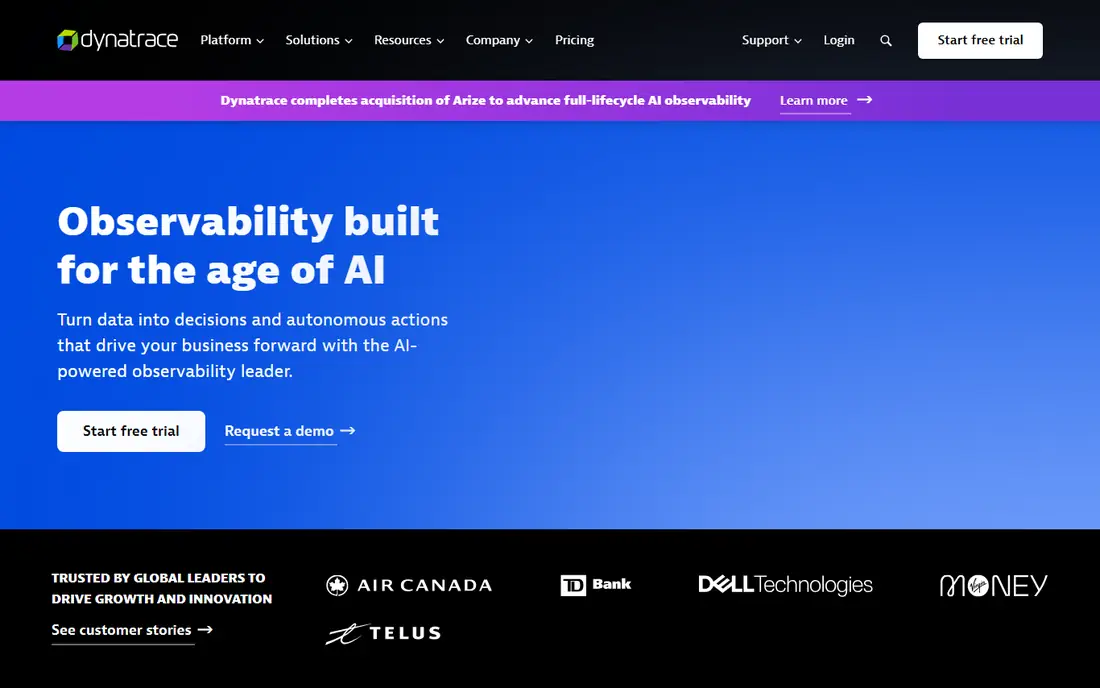
Dynatrace offers automated full-stack observability, with automatic discovery of services, dependencies, and topology, plus AI-driven root-cause analysis that points to the failing component. Its automation covers anomaly detection, problem correlation, and remediation workflows, which reduces manual triage for large estates.
Pricing is quote-only and enterprise-oriented, and agent deployment across a large estate takes planning. Dynatrace fits large enterprises with complex, dynamic environments that want automation to replace manual event triage, and that can fund an enterprise platform.
What we like- Automatic discovery and mapping
- AI root-cause analysis
- Broad automation
Watch out for- Quote-only pricing
- Enterprise focus
- Agent deployment takes effort
#4BigPanda
Best for: Incident correlation and management4.5/5 on
G2 (159 reviews, checked Oct 2026)
Visit bigpanda.io
Starting priceSee website
Free planFree trial
BigPanda focuses on incident management and collaboration, correlating alerts into incidents and routing them to the right team with context. Its interface is highly intuitive compared with Moogsoft and Splunk, and integration with ServiceNow and Jira suits teams that manage incidents through ITSM tools. Correlation quality is good and improving in comparisons.
Predictive analytics are moderate rather than advanced, and observability depth is narrower than Splunk or Datadog. BigPanda fits incident-focused teams that want easier adoption than Moogsoft, and that already run ServiceNow or Jira for incident workflows.
What we like- Intuitive interface
- Good correlation
- Strong ServiceNow and Jira integration
Watch out for- Moderate to high cost
- Predictive analytics are moderate
- Narrower observability
#5Moogsoft
Best for: Advanced event correlation4.5/5 on
G2 (39 reviews, checked Oct 2026)
Visit moogsoft.com
Starting priceSee website
Free planFree trial
Moogsoft offers the most advanced event correlation engine in AIOps comparisons, with strong automation and good predictive analytics for complex environments and critical services. It groups related events into situations, reduces noise, and drives automated remediation, which suits teams drowning in alerts from many monitoring tools.
Moogsoft is rated the highest cost and high complexity in comparisons, and it now sits inside Dell as Dell APEX AIOps after Dell acquisition, so buyers should confirm current product naming and roadmap. Moogsoft fits complex environments where correlation quality matters most, and where the team can staff specialized expertise.
What we like- Most advanced correlation engine
- Strong automation
- Good predictive analytics
Watch out for- Highest cost in comparisons
- High complexity
- Now part of Dell
#7ServiceNow ITOM
Best for: ITSM-integrated operations4.4/5 on
G2 (490 reviews, checked Oct 2026)
Visit servicenow.com
Starting priceSee website
Free planNo
ServiceNow IT Operations Management brings event management, service mapping, and discovery inside the ServiceNow platform, tying operations to incidents, changes, and configuration items. Teams that already run ServiceNow for ITSM get unified workflows from alert to incident to change, with service context attached automatically.
Pricing is enterprise and implementation is heavy, and the best value comes when the company already uses ServiceNow broadly. ServiceNow ITOM fits enterprises standardized on ServiceNow that want operations inside the same platform, not teams shopping for a standalone correlation engine.
What we like- Deep ITSM integration
- Service mapping
- Event management inside ServiceNow
Watch out for- Enterprise pricing
- Heavy implementation
- Best value needs wider ServiceNow use
#8LogicMonitor
Best for: Network and infrastructure monitoring4.5/5 on
G2 (643 reviews, checked Oct 2026)
Visit logicmonitor.com
Starting priceSee website
Free planFree trial
LogicMonitor is a SaaS-based observability platform that monitors networks, applications, and cloud infrastructure, with network device configurations, full data center visibility, network scanning, and flexible alerting. It bridges IT operations, developers, and business leaders with real-time dashboards and reporting.
AIOps correlation depth trails Moogsoft and BigPanda, and pricing is quote-based. LogicMonitor fits teams that need strong network and infrastructure monitoring with SaaS simplicity, especially MSPs and mid-size enterprises with hybrid estates.
What we like- SaaS-based observability
- Network device coverage
- Data center visibility
Watch out for- Less AIOps depth than Moogsoft
- Pricing is quote-based
- Learning curve
How we chose
We compared these tools on event correlation quality, noise reduction, observability depth, integration breadth, deployment model, and pricing transparency. AIOps comparisons shaped the Moogsoft, BigPanda, and Splunk rankings, and we flagged every case where pricing is quote-only, since most enterprise operations tools do not publish rates. We favored tools with clear correlation strengths for Netcool buyers, whose core need is event grouping and noise reduction.
We also separated three buyer types. Observability buyers should shortlist Splunk, Datadog, and Dynatrace, correlation buyers should shortlist Moogsoft and BigPanda, and response buyers should shortlist PagerDuty. ServiceNow and LogicMonitor suit teams with existing platform or network strengths. The right pick follows the biggest pain point, not the longest feature list. Teams that run Netcool today should also audit their custom rules and probes, since migration effort scales with customization depth, and a heavily customized Netcool estate takes longer to replicate than a standard one.
Run a proof of concept with your own event data
The best way to compare correlation engines is a proof of concept with your own data. Feed each finalist the same week of production alerts and measure noise reduction, grouping accuracy, and time to root cause. Vendor demos use clean data, while your data has the duplicates, flapping alerts, and mislabeled sources that reveal real quality.
Map integrations for every monitoring source
List every monitoring, logging, and ticketing source that feeds Netcool today, and confirm each finalist integrates with all of them. A correlation engine that misses one major source leaves a blind spot that defeats the purpose. Check whether integrations are native, webhook-based, or need custom code, since that changes implementation time.
Test on-call workflows end to end
Create a test incident, confirm routing, escalation, and status page updates work as expected, and check that resolved incidents close cleanly in ITSM tools. On-call workflow gaps cause more pain than dashboard differences, since they affect every incident. Include night-shift and holiday escalation rules in the test.
Check data retention and compliance
Operations data retention shapes both cost and compliance. Confirm how long each vendor stores metrics, logs, and incident history at each tier, and what longer retention costs, since Splunk-style platforms charge heavily for retained data. Check regional hosting options and compliance certifications for regulated workloads, and confirm export options so incident history can leave the platform if you switch again later. A tool that locks history behind an expensive tier creates a future migration problem.
Frequently asked questions
Is Netcool still available?
Yes. IBM Netcool Operations Insight continues as an enterprise event management platform with AI grouping and hybrid deployment options. The case for switching usually rests on SaaS delivery, correlation quality, or consolidation onto an observability or ITSM platform, rather than Netcool disappearing.
What is the closest Netcool alternative?
Moogsoft offers the most advanced correlation engine for Netcool-style event grouping, while BigPanda is easier to adopt for incident-focused teams. Splunk suits teams that want full observability beyond correlation. The closest pick depends on whether correlation, observability, or incident management is the priority.
Do I need AIOps or just better monitoring?
Pick AIOps when alert volume overwhelms the team and grouping matters more than new metrics. Pick better monitoring when coverage gaps cause missed incidents. Many teams need both, with monitoring feeding an AIOps correlation layer that groups and routes what monitoring finds. Start by counting daily alerts per engineer: if the number exceeds what one person can triage in a shift, correlation is the bottleneck, not detection. That count makes the business case clearer than any single vendor demo.
How long does an operations platform migration take?
Small migrations take weeks, while enterprise migrations with many sources, custom rules, and ITSM integration take months. The longest parts are source integration, correlation tuning, and on-call workflow testing, not platform setup. Run the new tool alongside Netcool during tuning before cutover.
Can PagerDuty replace Netcool?
No, not alone. PagerDuty handles incident response and on-call, but it needs monitoring and correlation sources feeding it. Pair PagerDuty with Splunk, Datadog, BigPanda, or Moogsoft for detection and correlation, and use PagerDuty for routing, escalation, and coordination.
Sources we checked (11)
- https://www.splunk.com
- https://www.datadoghq.com
- https://www.dynatrace.com
- https://www.bigpanda.io
- https://www.moogsoft.com
- https://www.pagerduty.com
- https://www.servicenow.com
- https://www.logicmonitor.com
- https://sourceforge.net/software/compare/IBM-Netcool-Operations-Insight-vs-Splunk-vs-Unomaly/
- https://blog.truegeometry.com/api/exploreHTML/540e469cd2fbb15caf3cccd0197aa816.exploreHTML
- https://slashdot.org/software/comparison/BigPanda-vs-Dell-APEX-AIOps-vs-IBM-Netcool-Operations-Insight-vs-Splunk/
Is your product missing or out of date?
We review this list regularly. Vendors can request a listing, send updated pricing or ask about featured placement.

Shihab Mia · Founder, Rankite
Shihab has 5+ years in B2B and SaaS SEO. He writes Rankite's software buying guides from pricing pages, documentation and public user reviews. More about Shihab.