How we make this list: we compare pricing pages, product documentation and public user reviews. Ratings come from G2, Capterra or Trustpilot, with the date we checked them.
Key takeaways
- Symfony is the stay in PHP answer: same language, stricter structure, and long term support releases for projects that must live a decade.
- Django and Ruby on Rails match Laravel's batteries included speed in Python and Ruby, with Django strongest near data and AI work.
- ASP.NET Core and Spring Boot serve the enterprise end, where hiring pools, typed codebases and existing Microsoft or Java estates decide the choice.
- Every framework here is free and open source, so the real costs are developer time, hosting and how fast your team can hire for the language.
Quick comparison
| Tool | Best for | Starting price | Free plan |
|---|
 Symfony | PHP teams needing stricter structure | Free | Yes |
 Django | Python teams, data heavy apps | Free | Yes |
 Ruby on Rails | Fast product builds in Ruby | Free | Yes |
 ASP.NET Core | Microsoft shops, high throughput | Free | Yes |
 Spring Boot | Enterprise Java systems | Free | Yes |
 AdonisJS | Laravel style in TypeScript | Free | Yes |
 NestJS | Structured Node and TypeScript APIs | Free | Yes |
 Phoenix | Real time apps at high concurrency | Free | Yes |
Is your product missing or out of date?
We review this list regularly. Vendors can request a listing, send updated pricing or ask about featured placement.
The best Laravel alternatives
Starting priceFree
Free planYes
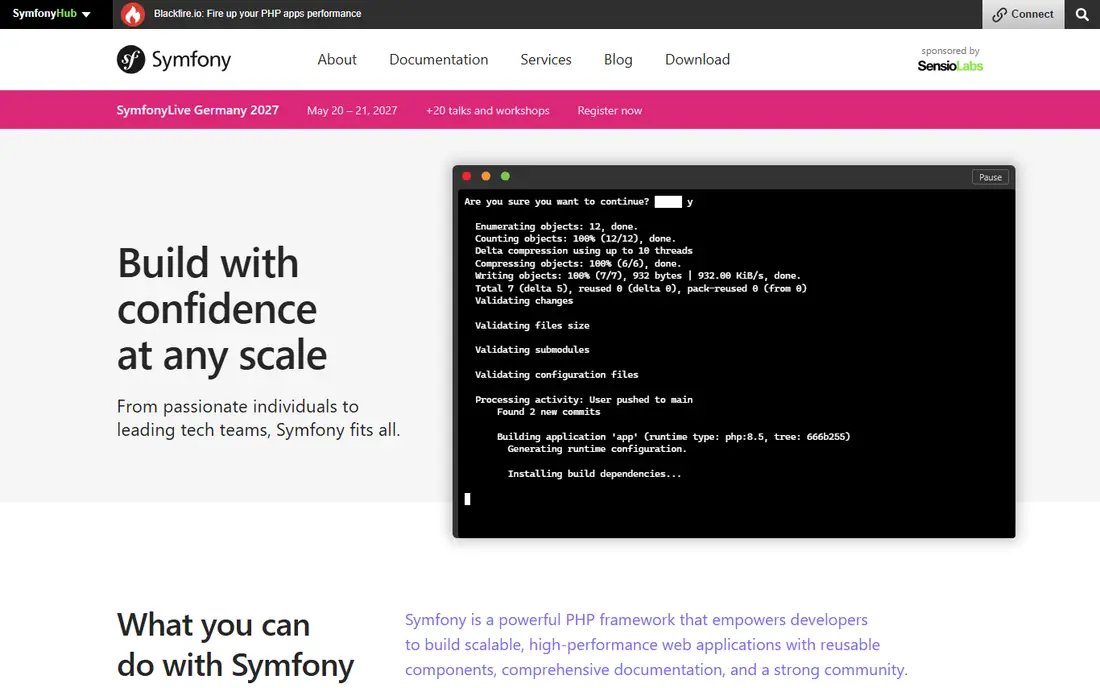
Symfony is the natural move when a Laravel codebase has grown past the point where conventions help and started to need architecture enforced instead. You keep PHP, your hosting and your team's language skills, and trade some speed for control.
It is also the safer pair of hands for a platform with a ten year horizon, such as a public sector system or a B2B product with enterprise contracts. Long term support releases exist precisely for buyers who cannot re-platform every few years.
What we like- Symfony is PHP's enterprise framework: a dependency injection container, a data mapper ORM in Doctrine, and reusable components that much of the PHP world, including parts of Laravel itself, builds on. Release discipline is the headline: predictable versions with long term support lines, so a platform can stay on a supported release for years. The profiler and debug tooling give deep visibility into each request. For big, long lived systems with several teams, that explicit structure pays for itself.
Watch out for- The learning curve is the steepest in PHP. Configuration is heavier, simple jobs take more code than in Laravel, and new developers take longer to become productive. The ecosystem of ready packages is smaller than Laravel's first party set. Small teams shipping a simple product will feel the ceremony more than the benefit.
Starting priceFree
Free planYes
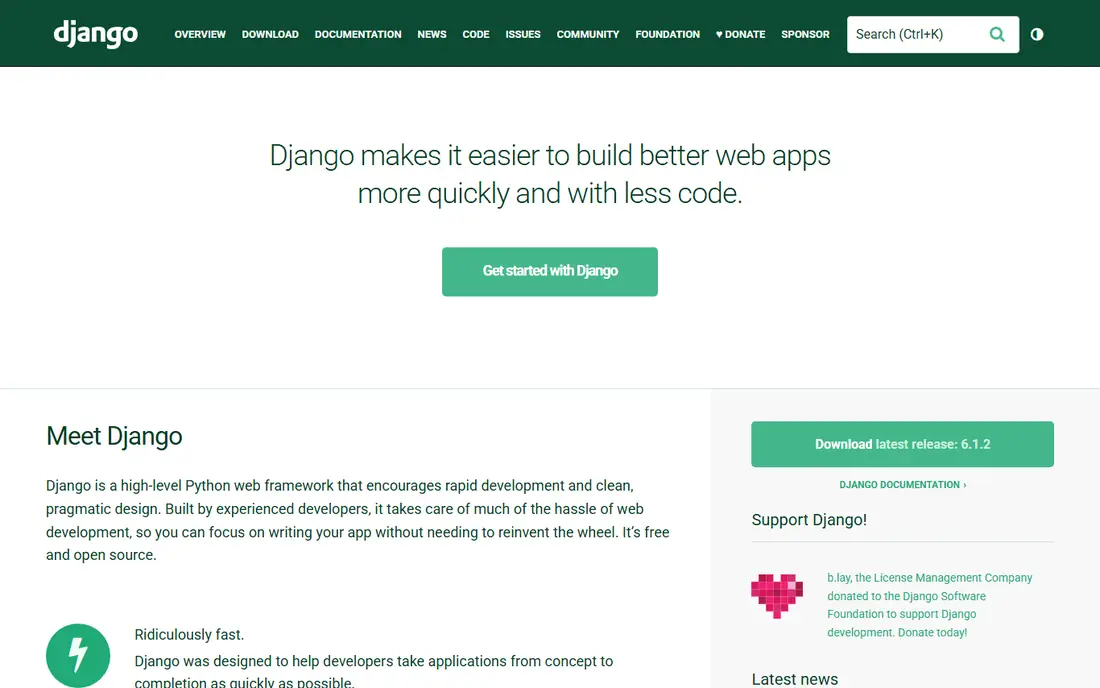
Choose Django when the app and the data work live together: dashboards, reporting tools, ML adjacent products, internal systems. It is the framework on this list most at home next to notebooks and pipelines.
Teams already speaking Python get Laravel style speed without a second language in the stack. Teams with no Python presence should weigh the hiring switch honestly, because framework migrations are really language migrations.
What we like- Django is Python's batteries included framework: ORM, migrations, authentication and a generated admin site ship in the box, which makes content and data rich applications fast to build. Its security defaults are strong and well documented. The Python connection matters more each year, because the same team can use the language's data and AI libraries beside the web app. Django 6.0, released in December 2025, added a built in background tasks framework and template partials. The community and package ecosystem are large.
Watch out for- Django's monolith shape fits CRUD and content apps better than fine grained APIs, though the REST framework add-on closes much of that gap. Async support has improved but parts of the stack still assume a synchronous world. The admin is a productivity gift that can become a crutch if customers end up using it as the product. Python hiring is easy in data hubs and thinner elsewhere.
Starting priceFree
Free planYes
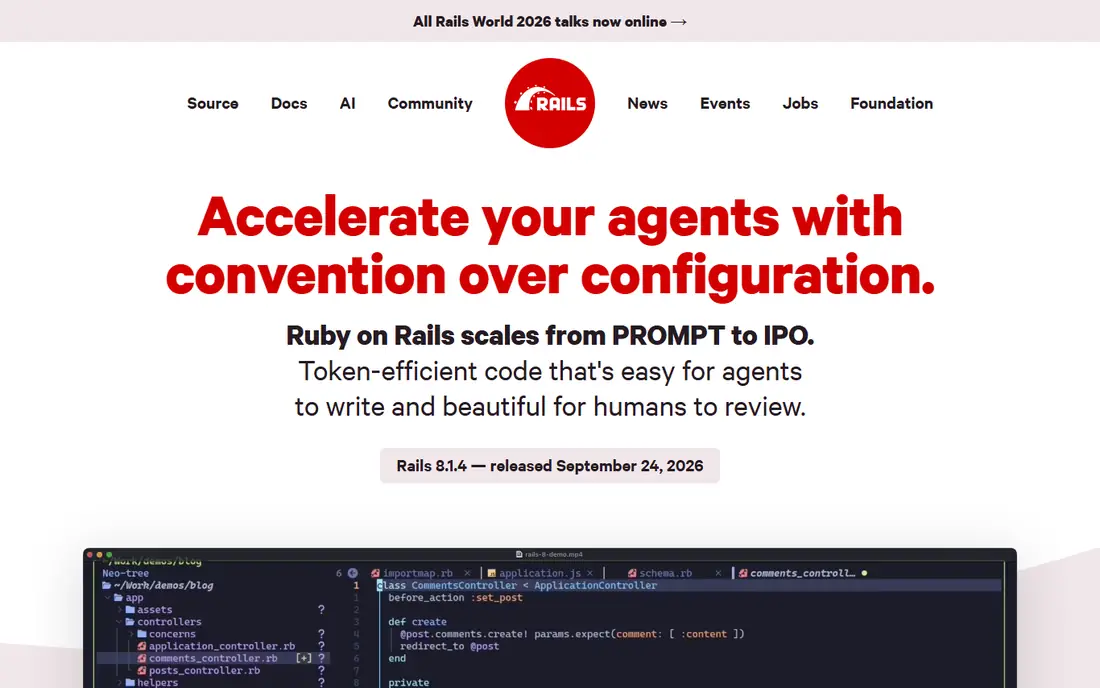
Rails is still the speed pick for a founding team that knows Ruby. The first version of a product arrives quickly, and the framework's opinions remove a hundred small decisions.
The caution is the long game. If your five year plan is a huge consumer platform, model the scaling cost early. If it is a profitable B2B product, Rails' speed advantage usually matters more than its ceiling.
What we like- Rails is the original convention over configuration framework, and for a small team building a product fast it remains hard to beat: scaffolding, migrations, background jobs, mailers, file uploads and websockets all ship inside the framework as Hotwire and its companions modernised the front end story. A huge stock of production SaaS was built on Rails, so patterns for billing, multi tenancy and admin are well worn. Ruby's hiring pool, while smaller than PHP or Python, is experienced and loyal.
Watch out for- Performance at very high concurrency takes more work and more servers than the JVM or Elixir options here. Ruby's popularity with new developers has cooled, so junior hiring is harder than it was a decade ago. The convention magic that makes Rails fast can also make unusual requirements awkward to express. Memory use per process is on the high side, which shows up in hosting bills at scale.
Starting priceFree
Free planYes
For a company already paying for Microsoft licences and Azure, ASP.NET Core is rarely a hard sell: one vendor, one language across desktop and web history, and performance headroom to spare.
For a PHP team with no Microsoft ties, it is the biggest jump on this list, justified mainly where enterprise clients or existing C# systems demand it.
What we like- ASP.NET Core is Microsoft's cross platform framework for C#, and it posts some of the strongest raw throughput numbers of any framework here while running on Linux as happily as on Windows. The tooling is excellent: Visual Studio and the dotnet CLI, strong typing that catches errors at build time, and first class support through Microsoft channels. For companies with a .NET estate and Azure contracts, it slots into existing identity, monitoring and support arrangements. Blazor lets C# teams build interactive front ends without a second language.
Watch out for- The talent pool sits mostly in enterprise markets, and community content skews corporate compared with Laravel's creator driven ecosystem. The framework rewards teams comfortable with compiled, typed, ceremony friendly code, which is a culture shift for PHP developers. Some advanced Azure services create pull toward Microsoft hosting. Release cadence is brisk, and long lived apps must plan upgrade cycles.
Starting priceFree
Free planYes
Spring Boot is the conservative enterprise choice, and conservative is not an insult. Banks, insurers and governments run on it because the skills, vendors and patterns are easy to buy and the platform changes slowly.
A startup choosing Spring Boot for speed of first release is usually making a mistake. A platform team choosing it for a decade of maintained services is usually making the right one.
What we like- Spring Boot is the default way to build Java backends, with an enormous ecosystem for security, data, messaging and cloud deployment, and the deepest enterprise hiring pool in this list. The JVM's maturity shows in tooling for profiling, monitoring and running large systems for years. Microservice patterns, container deployment and integration with enterprise middleware are all well trodden paths. Support options exist from major vendors for companies that need contracts behind their framework.
Watch out for- Verbose is the polite word. Simple endpoints take more code and configuration than in Laravel, Django or Rails, and build times and memory footprints are bigger. The learning surface is wide: a newcomer faces the framework, the language and a crowd of related Spring projects at once. Small products feel the weight most. Java developers also cost more in many markets than PHP developers.
Starting priceFree
Free planYes
AdonisJS exists for one clear reader: the Laravel developer whose new job, client or company standard is TypeScript. For that reader it removes most of the migration pain.
Everyone else should compare it against NestJS below and choose based on team taste, because both are capable and the difference is philosophy more than features.
What we like- AdonisJS is the closest thing to Laravel outside PHP: a full stack Node framework with its own ORM, authentication, validation, mail and queues, written in TypeScript and shaped by the same conventions Laravel developers know. For a PHP team moving to the JavaScript ecosystem, the mental model transfers almost whole. First party packages cover the common needs, and the framework has a clear, documented structure rather than a pick your own stack puzzle. It suits APIs and server rendered apps alike.
Watch out for- The community is far smaller than Laravel's or Nest's, so answers, packages and hires are harder to find. The ecosystem around it is younger, and some enterprise patterns need hand building. Node's single threaded model asks for care with CPU heavy work. If your team does not specifically want Laravel's shape in TypeScript, bigger Node options compete hard.
Starting priceFree
Free planYes
Nest is the pick for an API platform expected to grow: several services, several teams, one consistent shape. Its constraints are the product.
A solo developer building one small service will likely be happier in something lighter. A platform team tired of every Node service looking different will feel the opposite.
What we like- NestJS gives Node the structure it often lacks: modules, dependency injection and decorators in TypeScript, with first class patterns for REST and GraphQL APIs, microservices, websockets and queues. It is the enterprise face of the Node ecosystem, backed by a company offering support and training, and its hiring pool grows with the TypeScript market generally. Teams moving from Spring or ASP.NET find the architecture familiar. Documentation is thorough and the CLI generates consistent project shapes.
Watch out for- The structure that helps big teams can smother small ones
- A weekend API in Nest carries folders and abstractions a leaner tool skips. TypeScript configuration and decorator magic occasionally produce errors that take experience to read. Performance trails the JVM and .NET options under heavy load. Some developers simply dislike its Angular inspired style.
Starting priceFree
Free planYes
Phoenix is a targeted answer to a targeted problem: lots of users connected at once, all expecting live updates. Chat platforms, live events, multiplayer tools and streaming dashboards are where it earns its keep.
If that is your product, the small ecosystem is a fair price for a platform designed for exactly your hardest requirement. If it is not, the other seven will serve you with less retraining.
What we like- Phoenix runs on Elixir and the Erlang virtual machine, the platform built for telephone switches, which makes it exceptional at holding huge numbers of live connections: chat, presence, live dashboards and collaborative tools are its home ground. LiveView builds interactive pages from the server with little JavaScript, and many teams ship full products with a tiny front end footprint. Fault tolerance is a platform property, not a library, so failing pieces restart instead of taking the app down. Developer surveys consistently rate it among the most admired frameworks.
Watch out for- Elixir's hiring pool is the smallest on this list, and the functional programming model is a real switch for PHP developers. The package ecosystem is smaller, so some integrations you take for granted elsewhere need building. Mainstream hosting and agency support are thinner. If your app is ordinary CRUD at ordinary scale, Phoenix's strengths sit unused while its learning curve still applies.
How we chose
We picked frameworks that a team can adopt in October 2026 as a genuine Laravel replacement: actively maintained, open source, proven in production, and covering the main reasons teams switch, which are language fit, stricter architecture, enterprise ecosystem or real time performance. We included exactly one other PHP framework, Symfony, for teams that want to keep the language. Prices are simple here because every framework is free; the real costs, covered in the guide below, are people and hosting. Judgements rest on vendor documentation and current framework comparison reporting, not hands on testing.
How to pick a Laravel alternative
Start with the language your team can hire for, not the framework you admire. A framework decision is a five year hiring decision. Check your local market: PHP and Python developers are widely available, Java and C# pools are deep in enterprise cities, Ruby and Elixir pools are smaller and more specialised.
Then match the framework to the app's shape. Content and CRUD products suit Django and Rails. Strict, multi team platforms suit Symfony, Spring Boot and NestJS. Live connection heavy products suit Phoenix. An existing Microsoft or Java estate usually settles the question by itself.
Finally, prototype the ugliest requirement, not the demo page. Every framework here builds a login screen in an afternoon. Build the report, the integration or the real time feature that scares you, and let that result decide.
Frequently asked questions
What is the best Laravel alternative in PHP?
Symfony. It is the mature enterprise PHP framework, with long term support releases, strict structure and components the wider PHP ecosystem builds on. The trade is a steeper learning curve and more code for simple jobs. Lighter PHP options such as CodeIgniter exist for small projects, but Symfony is the full replacement.
Is Django better than Laravel?
Neither is better in the abstract. Django wins when the team works in Python or the product sits near data and AI tooling, and its built in admin speeds internal tools. Laravel wins on hosting choice, package ecosystem for web products and the size of its community. Pick by language and hiring market, not by feature lists.
Are all these frameworks really free?
Yes. Every framework in this guide is open source and free to use commercially, including ASP.NET Core and Spring Boot. The costs around them are not zero: developers, hosting, and in the enterprise cases optional commercial support contracts. Budget for people first; the licence line is the one that reads zero.
Which alternative scales best for real time features?
Phoenix, on Elixir and the Erlang virtual machine, is built for very large numbers of simultaneous live connections, which is why chat and live dashboard products choose it. NestJS and ASP.NET Core also handle real time well at normal scale. Most products never reach the load where this decides the choice; team fit usually matters first.
Should I rewrite my Laravel app in another framework?
Usually not. A rewrite costs a year of feature progress and imports new bugs to replace known ones. Legitimate reasons are a company wide language change, a hiring wall, or a hard requirement the runtime cannot meet. If the pain is structure alone, Symfony's ideas can be adopted inside a growing Laravel codebase before any rewrite is considered.
Sources we checked (0)
Is your product missing or out of date?
We review this list regularly. Vendors can request a listing, send updated pricing or ask about featured placement.

Shihab Mia · Founder, Rankite
Shihab has 5+ years in B2B and SaaS SEO. He writes Rankite's software buying guides from pricing pages, documentation and public user reviews. More about Shihab.