How we make this list: we compare pricing pages, product documentation and public user reviews. Ratings come from G2, Capterra or Trustpilot, with the date we checked them.
Key takeaways
- Istio is the most capable service mesh, but its operational complexity drives teams toward simpler or lighter alternatives.
- Linkerd is the best default for most teams: simpler to run, lighter on resources, and quick to install.
- Cilium is the best choice if you already run Cilium as your container network interface, since its eBPF-based mesh removes sidecar overhead.
- Consul suits hybrid environments spanning Kubernetes and virtual machines, while cloud-managed meshes suit single-cloud teams.
- Every core mesh here is free and open source; commercial support is quote-based, so budget engineering time, not licenses.
Quick comparison
| Tool | Best for | Starting price | Free plan |
|---|
 Linkerd | Simplicity and performance | Free | Yes |
 Consul | Hybrid Kubernetes and VM estates | Free | Yes |
 Cilium | eBPF-based sidecar-less mesh | Free | Yes |
 Kuma | Multi-zone universal mesh | Free | Yes |
 Traefik Mesh | Lightweight small-team mesh | Free | Yes |
 AWS App Mesh | AWS-native managed mesh | See website | No |
 Gloo Mesh | Multi-cluster Istio management | See website | No |
 Kong Mesh | Enterprise multi-zone mesh | See website | No |
Is your product missing or out of date?
We review this list regularly. Vendors can request a listing, send updated pricing or ask about featured placement.
The best Istio alternatives
Starting priceFree
Free planYes
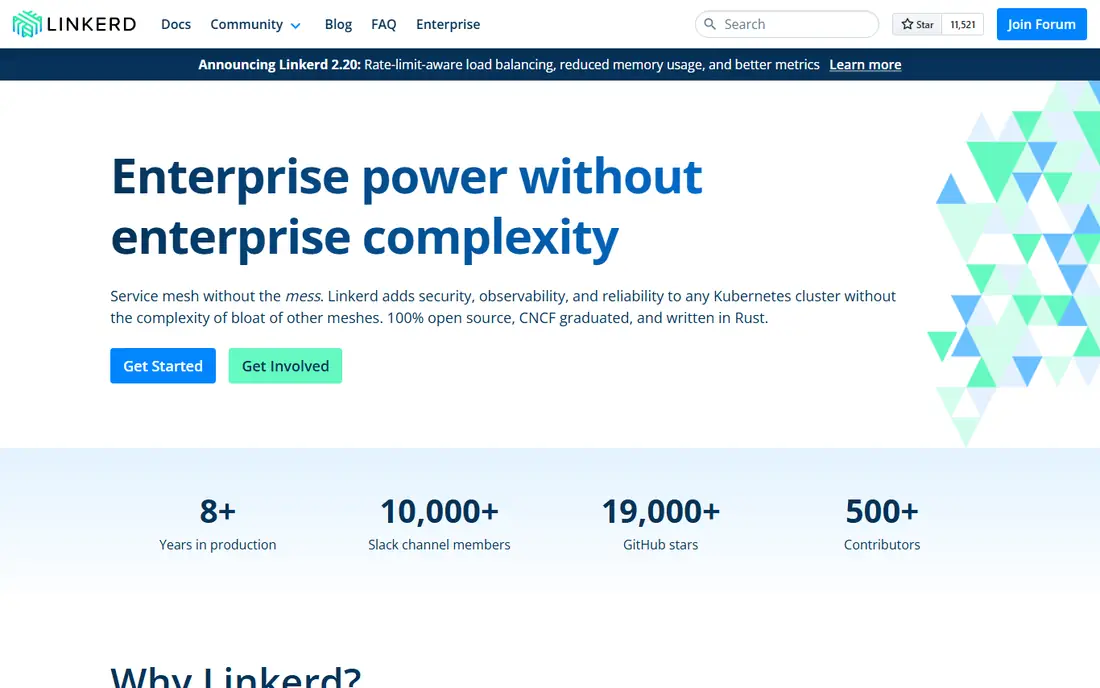
Linkerd is the best Istio alternative for most teams, and the choice to make when you cannot articulate a concrete need for Istio's advanced features. Installation takes an afternoon rather than weeks, the control plane is small, and the Rust-based proxy uses far less memory per sidecar than Envoy, which compounds into real savings across hundreds of pods. Observability comes built in: golden metrics, dashboards, and tracing work without assembling a separate stack.
The trade-off is feature depth. Linkerd lacks Istio's method and path-level authorization, advanced egress control, and mature multi-cluster policy model, though multi-cluster support has improved. Since 2024, signed stable production releases flow through Buoyant Enterprise, so teams that want vendor-supported builds need a commercial contract, while the open-source project remains free. For teams that want mTLS, observability, and traffic control without a platform team babysitting upgrades, Linkerd is the correct default.
What we like- Simplest mesh to install and run
- Lightweight Rust proxy uses less memory
- Good observability out of the box
Watch out for- Fewer advanced traffic features than Istio
- Smaller ecosystem
- Stable production builds now flow through Buoyant
Starting priceFree
Free planYes
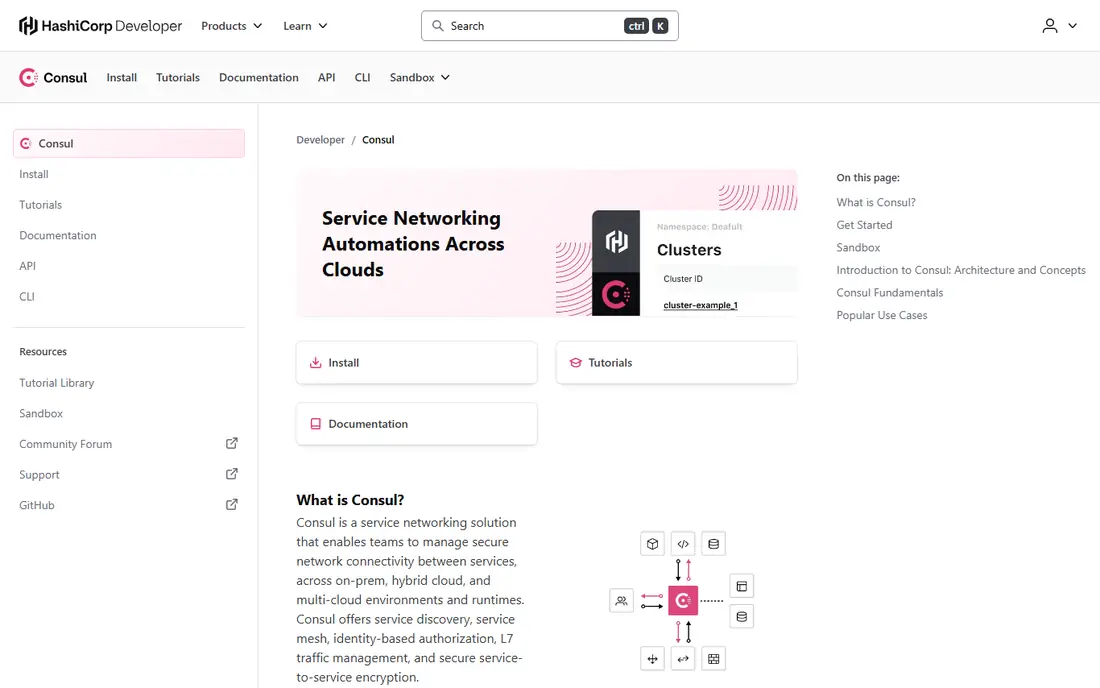
Consul from HashiCorp is the best alternative for hybrid environments that span Kubernetes and virtual machines. It combines service discovery with a service mesh, so the same tool that tells services where each other live also encrypts their traffic with mTLS and enforces intentions between services. Mesh expansion to VMs is a genuine strength: services outside Kubernetes join the mesh with more manual setup than pods, but it works, which matters for estates migrating gradually.
Consul's mesh features trail Istio's in traffic policy depth, and operating it is more complex than Linkerd, with agents, servers, and federation to manage. Enterprise features like advanced governance and support are paid, and pricing is quote-based. For hybrid estates where discovery and mesh must cover both worlds, Consul is the natural choice.
What we like- Service discovery plus mesh in one tool
- Spans Kubernetes and VMs
- Mature HashiCorp ecosystem
Watch out for- More complex than Linkerd
- Mesh features trail Istio
- Enterprise features are paid
Starting priceFree
Free planYes
Cilium is the most architecturally interesting alternative, and the best choice if you already run Cilium as your container network interface. Instead of injecting a sidecar proxy into every pod, Cilium uses eBPF programs in the Linux kernel to enforce policy, encrypt traffic, and observe flows, which cuts CPU and memory overhead sharply compared with sidecar meshes. Hubble, its observability layer, gives flow-level visibility that sidecar meshes struggle to match.
The catch is commitment: Cilium's mesh works best when Cilium is already your CNI, so adopting it means adopting a network layer, not just a mesh. The mesh model is newer than Istio's or Linkerd's, and enterprise features like extended Hubble observability and compliance tooling flow through Isovalent, now part of Cisco's portfolio, on quote-based contracts. For teams already standardized on Cilium networking, the mesh is a natural and high-performance extension.
What we like- EBPF in the Linux kernel removes sidecar overhead
- Excellent observability through Hubble
- Doubles as your CNI
Watch out for- Requires Cilium as your network layer
- Newer mesh model
- Enterprise features flow through Isovalent and Cisco
Starting priceFree
Free planYes
Kuma, from Kong, is a universal service mesh designed to run across Kubernetes and virtual machines under one multi-zone control plane. It is built on Envoy, so its data plane behavior is familiar to Istio users, while its policy model is simpler and its control plane is easier to operate at moderate scale. Multi-zone deployments, where one global control plane manages several zone control planes, are a first-class design goal rather than an afterthought.
The community is smaller than Istio's or Linkerd's, and running Kuma outside Kubernetes requires PostgreSQL for state, which adds an operational dependency. Third-party integrations are fewer. For organizations that need one mesh across zones and platforms without Istio's weight, Kuma is a strong middle path.
What we like- Universal mesh across Kubernetes and VMs
- Multi-zone control plane
- Built on Envoy with familiar policy
Watch out for- Smaller community than Istio or Linkerd
- Needs PostgreSQL outside Kubernetes
- Fewer third-party integrations
Starting priceFree
Free planYes
Traefik Mesh is the lightest alternative here, built for small teams that want service-to-service traffic management without a heavy control plane. Its sidecar-less design keeps resource use low, and teams already using Traefik as an ingress proxy find the configuration model familiar. Installation is quick, and the operational burden is the smallest of any mesh in this guide.
The limits are real: no multi-cluster support, limited advanced traffic policy, and a smaller community than the leaders. For a single cluster where the goal is basic mesh visibility, encryption, and simple routing, Traefik Mesh is pleasant to run. For multi-cluster or policy-heavy estates, look at Linkerd or Kuma instead.
What we like- Very light and simple
- Sidecar-less design
- Familiar to Traefik proxy users
Watch out for- No multi-cluster support
- Limited advanced features
- Smaller community and ecosystem
Starting priceSee website
Free planNo
AWS App Mesh is the managed alternative for AWS-only estates. Amazon operates the control plane, and the mesh integrates with CloudWatch, X-Ray, and other AWS services, so teams already on AWS get observability without running another platform. It works with ECS, EKS, and EC2 services, which suits mixed AWS workloads.
The obvious limit is AWS-only: multi-cloud or on-prem services cannot join, and policy flexibility trails Istio's. Pricing depends on AWS resource usage rather than a flat license, so model it against your service count. For AWS-standardized teams that want a mesh without operating one, App Mesh is the simplest path.
What we like- Fully managed by AWS
- Integrates with CloudWatch and AWS services
- No control plane to operate
Watch out for- AWS-only
- Less flexible than open meshes
- Pricing depends on AWS resource usage
#7
Gloo Mesh
Best for: Multi-cluster Istio management
Visit solo.io
Starting priceSee website
Free planNo
Gloo Mesh from Solo.io is not a replacement for Istio but a management layer over it, aimed at organizations running Istio across many clusters. It centralizes policy management, unifies observability, and simplifies upgrades across clusters, which is exactly the pain that grows as Istio estates scale. Teams that already run Istio and struggle with multi-cluster governance get the most value.
Pricing is negotiated per engagement based on cluster count and support tier, and Gloo Mesh adds a vendor to an already complex stack. If you are leaving Istio because of complexity, Gloo Mesh is the wrong direction. If you are keeping Istio and need multi-cluster control, it is the leading management layer.
What we like- Centralized policy and observability across many Istio clusters
- Simplifies upgrades
- Strong governance
Watch out for- Layer on top of Istio, not a replacement
- Quote-based pricing
- Adds a vendor to an already complex stack
Starting priceSee website
Free planNo
Kong Mesh is the enterprise distribution of Kuma, adding multi-zone governance, support, and enterprise features for organizations that need a supported universal mesh. It suits enterprises running services across zones and platforms with compliance and policy requirements, and it integrates with Kong's gateway ecosystem for teams already using Kong.
Pricing is quote-based and enterprise-scale, and the platform is heavier than Linkerd or Traefik Mesh. For enterprises that want Kuma's universal model with vendor support and governance, Kong Mesh is the commercial path. For smaller teams, open-source Kuma or Linkerd is the better starting point.
What we like- Enterprise multi-zone support
- Strong policy and governance
- Kong ecosystem integration
Watch out for- Quote-based enterprise pricing
- Heavier than Linkerd or Traefik Mesh
- Smaller open-source community than Istio
How we chose
We compared service meshes that replace Istio's core job: securing, observing, and controlling traffic between services in Kubernetes, with mTLS encryption, traffic policy, and telemetry. We weighed operational complexity, performance overhead, platform coverage, multi-cluster support, and ecosystem from vendor pages and 2026 mesh comparisons. We left out pure API gateways, which manage external traffic rather than service-to-service traffic, and ingress-only tools. Where pricing is quote-based, we say so rather than inventing a figure.
How to pick an Istio replacement
Match the mesh to your team's operational capacity, not just the feature list. If you cannot articulate a concrete need for Istio's advanced authorization or multi-cluster policy, choose Linkerd. If you already run Cilium networking, evaluate Cilium's mesh. If your estate spans Kubernetes and VMs, choose Consul or Kuma. If you are AWS-only, consider App Mesh. If you are keeping Istio across many clusters, add Gloo Mesh for governance. The wrong mesh at the wrong scale becomes technical debt paid in on-call pages.
Benchmark the latency tax honestly
Every mesh adds latency, but the amount differs sharply. Sidecar proxies add per-hop latency and memory, while eBPF-based meshes cut overhead to a fraction. Benchmark your real request paths with and without the mesh, at production concurrency, and measure tail latency, not just averages. A mesh that looks fast on a demo can add painful tail latency under load.
Start with mTLS and observability, not policy
The highest-value mesh features are the simplest: mutual TLS encryption between services and observability into who calls whom and how slowly. Deploy those first, prove value, and add traffic policy gradually. Teams that start with complex policy before they understand their traffic graph spend months debugging rules for services they barely use.
Frequently asked questions
Do I even need a service mesh?
Not always. If you run a handful of services in one cluster with simple traffic, an ingress controller and good monitoring may be enough. A mesh earns its complexity when you have dozens of services, need mTLS between them, want traffic splitting for canary releases, or need observability into service-to-service calls. Start simple and add a mesh when the pain is concrete.
Is Linkerd really simpler than Istio?
Yes, by a wide margin. Linkerd installs in minutes, has a small control plane, and its dashboards work out of the box. Istio's control plane is larger, its configuration surface is far bigger, and debugging a broken request path often needs several specialist commands. The simplicity gap is the main reason teams switch.
What is a sidecar-less mesh?
Traditional meshes inject a sidecar proxy container into every pod to handle traffic. Sidecar-less meshes, like Cilium's eBPF model or Istio's ambient mode, handle traffic at the node or kernel level instead, saving CPU and memory across the cluster. The savings compound: a small per-pod saving becomes large across hundreds of pods.
Can a mesh run on virtual machines?
Yes, with the right tool. Consul, Kuma, and Istio support mesh expansion to VMs, though setup is more manual than for Kubernetes pods. Linkerd and Traefik Mesh are Kubernetes-focused. If VMs matter, shortlist Consul or Kuma and test VM onboarding during the trial.
How much does an enterprise service mesh cost?
The open-source cores are free. Enterprise support and management layers are quote-based, typically ranging from tens of thousands to over one hundred thousand dollars a year depending on scale, according to 2026 mesh guides. Budget engineering time as the real cost: operating any mesh needs platform engineering capacity regardless of license fees.
Sources we checked (8)
- https://linkerd.io
- https://www.consul.io
- https://cilium.io
- https://kuma.io
- https://traefik.io
- https://aws.amazon.com
- https://www.solo.io
- https://konghq.com
Is your product missing or out of date?
We review this list regularly. Vendors can request a listing, send updated pricing or ask about featured placement.

Shihab Mia · Founder, Rankite
Shihab has 5+ years in B2B and SaaS SEO. He writes Rankite's software buying guides from pricing pages, documentation and public user reviews. More about Shihab.