How we make this list: we compare pricing pages, product documentation and public user reviews. Ratings come from G2, Capterra or Trustpilot, with the date we checked them.
Key takeaways
- PowerCenter is the historic enterprise ETL leader, but guides put its annual cost at 50,000 to 500,000 dollars plus, with limited change data capture and complex licensing.
- Salesforce acquisition of Informatica, completed in November 2025, pushed many teams to reassess vendor lock-in, ecosystem dependency, and pricing changes.
- Cloud ELT tools such as Fivetran and Airbyte suit modern warehouse stacks, while Talend and SSIS suit hybrid and Microsoft estates respectively.
- Who owns your tool in two years is now a legitimate selection criterion, with Fivetran plus dbt merging in June 2026 and Talend under Qlik.
Quick comparison
| Tool | Best for | Starting price | Free plan |
|---|
 Talend | Hybrid ETL with data quality | Free open source | Yes |
 Microsoft SSIS | Microsoft-centric ETL | Included with SQL Server | Yes |
 Apache NiFi | Open-source data flows | Free, open source | Yes |
 Airbyte | Open-source ELT | Free open source | Yes |
 Fivetran | Hands-off automated ELT | Free under 500K MAR | Yes |
 Matillion | Warehouse-native ELT | Usage-based credits | Free trial |
 Azure Data Factory | Azure and hybrid integration | Pay per activity | Yes |
 AWS Glue | AWS-native serverless ETL | $0.44 per DPU-hour | Yes |
Is your product missing or out of date?
We review this list regularly. Vendors can request a listing, send updated pricing or ask about featured placement.
#1Talend
Best for: Hybrid ETL with data quality4.0/5 on
G2 (65 reviews, checked Oct 2026)
Visit talend.com
Starting priceFree open source
Free planYes
Talend, now Qlik Talend Cloud, is the hybrid ETL alternative with more than 900 connectors, built-in data quality, and deployment across self-hosted and cloud environments. It covers ETL and ELT patterns with change data capture as an add-on, and its open-source edition lets teams start free. Talend suits hybrid estates that need data quality inside the integration tool itself.
Enterprise total cost runs higher once training and modules add up, and Qlik ownership under Thoma Bravo means roadmap questions deserve attention. Talend fits teams that want open-source flexibility plus enterprise data quality, and that run hybrid infrastructure rather than a single cloud.
What we like- 900-plus connectors
- Built-in data quality
- Hybrid deployment
- Open-source edition
Watch out for- Higher total cost at enterprise scale
- Real training investment
- Now Qlik-owned
Starting priceIncluded with SQL Server
Free planYes
Microsoft SQL Server Integration Services is the Microsoft-centric ETL alternative, included with SQL Server licensing and deeply integrated with SQL Server, Excel, and Microsoft data tools. Visual design and mature tooling suit teams already on Microsoft infrastructure, and it handles enterprise ETL workloads reliably.
SSIS is Microsoft-centric, with on-premises heritage, so cloud-native teams need Azure Data Factory alongside for full cloud coverage. SSIS fits Microsoft shops that want ETL without a second vendor bill, and that already license SQL Server.
What we like- Included with SQL Server licensing
- Deep Microsoft integration
- Visual design
- Mature tooling
Watch out for- Microsoft-centric
- On-premises heritage
- Cloud story needs ADF alongside
Starting priceFree, open source
Free planYes
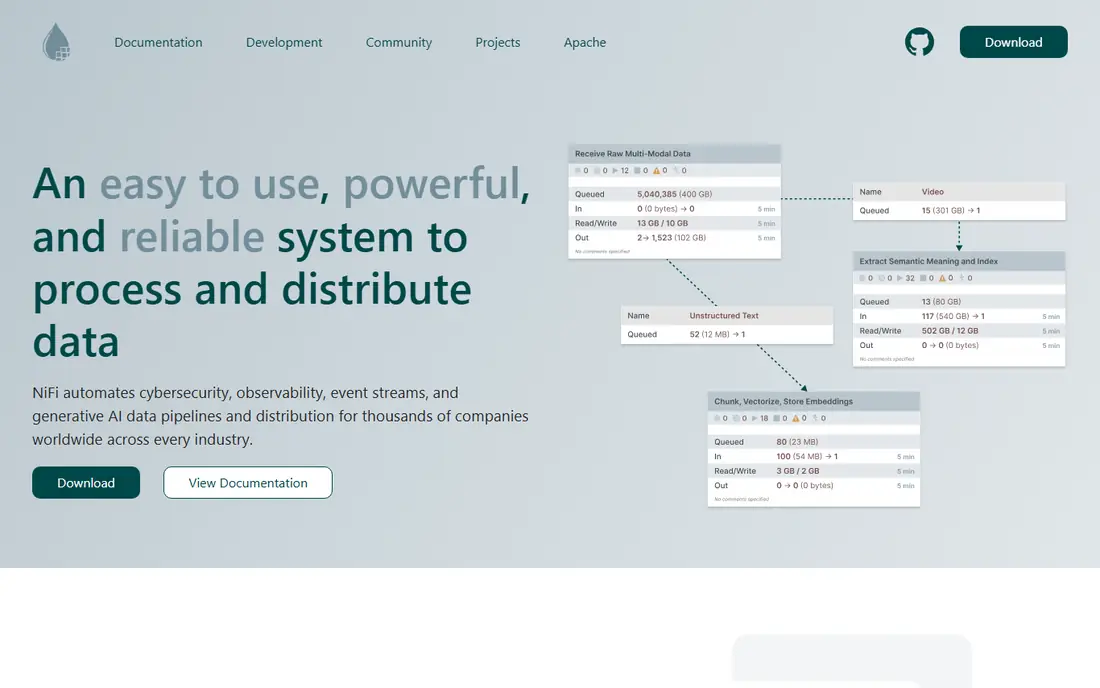
Apache NiFi is the open-source data flow platform, with visual flow design, strong streaming and routing, and no vendor lock-in. It moves data between systems with processors for enrichment, routing, and transformation, and it suits teams that want full control over data movement without license costs.
Self-hosting needs infrastructure expertise, and operations effort grows at scale, while warehouse-native ELT depth trails Matillion and Fivetran. NiFi fits engineering teams that want open-source flexibility for streaming and routing, and that can staff the platform.
What we like- Free and open source
- Visual flow design
- Strong streaming and routing
- No vendor lock-in
Watch out for- Needs infrastructure expertise
- Ops effort for scale
- Less warehouse-native ELT depth
#4Airbyte
Best for: Open-source ELT4.4/5 on
G2 (78 reviews, checked Oct 2026)
Visit airbyte.com
Starting priceFree open source
Free planYes
Airbyte is the open-source ELT alternative that engineering teams prefer when they want no lock-in, with a broad connector catalog and both self-hosted and cloud deployment. Cloud Standard latency runs 60 minutes and Plus runs 15 minutes in one 2026 comparison, with volume or capacity pricing through Data Workers. Airbyte Agents and MCP servers arrived in May 2026 for AI pipeline operations.
Self-hosting needs infrastructure expertise, and cloud latency floors trail Fivetran top tiers. Airbyte fits engineering teams that want open-source ELT with cloud optionality, and that value connector breadth over managed-service polish.
What we like- Open-source ELT
- No lock-in
- Broad connectors
- Cloud latency 60 minutes Standard, 15 minutes Plus
Watch out for- Self-hosting needs expertise
- Cloud latency floors
- Capacity pricing on cloud
#5Fivetran
Best for: Hands-off automated ELT4.3/5 on
G2 (841 reviews, checked Oct 2026)
Visit fivetran.com
Starting priceFree under 500K MAR
Free planYes
Fivetran is the hands-off automated ELT leader, with more than 700 connectors, batch change data capture, and automated schema migration that needs minimal pipeline maintenance. Pricing is monthly-active-row based, with free use under 500,000 MAR in one comparison, and top tiers reaching 1-minute latency versus 5 minutes on Standard. Fivetran merged with dbt in June 2026, which changes the combined roadmap.
Cost is hard to predict at high volume, since MAR counts grow with data, and the dbt merger deserves roadmap attention. Fivetran fits teams that want automated ELT with minimal engineering effort, especially on Snowflake and BigQuery.
What we like- Hands-off automated ELT
- 700-plus connectors
- Batch CDC
- Free under 500,000 monthly active rows
Watch out for- Cost hard to predict at high volume
- MAR-based pricing
- Merged with dbt in June 2026
Starting priceUsage-based credits
Free planFree trial
Matillion suits SQL-heavy teams transforming inside the warehouse, with push-down ELT that runs transformations on warehouse compute rather than a separate engine. Credits priced by task hours cover usage, with batch latency in minutes and CDC on the Scale tier, plus Maia agents generally available across four warehouses in one 2026 comparison. Snowflake, BigQuery, and Redshift teams benefit most.
Credit pricing needs modeling against real workloads, and warehouse focus limits non-warehouse use cases. Matillion fits SQL-strong teams that want warehouse-native ELT with agent-assisted pipeline building, rather than a generic ETL engine.
What we like- Warehouse-native push-down ELT
- SQL-heavy team fit
- Maia agents
- CDC on Scale tier
Watch out for- Credit pricing needs modeling
- Warehouse-centric
- Batch latency on lower tiers
#7Azure Data Factory
Best for: Azure and hybrid integration4.6/5 on
G2 (101 reviews, checked Oct 2026)
Visit microsoft.com
Starting pricePay per activity
Free planYes
Azure Data Factory is the cloud-native integration service for Azure and hybrid environments, with consumption-based pricing per activity run and hybrid connectivity to on-premises sources. It covers ETL and ELT patterns with more than 90 connectors in one comparison, and it integrates deeply with Azure Synapse, Databricks, and Microsoft Fabric.
Azure focus limits multi-cloud teams, change data capture is limited compared with dedicated CDC tools, and consumption pricing needs monitoring to avoid surprises. Azure Data Factory fits Microsoft-centric and hybrid teams that want cloud-native integration inside Azure billing.
What we like- Azure-native
- Hybrid connectivity
- Consumption pricing
- 90-plus connectors
Watch out for- Azure-centric
- Limited CDC
- Pricing needs monitoring
Starting price$0.44 per DPU-hour
Free planYes
AWS Glue is the AWS-native serverless ETL service, charging from 44 cents per DPU-hour in guides, with deep integration across S3, Redshift, Athena, and other AWS services. It suits teams already on AWS that want serverless ETL without managing clusters, using Python or Scala for transformations.
AWS lock-in is real, and Python or Scala skills are needed for custom transforms, while costs scale with job size and DPU usage. AWS Glue fits AWS-committed teams that want serverless ETL inside AWS billing, rather than multi-cloud portability.
What we like- Serverless ETL on AWS
- Pay per DPU-hour from 44 cents
- Deep AWS integration
- Python and Scala
Watch out for- AWS lock-in
- Needs Python or Scala skills
- Pricing scales with job size
How we chose
We compared these tools on pattern support, change data capture, connector breadth, deployment model, pricing model, and ownership stability. Data integration comparisons from 2026 shaped the figures, and we flagged every case where pricing is usage-based or quote-based, since ETL vendors rarely publish simple rates. We favored tools with clear cloud or open-source paths for PowerCenter workloads, and tools whose latency model matches the use case.
We also separated three buyer types. Cloud warehouse buyers should shortlist Fivetran, Airbyte, and Matillion, hybrid buyers should shortlist Talend, and cloud-committed buyers should shortlist Azure Data Factory or AWS Glue. SSIS suits Microsoft shops, while NiFi suits open-source streaming teams. The right pick follows warehouse, cloud, and transformation style, not connector count alone.
Confirm genuine log-based CDC, not frequent batch pulls
Batch is fine for reporting, but operational analytics needs fresh data. Confirm the tool offers genuine log-based change data capture, reading database transaction logs directly, rather than frequent batch pulls dressed up as real-time. Sub-minute latency is the bar for real-time integration, and only some tools here meet it at standard tiers.
Model usage pricing against real volumes
MAR-based, credit-based, and DPU-hour pricing all scale with data volume, so model costs against real row counts, job sizes, and run frequencies before signing. Fivetran costs are hard to predict at high volume, Matillion credits need task-hour modeling, and Glue DPU-hours scale with job size. A proof of concept with production-like volumes reveals the real bill.
Check security, compliance, and ownership stability
Enterprise ETL needs SOC 2 Type II, plus HIPAA with a signed business associate agreement, GDPR, and CCPA where they apply, plus encryption, field-level masking, role-based access, single sign-on, multi-factor authentication, and full audit trails. Ownership stability also matters: Informatica under Salesforce, Talend under Qlik, and Fivetran plus dbt merged all change roadmaps, so ask vendors about two-year plans.
Run parallel pipelines before cutover
Run the new tool alongside PowerCenter for at least one full reporting cycle, comparing row counts, transformation results, and latency on the same source data. Parallel running catches mapping gaps, data quality differences, and CDC edge cases before they reach production reports. Do not retire PowerCenter mappings until the new pipeline passes reconciliation on every critical table, since rollback after decommission is far harder than a longer parallel run.
Frequently asked questions
Is PowerCenter still available?
Yes. Informatica PowerCenter continues as an enterprise ETL platform, now under Salesforce ownership completed in November 2025. The case for switching usually rests on cost, cloud-native architecture, real-time capability, or lock-in concerns rather than PowerCenter disappearing.
What is the best PowerCenter alternative for Snowflake?
Fivetran, Matillion, and Airbyte lead for Snowflake, with Fivetran for hands-off ELT, Matillion for SQL-heavy push-down ELT, and Airbyte for open-source flexibility. All three offer native Snowflake connectivity and warehouse-optimized performance without on-premises infrastructure.
Can open-source tools replace PowerCenter?
Yes, for teams with engineering capacity: Talend open source, Apache NiFi, and Airbyte open source all cover substantial PowerCenter workloads free. Enterprise governance, support, and managed operations still favor commercial tools, so open source fits teams that can staff the platform themselves.
How long does an ETL migration take?
Small migrations take weeks, while enterprise migrations with hundreds of mappings take months. The longest parts are mapping conversion, data quality validation, and parallel running, not tool installation. Budget time for a proof of concept on your most complex mappings before committing to a cutover date.
Should I pick ETL or ELT?
Pick ETL when transformations must happen before loading, such as complex cleansing or governance checks. Pick ELT when the warehouse can transform at scale, which suits most modern Snowflake, BigQuery, and Redshift stacks. Fivetran and Airbyte are ELT-first, while Talend, SSIS, and NiFi cover both patterns. Hybrid teams often run both patterns, using ETL for regulated feeds and ELT for analytics loads.
Sources we checked (11)
- https://www.talend.com
- https://www.microsoft.com
- https://nifi.apache.org
- https://airbyte.com
- https://fivetran.com
- https://matillion.com
- https://aws.amazon.com
- https://estuary.dev/blog/informatica-alternatives/
- https://nexla.com/blog/top-10-data-integration-tools/
- https://peliqan.io/blog/data-integration-tools/
- https://hevodata.com/learn/etl-tools-for-enterprise-data-integration/
Is your product missing or out of date?
We review this list regularly. Vendors can request a listing, send updated pricing or ask about featured placement.

Shihab Mia · Founder, Rankite
Shihab has 5+ years in B2B and SaaS SEO. He writes Rankite's software buying guides from pricing pages, documentation and public user reviews. More about Shihab.