How we make this list: we compare pricing pages, product documentation and public user reviews. Ratings come from G2, Capterra or Trustpilot, with the date we checked them.
Key takeaways
- Informatica PowerCenter runs roughly $50,000 to $500,000-plus per year, so every alternative here costs less for most teams.
- Fivetran and Airbyte cover automated ELT into warehouses, while Talend and Matillion add visual transformation for teams that need it.
- Integrate.io's flat $1,999 per month removes usage surprises, which suits teams burned by row-based billing.
- Open-source options such as Airbyte and Apache NiFi cost nothing in license but need engineering time to run.
- Informatica now operates as Informatica from Salesforce, so confirm the current product name and terms when comparing.
Quick comparison
| Tool | Best for | Starting price | Free plan |
|---|
 Fivetran | Automated SaaS ingestion | Free | Yes |
 Airbyte | Open-source ELT with control | Free | Yes |
 Talend | Enterprise hybrid integration | Free | Yes |
 Matillion | Warehouse-native ELT | See website | No |
 Integrate.io | Flat-fee low-code pipelines | $1,999 per month | No |
 Azure Data Factory | Microsoft ecosystem pipelines | See website | No |
 Apache NiFi | Real-time data flows | Free | Yes |
 Dell Boomi | Low-code app and data integration | See website | No |
Is your product missing or out of date?
We review this list regularly. Vendors can request a listing, send updated pricing or ask about featured placement.
#1Fivetran
Best for: Automated SaaS ingestion4.3/5 on
G2 (841 reviews, checked Oct 2026)
Visit fivetran.com
Starting priceFree
Free planYes
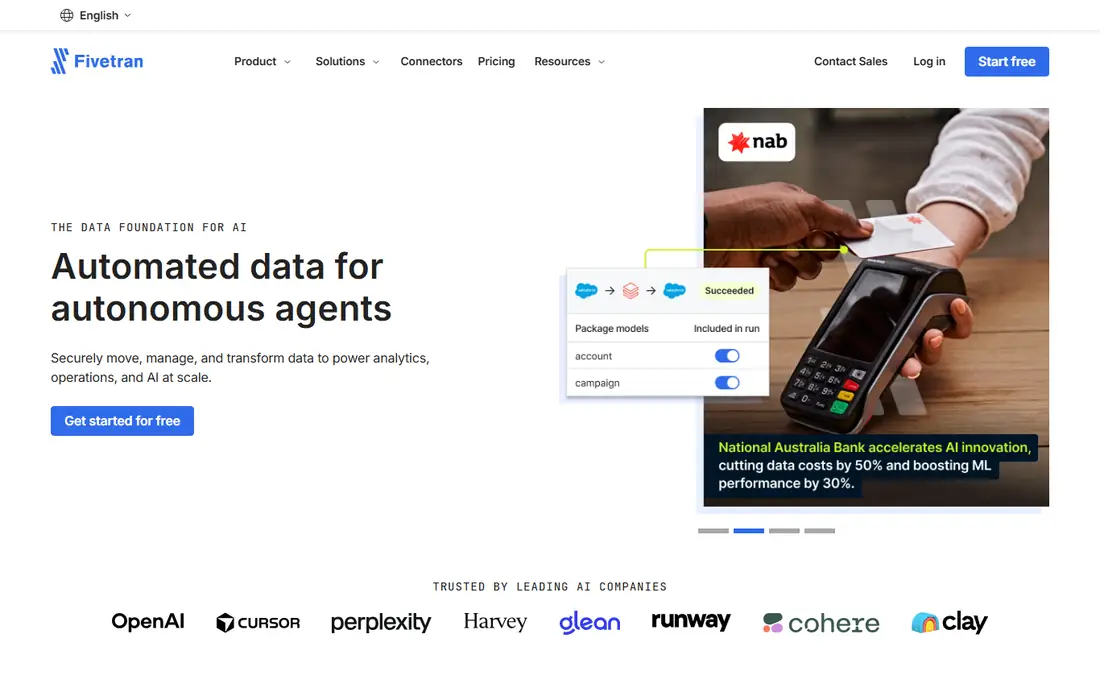
Fivetran automates data ingestion into warehouses with managed connectors that handle schema changes, incremental loads, and CDC without pipeline code. With more than 700 connectors covering SaaS apps and databases, it suits analytics teams that want data flowing with minimal engineering attention.
Pricing is usage-based on monthly active rows, with a free tier under 500,000 MAR, which makes small pipelines cheap and large pipelines expensive. That model rewards teams with stable row counts and punishes teams with volatile or growing volumes, so model costs at peak volume.
Transformation is basic without dbt, so teams that need heavy in-pipeline logic pair Fivetran with a transformation layer. Pick Fivetran when hands-off ingestion matters most. Pick Airbyte when control and cost matter more.
What we like- 700 plus managed connectors
- Automated CDC and schema handling
- Minimal maintenance
Watch out for- Usage-based MAR billing climbs at scale
- Transformation is basic without dbt
- Less control than open source
#2Airbyte
Best for: Open-source ELT with control4.4/5 on
G2 (78 reviews, checked Oct 2026)
Visit airbyte.com
Starting priceFree
Free planYes
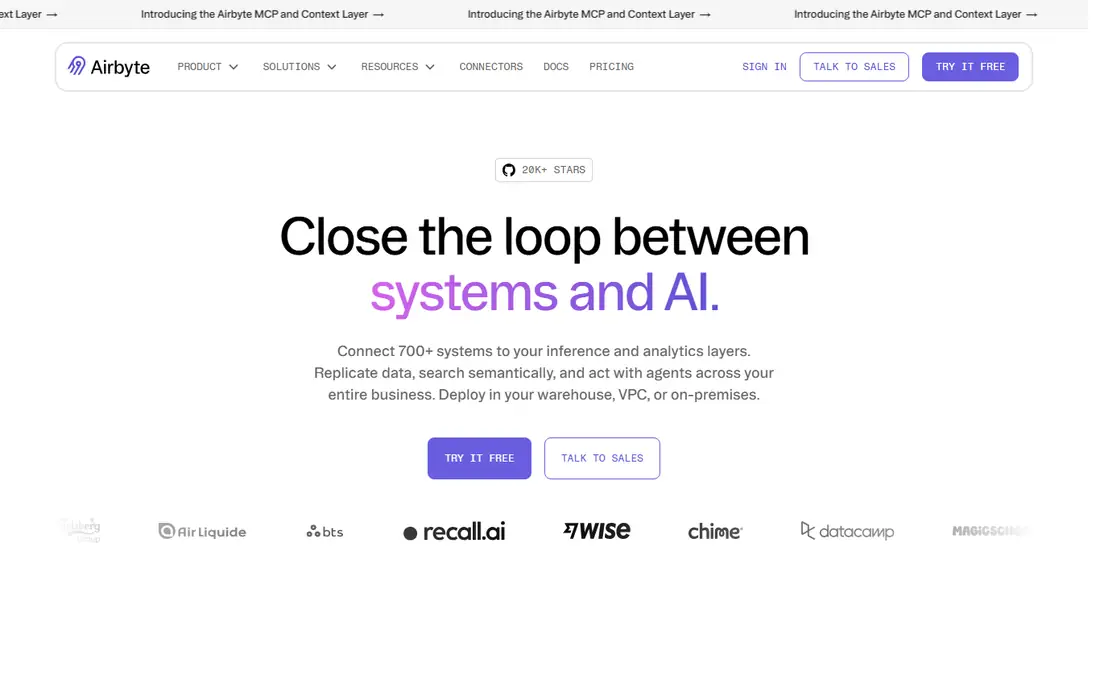
Airbyte is the open-source ELT standard, with more than 700 connectors and a custom connector builder for sources nobody else covers. Teams self-host for free or use the managed cloud, which charges by usage credits or capacity tiers. The open-source model gives engineers control over pipelines, deployment, and data residency.
The platform focuses on ingestion, not transformation, so teams pair Airbyte with dbt or SQL models in the warehouse. That ELT pattern suits modern analytics stacks where the warehouse does the heavy work and the pipeline only moves data reliably.
Self-hosting needs engineering time for upgrades, monitoring, and scaling, while the cloud tier removes that burden at a usage cost. Pick Airbyte when control, connector breadth, and open source matter. Pick Fivetran when fully managed simplicity matters more.
What we like- Open source with 700 plus connectors
- Self-host or cloud
- Custom connector builder
Watch out for- ELT only, no built-in transformation
- Managed cloud costs by usage or capacity
- Self-hosting needs engineering
#3Talend
Best for: Enterprise hybrid integration4.0/5 on
G2 (65 reviews, checked Oct 2026)
Visit talend.com
Starting priceFree
Free planYes
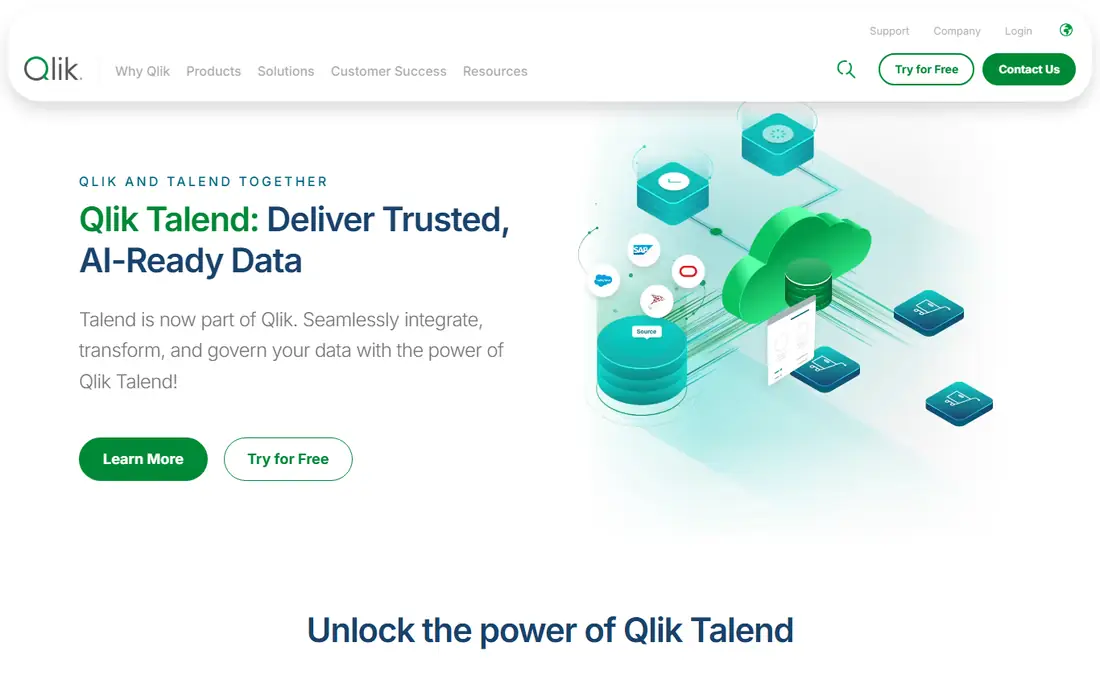
Talend, now Qlik Talend, covers enterprise hybrid integration with a visual designer for ETL and ELT, plus data quality and governance features that regulated industries need. With more than 900 connectors, it handles on-premises, cloud, and hybrid sources in one platform, and an open-source edition exists for evaluation.
The governance strength is the draw for regulated teams: data quality rules, lineage, and stewardship sit alongside pipelines, which suits banks, insurers, and healthcare organizations. Per-user licensing on enterprise tiers keeps costs tied to team size rather than row volume.
The toolchain is Java-heavy and needs specialist skills, which raises hiring and training costs. Small teams will find Talend heavy. Pick Talend when enterprise governance and hybrid deployment matter. Pick a cloud-native tool when speed and simplicity lead.
What we like- 900 plus connectors
- Visual ETL and ELT designer
- Data quality and governance strengths
Watch out for- Java-heavy toolchain needs specialists
- Enterprise pricing is custom
- Complexity for small teams
Starting priceSee website
Free planNo
Matillion builds ELT pipelines that run inside the cloud warehouse, using SQL transformations that data teams already know. Its low-code interface covers Snowflake, BigQuery, and Redshift users, with more than 150 connectors and a visual designer for warehouse-native jobs.
That warehouse-native design is efficient: transformations run where the data lives, avoiding a separate processing layer. For a team standardized on one warehouse, Matillion feels like a natural extension of the warehouse itself.
Pricing runs on consumption credits, and warehouse compute costs amplify at scale, which is the main complaint in comparisons. Matillion is also warehouse-only, with less app integration depth than Boomi or MuleSoft. Pick Matillion when warehouse-native ELT leads. Pick an iPaaS when app integration leads.
What we like- Warehouse-native transformations in SQL
- Low-code UI
- Strong Snowflake, BigQuery, and Redshift fit
Watch out for- Usage credits amplify warehouse compute costs
- Cloud-warehouse only
- Less app integration depth
#5Integrate.io
Best for: Flat-fee low-code pipelines4.3/5 on
G2 (213 reviews, checked Oct 2026)
Visit integrate.io
Starting price$1,999 per month
Free planNo
Integrate.io is a cloud-native pipeline platform with a flat $1,999 monthly fee covering ETL, ELT, CDC, reverse ETL, and API management, with no row limits, pipeline caps, or consumption meters. That predictability is the headline: teams burned by Fivetran's MAR billing or Matillion's credit amplification know their cost in advance.
The low-code interface offers more than 220 built-in transformations, and production pipelines can run in days, with a 30-day onboarding program that gets teams self-sufficient fast. Unlike Informatica, it needs no certified specialists to operate, which shortens hiring and training.
The entry price exceeds free tools, and connector counts trail Fivetran's 700-plus. Pick Integrate.io when predictable cost and low-code speed matter most. Pick a free tool when budget is zero and engineering time is available.
What we like- Flat $1,999 monthly fee, no row limits
- ETL, ELT, CDC, and reverse ETL in one product
- 220 plus transformations
Watch out for- Higher entry than free tools
- Fewer connectors than Fivetran
- Smaller ecosystem than Talend
Starting priceSee website
Free planNo
Azure Data Factory orchestrates data movement inside Microsoft's cloud, with visual pipelines, optional code, and pay-as-you-go pricing by activities and compute. It covers more than 90 connectors, with hybrid support for on-premises sources through integration runtimes.
For a team standardized on Azure, Data Factory is the natural pipeline choice: it connects to Azure Synapse, Databricks, and SQL services without a third vendor, and costs follow actual usage. The visual designer suits data engineers who want orchestration without managing infrastructure.
Azure-only deployment is the limit, and CDC support is thinner than Fivetran's. SaaS connector breadth also trails the ELT specialists. Pick Azure Data Factory when Azure is the core platform. Pick a cloud-neutral tool when multi-cloud or SaaS breadth matters.
What we like- Visual pipelines with optional code
- Pay-as-you-go by activity and compute
- Hybrid and Azure-native coverage
Watch out for- Azure only
- CDC support is limited
- Less SaaS connector breadth than Fivetran
Starting priceFree
Free planYes
Apache NiFi handles real-time data flows with more than 280 processors for routing, transformation, and delivery. It suits IoT, cybersecurity, and streaming use cases where data must move and transform continuously rather than in nightly batches.
The visual flow designer lets engineers build and monitor pipelines without writing pipeline code for every step, and the open-source license costs nothing. That combination makes NiFi the default for real-time routing in cost-sensitive teams.
Running NiFi at scale needs engineering for clustering, monitoring, and security, and there is no managed SaaS option to offload that work. The learning curve on flow design is real. Pick NiFi when real-time flows lead. Pick a batch ELT tool when nightly warehouse loads are the job.
What we like- Free and open source
- 280 plus processors
- Real-time routing and streaming
Watch out for- Needs engineering to run at scale
- No managed SaaS option
- Learning curve on flow design
Starting priceSee website
Free planNo
Dell Boomi, now Boomi, is a low-code integration platform covering app integration, API management, and data pipelines in one system. With more than 1,000 connectors, it connects cloud and on-premises applications, which suits enterprises whose integration problem spans SaaS apps, not just warehouses.
The low-code designer lets integration teams build flows without heavy coding, and hybrid deployment covers on-premises systems that pure cloud tools cannot reach. CDC support runs through connectors, and the platform scales from departmental flows to enterprise programs.
Pricing is custom, starting near $1,000 per month in comparisons, with per-connector costs adding up at scale. Warehouse-native ELT depth trails Matillion. Pick Boomi when app integration leads. Pick an ELT specialist when warehouse loading leads.
What we like- 1,000 plus connectors
- Low-code hybrid integration
- App and data integration in one platform
Watch out for- Custom pricing from about $1,000 per month
- Per-connector costs add up
- Less warehouse-native depth
How we chose
We compared tools that replace Informatica's integration jobs, ETL, ELT, and app integration, using vendor pages and 2026 comparison data. We favored published prices where available and marked quote-based tools as such. We also split the list by pattern, ELT versus ETL versus iPaaS, since those patterns suit different stacks, and we noted Informatica's move to Informatica from Salesforce for buyers checking the current vendor name.
ETL, ELT, and iPaaS: picking the right pattern
The pattern decides the tool. ETL transforms data before loading, which suits legacy warehouses and governed pipelines where the target schema is fixed. Talend and Informatica PowerCenter follow this pattern, and enterprise teams with strict governance still need it.
ELT loads raw data first and transforms inside the warehouse, which suits cloud analytics stacks. Fivetran, Airbyte, and Matillion follow this pattern, and the warehouse's compute handles transformation. That pattern is cheaper to operate and faster to change, since raw data stays available for new models.
iPaaS connects applications, not just warehouses. Boomi and Azure Data Factory cover app-to-app flows, API management, and hybrid systems alongside data movement. A team whose problem is syncing Salesforce to NetSuite needs an iPaaS, not an ELT loader. Name the pattern first: warehouse loading, governed transformation, or app integration. The pattern picks the category, and the category picks the tool.
Frequently asked questions
What is Informatica called now?
Informatica now operates as Informatica from Salesforce, following Salesforce's acquisition. Product names and terms may change, so confirm the current branding and licensing when comparing alternatives.
What is the cheapest Informatica alternative?
Airbyte and Apache NiFi are free and open source, though self-hosting needs engineering time. Fivetran offers a free tier under 500,000 monthly active rows. For a managed flat price, Integrate.io runs $1,999 per month with no row limits.
Should I choose ETL or ELT?
Choose ELT when your warehouse is cloud-native and transformation can run in SQL after loading, which suits most modern analytics teams. Choose ETL when governance requires transformation before loading, or when the target system cannot transform data itself.
Which alternative has the most connectors?
Boomi lists more than 1,000 connectors, Talend more than 900, and Fivetran and Airbyte more than 700 each. Connector count matters less than coverage of your exact sources, so confirm your sources before buying.
Do these tools replace Informatica's data quality and governance?
Talend covers data quality and governance most closely among the alternatives. Fivetran and Airbyte focus on movement, not governance, so teams needing full governance should pair them with a quality tool or choose Talend.
How fast can I migrate off Informatica?
Low-code cloud tools such as Integrate.io report production pipelines in days, while enterprise migrations to Talend or Boomi take weeks to months depending on pipeline count and complexity. Run a pilot on your five most critical pipelines before committing to a full migration.
Sources we checked (5)
- https://www.integrate.io/blog/top-5-informatica-alternatives/
- https://peliqan.io/blog/data-integration-tools/
- https://improvado.io/blog/informatica-alternatives
- https://skyvia.com/blog/top-informatica-alternatives/
- https://hevodata.com/learn/informatica-alternatives/
Is your product missing or out of date?
We review this list regularly. Vendors can request a listing, send updated pricing or ask about featured placement.

Shihab Mia · Founder, Rankite
Shihab has 5+ years in B2B and SaaS SEO. He writes Rankite's software buying guides from pricing pages, documentation and public user reviews. More about Shihab.