How we make this list: we compare pricing pages, product documentation and public user reviews. Ratings come from G2, Capterra or Trustpilot, with the date we checked them.
Key takeaways
- Hugging Face itself is not listed here, since this article covers alternatives to it: platforms for running, hosting, and deploying AI models by API.
- Replicate is the simplest way to run open-source models by API, with per-second GPU billing and tens of thousands of ready models.
- Together AI suits production language model apps with fast serverless inference and per-token pricing, plus dedicated GPUs for heavy use.
- Modal suits bursty Python workloads, since scale-to-zero billing means idle time costs little, unlike always-on replicas.
- The sticker price matters less than whether idle time is billed: always-on H100 replicas cost thousands per month, while bursty use on serverless platforms costs far less.
Quick comparison
| Tool | Best for | Starting price | Free plan |
|---|
 Replicate | Simple model APIs | $0.81 per GPU hour | No |
 Together AI | Production LLM inference | $1 free credit | Yes |
 Modal | Serverless Python GPU jobs | Pay as you go | No |
 Baseten | Managed model APIs | See website | No |
 RunPod | Raw GPU rental | $0.20 per hour | No |
 Kaggle | Free notebooks and GPUs | Free | Yes |
 Amazon SageMaker | AWS end-to-end MLOps | See website | No |
 fal.ai | High-volume image generation | $0.008 per image | No |
Is your product missing or out of date?
We review this list regularly. Vendors can request a listing, send updated pricing or ask about featured placement.
The best Hugging Face alternatives
Starting price$0.81 per GPU hour
Free planNo
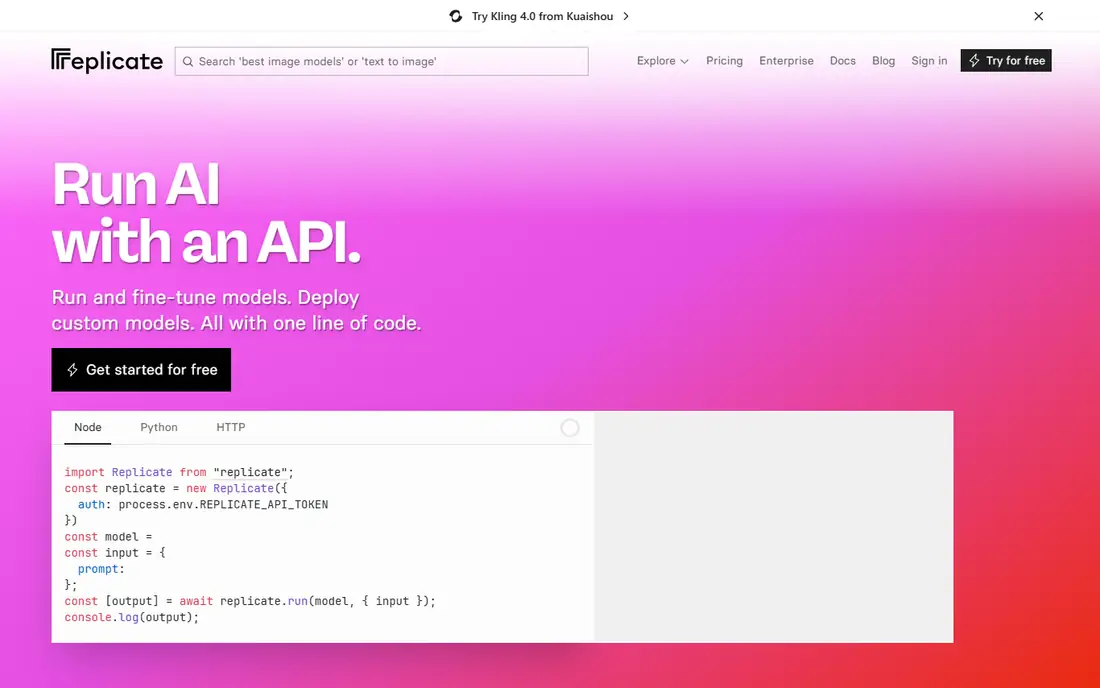
Replicate removes the pain of deploying open-source models: you find a model you like, many of which also appear on Hugging Face, and Replicate gives you a simple API to run it, with no servers, Docker containers, or CUDA drivers to manage. That simplicity makes it one of the quickest ways to get from a model to a working API, ideal for developers prototyping an idea or adding an AI feature to an app without committing to a full MLOps platform. Pricing is per second of compute time, with a standard Nvidia T4 GPU around $0.81 per hour and an A100 around $5.04 per hour, and image generation typically costs $0.003 to $0.01 per image.
Replicate has no free tier beyond pay-per-use billing, and it gets expensive at high volume, since per-second pricing without bulk discounts adds up for always-on workloads. Control over performance is also limited compared with dedicated GPUs. For prototyping, media AI, and apps with variable traffic, Replicate is the best simple pick, and its model library covers vision, audio, and language models ready to call by API.
What we like- Simple API for any model
- Tens of thousands of ready models
- Per-second billing
- No server management
Watch out for- No free tier, pay-per-use only
- Expensive at high volume
- Limited control over performance
Starting price$1 free credit
Free planYes
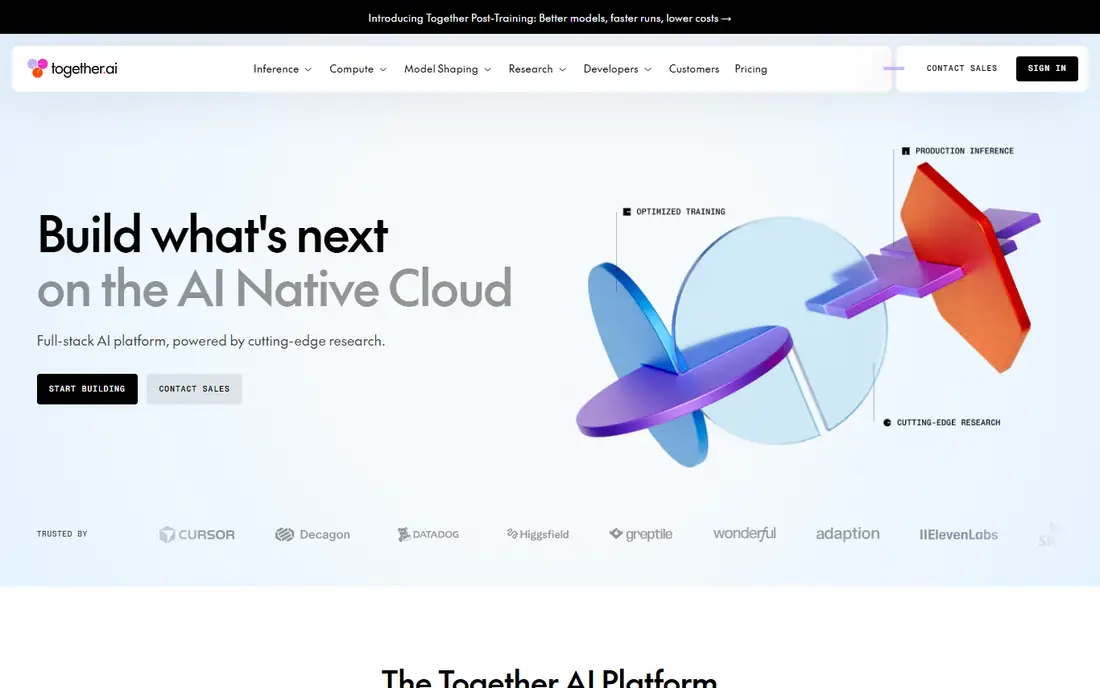
Together AI offers fast language model and image inference with serverless per-token pricing and dedicated GPUs from $0.85 per hour, plus built-in fine-tuning and batch inference at a discount. Its curated catalog covers about 200 models, smaller than Hugging Face million-plus Hub, but focused on production-ready open models with optimized serving, making it a strong choice for production language model apps where speed and token cost matter. Serverless pricing costs almost nothing at light volume and needs no capacity planning, while dedicated GPUs undercut per-token pricing past a few billion tokens per month.
The curated catalog means niche models may be missing, and dedicated GPU pricing adds up for always-on replicas, with one comparison putting Together dedicated H100 at $4,008 per month for always-on use. Token costs also vary by model, so budgeting needs real traffic estimates. For production LLM apps that want speed and simple token pricing without managing GPUs, Together AI is the best pick, and its batch discount suits offline workloads.
What we like- Fast serverless LLM inference
- Per-token pricing
- Dedicated GPUs from $0.85 per hour
- Fine-tuning built in
Watch out for- Curated catalog of 200 plus models, smaller than Hugging Face
- Dedicated pricing adds up
- Token costs vary by model
Starting pricePay as you go
Free planNo
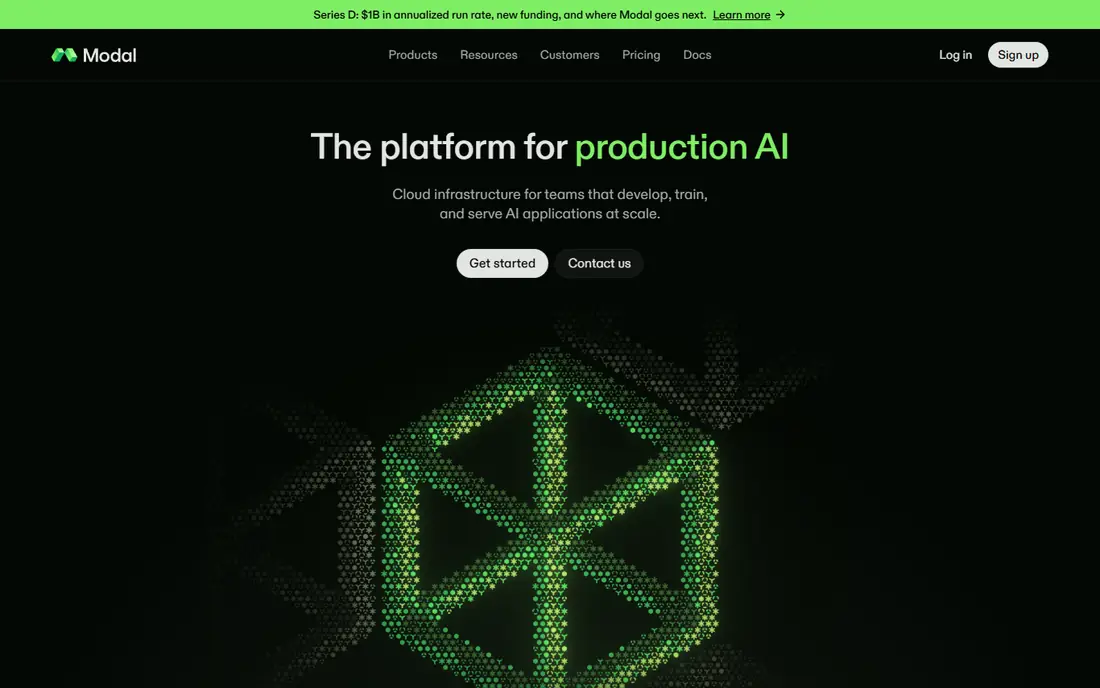
Modal deploys AI models, batch jobs, scheduled tasks, and webhooks on serverless GPUs and CPUs through a Pythonic interface, with scale-to-zero billing that makes bursty workloads far cheaper than always-on replicas. One comparison puts an always-on H100 replica on Modal at $2,884 per month, while two hours of real GPU work per day on a scale-to-zero platform bills roughly $237 per month, a tenfold difference driven entirely by idle time. That makes Modal ideal for async Python tasks, batch processing, and jobs that run intermittently rather than constantly.
Runtime control is limited compared with raw GPU rental or full container platforms, monitoring is minimal, and Modal is Python-focused, with no frontend or full-stack app support. For developers running Python AI workloads that spike and idle, Modal is the best serverless pick, and its scale-to-zero model is the single biggest cost lever for bursty traffic.
What we like- Scale-to-zero billing for bursty work
- Pythonic interface
- Scheduled jobs and webhooks
- Serverless GPUs and CPUs
Watch out for- Limited runtime control
- Minimal monitoring
- Python-focused, not full-stack apps
Starting priceSee website
Free planNo
Baseten provides managed model APIs for serverless inference and dedicated GPUs for production workloads, with autoscaling and managed infrastructure that removes server management for teams deploying custom models. Its Model APIs suit light-volume token work at near-zero cost, while dedicated GPUs suit steady production traffic, with one comparison putting Baseten always-on H100 at $4,745 per month, higher than Modal or Together dedicated. The platform suits demos, internal tools, and production APIs where managed serving beats self-hosting.
Pricing for dedicated tiers is not published in detail, runtime is Python-only, and monitoring is basic compared with full-stack platforms. For teams that want managed model serving without building MLOps infrastructure, Baseten is a strong pick, particularly for custom models that need a stable API with autoscaling, and its serverless tier keeps light-volume costs low.
What we like- Model APIs for serverless inference
- Dedicated GPUs for production
- Autoscaling
- Managed infrastructure
Watch out for- Pricing not published for dedicated tiers
- Python-only runtime
- Monitoring basic compared with full platforms
Starting price$0.20 per hour
Free planNo
RunPod offers raw GPU rental with the lowest costs among managed options, starting around $0.20 per hour for smaller GPUs, with on-demand and reserved instances of high-performance GPUs including H100. That control suits teams that want to run their own serving engine, such as vLLM or SGLang, on their own schedule, with full control over drivers, models, and scaling. For steady, high-utilization workloads, self-hosting on rented GPUs beats every managed per-token price, since a reserved H100 at high utilization undercuts managed inference costs.
You manage everything: CUDA drivers, serving engines, uptime, and 3 a.m. out-of-memory pages, which needs engineering skill and on-call coverage. There are no managed model APIs, so teams must build their own. For ML teams with the skill to self-host and steady high utilization, RunPod is the best raw GPU pick, and its low hourly rates make experimentation cheap.
What we like- Lowest raw GPU costs
- On-demand and reserved instances
- Full control over environment
- High-performance GPUs
Watch out for- You manage drivers, serving, and uptime
- No managed model APIs
- Support varies by instance type
#6Kaggle
Best for: Free notebooks and GPUs4.7/5 on
G2 (34 reviews, checked Oct 2026)
Visit kaggle.com
Starting priceFree
Free planYes
Kaggle offers free notebooks with GPU access, datasets, and competitions, making it the best free starting point for learning, experimenting, and prototyping with AI models. No setup is needed: notebooks run in the browser with GPU quotas that cover many experiments, and the community provides kernels, datasets, and discussion that help beginners learn faster. For students, researchers, and hobbyists, Kaggle removes the cost barrier to trying models that would otherwise need paid GPUs.
Time and quota limits mean Kaggle cannot serve production traffic, and its notebook environment is not an API platform, so models built there must move elsewhere for deployment. For learning and prototyping, Kaggle is unmatched on price, and it pairs well with Replicate or Together AI when a prototype is ready for production serving.
What we like- Free notebooks with GPU access
- Datasets and competitions
- Community and learning resources
- No setup
Watch out for- Time and quota limits
- Not for production serving
- Notebook environment, not an API platform
#7Amazon SageMaker
Best for: AWS end-to-end MLOps4.3/5 on
G2 (57 reviews, checked Oct 2026)
Visit aws.amazon.com
Starting priceSee website
Free planNo
Amazon SageMaker is the default choice for companies all-in on Amazon Web Services, offering an end-to-end machine learning platform covering data labeling, model training, deployment, and monitoring in one place. Deep integration with every other AWS service suits large, experienced teams with complex MLOps needs, from data pipelines to governed model registries, and SageMaker scales to enterprise workloads that smaller platforms cannot handle.
Pricing is famously complex, with separate charges for compute instances, storage, and data processing that make monthly bills hard to predict, and the platform is overwhelming for smaller teams. AWS lock-in is tight, and costs grow quickly at scale. For AWS-centric enterprises with dedicated ML teams, SageMaker is the best end-to-end pick, while smaller teams should start with Replicate, Together AI, or Modal instead.
What we like- End-to-end ML platform
- Deep AWS integration
- Labeling, training, deployment, and monitoring in one place
Watch out for- Famously complex pricing
- Overwhelming for small teams
- Tight AWS lock-in
- Expensive at scale
#8
fal.ai
Best for: High-volume image generation
Visit fal.ai
Starting price$0.008 per image
Free planNo
fal.ai provides serverless APIs for media models, with high-volume image generation around $0.008 per image, cheaper than Replicate typical $0.003 to $0.01 range at volume, and fast scaling for image apps. It suits developers building image generation, editing, and video features into apps, where media model speed and cost matter more than language model breadth. Serverless scaling handles spikes without capacity planning, and model APIs are simple to call.
fal.ai is image-focused, with less language model depth than Together AI or Baseten, and pricing varies by model, so budgeting needs per-model checks. Its catalog is smaller than Replicate. For image-heavy apps that need low per-image costs at volume, fal.ai is the best pick, and it pairs well with Together AI for language features in the same app.
What we like- Cheaper high-volume image generation
- Fast media model APIs
- Serverless scaling
- Good for image apps
Watch out for- Image-focused, less LLM depth
- Pricing varies by model
- Smaller catalog than Replicate
How we chose
We compared platforms on model catalog breadth, API simplicity, billing model, scale-to-zero support, GPU control, and price transparency, weighting whether idle time is billed alongside headline rates. We favored platforms with published pricing where available, and we marked Baseten and SageMaker as See website where pricing is complex or custom rather than guessing a figure. Prices come from vendor pages and current guides, and GPU rates change often, so verify current rates before committing. We did not test any platform hands-on, and we did not list Hugging Face itself as one of its own alternatives.
Buying guide
Start from your traffic pattern, not your model list. If traffic is bursty, choose a scale-to-zero platform such as Modal or a serverless API such as Together AI or Replicate, since idle time is the biggest cost lever. If traffic is steady and high, compare dedicated GPUs on Together AI, Baseten, or RunPod self-hosting, since dedicated GPUs undercut per-token pricing at volume. If you are learning, start free on Kaggle, and if you are AWS-centric with a dedicated ML team, evaluate SageMaker for end-to-end governance.
Before committing, test with your real model and traffic: measure latency, cost per request at your volume, and cold-start behavior for serverless platforms, since cold starts hurt interactive apps. Check whether your model is available on the platform, whether fine-tuning is included, and whether compliance and security features meet your needs for production data. Finally, remember the self-hosting escape hatch: open serving engines such as vLLM and SGLang run on any rented GPU, so a managed platform should earn its margin with simplicity, speed, or reliability, not lock-in.
Frequently asked questions
What is the best Hugging Face alternative for beginners?
Replicate is the best beginner pick, with a simple API and tens of thousands of ready models, no server management, and per-second billing. Kaggle is the best free starting point for learning, with free notebooks and GPU access.
Which Hugging Face alternative is cheapest?
For bursty workloads, Modal scale-to-zero billing is cheapest, since idle time costs little. For steady high utilization, RunPod raw GPU rental at around $0.20 per hour for smaller GPUs undercuts managed per-token pricing. For light token work, Together AI serverless costs almost nothing.
Can I use these tools without Hugging Face models?
Yes. Most platforms host models independently, and many models that appear on Hugging Face also run on Replicate, Together AI, and other platforms. Check model availability on your chosen platform, since catalogs differ.
What is the difference between serverless and dedicated GPUs?
Serverless GPUs scale to zero when idle, so you pay only for work done, which suits bursty traffic. Dedicated GPUs stay warm always, so you pay around the clock, which suits steady high traffic where per-token pricing would cost more.
Should I self-host instead of using a managed platform?
Self-hosting wins with steady, high utilization and someone to own drivers and uptime, since a reserved H100 at 70 percent utilization beats managed per-token prices. At low utilization, managed platforms win, since idle dedicated GPUs waste money.
Does Hugging Face itself offer inference?
Yes, Hugging Face offers serverless inference through providers and dedicated Inference Endpoints, but this article covers alternatives for teams that want simpler APIs, faster inference, serverless billing, or raw GPU control outside the Hugging Face ecosystem.
Sources we checked (0)
Is your product missing or out of date?
We review this list regularly. Vendors can request a listing, send updated pricing or ask about featured placement.

Shihab Mia · Founder, Rankite
Shihab has 5+ years in B2B and SaaS SEO. He writes Rankite's software buying guides from pricing pages, documentation and public user reviews. More about Shihab.