How we make this list: we compare pricing pages, product documentation and public user reviews. Ratings come from G2, Capterra or Trustpilot, with the date we checked them.
Key takeaways
- OpenBao is the closest drop-in replacement for Vault itself, with the same workflow and an open source license, but you still run the cluster.
- If your team lives in one cloud, that cloud's own secret store is usually cheaper and simpler than a separate vault, at the cost of portability.
- Doppler and Infisical suit small teams that want a managed service with a good developer experience and no cluster to operate.
- Per-secret and per-operation pricing can surprise you at scale, so model your secret count and read volume before committing.
- Short-lived, dynamically generated credentials beat long-lived static secrets, and only some tools on this list issue them.
Quick comparison
| Tool | Best for | Starting price | Free plan |
|---|
 OpenBao | Vault users who want a truly open source replacement | Free | Yes |
 Infisical | Small teams that want a modern, developer-friendly vault | See website | Yes |
 Doppler | Teams that want managed secrets with no infrastructure to run | $21 per user/month | Yes |
 AWS Secrets Manager | Workloads that already run on AWS | $0.40 per secret/month | Free trial |
 Azure Key Vault | Workloads that already run on Azure | $0.03 per 10,000 operations | No |
 Akeyless | Enterprises that want Vault-class depth without running a vault | See website | Free trial |
 1Password Secrets Automation | Teams already standardized on 1Password | See website | Free trial |
Is your product missing or out of date?
We review this list regularly. Vendors can request a listing, send updated pricing or ask about featured placement.
The best HashiCorp Vault alternatives
#1
OpenBao
Best for: Vault users who want a truly open source replacement
Visit openbao.org
Starting priceFree
Free planYes
OpenBao began as a community fork of HashiCorp Vault, and it shows. If your team already knows Vault's concepts, policies, and API, the move feels familiar, because the core workflow is the same: store key-value secrets, issue short-lived dynamic credentials for databases and cloud services, and revoke them when their lease ends. For teams that objected to Vault's Business Source License, OpenBao removes that concern entirely, since the code is published under an OSI-approved open source license and governed by a community project.
The honest catch is operational. OpenBao gives you the software, not the service, so high availability, backups, upgrades, and incident response stay your job. That trade suits platform teams that already run stateful infrastructure and want full control. Smaller teams without that appetite will get more value from a managed option on this list.
What we like- Vault-compatible workflow and API
- Open source under MPL 2.0
- Dynamic secrets and leasing
Watch out for- You operate the cluster yourself
- Smaller community than Vault
- Enterprise support comes from third parties
#2
Infisical
Best for: Small teams that want a modern, developer-friendly vault
Visit infisical.com
Starting priceSee website
Free planYes
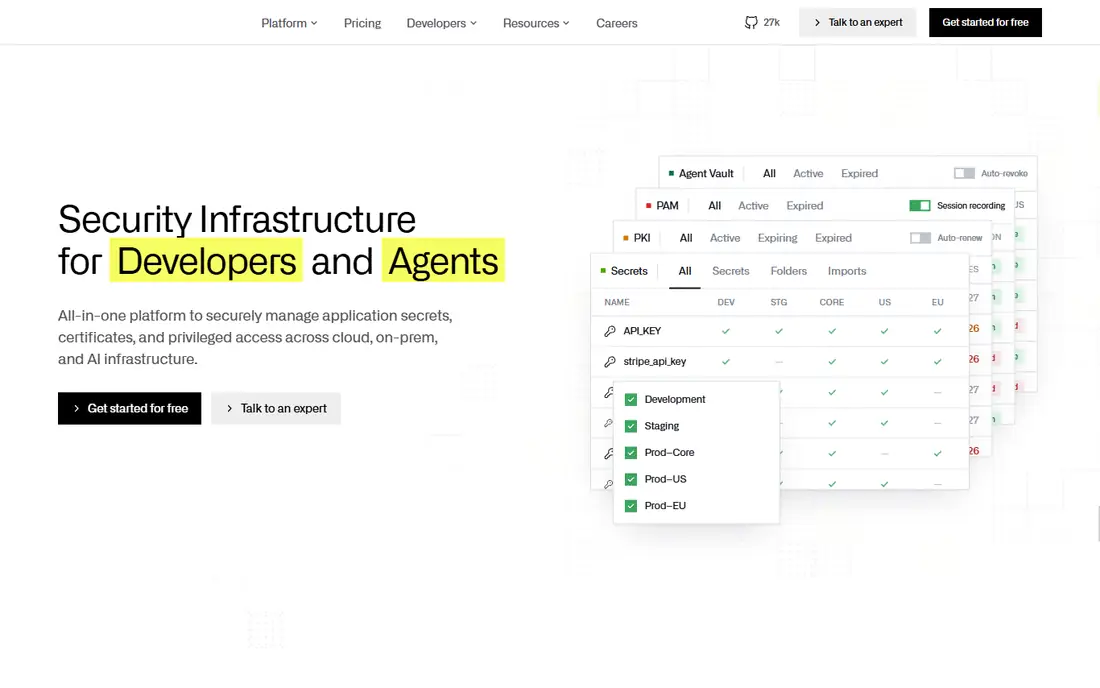
Infisical pitches itself as the approachable end of secrets management, and the product backs that up with a fast setup. Most teams import an existing env file with one CLI command and have secrets flowing into local development, CI, and staging within the hour. The dashboard is organized around projects and environments, which maps neatly onto how small product teams already think about their apps, and the Kubernetes operator keeps pods fed without application code changes.
Where Infisical asks for care is pricing shape. The core is open source and free to self-host, and the cloud free tier covers small teams, but paid cloud pricing scales with the number of human and machine identities. A shop with a handful of services will barely notice. A shop with hundreds of microservices and CI runners should count identities before signing up, and confirm whether dynamic credentials are included in the tier they plan to buy.
What we like- Open source core with a hosted cloud option
- Clean CLI and dashboard
- Kubernetes operator and secret syncs
Watch out for- Paid pricing scales per identity, which adds up with many machine accounts
- Dynamic secrets sit on higher tiers
#3
Doppler
Best for: Teams that want managed secrets with no infrastructure to run
Visit doppler.com
Starting price$21 per user/month
Free planYes
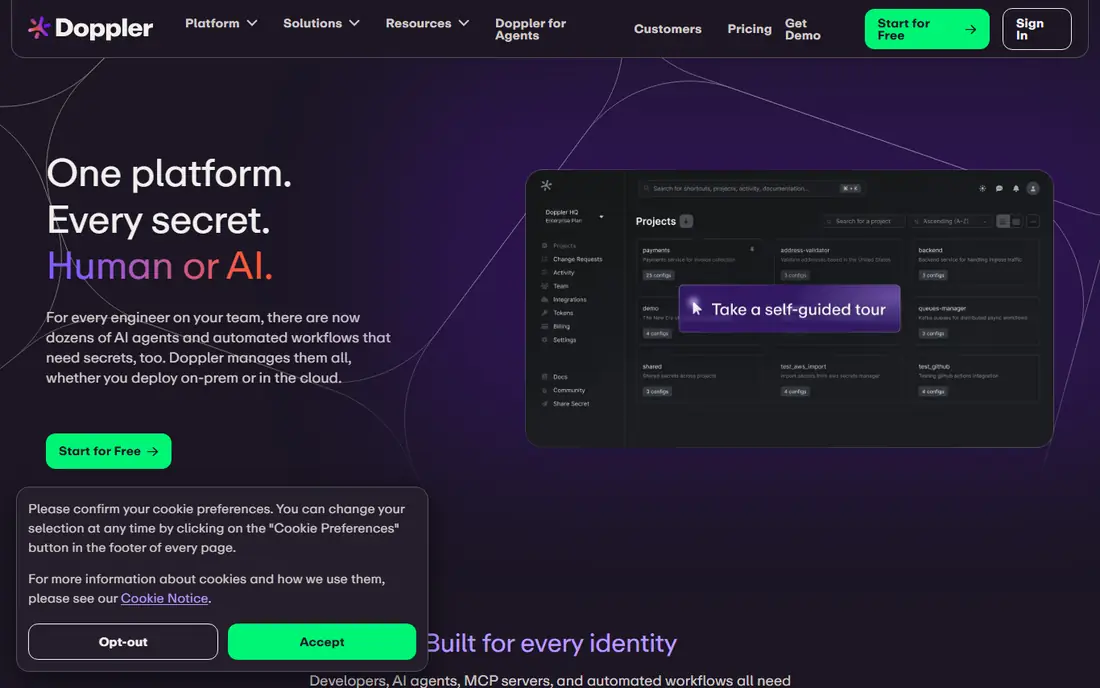
Doppler takes the opposite approach from OpenBao: it removes the infrastructure completely. You get a hosted dashboard, a CLI that injects secrets into local runs and pipelines, and syncs that push values into GitHub Actions, cloud providers, and Kubernetes. For a team that just wants secrets to stop living in shared env files and chat messages, Doppler is the shortest path from chaos to a single source of truth, with role-based access and a full activity log.
The limit worth knowing is that Doppler is mainly a distribution system, not a credential factory. It stores and syncs secrets well, and it can rotate some cloud credentials on a schedule, but it does not generate short-lived database credentials on demand the way Vault or OpenBao do. If your threat model depends on credentials that expire within minutes, look at the self-hosted engines or Akeyless instead. Doppler's per-seat pricing also means a large engineering org pays for every developer, even those who rarely touch secrets.
What we like- No cluster to operate
- Strong sync to CI and cloud platforms
- Clear per-environment structure
Watch out for- No dynamic secret generation on most plans
- Per-seat pricing grows with headcount
Starting price$0.40 per secret/month
Free planFree trial
For a team that already runs on AWS, Secrets Manager is often the path of least resistance. Access is governed by IAM policies you already understand, rotation is built in for supported databases through Lambda functions, and every read is logged to CloudTrail. There is nothing to install, patch, or scale, and replication across regions is a configuration choice rather than a project.
Billing deserves a spreadsheet before you commit. At $0.40 per secret per month plus $0.05 per 10,000 API calls, a small estate costs almost nothing, but thousands of secrets read on every request add up fast, and each cross-region replica bills as its own secret. Caching secrets in memory with a short lifetime, grouping related fields into one JSON secret, and moving plain configuration to Parameter Store are the usual ways teams keep the bill in check. The other limit is scope: this is an AWS service, so a second cloud or an on-prem estate needs its own answer.
What we like- Deep IAM and Lambda integration
- Built-in rotation for supported databases
- No servers to run
Watch out for- Cost grows with secret count and read volume
- AWS-only, so multi-cloud teams need a second tool
Starting price$0.03 per 10,000 operations
Free planNo
Azure Key Vault charges by the operation rather than by the secret, which makes it strikingly cheap for many workloads. Secret, key, and certificate operations on the Standard tier cost $0.03 per 10,000 transactions, with certificate renewals billed separately at $3 each, and there is no storage fee per secret. Applications authenticate with managed identities, so code never carries a credential to reach the vault, and the Premium tier adds HSM-backed keys for regulated workloads.
The trade-offs mirror AWS. Key Vault fits Azure estates beautifully and feels awkward anywhere else, and its rotation story is narrower than Vault's dynamic secrets: you get automated key rotation and certificate lifecycle features, but generating short-lived database credentials on demand is not its model. Teams should also watch diagnostic logging costs, since verbose logs sent to Log Analytics can quietly exceed the vault bill itself. Cache aggressively and keep retention short.
What we like- Very cheap per-operation pricing
- Managed identities remove credential handling
- HSM-backed keys on Premium
Watch out for- No per-secret storage fee structure to compare directly
- Rotation tooling is thinner than Vault's
- Azure-centric
#6
Akeyless
Best for: Enterprises that want Vault-class depth without running a vault
Visit akeyless.io
Starting priceSee website
Free planFree trial
Akeyless aims at organizations that want Vault's depth but refuse the operational burden. Delivered as SaaS with optional gateways inside your own network, it covers secrets, keys, and certificates under one policy model, issues dynamic and just-in-time credentials, and authenticates workloads through cloud identities, Kubernetes identities, and certificates. Its zero-knowledge design, built on distributed key fragments, means the vendor cannot reconstruct your keys, which matters to security teams in regulated industries.
The friction is commercial and cultural rather than technical. Pricing is custom, so you cannot budget from a public price list, and the platform's breadth (privileged access, certificate lifecycle, encryption, and agent access) can feel like more than a ten-person team needs. Akeyless fits best where a security team already owns secrets policy and wants one control plane across clouds, rather than where a single app team wants a quick env file replacement.
What we like- SaaS delivery with dynamic secrets
- Zero-knowledge architecture
- Broad auth methods including Kubernetes and cloud identities
Watch out for- Custom pricing only, so budgeting needs a sales conversation
- Broad platform can feel heavy for small teams
#7
1Password Secrets Automation
Best for: Teams already standardized on 1Password
Visit 1password.com
Starting priceSee website
Free planFree trial
Many teams already pay for 1Password to manage employee passwords, and Secrets Automation extends that same vault to infrastructure credentials. Applications fetch secrets at runtime through the 1Password CLI using op references, so config files checked into git contain pointers rather than values, and rotating a leaked key is a single change in the vault. The sharing model is a genuine strength: per-vault permissions and guest access make contractor onboarding tidy.
The catch is fit. This is a password manager that learned infrastructure secrets, not a vault built for them from the ground up, so there is no dynamic credential generation and no PKI engine comparable to Vault's. If your whole company already lives in 1Password, the consolidation argument is strong and the marginal effort is small. If you do not, a dedicated secrets platform gives you more for the same evaluation effort.
What we like- One vault for human and machine credentials
- Mature CLI with op references
- Strong sharing and access controls
Watch out for- Developer tooling is bundled into business plans, so standalone value is harder to judge
- No dynamic secret generation
How we chose
We compared tools that genuinely replace HashiCorp Vault for storing and delivering secrets, not general password managers or cloud consoles with a secrets tab. Pricing figures come from each vendor's own pricing page or official documentation, checked in October 2026, and where a vendor publishes no public price we say so rather than guessing. We weighed deployment model, dynamic versus static secrets, developer experience, audit and access controls, and how each tool behaves at both small-team and enterprise scale, using public documentation and user reviews on G2, Capterra, and Reddit as a cross-check.
What to check before you switch
A secrets migration touches every service you run, so a short pilot beats a big-bang cutover. Start with one non-critical application, move its secrets, and prove that rotation, revocation, and audit logging all behave as expected before touching production databases.
Count your identities and reads
Price these tools on your real numbers, not the headline rate. Per-seat tools charge for every developer, per-secret tools charge for every stored item and replica, and per-operation tools charge for every read. Pull a month of deployment and runtime data first, then model each candidate against it.
Decide how much dynamism you need
Static secrets with scheduled rotation are enough for many teams, and they are simpler to operate. If your compliance requirements or threat model demand credentials that live for minutes, your shortlist narrows to the self-hosted engines and Akeyless, because managed developer tools mostly store and sync rather than generate.
Plan the migration path
Vault-compatible APIs make OpenBao the smoothest exit from Vault itself, while export and import tooling matters more when moving to a managed service. Check that your chosen tool can import from your current store, supports your CI system and Kubernetes setup, and lets you export everything again if you ever leave.
Frequently asked questions
Is OpenBao really a drop-in replacement for HashiCorp Vault?
For most common workflows, yes. OpenBao preserves Vault's API and concepts, so applications and tooling built against Vault usually work with minimal changes. You should still run a pilot, because some enterprise features and integrations differ, and support comes from the community and third-party vendors rather than a single company.
What is the cheapest HashiCorp Vault alternative?
It depends on your shape. OpenBao costs nothing for the software itself, though you pay for infrastructure and engineering time. Among managed services, the cloud-native stores are usually cheapest at modest scale, since Azure charges per operation and Google charges per secret version, while per-seat tools cost more as headcount grows.
Do I need dynamic secrets, or are static secrets enough?
Static secrets with rotation on a schedule are enough for many teams, especially when access is tightly scoped and audited. Dynamic secrets help most where credentials are widely distributed, long-lived, or hard to rotate after a leak, because each credential expires on its own and revoking access is automatic.
Can I run a secrets manager without any servers?
Yes, with a managed service such as Doppler, Infisical Cloud, Akeyless, or your cloud provider's own secret store. You trade some control for freedom from patching, backups, and high-availability design, which is the right trade for most small and mid-size teams.
How long does a migration from Vault usually take?
A small estate with a handful of services can move in days, especially to a Vault-compatible tool. Larger estates with many integrations, custom policies, and compliance requirements should plan weeks, including a pilot, policy translation, rotation of every migrated secret, and a rollback plan.
Sources we checked (9)
- https://openbao.org
- https://infisical.com/platform/secrets-management
- https://www.doppler.com
- https://aws.amazon.com/secrets-manager/pricing/
- https://azure.microsoft.com/en-us/pricing/details/key-vault/
- https://www.akeyless.io
- https://1password.com/resources/guides/managing-developer-secrets-with-1password
- https://vault.secrets.io/
- https://devtoollab.com/blog/best-secrets-management-tools
Is your product missing or out of date?
We review this list regularly. Vendors can request a listing, send updated pricing or ask about featured placement.

Shihab Mia · Founder, Rankite
Shihab has 5+ years in B2B and SaaS SEO. He writes Rankite's software buying guides from pricing pages, documentation and public user reviews. More about Shihab.