How we make this list: we compare pricing pages, product documentation and public user reviews. Ratings come from G2, Capterra or Trustpilot, with the date we checked them.
Key takeaways
- Mojeek and Marginalia are the genuinely AI free search engines here: independent indexes, no AI answers injected into results, no AI summaries at all.
- DuckDuckGo, Startpage, and Brave let you search without AI answers, but each now offers optional AI features you may need to leave off or switch off in settings.
- Kagi is the paid option at 10 dollars a month, with AI tools kept separate and optional rather than woven into results.
- Read the fine print on every engine: several big names now add AI answers by default, and in the worst cases cannot fully turn them off.
Quick comparison
| Tool | Best for | Starting price | Free plan |
|---|
 Mojeek | Truly AI free results from its own index | Free | Yes |
 DuckDuckGo | Mainstream results with AI kept optional | Free | Yes |
 Startpage | Google results without tracking or AI answers | Free | Yes |
 Kagi | Paid search with AI firmly optional | $10 per month | No |
 Brave Search | Independent index, AI answers you can disable | Free | Yes |
 Marginalia | Non commercial, human web discovery | Free | Yes |
 Ecosia | Tree planting search with AI kept to chat | Free | Yes |
 SearXNG | Self hosted search you control completely | Free | Yes |
Is your product missing or out of date?
We review this list regularly. Vendors can request a listing, send updated pricing or ask about featured placement.
The best Google alternatives without AI
Starting priceFree
Free planYes
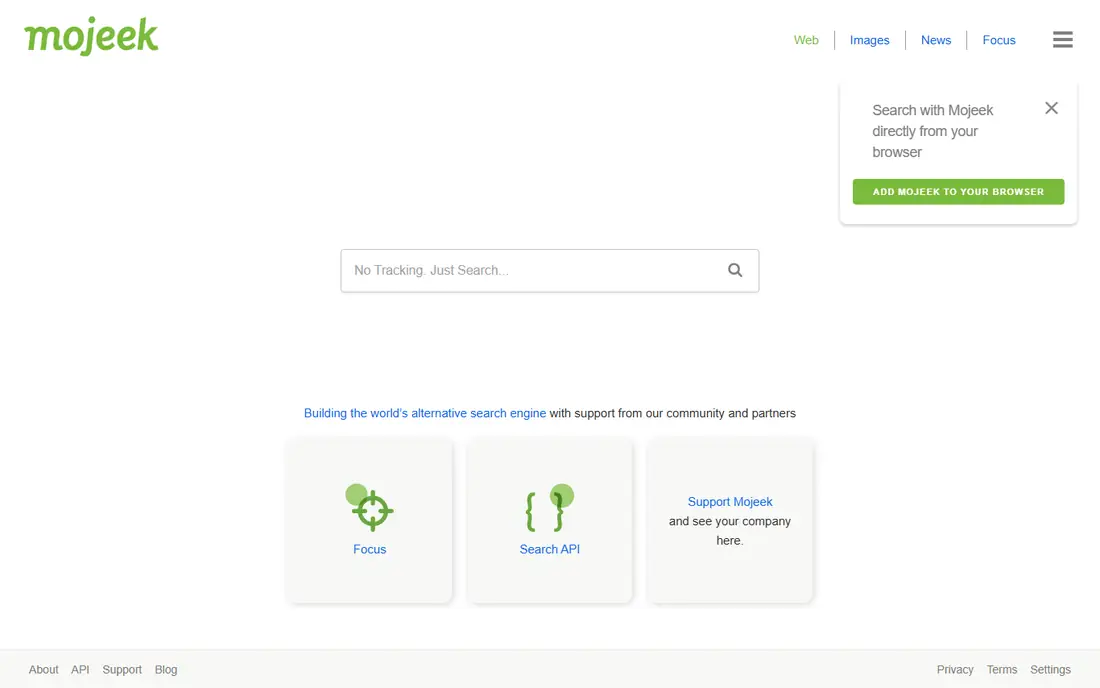
What we like- Mojeek is the clearest answer to the question in this guide's title. It crawls and indexes the web itself from its UK data centre, returns plain link results with no AI generated answers, no AI summaries, and no AI features pushed into the page, and it does not track or profile its users. The index has grown large enough for everyday searching, and its results often surface smaller sites that the big engines bury. For a reader whose requirement is no AI, full stop, Mojeek is the honest first pick.
Watch out for- The independent index is smaller than Google's or Bing's, so obscure, local, and very fresh queries can come back thin. It lacks the local business results, maps integration, and instant answer boxes mainstream users rely on. Mojeek does offer separate experimental AI related projects away from its main search, which purists should know about, though the search product itself stays clean.
Starting priceFree
Free planYes
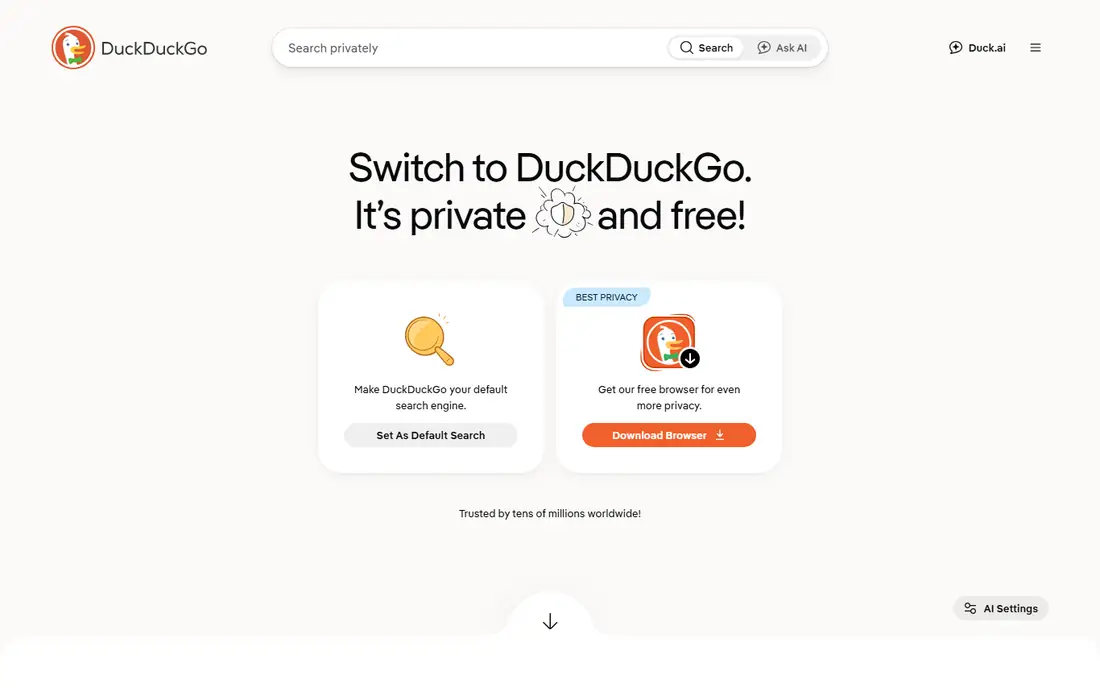
What we like- DuckDuckGo remains the easiest switch for most people: familiar result pages built from Bing and its own crawler, no tracking, and no AI Overview style generated answers blended into results. It now operates an AI chat service, but it is a separate product you choose to open, not something injected into your searches, and DuckDuckGo has built its name on user control of exactly this kind. Bangs, its shortcut syntax for searching other sites directly, is a power feature no rival matches.
Watch out for- The core results lean on Bing's index, so ranking quality follows Microsoft rather than DuckDuckGo itself. The company's AI chat exists and is promoted on the site, which readers wanting a fully AI free company, not just AI free results, may count against it. News and local depth trail Google.
Starting priceFree
Free planYes

What we like- Startpage sells one simple proposition: Google's results, fetched anonymously so Google cannot tie them to you, presented as a classic list of links without Google's AI Overviews layered on top. For searchers whose real problem is the AI layer and the tracking, rather than Google's ranking itself, that is precisely the fix. Its Anonymous View feature opens result pages through a proxy as well, extending the privacy cover past the search page.
Watch out for- Because the results are Google's, anything Google changes about ranking reaches you too
- You escape the presentation, not the index. Startpage is owned by an advertising company, System1, which its privacy claims have to be weighed against, though independent audits support its no logging position. There are no AI controls to manage because there are no AI features, but also no extras like maps of its own.
Starting price$10 per month
Free planNo
What we like- Kagi charges 10 dollars a month for its Professional plan because it sells search itself rather than your attention: no ads, results you can personalize by raising or lowering whole domains, and small web results given real prominence. Its AI tools, including a summarizer and an assistant on the 25 dollar Ultimate tier, are separate destinations you visit on purpose
- Standard results stay a clean list of links unless you invoke them. For heavy searchers, the personalization alone justifies the fee.
Watch out for- Ten dollars a month for search is a hard sell to anyone who has never paid for it, and there is no free plan beyond a small trial allowance. Kagi's index mixes its own crawling with external sources, so it is not fully independent in Mojeek's sense. AI exists in the building and on the top tier, firmly optional today, which readers should recheck as the product evolves.
Starting priceFree
Free planYes
What we like- Brave Search runs its own index, built from the Brave browser's anonymous usage signals and its own crawler, so results are not rented from Google or Bing. Its core results page is a conventional list, and while Brave offers an Answer with AI summary feature, it is presented as an optional extra that can be turned off in settings, returning a clean page. Goggles, its re ranking feature, lets users apply community built result filters, such as removing content farms.
Watch out for- This is the entry where the off switch matters most: Brave has invested in AI answers and its Leo assistant in the browser, so readers must check the settings state rather than assume. Its index, while independent, is still smaller than Google's for long tail and local queries. Occasional promotional placements of Brave products appear in the experience.
Starting priceFree
Free planYes
What we like- Marginalia is a one project search engine run as a non commercial experiment, indexing the independent, text heavy web: blogs, documentation, hobbyist sites, and the corners the commercial engines rank down. There is no AI anywhere in it, no ads, and no tracking, and its ranking deliberately favours content rich pages over optimized ones. For finding what the pre social web felt like, and for research into niche topics, it surfaces pages nothing else here will show you.
Watch out for- The index is small by design and skewed to English text sites, so shopping, local, news, and image searches are not its job. It is a side project with a small operation behind it, not a daily driver for mainstream needs. Treat it as a specialist second engine rather than your only one.
Starting priceFree
Free planYes
What we like- Ecosia funds tree planting from its ad revenue and runs its results mainly from Bing and Google sources presented as a standard list of links. Its AI experiments live in a separate chat product rather than in generated answers above your results, so everyday searching stays conventional. For searchers leaving Google mainly over AI clutter and corporate behaviour, Ecosia pairs the classic format with a visible use of the money your searches generate.
Watch out for- Ecosia's AI chat exists and the company promotes climate themed AI features, so it is AI adjacent even if the results page stays clean
- It also tested AI search elements in some markets, which is worth checking from your region. Result quality follows its upstream providers. Privacy is good but the ads still exist, unlike Kagi or Mojeek's model.
Starting priceFree
Free planYes
What we like- SearXNG is open source metasearch software: run it yourself, or use a public instance, and it queries dozens of engines at once and returns one clean list of links, with no AI layer anywhere and no profile of you anywhere either. Self hosting gives total control over which sources are used and how results are presented, which is the strongest guarantee in this guide: an AI feature cannot be forced on you by a product update. Public instances run by volunteers offer the same format without the setup.
Watch out for- Self hosting is real work: a server, updates, and some configuration, aimed at technical users. Public instances vary in speed and trustworthiness, since you are trusting an unknown operator instead. Results inherit the habits of the upstream engines it queries, minus their presentation layers, and there is no support line when something breaks.
How we chose
We required one thing above all: a searcher must be able to get a plain list of links without a generated answer in the way. Engines were ranked by how completely they meet that test, no AI at all first, AI fully separable second, AI that must be disabled third, then by index independence, result quality for everyday queries, and privacy practice. We excluded engines whose AI answers cannot be switched off, however good their other features, because they do not answer this guide's question.
How to choose the right Google alternative without AI
Decide which kind of no AI you mean. If you mean no generated answers in your results but you do not mind the company offering a separate chat tool, DuckDuckGo, Startpage, Kagi, and Ecosia all qualify and give the most mainstream result quality. If you mean no generative AI involvement at all, Mojeek, Marginalia, and a self hosted SearXNG are the honest list, and you accept smaller indexes as the price. Brave sits between: independent and capable, with AI present but switchable.
Then test with your real searches for a week. Run your ten most typical queries, including one local, one news, and one obscure, on the new engine before changing your browser default, because index gaps show up on your long tail queries, not on famous ones. Most people land on a two engine habit: a mainstream alternative for daily use, and Mojeek or Marginalia when they want the unfiltered web. Set the default in your browser's search settings so the habit sticks, and recheck the AI situation every few months, since this category's defaults keep moving.
Frequently asked questions
Can I turn off AI Overviews in Google itself?
Not reliably. Google does not offer a setting to disable AI Overviews. Workarounds exist, such as adding a parameter to searches or defaulting to the Web results filter, but they are unofficial, vary by region, and break as Google changes things. Readers who want a durable answer end up switching engines, which is why this guide exists.
Which search engines have no AI at all?
Mojeek and Marginalia have no AI answers or AI features in their search products, and SearXNG contains no AI layer of its own. DuckDuckGo, Startpage, and Ecosia keep results free of generated answers but their companies offer separate AI chat products. Brave Search includes an AI answer feature that can be turned off in settings.
Are these engines as good as Google for everyday searching?
For most head queries, yes: the top results for common questions are similar, especially on Startpage, which uses Google's results, and DuckDuckGo and Ecosia, which draw on Bing. The gaps appear in local search, very fresh news, and obscure long tail queries, where Google's index size shows. Most switchers report a week of adjustment rather than a lasting loss.
Why does Kagi charge when the others are free?
Because its business model is the subscription rather than advertising. Free engines earn from ads or, in Brave's case, a wider product ecosystem, while Kagi sells the search itself, which buys you no ads and personalization controls. Whether search is worth 10 dollars a month depends on how many hours a day you spend in results pages.
Do these engines track me?
Mojeek, DuckDuckGo, Startpage, and Kagi all build their offer on not tracking or profiling searchers, and Marginalia and SearXNG collect nothing by design. Ecosia stores less than Google but does run advertising. No alternative here matches Google's combination of search history tied to a signed in account used across an ad network, which is the main thing switchers are escaping.
Sources we checked (0)
Is your product missing or out of date?
We review this list regularly. Vendors can request a listing, send updated pricing or ask about featured placement.

Shihab Mia · Founder, Rankite
Shihab has 5+ years in B2B and SaaS SEO. He writes Rankite's software buying guides from pricing pages, documentation and public user reviews. More about Shihab.