How we make this list: we compare pricing pages, product documentation and public user reviews. Ratings come from G2, Capterra or Trustpilot, with the date we checked them.
Key takeaways
- Glean alternatives help employees find answers across company apps, docs, and messages without searching each tool separately.
- Coveo leads for enterprise search with AI relevance, while Elastic suits teams that want open, customizable search infrastructure.
- Guru suits customer-facing teams that need verified answers inside support and sales workflows.
- Algolia suits product and website search, while Sana, Tettra, and Bloomfire suit internal knowledge bases.
- The right pick depends on whether you need company-wide search, team knowledge, or customer-facing search.
Quick comparison
| Tool | Best for | Starting price | Free plan |
|---|
 Coveo | Enterprise AI search | See website | No |
 Elastic | Custom search infrastructure | See website | Yes |
 Guru | Verified team knowledge | See website | No |
 Algolia | Product and site search | Free | Yes |
 Sana | AI knowledge assistant | See website | No |
 Tettra | Simple team knowledge base | See website | No |
 Bloomfire | Knowledge management | See website | No |
 Slite | Team docs and search | Free | Yes |
Is your product missing or out of date?
We review this list regularly. Vendors can request a listing, send updated pricing or ask about featured placement.
The best Glean alternatives
#1Coveo
Best for: Enterprise AI search4.3/5 on
G2 (142 reviews, checked Oct 2026)
Visit coveo.com
Starting priceSee website
Free planNo
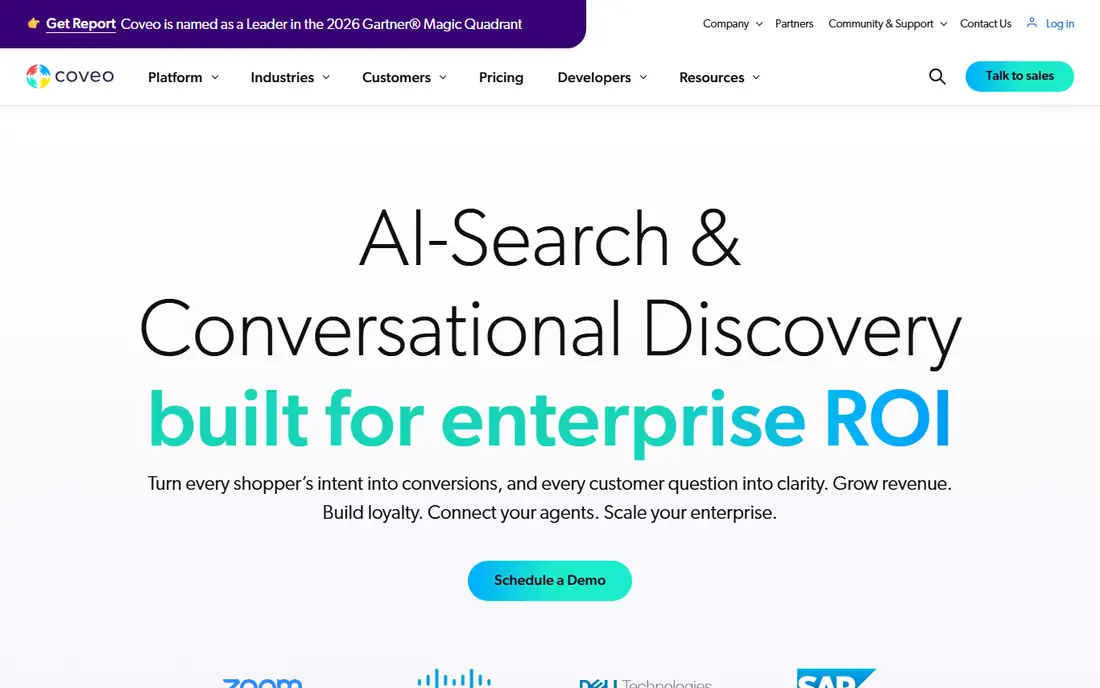
Coveo is an enterprise AI search platform that indexes content across company systems, websites, and support tools, then ranks results with machine learning tuned to each user and context. It suits large firms that need search for employees, customers, and e-commerce, with personalization and recommendations built in. Connectors cover Salesforce, ServiceNow, SharePoint, and many other systems.
The trade-offs are price and complexity. Coveo is priced for enterprises, implementation takes time and skilled staff, and small teams will find it heavy. Even so, Coveo suits large organizations that want proven enterprise AI search with deep relevance tuning.
What we like- Strong AI relevance and personalization
- Broad enterprise connectors
- Good for commerce and support
Watch out for- High cost
- Implementation takes time
- Complex for small teams
#2Elastic
Best for: Custom search infrastructure4.5/5 on
G2 (109 reviews, checked Oct 2026)
Visit elastic.co
Starting priceSee website
Free planYes
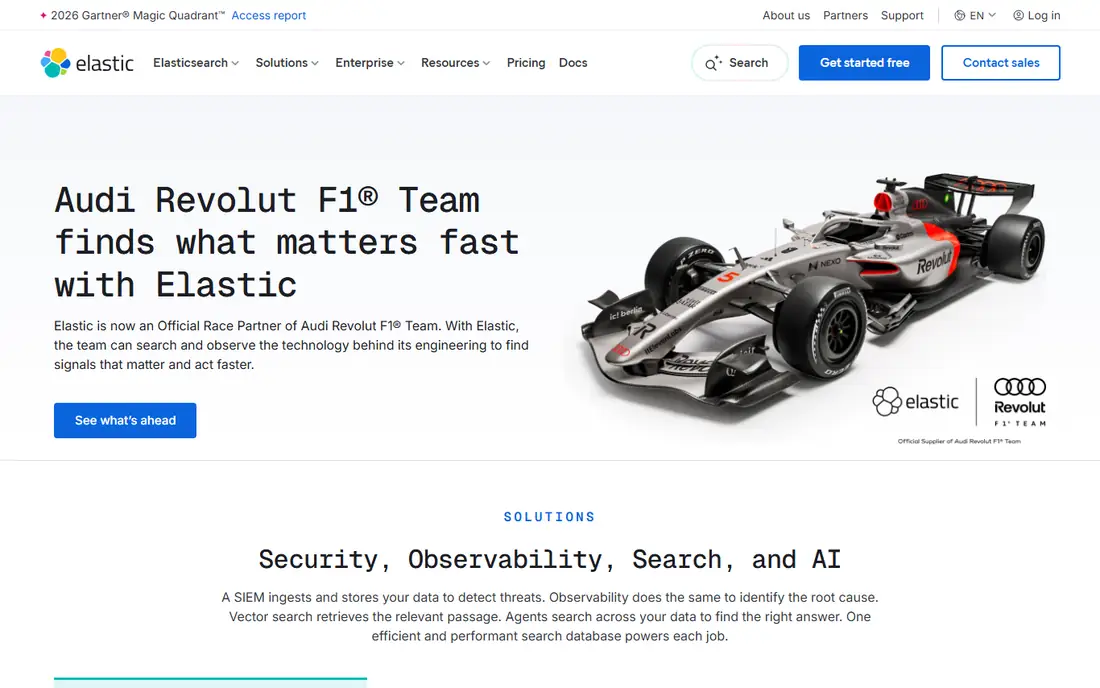
Elastic, built on Elasticsearch, is the most widely used open search infrastructure, powering internal search, site search, logs, and security analytics for firms of all sizes. Teams can build custom enterprise search with full control over indexing, ranking, and security, and the open source core keeps entry costs low. Elastic Cloud removes server management for firms that prefer a hosted service.
The limits are engineering effort and cost. Running Elastic well needs engineers, enterprise features such as advanced security and machine learning cost extra, and relevance tuning takes skill. Even so, Elastic suits engineering-led teams that want open, customizable search infrastructure rather than a closed SaaS product.
What we like- Open and customizable
- Huge community
- Powers search for many large firms
Watch out for- Needs engineering to run well
- Enterprise features cost extra
- Relevance tuning takes skill
#3Guru
Best for: Verified team knowledge4.7/5 on
G2 (2,345 reviews, checked Oct 2026)
Visit getguru.com
Starting priceSee website
Free planNo
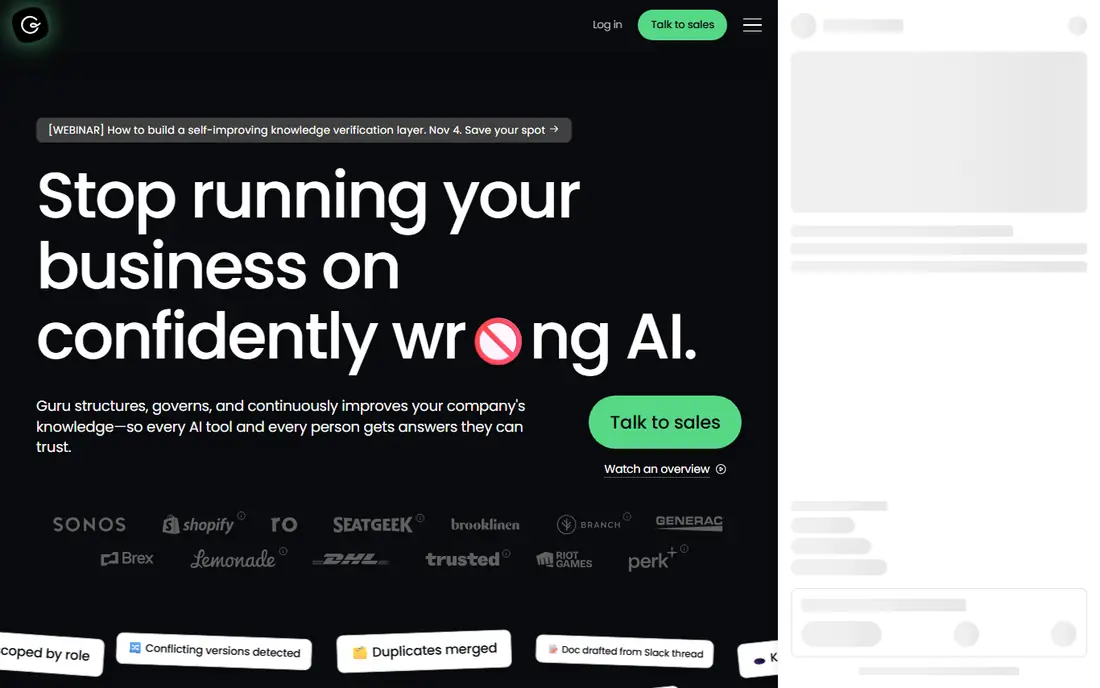
Guru is a knowledge platform that delivers verified answers inside the tools teams already use, such as Slack, Salesforce, Zendesk, and browsers, so support and sales staff get trusted answers without leaving their workflow. Cards carry verification status and owners, so outdated answers surface for review. Guru suits customer-facing teams where wrong answers cost deals or satisfaction.
The trade-offs are scope and cost. Guru focuses on team knowledge rather than company-wide search across all apps, pricing grows with users, and setup needs real content work to be useful. Even so, Guru suits support and sales teams that need verified, in-workflow answers.
What we like- Verified answers inside workflows
- Browser extension and Slack integration
- Good for support teams
Watch out for- Knowledge base focus, less company-wide search
- Pricing grows with users
- Setup needs content work
#4Algolia
Best for: Product and site search4.5/5 on
G2 (454 reviews, checked Oct 2026)
Visit algolia.com
Starting priceFree
Free planYes
Algolia is a hosted search API known for speed, serving product, site, and documentation search for thousands of companies. Developers integrate it with websites and apps, and its ranking, typo tolerance, and analytics suit e-commerce catalogs and help centers. A free tier covers small projects, and paid plans scale with search volume.
The limits are internal scope and cost. Algolia is stronger for customer-facing search than for company-wide employee search across many internal apps, pricing grows with search volume, and setup needs developers. Even so, Algolia suits product and documentation teams that want fast, developer-friendly search.
What we like- Very fast search
- Excellent developer tools
- Strong for e-commerce and docs
Watch out for- Internal enterprise search is thinner
- Pricing grows with searches
- Needs developers
Starting priceSee website
Free planNo
Sana is an AI knowledge platform that builds an assistant over company documents, wikis, and tools, answering employee questions with cited sources and offering learning courses alongside search. It suits firms that want a Glean-style AI assistant with a modern interface and learning features, especially for onboarding and training. The assistant grounds answers in company content rather than general web knowledge.
The trade-offs are maturity and connectors. Sana is newer than Coveo or Elastic, pricing is quote-based, and the connector list is smaller. Even so, Sana suits firms that want an AI knowledge assistant with learning tools and a polished experience.
What we like- AI assistant over company knowledge
- Learning tools included
- Modern interface
Watch out for- Newer vendor
- Pricing is quote-based
- Smaller connector list than Coveo
#6Tettra
Best for: Simple team knowledge base4.7/5 on
G2 (161 reviews, checked Oct 2026)
Visit tettra.co
Starting priceSee website
Free planNo
Tettra is a simple internal knowledge base that organizes team knowledge, assigns owners, and flags outdated pages, with Slack integration for asking and answering questions. It suits small and mid-size teams that need a clean, easy knowledge base without enterprise search complexity. Verification workflows keep answers fresh, and the interface is friendly for non-technical users.
The limits are scale and AI depth. Tettra suits smaller teams better than large enterprises, connectors are fewer than Coveo, and AI search depth trails Glean and Sana. Even so, Tettra suits teams that want a simple, verified knowledge base with Slack at the center.
What we like- Simple knowledge base
- Slack integration
- Verification and ownership features
Watch out for- Smaller scale than enterprise tools
- Fewer connectors
- Less AI depth
Starting priceSee website
Free planNo
Bloomfire is a knowledge management platform that centralizes documents, videos, and Q and A with search, so support, research, and operations teams can find trusted content in one place. It suits firms that need a shared knowledge hub with community features, such as asking experts and curating collections. The platform covers both internal knowledge and customer-facing help content.
The trade-offs are polish and AI depth. The interface feels dated in places, pricing is quote-based, and AI answer features trail Glean, Coveo, and Sana. Even so, Bloomfire suits teams that want a solid knowledge hub with search and community tools.
What we like- Knowledge management plus search
- Good for support and research teams
- Community features
Watch out for- Interface feels dated in places
- Pricing is quote-based
- AI features trail leaders
Starting priceFree
Free planYes
Slite is a team documentation tool with clean writing, organized collections, and built-in search, which suits small and mid-size teams that want docs and answers in one place. Its free tier covers small teams, and paid plans add more storage, permissions, and analytics. Slite is easy to adopt, since writing docs feels like using a modern notes app.
The limits are scope and scale. Slite focuses on docs rather than company-wide search across dozens of apps, enterprise connectors are fewer, and it suits smaller teams better than large enterprises. Even so, Slite suits teams that want clean docs with search as a starting point for knowledge management.
What we like- Clean team docs
- Built-in search
- Free tier for small teams
Watch out for- Docs focus, less company-wide search
- Fewer enterprise connectors
- Smaller scale
How we chose
We compared Glean alternatives on search coverage, AI answer quality, connectors, verification, security, and pricing, favoring tools with proven enterprise or team deployments. We excluded general chatbots without company search and wikis without search. Prices are quote-based for enterprise tools, so we wrote See website where a vendor does not publish a clear starting price.
Buying guide
Start by listing the systems your employees actually search: Google Drive, Slack, Salesforce, Confluence, SharePoint, and others, since a tool that cannot connect to your core systems is useless no matter how good its AI is. Ask vendors for a connector list in writing and test the three systems your teams use most before signing. Next, test answer quality on real employee questions, not vendor demos, since relevance and citation quality vary sharply. Check security too: permissions must follow source systems, so an employee cannot see restricted docs through search that they cannot open directly.
Then weigh build versus buy. Elastic suits engineering teams that want control, while Coveo, Sana, and Guru suit firms that want a managed product with support. Consider total cost too, since managed platforms charge per user while self-hosted search costs engineering time, and the cheaper option depends on your team's size and skills. Finally, plan content cleanup, since search over messy, duplicated, outdated docs returns messy answers. A tool launch paired with a cleanup of top knowledge bases gives far better results than search alone, and usage analytics after launch show which questions still go unanswered. Assign owners to top content areas as well, since search quality decays fast when no one maintains the source docs. Measure success after launch too, tracking search success rates, unanswered questions, and time saved, so you can show whether the tool earns its cost.
Frequently asked questions
What is a Glean alternative?
It is an enterprise search or knowledge tool other than Glean that helps employees find answers across company apps, docs, and messages, such as Coveo, Elastic, Guru, Algolia, or Sana.
Do I need enterprise search or a knowledge base?
Enterprise search suits firms with many systems and scattered content, while a knowledge base such as Tettra or Slite suits teams that need one curated home for verified answers. Large firms often need both, with search sitting on top of curated bases and raw systems together.
How do these tools handle permissions?
Good tools respect source system permissions, so search results only show docs the user can already access. Check permission handling during a trial with restricted test docs, since leaking restricted docs through search is a serious risk.
Is AI search accurate?
AI answers are only as good as the underlying content and citations. Tools that cite sources, such as Sana and Glean-style assistants, let users verify answers, while tools without citations need more caution and manual checking.
Can small teams use these tools?
Yes. Slite, Tettra, and Algolia offer free or low-cost tiers for small teams, while Coveo and Elastic suit larger firms. Start with a knowledge base if your team is small, and move to enterprise search as systems and content multiply.
Sources we checked (0)
Is your product missing or out of date?
We review this list regularly. Vendors can request a listing, send updated pricing or ask about featured placement.

Shihab Mia · Founder, Rankite
Shihab has 5+ years in B2B and SaaS SEO. He writes Rankite's software buying guides from pricing pages, documentation and public user reviews. More about Shihab.