How we make this list: we compare pricing pages, product documentation and public user reviews. Ratings come from G2, Capterra or Trustpilot, with the date we checked them.
Key takeaways
- Apollo.io is the closest all-in-one replacement for small and mid-sized teams, combining a contact database with sequences and a free plan.
- Clay suits teams that want waterfall enrichment across many providers and are willing to build workflows to get higher match rates.
- ZoomInfo and Cognism lead on depth and phone coverage, but both use annual contracts and custom pricing that put them out of reach for small teams.
- Hunter, Prospeo, and Dropcontact are leaner options for email-first enrichment, with lower entry costs and simpler credit models.
- Credit expiry, seat minimums, and CRM fit affect the real cost more than the headline monthly price.
Quick comparison
| Tool | Best for | Starting price | Free plan |
|---|
 Apollo.io | All-in-one prospecting | $49 per user/month (billed annually) | Yes |
 ZoomInfo | Enterprise data and intent | See website | No |
 Clay | Waterfall enrichment workflows | $167 per month (billed annually) | Yes |
 Lusha | Quick LinkedIn lookups | See website | Yes |
 Cognism | European data and mobiles | See website | No |
 Hunter | Email finding and verification | See website | Yes |
 UpLead | Real-time verified contacts | $74 per month (billed annually) | Free trial |
 Prospeo | Verified emails at low cost | See website | Yes |
 Dropcontact | GDPR-focused enrichment | $24 per month | Free trial |
Is your product missing or out of date?
We review this list regularly. Vendors can request a listing, send updated pricing or ask about featured placement.
The best Clearbit alternatives
Starting price$49 per user/month (billed annually)
Free planYes
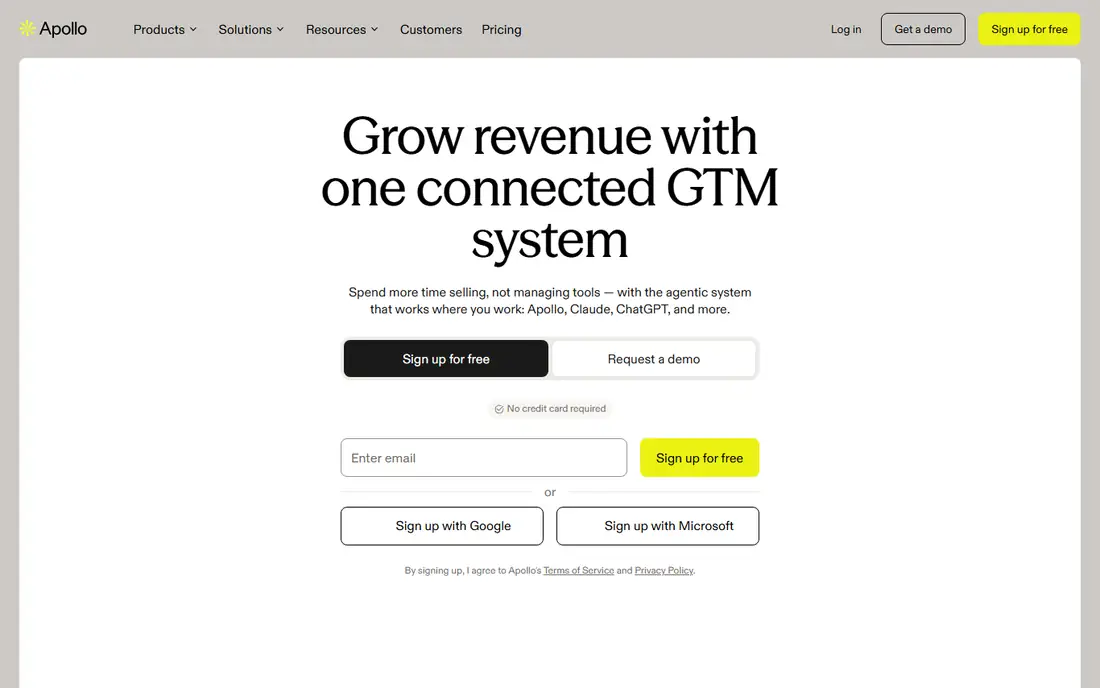
Apollo.io is the default starting point for teams leaving Clearbit. It combines a large B2B contact database with prospecting, sequences, and a dialer in one seat, so a small team can search, enrich, and send outreach without stitching three tools together. The free plan lets a team test search quality before paying, and paid plans start at $49 per user per month when billed annually.
The trade-off sits in phone data and credit use. Apollo is strong on emails and company firmographics, but mobile coverage trails ZoomInfo and Cognism in many segments. Teams that cold call heavily should sample phone numbers in their own market before committing, and watch credit limits on higher-volume plans.
Apollo fits startups and mid-sized sales teams that want one tool for data and outreach. It is less suited to enterprise teams that need deep intent data, org charts, and phone-verified mobiles at scale, where a specialist provider may justify a higher price.
What we like- Large contact database
- Built-in sequences and dialer
- Transparent published pricing
Watch out for- Phone coverage is weaker than enterprise rivals
- Credit overages can raise the real cost
#2ZoomInfo
Best for: Enterprise data and intent4.5/5 on
G2 (9,130 reviews, checked Oct 2026)
Visit zoominfo.com
Starting priceSee website
Free planNo
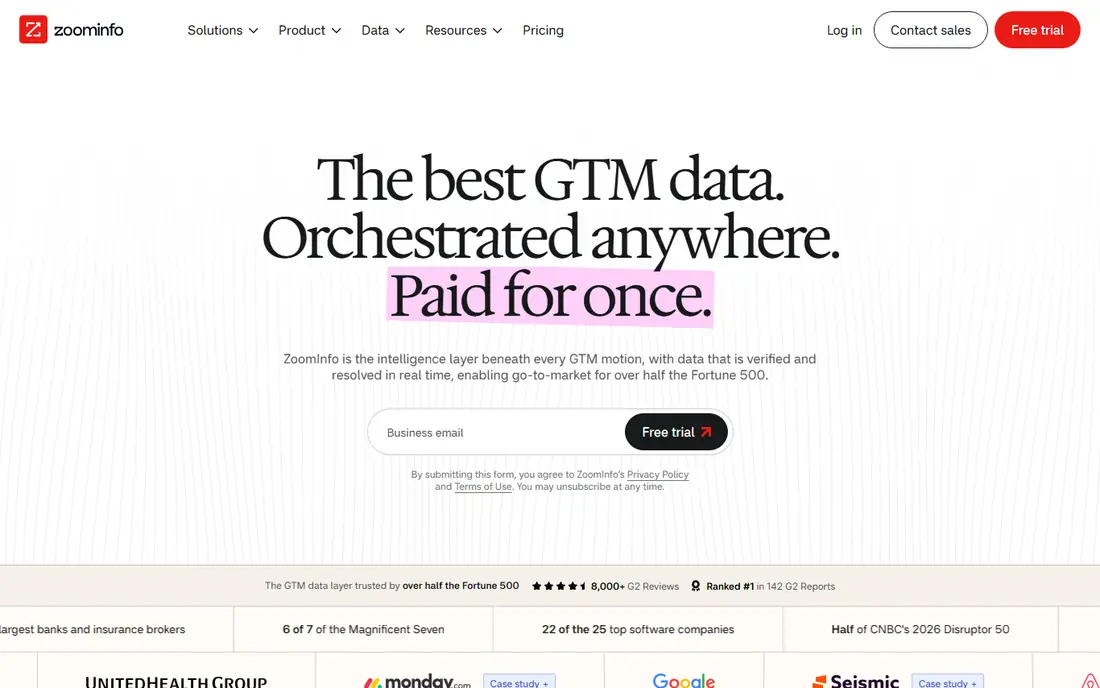
ZoomInfo remains the enterprise benchmark for B2B data. Its database, intent signals, and org charts help large teams prioritize accounts, map buying groups, and time outreach around buying signals. For a team with a defined enterprise motion, that depth can matter more than a lower monthly fee elsewhere.
Cost is the barrier. ZoomInfo does not publish a simple starting price, and contracts are annual with seat minimums, so the total commitment is far above Apollo or Lusha. Smaller teams often find the platform powerful but hard to justify unless they use the data daily across many reps.
ZoomInfo fits enterprise sales and marketing teams with a large addressable market and a budget for data as a core input. It is a poor fit for a lone founder or a small team that only needs occasional enrichment, where a credit-based tool will cost far less.
What we like- Deep contact and company database
- Intent signals and org charts
- Strong US coverage
Watch out for- Custom annual pricing with seat minimums
- High total cost for small teams
#3Clay
Best for: Waterfall enrichment workflows4.6/5 on
G2 (234 reviews, checked Oct 2026)
Visit clay.com
Starting price$167 per month (billed annually)
Free planYes
Clay takes a different approach from a single database. It runs enrichment through a waterfall of many data providers in sequence, filling gaps that any one provider misses. Teams build workflows that search, enrich, verify, and push records to a CRM, which can lift match rates well above a single-source tool.
That power comes with setup time. Clay rewards teams that think in workflows and have someone to build and maintain them, such as a sales operations or growth hire. A team that just wants to look up a contact and move on may find Clay heavier than Apollo or Lusha.
Clay fits growth and revenue operations teams that run outbound at scale and care about data completeness. It is less suited to reps who want a simple browser extension and a quick lookup during a call.
What we like- Waterfall enrichment across many providers
- Flexible workflow builder
- Strong CRM sync options
Watch out for- Learning curve for new users
- Costs rise with enrichment volume
#4Lusha
Best for: Quick LinkedIn lookups4.3/5 on
G2 (1,668 reviews, checked Oct 2026)
Visit lusha.com
Starting priceSee website
Free planYes
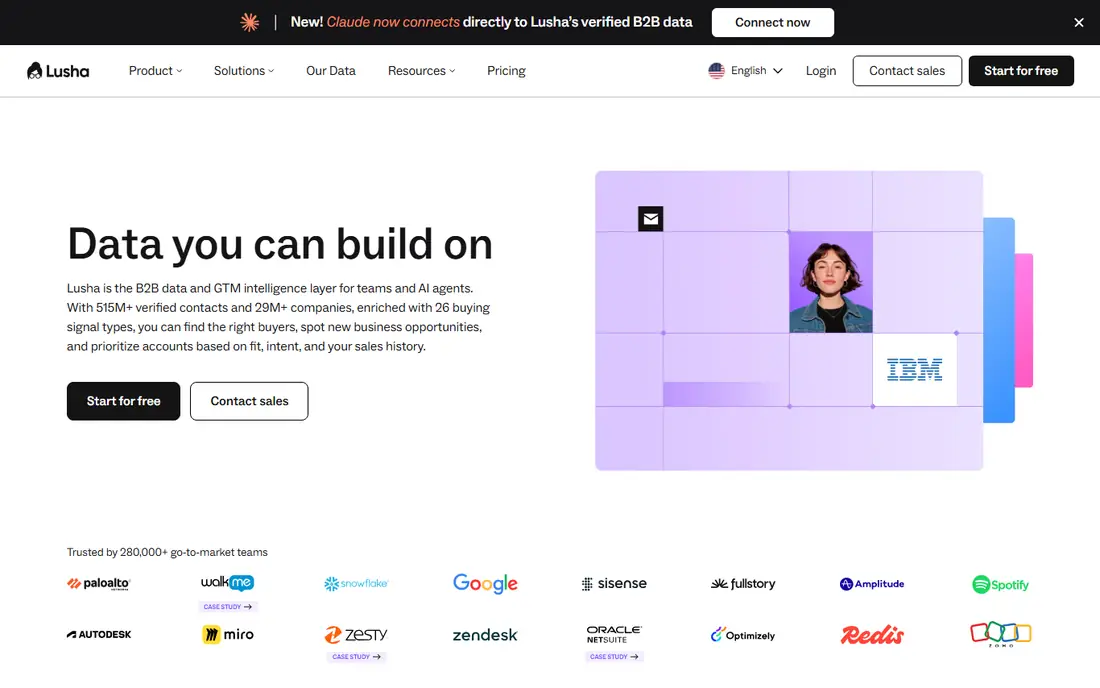
Lusha is built for speed. A rep opens a LinkedIn profile or company page, clicks the extension, and gets contact details without leaving the browser. That workflow suits prospecting sessions where the rep already knows the target accounts and needs emails and phones quickly.
The free plan gives a small monthly credit allowance, which is enough to test accuracy in a team's own market. Paid plans add more credits and team features, but high-volume teams should model credit use carefully, since enrichment can consume credits faster than expected.
Lusha fits small sales teams and individual reps who prospect mainly on LinkedIn. It is less suited to teams that need bulk enrichment, intent data, or deep company hierarchies, where Apollo, Clay, or ZoomInfo offer more.
What we like- Fast browser extension
- Simple credit model
- Useful direct dial coverage in many markets
Watch out for- Database depth is below ZoomInfo
- Credits can run out fast on high-volume teams
#5Cognism
Best for: European data and mobiles4.5/5 on
G2 (1,365 reviews, checked Oct 2026)
Visit cognism.com
Starting priceSee website
Free planNo
Cognism is the strongest pick in this list for European outbound. Its Diamond Data set uses human verification for mobile numbers, and its compliance tools cover GDPR and do-not-call screening, which matter when prospecting across the UK and Europe. That focus explains why many European teams choose Cognism over US-centric databases.
Pricing is custom and annual, so buyers should expect a sales conversation and a commitment. There is no free plan, which makes sampling harder, though demos and trials can help a team check coverage in its target countries before signing.
Cognism fits B2B teams selling into Europe, or global teams where mobile reach matters. It is less attractive for a US-only startup on a tight budget, where Apollo or UpLead may cover the same accounts for less.
What we like- Phone-verified mobile numbers
- Strong European coverage
- Compliance features for GDPR and do-not-call lists
Watch out for- Custom annual pricing
- No free plan for testing at scale
#6Hunter
Best for: Email finding and verification4.4/5 on
G2 (656 reviews, checked Oct 2026)
Visit hunter.io
Starting priceSee website
Free planYes
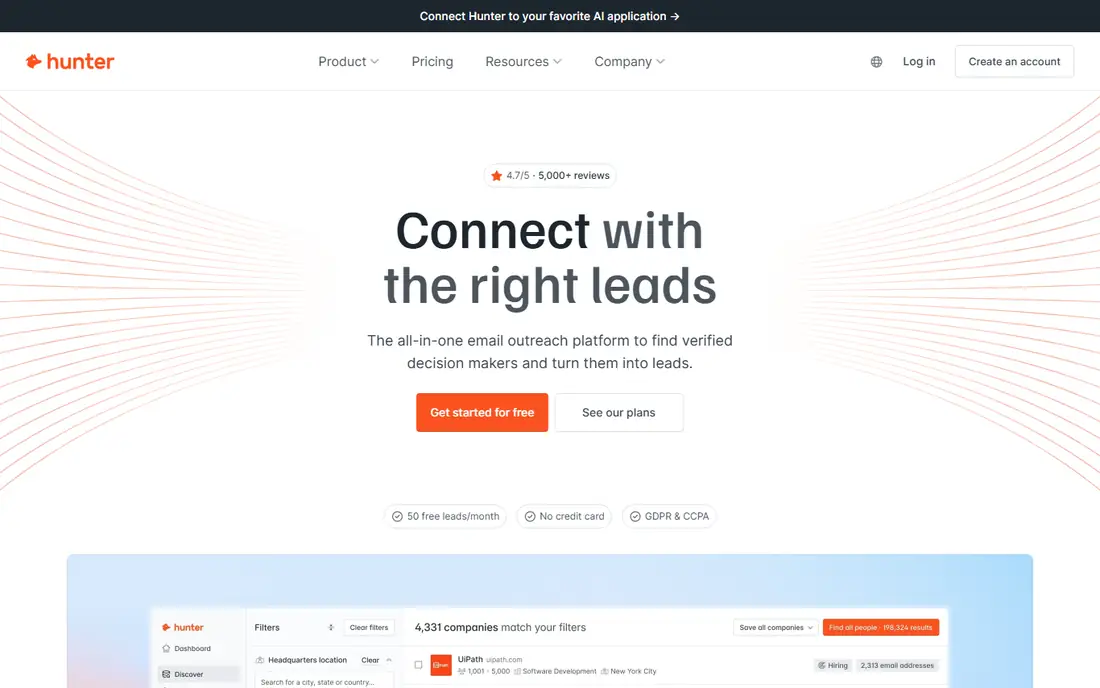
Hunter does one job with clarity: find and verify professional email addresses. A user can search by domain to see addresses tied to a company, verify a single address, or run bulk verification before a campaign. That focus keeps the tool simple and the learning curve short.
The free plan includes a monthly credit allowance, which suits occasional use and testing. Paid plans scale by credits, so a team can match spend to email volume rather than paying per seat for features it will not use. Hunter also offers a browser extension and an API for teams that want to embed email finding in another workflow.
Hunter fits marketing and sales teams that mainly need reliable emails, plus founders doing outreach by hand. It is not a replacement for a full contact database when phones, intent, and org charts are central to the motion.
What we like- Focused email finder and verifier
- Domain search for company contacts
- Simple pricing by credits
Watch out for- No phone database to match enterprise tools
- Limited company intelligence beyond emails
#7UpLead
Best for: Real-time verified contacts4.7/5 on
G2 (831 reviews, checked Oct 2026)
Visit uplead.com
Starting price$74 per month (billed annually)
Free planFree trial
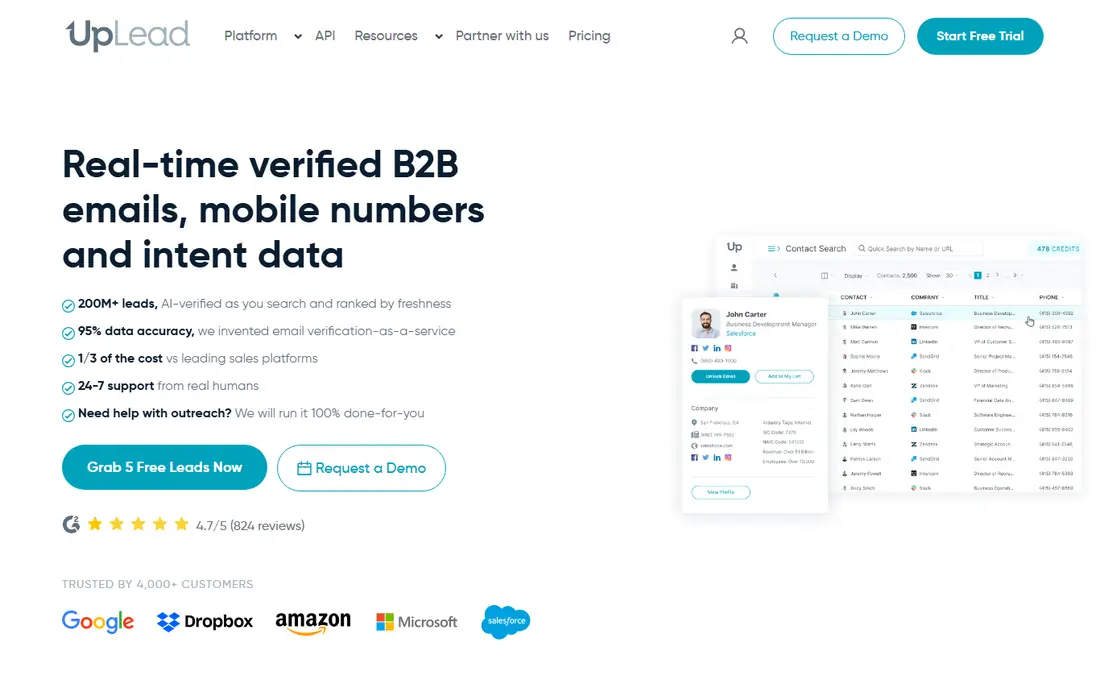
UpLead pitches accuracy through real-time verification at the point of download. Instead of pulling a stale record, the platform checks the email when the user requests it, which can reduce bounces on outreach lists. That approach appeals to teams that have been burned by outdated data in larger databases.
Pricing is subscription based, with a lower annual rate than the monthly rate, and a short trial lets teams test the data. The interface is simple, with search filters for role, industry, location, and technology, plus CRM integrations for pushing lists into sales tools.
UpLead fits small and mid-sized teams that want verified emails without enterprise complexity. It is less suited to teams that need deep intent data, large-scale waterfall enrichment, or advanced workflow building, where Clay or ZoomInfo may fit better.
What we like- Real-time email verification
- Straightforward subscription
- Credit rollover on some plans
Watch out for- Smaller database than Apollo or ZoomInfo
- Fewer intent and workflow features
Starting priceSee website
Free planYes
Prospeo positions itself as a direct replacement for the old Clearbit Connect extension, with a browser tool that works on websites and CRMs. The free tier gives a monthly allowance of verified emails and extension credits, which is enough for a solo rep or a small team to judge accuracy.
The cost math is simple. Prospeo charges far less per email than many enterprise tools, and it does not require a HubSpot subscription or an annual contract to start. That makes it easy to try alongside another tool, then keep the one that performs better in the team's own segments.
Prospeo fits self-serve teams, founders, and small sales teams that need verified emails without platform lock-in. It is less suited to teams that need phones, intent, or account hierarchies, where a broader database will be needed as well.
What we like- Low cost per verified email
- Browser extension for any site
- CRM integrations including HubSpot and Salesforce
Watch out for- Email-focused, so phone coverage is limited
- Smaller brand presence than Apollo
Starting price$24 per month
Free planFree trial
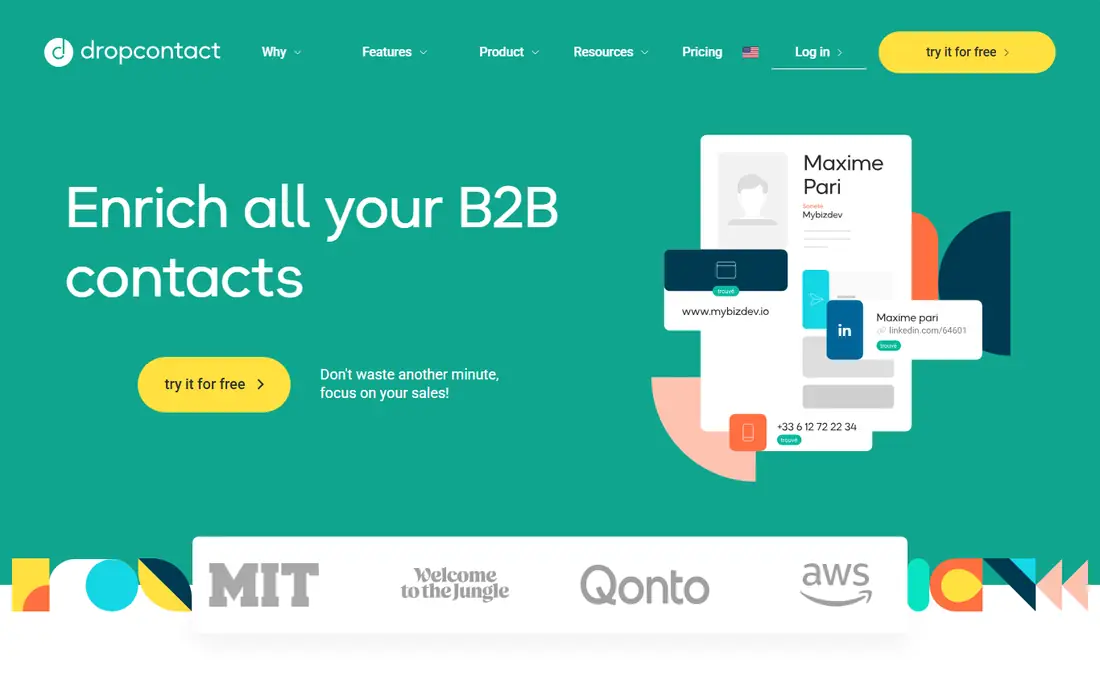
Dropcontact is a French enrichment tool with a clear compliance pitch. It finds and verifies emails, enriches company data, and is designed around GDPR rules, which matters for teams prospecting in Europe. The subscription model is simple, starting at $24 per month, without the per-seat credit maze found in larger platforms.
The tool integrates with CRMs and can enrich lists in bulk, plus it offers an API for teams that want to automate enrichment. Data quality is best judged in the team's own market, since coverage varies by country and industry, as it does for every provider in this list.
Dropcontact fits European-focused teams and privacy-conscious buyers who want a simple, compliant enrichment tool. It is less suited to US enterprise teams that need deep phone coverage and intent signals, where Cognism or ZoomInfo may be stronger.
What we like- Strong GDPR alignment
- Email finding and verification
- Simple subscription without per-seat complexity
Watch out for- Smaller database than enterprise rivals
- Limited phone and intent features
How we chose
We compared tools on data coverage, email and phone accuracy in practice, CRM fit, and total cost including credits, seat minimums, and annual commitments. We checked vendor pricing pages and documentation, and we read public reviews on G2, Capterra, and Reddit for recurring complaints about stale data, credit expiry, and support. Tools were kept only if they offer standalone enrichment or prospecting today, without requiring a specific CRM as a precondition.
We also weighed the reason teams leave Clearbit. A tool that only works inside one CRM repeats the lock-in problem, so standalone access and API or integration options counted heavily. Company size fit mattered too, since a tool priced for enterprise use is a poor recommendation for a five-person team, even when its data is excellent.
Start from the motion, not the database size. A team that sends cold email needs verified emails and bounce control. A team that cold calls needs mobiles. A team that runs account-based marketing needs company data, intent, and org structure. Matching the tool to that motion avoids paying for data that never gets used.
Test accuracy in your own market
Run the same 100 target accounts through two shortlisted tools and compare match rates, bounce rates, and phone coverage. Vendor claims describe a global average, while a team's own segments may behave very differently. A free plan or trial is the cheapest way to run that test, and it reveals stale records before a contract locks the team in.
Model the full cost, not the headline price
Add seat fees, credit packs, overage charges, and any annual minimum. Check whether credits expire monthly or roll over, and whether a seat minimum forces the team to buy more licences than it needs. A $49 seat can cost far more per rep once credits and add-ons are included.
Check CRM and workflow fit
Confirm the tool syncs cleanly with the CRM in use, whether that is HubSpot, Salesforce, Pipedrive, or another system. Check how duplicates are handled, how enrichment updates existing records, and whether the API supports bulk work. A tool that creates messy CRM records will cost more in cleanup time than it saves in prospecting time.
Decide on compliance needs early
European prospecting brings GDPR duties, and phone outreach brings do-not-call screening. Choose a tool with compliance features that match the markets being targeted, and confirm how data is sourced and refreshed. That check is easier before signing than after a campaign has already run.
Frequently asked questions
Why are teams looking for Clearbit alternatives?
Clearbit became Breeze Intelligence inside HubSpot, so standalone access ended for many users. Teams that do not use HubSpot, or that want enrichment across several CRMs, need a separate provider. Pricing and credit rules inside HubSpot also pushed teams to compare standalone tools with clearer models.
Is Apollo.io a good direct replacement for Clearbit?
For many small and mid-sized teams, yes. Apollo combines a contact database with outreach, and it works outside HubSpot. The main gaps are phone coverage in some segments and credit limits on larger teams, so sampling phone data in the team's own market is wise before switching fully.
What is waterfall enrichment, and is it worth it?
Waterfall enrichment queries several data providers in sequence until a record is found or verified, rather than relying on one database. It can lift match rates, especially for hard-to-find contacts. It is worth it for teams running outbound at scale, but it adds cost and setup time that a small team may not need.
How do I avoid paying for stale contact data?
Test a sample list before buying, check bounce rates on a small campaign, and ask how often records are refreshed. Real-time verification at download, as offered by UpLead and others, helps, but no provider is perfect. Regular list cleaning and verification before sending remain good practice.
Should a small team choose ZoomInfo or Cognism?
Usually not as a first tool, unless the team sells into enterprise accounts or Europe at scale and can use the data daily. Both use annual contracts and custom pricing, which can strain a small budget. A credit-based or low-seat tool such as Apollo, Lusha, or Prospeo is often a better starting point.
Can I use more than one enrichment tool?
Yes, and many teams do. A common setup uses one database for prospecting, a second tool for verification, and a workflow tool such as Clay to combine them. That mix costs more, so it only makes sense when the higher match rate or lower bounce rate pays for the extra subscription.
Sources we checked (9)
- https://www.apollo.io/pricing
- https://www.zoominfo.com/pricing
- https://www.clay.com/pricing
- https://www.lusha.com/pricing
- https://www.cognism.com/pricing
- https://hunter.io/pricing
- https://www.uplead.com/pricing
- https://prospeo.io
- https://www.dropcontact.com/pricing
Is your product missing or out of date?
We review this list regularly. Vendors can request a listing, send updated pricing or ask about featured placement.

Shihab Mia · Founder, Rankite
Shihab has 5+ years in B2B and SaaS SEO. He writes Rankite's software buying guides from pricing pages, documentation and public user reviews. More about Shihab.