How we make this list: we compare pricing pages, product documentation and public user reviews. Ratings come from G2, Capterra or Trustpilot, with the date we checked them.

Key takeaways
- Chargebee's current entry plans charge a percentage of invoicing volume, so the best alternative depends on whether you prefer a percentage, a flat monthly fee, or a merchant-of-record model.
- Stripe Billing suits teams already processing on Stripe, while Paddle and FastSpring suit global software sellers that want tax handled for them.
- Flat-fee tools like Recurly and Maxio look expensive at small volumes but can be cheaper than percentage billing once billings grow.
- Billing fees sit on top of payment processing, except at merchant-of-record vendors where one rate bundles processing, tax and fraud protection.
Quick comparison
| Tool | Best for | Starting price | Free plan |
|---|
 Stripe Billing | Teams already on Stripe | 0.7% of billing volume (pay as you go) | Free trial |
 Recurly | Churn recovery and dunning | $249 per month (plus 0.9% of billing volume) | Free trial |
 Paddle | Global SaaS tax offload | 5% + $0.50 per transaction | No |
 Zoho Billing | Early-stage teams on Zoho | $39 per month (Standard, billed annually) | Free trial |
 Zuora | Enterprise order-to-cash | See website | No |
 Maxio | Finance-led B2B SaaS metrics | $599 per month (Grow, up to $100,000 monthly billings) | Free trial |
 FastSpring | Digital goods merchant of record | See website | No |
 Lago | Open-source usage billing | See website | Yes (open-source self-hosted) |
Is your product missing or out of date?
We review this list regularly. Vendors can request a listing, send updated pricing or ask about featured placement.
The best Chargebee alternatives
#1Stripe Billing
Best for: Teams already on Stripe4.4/5 on
G2 (142 reviews, checked Oct 2026)
Visit stripe.com
Starting price0.7% of billing volume (pay as you go)
Free planFree trial

Stripe Billing is the natural alternative for companies already processing payments on Stripe. The pay-as-you-go rate is 0.7% of billing volume, with plans from around $620 per month for larger volumes, and no base fee at the entry tier. Subscriptions, trials, proration, coupons and dunning all work through the same API developers already use for payments.
The catch is stacking: the 0.7% billing fee sits on top of Stripe's standard 2.9% + $0.30 card processing, so the combined rate is higher than either figure alone. Advanced usage-based billing may need a metering partner like Metronome. Stripe Billing fits developer-led teams that value API control and already run on Stripe.
What we like- Deep API flexibility
- Billing percentage with no base fee on pay-as-you-go
- Tight Stripe payments integration
Watch out for- Percentage sits on top of 2.9% + $0.30 processing
- Advanced usage billing needs separate tooling
#2Recurly
Best for: Churn recovery and dunning4.1/5 on
G2 (227 reviews, checked Oct 2026)
Visit recurly.com
Starting price$249 per month (plus 0.9% of billing volume)
Free planFree trial
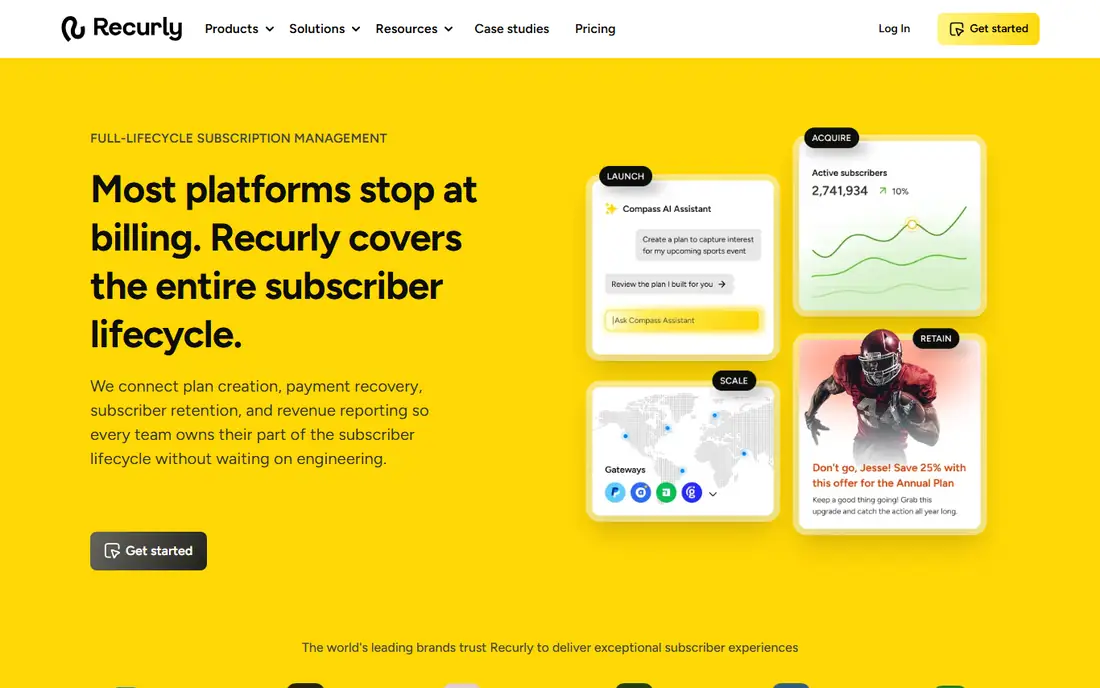
Recurly is a billing layer that connects to your payment gateway, built for subscription businesses that care most about keeping subscribers. Its churn recovery and dunning tools are the strongest in this list at the core product level, and the Starter plan includes the first $40,000 of billings each month before the 0.9% rate applies. That makes the $249 monthly fee easier to justify once billings pass a few thousand dollars a month.
At very small volumes the flat fee dominates: on $24,000 a year of billings, Recurly costs $2,988 a year against $168 for Stripe Billing's percentage, which is why small teams usually start elsewhere. Revenue recognition is a separate add-on around $850 per month on annual billing. Recurly fits mid-market subscription businesses where churn recovery pays for the platform.
What we like- Strong involuntary-churn recovery and dunning
- First $40,000 of monthly billings included
- Mature subscription logic
Watch out for- Flat fee looks costly at small volumes
- Revenue recognition add-on costs extra
#3Paddle
Best for: Global SaaS tax offload4.5/5 on
G2 (240 reviews, checked Oct 2026)
Visit paddle.com
Starting price5% + $0.50 per transaction
Free planNo
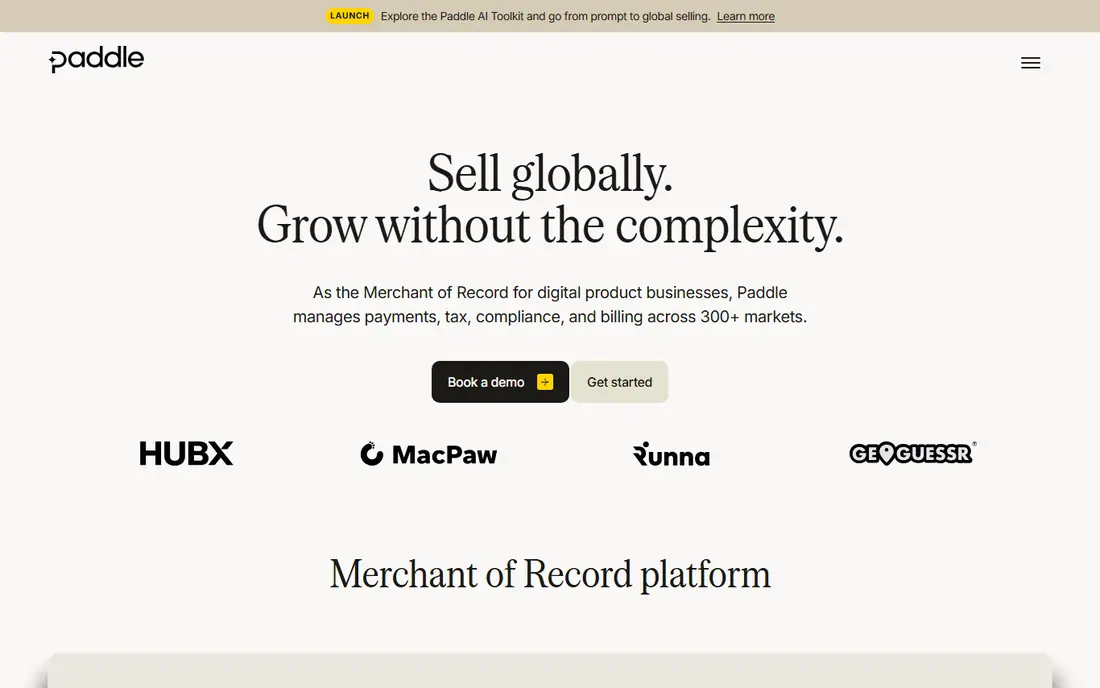
Paddle is a merchant of record, which means Paddle is the legal seller, collects payment, handles global sales tax and fraud protection, and pays you out. The single rate of 5% + $0.50 per transaction bundles all of that, so there is no separate gateway fee, tax tool or fraud bill. For a software company selling worldwide from day one, that simplicity removes a large administrative burden.
The trade is cost at scale: 5% of every transaction exceeds a billing percentage plus processing once volumes grow, and usage billing depth is limited compared with dedicated metering tools. Paddle fits global self-serve software sellers that want tax offloaded completely, and that value simplicity over the lowest possible rate.
What we like- Merchant of record handles global sales tax
- One rate bundles processing, tax and fraud
- Built for software sellers
Watch out for- Percentage model costs more at high volumes
- Limited usage billing depth
#4Zoho Billing
Best for: Early-stage teams on Zoho4.5/5 on
Capterra (109 reviews, checked Oct 2026)
Visit zoho.com
Starting price$39 per month (Standard, billed annually)
Free planFree trial
Zoho Billing is the budget pick for early-stage subscription businesses, especially those already running Zoho Books or Zoho CRM. Standard costs $39 per month and Premium $79 per month on annual billing, with subscription plans, trials, proration and customer portals included. For a team billing under $1 million a year, that price is hard to beat.
The limits are depth: usage-based billing needs Premium and up, and revenue recognition appears only on the Enterprise edition. Zoho Billing fits startups and small SaaS teams that want solid subscription logic inside the Zoho ecosystem, and that do not yet need enterprise revenue recognition.
What we like- Low entry price
- Integrates with Zoho Books and CRM
- Subscription logic for early-stage teams
Watch out for- Revenue recognition only on Enterprise edition
- Usage billing needs Premium and up
#5Zuora
Best for: Enterprise order-to-cash3.9/5 on
G2 (311 reviews, checked Oct 2026)
Visit zuora.com
Starting priceSee website
Free planNo
Zuora is the enterprise order-to-cash platform, covering subscriptions, orders, billing and revenue recognition across multiple entities and complex pricing models. Its revenue module is a separate product with the depth public companies need for compliance, and its multi-entity support suits global enterprises that smaller tools cannot model.
Pricing is quote-only with no published rate, and implementation is typically an enterprise project with consultants. That makes Zuora wrong for startups and right for large companies whose billing complexity genuinely exceeds what Recurly or Maxio handle. Buy Zuora when finance, not engineering, drives the purchase.
What we like- Deepest order-to-cash and revenue recognition depth
- Multi-entity support
- Enterprise scale
Watch out for- Quote-only pricing
- Implementation typically enterprise-scale
#6Maxio
Best for: Finance-led B2B SaaS metrics4.3/5 on
G2 (832 reviews, checked Oct 2026)
Visit maxio.com
Starting price$599 per month (Grow, up to $100,000 monthly billings)
Free planFree trial
Maxio, born from the Chargify and SaaSOptics merger, is built for finance-led B2B SaaS teams that want billing connected to SaaS metrics. The Grow plan costs $599 per month for up to $100,000 in monthly billings, with usage-based billing supported and revenue recognition included on advanced tiers. That metric linkage helps finance teams report MRR, churn and expansion from the same system that bills customers.
The flat fee is the drawback at small scale: on $24,000 a year of billings, Maxio costs $7,188 a year, far above percentage-based rivals. The Grow cap also forces a custom quote past $100,000 in monthly billings. Maxio fits B2B SaaS companies with sales-led motions and finance teams that want metrics and billing together.
What we like- Billing tied to SaaS metrics like MRR and ARR
- Revenue recognition included at advanced tiers
- B2B focus
Watch out for- Grow tier caps at $100,000 monthly billings
- Flat fee is costly at small volumes
#7FastSpring
Best for: Digital goods merchant of record4.5/5 on
G2 (187 reviews, checked Oct 2026)
Visit fastspring.com
Starting priceSee website
Free planNo
FastSpring is a merchant of record for digital goods and software, handling global tax, compliance and payments so sellers do not register for VAT or GST in every customer country. One comparison cites rates around 5.9% + $0.95, while another cites roughly 8.5%, so this article marks pricing "See website" rather than picking one figure. The model suits legacy software sellers and digital goods stores with global customers.
Like Paddle, FastSpring costs more per transaction than a billing layer plus gateway, but it removes tax administration entirely. It fits software and digital goods sellers that want a full merchant-of-record service and are comfortable with quote-based pricing.
What we like- Merchant of record for digital goods
- Global tax and compliance handled
- Long track record with software sellers
Watch out for- Quote-based pricing
- Percentage rates higher than billing-layer tools
#8Lago
Best for: Open-source usage billing5.0/5 on
G2 (1 reviews, checked Oct 2026)
Visit getlago.com
Starting priceSee website
Free planYes (open-source self-hosted)
Lago is the open-source answer for usage-based billing, built for AI and API products that charge on consumption rather than flat subscriptions. Its metering engine handles events at volume, and the self-hosted open-source version is free, which appeals to engineering-led teams that want to own their billing infrastructure. Paid cloud pricing varies across guides, from around $500 per month in one comparison to quote-based in others, so this article marks it "See website".
Lago is a metering engine, not a full billing suite, so most teams pair it with a revenue recognition tool and a payment gateway. It fits consumption-priced products that need precise metering more than they need subscription management depth.
What we like- Open-source metering engine
- Built for usage and consumption billing
- Self-hosting option
Watch out for- Paid pricing varies across guides
- Usually paired with a separate revenue recognition tool
How we chose
We compared tools on pricing model, merchant-of-record status, usage billing support, revenue recognition depth and the limits reviewers cite most often. Sources included vendor pricing pages and independent comparisons checked in September and October 2026, including a subscription billing fee comparison and a Chargebee review. Where prices conflicted across guides, the article says "See website" instead of picking one figure. We did not claim hands-on testing, and billing fees should always be modeled on your own volume.
What to check before you sign
Model the total cost on your real volume, not the headline rate. A percentage tool costs little at $2,000 a month and a lot at $200,000, while a flat-fee tool does the opposite. Run three scenarios, current volume, double, and ten times, and see which model wins at each stage. Include processing fees, since billing percentages usually sit on top of them.
Next, decide the merchant-of-record question early. If you sell software worldwide and do not want to register for taxes in dozens of countries, Paddle or FastSpring remove that burden at a percentage cost. If you already handle tax or sell mostly domestically, a billing layer like Stripe Billing, Recurly or Zoho Billing costs less.
Finally, test dunning and proration with real scenarios before migrating. Failed-payment retries, plan changes mid-cycle, trials converting to paid, and usage overages are where billing tools earn or lose their price. Migrate a small cohort first, reconcile every invoice against the old system, and only then move the full base.
Frequently asked questions
What is the best Chargebee alternative?
It depends on your model. Stripe Billing suits teams already on Stripe, Recurly suits churn-focused subscription businesses, Paddle and FastSpring suit global software sellers that want tax handled, and Zoho Billing suits early-stage teams on a budget.
How much does subscription billing software cost?
Entry pricing ranges from percentage models like Stripe Billing at 0.7% of billing volume and Chargebee Growth at 0.80%, to flat fees like Recurly at $249 per month and Maxio at $599 per month, to merchant-of-record rates like Paddle at 5% + $0.50 per transaction.
What is a merchant of record?
A merchant of record is the legal seller of a transaction: it collects payment, handles sales tax and VAT, manages fraud and chargebacks, and pays the software company out. Paddle and FastSpring are merchant-of-record vendors, while Stripe Billing, Recurly and Zoho Billing are billing layers that leave tax to you.
Do billing fees replace payment processing fees?
Usually not. Billing percentages sit on top of card processing, typically 2.9% + $0.30 in the US, except at merchant-of-record vendors where one rate bundles processing, tax and fraud protection. Always add both together when comparing.
Can I switch billing tools without losing subscribers?
Yes, but migration needs care: payment methods must transfer securely, subscription states must match, and invoices must reconcile. Most vendors offer migration help, and a small-cohort pilot with full reconciliation is the safe path.
Should a startup use a flat-fee billing tool?
Usually not at first. Flat fees like $249 or $599 per month dominate costs at small volumes, while percentage tools cost almost nothing until revenue grows. Move to a flat-fee tool when volume makes the percentage more expensive than the flat rate.
Sources we checked (5)
- https://whop.com/blog/chargebee-ultimate-review/
- https://www.stackscout.net/articles/cc_20260930_173932.html
- https://dodopayments.com/blogs/recurly-alternatives
- https://cartmango.com/recurring-billing-software/
- https://resources.rework.com/tools/billing-revenue/best-subscription-billing-software-2026
Is your product missing or out of date?
We review this list regularly. Vendors can request a listing, send updated pricing or ask about featured placement.

Shihab Mia · Founder, Rankite
Shihab has 5+ years in B2B and SaaS SEO. He writes Rankite's software buying guides from pricing pages, documentation and public user reviews. More about Shihab.