How we make this list: we compare pricing pages, product documentation and public user reviews. Ratings come from G2, Capterra or Trustpilot, with the date we checked them.
Key takeaways
- GitHub is where most Bitbucket teams land: the largest developer community, free private repositories, and Team at 4 dollars per user a month.
- GitLab is the self hosting and all in one answer, with source, CI, and security in a single application, free at the core and Premium at 29 dollars per user.
- Gitea and Codeberg serve teams that want lightweight, free, and independent hosting, one on your own server and one run by a nonprofit.
- Bitbucket's own differentiator was price at small scale and Jira integration; every switch should price the Atlassian connection it gives up.
Quick comparison
| Tool | Best for | Starting price | Free plan |
|---|
 GitHub | Teams and the open source world | Free | Yes |
 GitLab | Self hosted all in one DevSecOps | Free | Yes |
 Gitea | Lightweight self hosted Git | Free | Yes |
 Codeberg | Free nonprofit hosting | Free | Yes |
 Azure DevOps | Microsoft centred enterprises | $6 per user per month | Yes |
 SourceHut | Minimalist, email driven workflows | $2 per month | No |
 RhodeCode | Regulated enterprise self hosting | See website | No |
 AWS CodeCommit | AWS native teams, closing to new users | See website | Yes |
Is your product missing or out of date?
We review this list regularly. Vendors can request a listing, send updated pricing or ask about featured placement.
The best Bitbucket alternatives
#1GitHub
Best for: Teams and the open source world4.7/5 on
G2 (2,412 reviews, checked Oct 2026)
Visit github.com
Starting priceFree
Free planYes
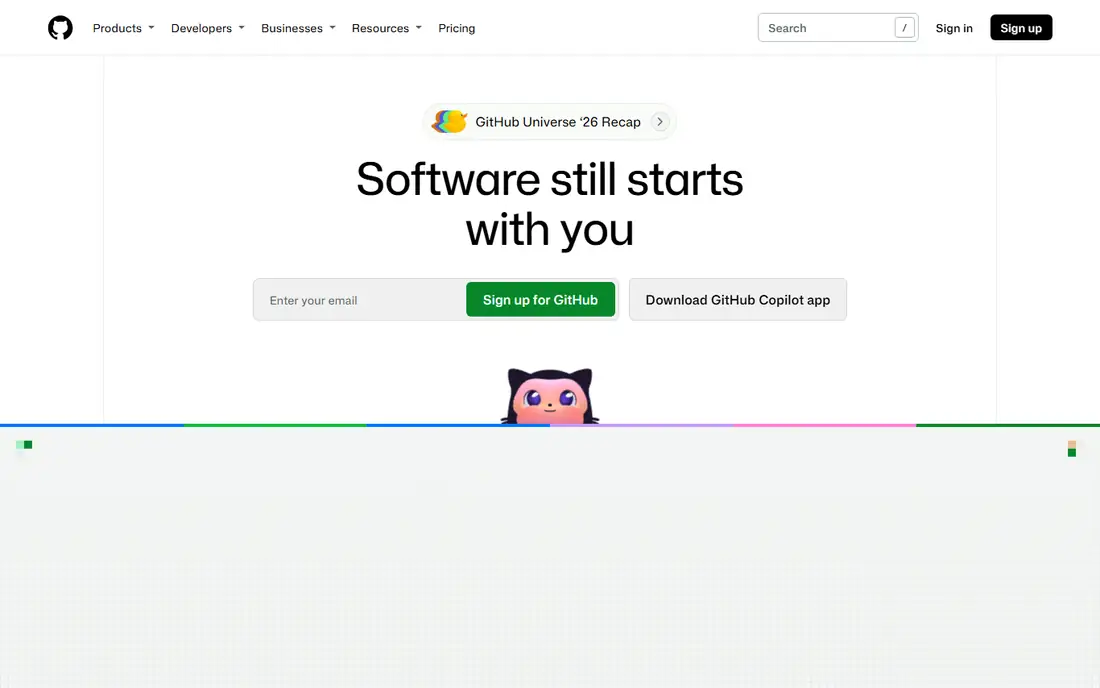
What we like- GitHub is the centre of the development world: free unlimited private repositories for individuals and organizations, GitHub Actions for CI with generous included minutes, Copilot for AI assistance, and the hiring pool and open source ecosystem already in place. Team costs 4 dollars per user a month and Enterprise 21, and migration from Bitbucket is a well worn path with importers for repositories, issues, and pull requests. For most Bitbucket teams the question is not whether GitHub fits but what took them so long.
Watch out for- Leaving Bitbucket usually means leaving the Atlassian gravity well: Jira integration exists but is not the native pairing Bitbucket enjoys. Self hosting means GitHub Enterprise Server at enterprise prices and effort. Advanced security and compliance features sit in higher tiers and add ons, and Actions minutes beyond the allowance are a real line item for CI heavy teams.
Starting priceFree
Free planYes

What we like- GitLab is the single application answer: Git hosting, CI and CD, container registry, security scanning, and project planning in one system, self hostable for free at the core tier, which no rival here matches for completeness. Premium at 29 dollars per user a month adds the governance and pipeline features enterprises need, and the SaaS version removes the hosting work. Organizations standardizing their whole delivery pipeline, rather than just repositories, choose it deliberately.
Watch out for- Self hosting GitLab means running a serious application with upgrades and backups as your job. Premium's per user price is the highest mainstream figure here, and Ultimate climbs far above it. The interface and feature sprawl take learning, and GitHub's community gravity still pulls open source projects the other way.
Starting priceFree
Free planYes
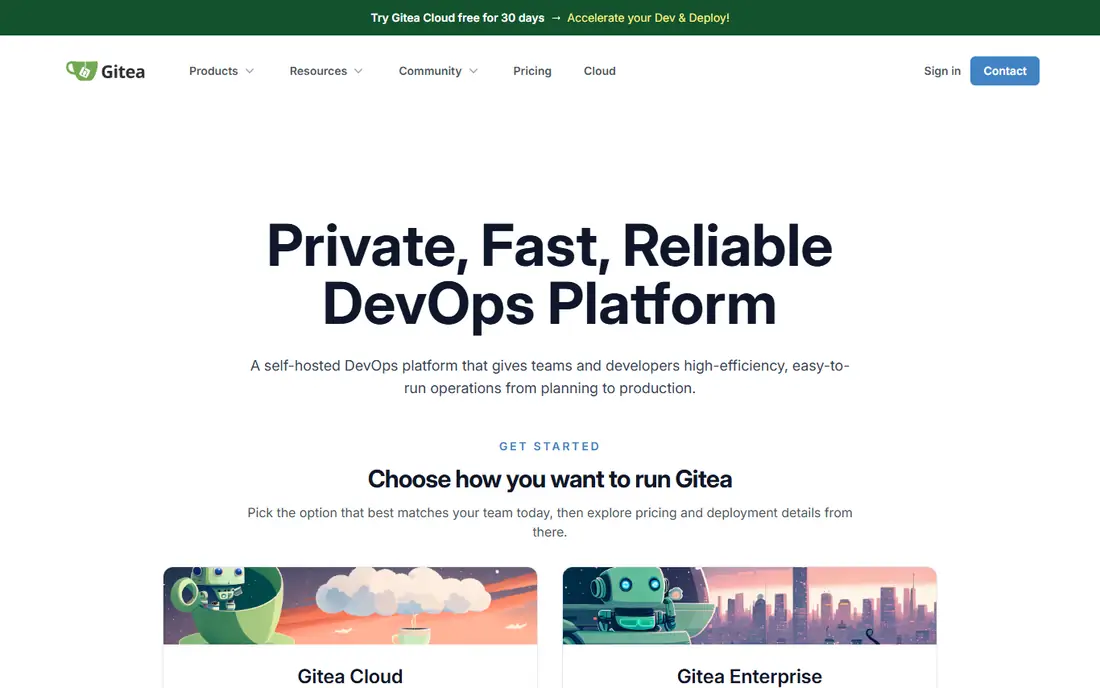
What we like- Gitea is a single small binary that runs a complete Git service, repositories, pull requests, issues, packages, and actions compatible CI, on hardware as modest as a Raspberry Pi class server. It is free and open source, starts in minutes, and asks almost nothing of the machine or the administrator, which makes it the self hosting default for small teams, labs, and personal infrastructure. A managed cloud offering exists for those who want Gitea without the server.
Watch out for- You are the hosting company: uptime, backups, updates, and security are your responsibility, and there is no vendor support line unless you buy the commercial offering. Enterprise identity and compliance depth trail GitLab and GitHub Enterprise. The ecosystem of integrations is community scale.
Starting priceFree
Free planYes
What we like- Codeberg is a Gitea based forge run by a German nonprofit, free for open source and community projects, funded by donations rather than venture money or advertising. For open source maintainers who want independence from the platform giants, it offers repositories, issues, pull requests, and CI through Woodpecker, with a community that has grown steadily as developers diversify away from GitHub. It is the principled hosting choice, and its existence pressure tests everyone else's pricing.
Watch out for- The donation funded model means service levels are a community promise, not an SLA, and private commercial work sits uneasily in its community remit. Feature development follows volunteer and small team capacity. Businesses needing contractual support, guaranteed uptime, or deep enterprise identity should self host or pay a commercial platform.
Starting price$6 per user per month
Free planYes
What we like- Azure DevOps bundles repositories, pipelines, boards, test plans, and artifacts into the Microsoft enterprise agreement world, free for the first five users and 6 dollars per user a month for Basic beyond that. For a Microsoft shop it aligns identity, compliance, and billing with everything else they run, and its pipelines handle Windows and .NET estates natively. Organizations already deep in Azure often find it the path of least procurement resistance.
Watch out for- The product's centre of gravity is shifting as Microsoft's developer story centres GitHub, and Azure Repos receives less visible momentum than its sibling. The interface feels enterprise dated beside GitHub and GitLab. Outside Microsoft estates there is little reason to choose it over the top two entries.
Starting price$2 per month
Free planNo
What we like- SourceHut is the deliberate minimalist forge: fast, text first pages, Git and Mercurial hosting, mailing list driven patch workflows, and CI, with no JavaScript required and no tracking. Paid plans start at 2 dollars a month, with financial aid available, and the whole platform is open source and self hostable. Developers who find modern forges bloated treat its restraint as the feature, and its email workflow suits distributed open source projects run the traditional way.
Watch out for- The patch by email model is a culture shock for teams raised on pull requests, whatever its merits. SourceHut's development has proceeded at a small team's pace, with parts long described as alpha. It is a connoisseur's tool
- A business team needing onboarding friendliness and integrations should look above.
#7RhodeCode
Best for: Regulated enterprise self hosting4.1/5 on
G2 (4 reviews, checked Oct 2026)
Visit rhodecode.com
Starting priceSee website
Free planNo
What we like- RhodeCode serves the regulated corner: enterprise self hosted repository management across Git, Mercurial, and Subversion, with fine grained permissions, audit trails, and code review built for banks, defence, and other compliance heavy organizations that cannot put source code in a public cloud. Its support for legacy version control systems under one permission model is genuinely rare. For an enterprise consolidating old Mercurial and SVN estates beside Git, it has few rivals.
Watch out for- Pricing is by quote, and the product is an enterprise sale, not a signup. The community and plugin ecosystem are small compared with the mainstream forges. Modern CI and DevOps breadth is not its pitch
- It manages repositories inside a wider toolchain you provide.
#8AWS CodeCommit
Best for: AWS native teams, closing to new users4.2/5 on
G2 (88 reviews, checked Oct 2026)
Visit aws.amazon.com
Starting priceSee website
Free planYes
What we like- CodeCommit is Amazon's managed Git hosting, priced around active users with a free tier of five users, designed to sit beside CodePipeline and the rest of the AWS toolchain with IAM based access control. Existing AWS estates already on it get competent, unglamorous Git hosting inside their existing security perimeter. We list it so its current users can see it placed honestly in the category.
Watch out for- The decisive fact: AWS closed CodeCommit to new customers and has steered new work toward partner and GitHub based options, so starting a new project on it in 2026 would be building on a service in maintenance. It never grew an ecosystem or community beyond its integration role. Existing users should plan a destination, most naturally GitHub or GitLab, rather than deepen the commitment.
How we chose
We compared Git hosting platforms on repository management, pull request and review workflow, built in CI, self hosting options, identity and compliance features, and pricing model. We favoured platforms in active development with importer paths from Bitbucket, and we flagged the one service, CodeCommit, whose closure to new customers changes what an honest recommendation looks like. Community scale counted, because a forge is a network as much as a tool.
How to choose the right Bitbucket alternative
Follow your centre of gravity. If your developers live in open source and your hiring pool assumes it, GitHub, and the migration is mostly mechanical. If the requirement is one system for source, pipelines, and security under your own roof, GitLab self hosted, with the operations budget to run it. If the requirement is simply ours and cheap, Gitea; if it is independence with principles, Codeberg for open source work.
Price the Atlassian thread before you cut it. Bitbucket's remaining magic is the Jira and Confluence pairing; GitHub and GitLab both integrate with Jira, but the depth of issue linking and the habits of your project managers are real switching costs that belong in the plan. Migrate in the low season, repository by repository with history intact, keep Bitbucket read only through the transition, and move the CI pipelines deliberately, since Pipelines syntax does not translate one to one into Actions or GitLab CI and those files carry your release process inside them.
Frequently asked questions
Why do teams leave Bitbucket?
The common triggers are pricing and packaging changes inside the Atlassian stack, CI minute costs on Pipelines, and gravity: new hires and open source dependencies live on GitHub. Some long time users still cite the removal of Mercurial support years ago as the moment the platform stopped being theirs. Jira integration remains the reason most stayers stay.
Can I migrate Bitbucket repositories with history?
Yes. Git history moves intact because it is Git: clone and push, or use the importers GitHub and GitLab provide. Pull request discussions, issue metadata, and pipeline definitions move imperfectly or not at all, and need export tools or manual recreation. Plan the repository move as the easy half of the project and the surrounding workflow as the real work.
Is self hosting really cheaper than SaaS?
The licence is free for Gitea and GitLab core, but the server, backups, updates, security patching, and your administrator's hours are not. For a small team the arithmetic favours SaaS until scale or regulation flips it. Self hosting wins on control, data residency, and independence, which are the honest reasons to choose it, with cost a possible bonus rather than the headline.
What is the best free Bitbucket alternative?
GitHub's free tier for most teams: unlimited private repositories with a capable CI allowance. Codeberg for open source projects wanting nonprofit hosting, and Gitea where free must also mean your own server. GitLab's free tier covers small teams well, with usage limits that growing teams feel sooner.
Should existing CodeCommit users migrate now?
Plan it rather than panic. The service continues for existing customers, but a platform closed to new users is in maintenance by definition, and your next compliance review or hiring round will ask the question anyway. GitHub and GitLab both publish migration paths from CodeCommit, and moving between projects costs far less than moving mid flight.
Sources we checked (0)
Is your product missing or out of date?
We review this list regularly. Vendors can request a listing, send updated pricing or ask about featured placement.

Shihab Mia · Founder, Rankite
Shihab has 5+ years in B2B and SaaS SEO. He writes Rankite's software buying guides from pricing pages, documentation and public user reviews. More about Shihab.