How we make this list: we compare pricing pages, product documentation and public user reviews. Ratings come from G2, Capterra or Trustpilot, with the date we checked them.
Key takeaways
- BigCommerce starts at $29 per month billed annually, with no transaction fees via embedded payment providers, and Performance from $1,499 per month.
- Shopify at $29 per month billed annually remains the best all-round platform for most small businesses, with the largest app ecosystem.
- WooCommerce is free and open source for WordPress users wanting full ownership, though hosting and extensions cost extra.
- Watch transaction fees, not just subscriptions: platform fees and payment processing can add 3 to 5 percent to every order.
- Adobe Commerce at $2,000 or more per month suits enterprise complexity only, while Ecwid, Square Online, and Shift4Shop offer genuinely free starts.
Quick comparison
| Tool | Best for | Starting price | Free plan |
|---|
 Shopify | Most small businesses | $29 per month | Free trial |
 WooCommerce | WordPress users, full control | Free | Yes |
 Adobe Commerce | Enterprise B2B and B2C | $2,000 per month | No |
 Wix | Design-first small stores | $29 per month | Yes |
 Squarespace | Beautiful stores for creatives | $19 per month | Free trial |
 Ecwid | Adding a store to an existing site | $5 per month | Yes |
 Square Online | Local sellers using Square | Free | Yes |
 Shift4Shop | US sellers wanting no platform fees | Free | Yes |
Is your product missing or out of date?
We review this list regularly. Vendors can request a listing, send updated pricing or ask about featured placement.
The best BigCommerce alternatives
#1Shopify
Best for: Most small businesses4.4/5 on
G2 (5,144 reviews, checked Oct 2026)
Visit shopify.com
Starting price$29 per month
Free planFree trial

Shopify remains the best all-round ecommerce platform for most small businesses, starting at $29 per month billed annually for Basic. It wins on ease of use, app ecosystem breadth, and dropshipping-specific integrations, with 765 or more dropshipping apps in comparison data.
The trade-off is transaction fees for third-party gateways: 0.5 to 2 percent depending on plan, which becomes meaningful at scale. For a high-ticket store generating $300,000 a year on a non-Shopify-Payments gateway, a 1 percent fee on the mid-tier plan costs $3,000 a year that BigCommerce removes for embedded-provider sales.
Shopify Plus starts at $2,300 per month on a 3-year term, or $2,500 on a 1-year term, for enterprise stores. Pick Shopify when ease of use and ecosystem lead. Pick BigCommerce when avoiding transaction fees leads.
What we like- Easiest UX
- Largest app ecosystem
- Best dropshipping integrations with 765+ apps
Watch out for- 0.5 to 2% transaction fees for non-Shopify Pay
- Plus from $2,300 per month
- Fees scale with revenue
#2WooCommerce
Best for: WordPress users, full control4.4/5 on
G2 (1,283 reviews, checked Oct 2026)
Visit woocommerce.com
Starting priceFree
Free planYes
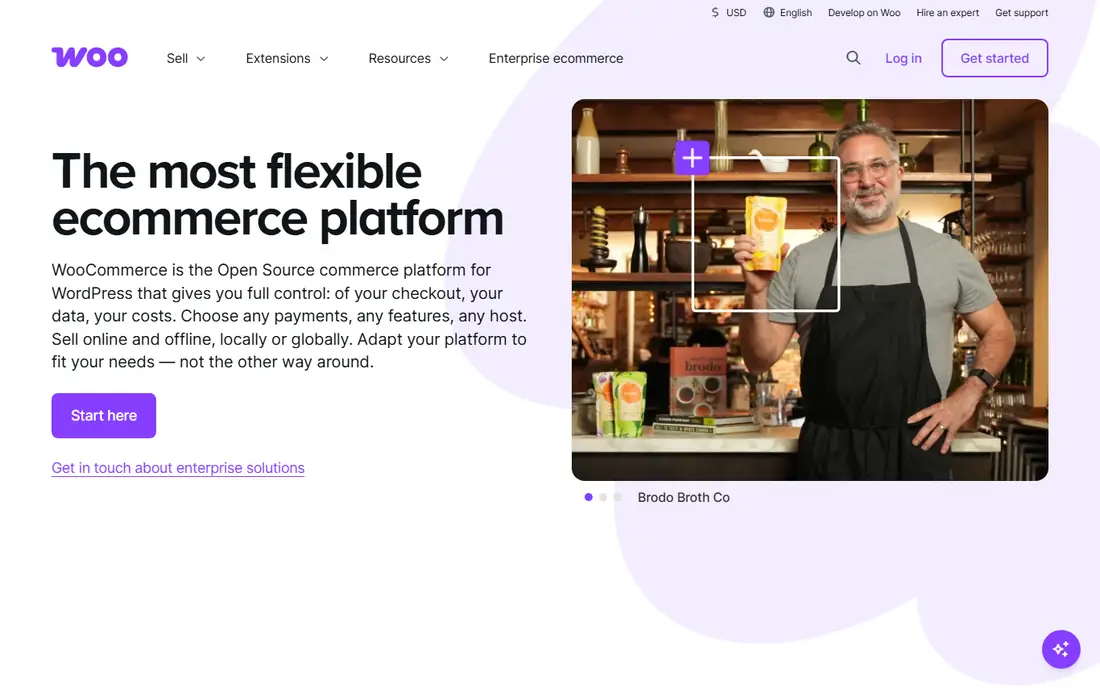
WooCommerce is free and open source, making it the best platform for WordPress users who want full ownership without monthly platform fees. Hosting runs roughly $10 to $125 per month, with extensions adding cost, but there are no platform transaction fees.
The SEO control is unmatched: content-driven stores gain from WordPress's blogging, content, and search strengths, which hosted platforms cannot match. Full ownership means the store files and database can move between compatible hosts.
The cost is technical ownership: hosting, plugins, security, and updates fall on the merchant. Pick WooCommerce when WordPress and SEO control lead. Pick Shopify when managed simplicity leads.
What we like- Free open-source plugin
- No platform transaction fees
- Unmatched SEO control
- Full ownership
Watch out for- Hosting $10 to $125 per month
- Manage hosting, plugins, and security independently
- Technical effort
Starting price$2,000 per month
Free planNo
Adobe Commerce, formerly Magento, suits mid-to-large enterprises with complex catalog requirements, B2B workflows, or multi-store operations needing a developer-grade platform. Entry runs $2,000 or more per month, with Adobe enterprise pricing from $22,000 to $125,000 or more per year.
The platform handles complexity that SaaS tools cannot: custom B2B price lists, approval paths, credit limits, and ERP data exchange at enterprise scale. For a large enterprise, that depth justifies the cost and developer effort.
Small stores should not start here. Pick Adobe Commerce when enterprise complexity demands it. Pick BigCommerce when mid-market SaaS simplicity leads.
What we like- Enterprise complexity handling
- Complex catalogs and B2B workflows
- Multi-store operations
Watch out for- $2,000 or more per month, Adobe enterprise $22,000 to $125,000+ per year
- Developer-grade effort
- Overkill for small stores
#4Wix
Best for: Design-first small stores4.2/5 on
G2 (1,888 reviews, checked Oct 2026)
Visit wix.com
Starting price$29 per month
Free planYes
Wix suits design-first small stores, with Core at $29 per month billed annually including payments and basic ecommerce. Small businesses with mixed website needs, such as a portfolio plus a store, find Wix's builder simpler than a dedicated ecommerce platform.
The free plan covers non-ecommerce sites, letting teams build before committing to commerce. For a small store launching this week, Wix's simplicity beats Shopify's depth.
Ecommerce depth trails Shopify and BigCommerce, and the site remains tied to Wix infrastructure. Pick Wix when a small, beautiful store leads. Pick Shopify when ecommerce depth leads.
What we like- Core plan includes payments and basic ecommerce
- Simple builder
- Free plan for non-ecommerce sites
Watch out for- Less ecommerce depth than Shopify
- Site tied to Wix infrastructure
- Pricing varies by region
#5Squarespace
Best for: Beautiful stores for creatives4.4/5 on
G2 (1,133 reviews, checked Oct 2026)
Visit squarespace.com
Starting price$19 per month
Free planFree trial
Squarespace suits design-led brands and creators, with Basic at $19 per month billed annually and Core removing the Squarespace store transaction fee. Its templates produce beautiful stores with minimal design effort, which suits creators and small brands.
The all-in-one pricing is clearer than app-heavy platforms: hosting, templates, and commerce ship together. A 14-day free trial lets teams test before paying.
Ecommerce depth trails Shopify, and full site export is partial. Pick Squarespace when design-led beauty leads. Pick Wix when a simpler builder leads.
What we like- Beautiful templates
- Basic $19 per month billed annually
- Core removes Squarespace store transaction fee
Watch out for- Less ecommerce depth than Shopify
- Partial content export
- POS via integrations
#6Ecwid
Best for: Adding a store to an existing site4.7/5 on
G2 (405 reviews, checked Oct 2026)
Visit ecwid.com
Starting price$5 per month
Free planYes
Ecwid suits adding a store to an existing site, with a free plan and Starter at $5 per month billed annually. It embeds into any website, so a business with an established site adds commerce without rebuilding.
That embed model is the draw: keep the existing site, design, and SEO, and add a store widget. For a content site or business site that needs a store as a secondary feature, Ecwid is the cheapest credible path.
Full-store depth trails Shopify and BigCommerce, since Ecwid is an embed, not a full storefront platform. Pick Ecwid when the site already exists. Pick Shopify when a full store leads.
What we like- Free plan available
- Starter $5 per month billed annually
- Embeds in any existing site
Watch out for- Less full-store depth than Shopify
- Embeds rather than full storefront
- Fewer native features
#7Square Online
Best for: Local sellers using Square4.2/5 on
G2 (482 reviews, checked Oct 2026)
Visit squareup.com
Starting priceFree
Free planYes
Square Online suits local sellers already using Square, with a free start per location and strong point-of-sale integration for in-person selling. Retailers selling offline and online keep inventory, payments, and customers in one Square ecosystem.
The low subscription entry is real, though payment processing becomes the central cost, as with all Square products. For a local shop adding an online store, Square's POS strength beats generic ecommerce platforms.
Ecommerce depth trails Shopify, and the store stays within the hosted Square ecosystem. Pick Square Online when local POS plus online leads. Pick Shopify when pure ecommerce depth leads.
What we like- Free start per location
- Strong POS for in-person selling
- Square ecosystem integration
Watch out for- Payment processing is central to cost
- Less ecommerce depth than Shopify
- Hosted Square ecosystem
#8Shift4Shop
Best for: US sellers wanting no platform fees3.9/5 on
G2 (39 reviews, checked Oct 2026)
Visit shift4shop.com
Starting priceFree
Free planYes
Shift4Shop suits US sellers wanting no platform fees, with a free tier when processing through Shift4, and $41 to $229 per month otherwise. Card processing runs 2.9 percent plus $0.30, with no platform fees on top, which suits merchants already processing through Shift4.
The free-with-processing model removes the subscription for qualifying merchants, a genuinely free start that few competitors match. For a US merchant on Shift4, the economics are hard to beat.
Dropshipping support is limited compared with Shopify, and the platform is US-focused. A merchant that relies on dropshipping apps should test Shift4Shop's app catalog before committing, since the catalog gap matters more than the subscription saving for that model, and switching platforms later costs far more in time, migration effort, retraining, and lost sales than the monthly fee saved. Pick Shift4Shop when Shift4 processing and no platform fees lead. Pick Square Online when local POS leads. The right platform is the one whose fee structure matches how the store actually sells, not the one with the lowest headline price.
What we like- Free with Shift4 processing
- No platform fees
- Card processing 2.9% plus $0.30
Watch out for- Free tier requires Shift4 processing
- Else $41 to $229 per month
- Limited dropshipping
- US-focused
How we chose
We compared tools that replace BigCommerce's core job, hosted ecommerce for growing stores, using vendor pages and 2026 comparison data. We favored published prices and marked ranges where sources disagree, since BigCommerce's own entry appears as $29 to $39 per month depending on billing. We also judged each tool on transaction fees, not just subscriptions, since fees scale with revenue.
The 24-month cost: subscriptions are the smallest line
The 24-month cost of an ecommerce platform is the subscription, payment fees, apps and extensions, implementation, hosting, and the team's time. Entry prices differ by orders of magnitude, but as sales grow, the largest lines are usually fees that scale with revenue and people's time, not the subscription.
Shopify's transaction fees illustrate the point: a 1 percent fee on $300,000 of annual sales costs $3,000 a year, dwarfing the $29 monthly subscription. BigCommerce's embedded-provider fee removal saves that $3,000, though its own Growth-tier Open Payment Provider Fee of 1.0 percent costs the same on a non-embedded processor.
WooCommerce's free plugin hides hosting, extension, and maintenance costs, while Adobe Commerce's $2,000 monthly entry hides implementation and developer costs. Decide for where revenue will be in two years, because the cheapest platform today is rarely the cheapest after a migration, and platform migrations are painful, time-consuming, and expensive.
Frequently asked questions
How much does BigCommerce cost?
BigCommerce starts at $29 per month billed annually, with plans to $399 per month and Performance from $1,499 per month. It charges no transaction fees via embedded payment providers, though non-embedded processors incur 0.6 to 2.0 percent fees depending on tier.
What is the best BigCommerce alternative overall?
Shopify at $29 per month billed annually is the best all-round alternative for most small businesses, with the easiest UX and largest app ecosystem. BigCommerce suits mid-market and B2B stores wanting stronger native features without transaction fees.
Which alternative is free?
WooCommerce's plugin is free, with hosting extra, and Ecwid, Square Online, and Shift4Shop offer genuinely free starts. Square Online is free per location, Shift4Shop is free with Shift4 processing, and Ecwid offers a free plan.
Which alternative has no transaction fees?
WooCommerce charges no platform transaction fees, and BigCommerce charges none via embedded providers. Shopify charges 0.5 to 2 percent for non-Shopify Pay gateways, which becomes meaningful at scale.
Which alternative suits enterprise B2B?
Adobe Commerce at $2,000 or more per month suits enterprise B2B and B2C with complex catalogs, B2B workflows, and multi-store operations. BigCommerce also handles B2B and B2C hybrid operations at SaaS simplicity for mid-market firms.
Should I choose Shopify or WooCommerce?
Choose Shopify when launch speed, ease of use, and reliability matter more than deep customization. Choose WooCommerce when content-driven SEO, WordPress ownership, and full control matter more, accepting the technical effort of hosting and plugins.
Sources we checked (6)
- https://ecommerceparadise.com/bigcommerce-review-2026-is-it-the-right-ecommerce-platform-for-your-dropshipping-store/
- https://www.akoode.com/blog/shopify-vs-woocommerce-vs-magento
- https://techilu.com/best-cms-for-ecommerce/
- https://rankite.com/blog/best-ecommerce-software
- https://www.evelumo.com/blog/how-to-choose-ecommerce-platform/
- https://webchoicedesk.com/en-us/best-website-builder-online-store/
Is your product missing or out of date?
We review this list regularly. Vendors can request a listing, send updated pricing or ask about featured placement.

Shihab Mia · Founder, Rankite
Shihab has 5+ years in B2B and SaaS SEO. He writes Rankite's software buying guides from pricing pages, documentation and public user reviews. More about Shihab.