How we make this list: we compare pricing pages, product documentation and public user reviews. Ratings come from G2, Capterra or Trustpilot, with the date we checked them.
Key takeaways
- BMC Control-M is the safest enterprise default, and its SaaS tier now starts at $2,400 per month billed annually, which finally gives mid-size teams a public entry price.
- Redwood owns three products on this list (RunMyJobs, ActiveBatch, Tidal). Pick by deployment model: SaaS-first goes RunMyJobs, self-hosted low-code goes ActiveBatch.
- Apache Airflow and Prefect are the only options here that do not require a sales call. Airflow is free but you operate it; Prefect Cloud starts at $100 per month.
- Banks and credit unions should shortlist OpCon first. It is built for core banking workflows, and its maker SMA Technologies now operates as Continuous.
Quick comparison
| Tool | Best for | Starting price | Free plan |
|---|
 Control-M Control-M | Large enterprises standardizing on one platform | $2,400/mo (billed annually, SaaS) | See website |
 Automic Automation Automic Automation | SAP and Oracle-heavy enterprises | See website | See website |
 ActiveBatch ActiveBatch | Mid-size IT teams wanting low-code plus deep extensibility | See website | See website |
 Stonebranch Stonebranch | Hybrid IT shops needing event-driven orchestration | See website | See website |
 RunMyJobs RunMyJobs | SAP-centric enterprises wanting fully managed SaaS | See website | See website |
 JAMS JAMS | Windows-centric IT teams wanting straightforward licensing | See website | See website |
 Tidal Tidal | Enterprises wanting a focused, dependable scheduler | See website | See website |
 OpCon OpCon | Banks and credit unions automating core operations | See website | See website |
 Apache Airflow Apache Airflow | Data teams with Python skills who want free and flexible | Free (open source) | Yes |
 Prefect Prefect | Python teams wanting orchestration without operating Airflow | $100/mo | Yes (Hobby free) |
Is your product missing or out of date?
We review this list regularly. Vendors can request a listing, send updated pricing or ask about featured placement.
Nobody buys workload automation because it sounds exciting. They buy it after a 2 a.m. page, when a failed batch job held up payroll or a cron script nobody remembers stopped running three weeks ago. The tools below are the ones IT teams standardize on, from free open-source orchestrators to the enterprise platforms that run the nightly close at Fortune 100 companies.
#1
Control-M
Best for: Large enterprises standardizing on one platform
Visit bmc.com
Starting price$2,400/mo (billed annually, SaaS)
Free planSee website
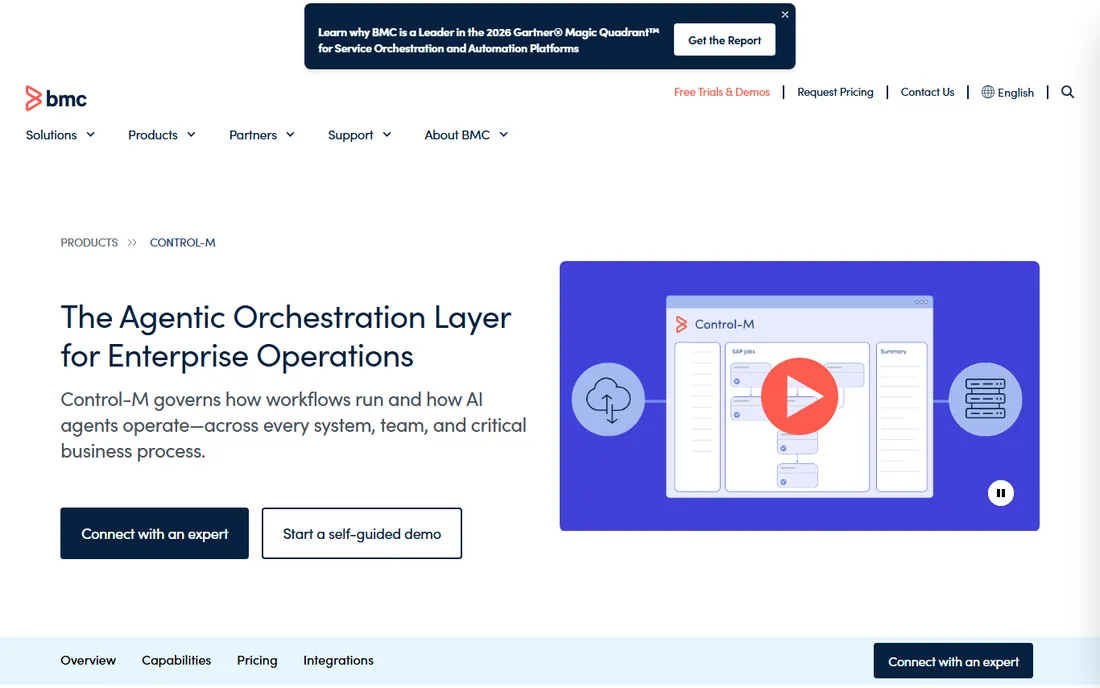
Control-M is the default answer in this category for a reason. BMC's platform orchestrates application and data workflows across mainframe, distributed, cloud, and SaaS from one console, and the integration catalog is the deepest here: SAP, Snowflake, Databricks, Airflow, Azure Data Factory, AWS, and more. Developers get jobs-as-code through the Automation API, defining workflows in JSON with version control and CI/CD integration instead of clicking through a GUI.
The notable change is packaging. BMC now publishes a SaaS tier starting at $2,400 per month billed annually, aimed at growing teams and hybrid cloud apps, with 24x7 support, SLA management, and high availability included. Complex, high-scale, and mainframe environments still go through enterprise quoting with customizable usage models.
The catch is scale in both directions. Below a certain job volume, Control-M is more platform than you need, and the enterprise sales motion is heavy. But if the goal is one orchestration standard across the whole company, this is the safest pick on the list.
What we like- Public SaaS entry price with full orchestration included
- Jobs-as-code with a real Automation API
- Deep SAP, cloud, and data pipeline integrations
Watch out for- Enterprise tier is quote-based and can get expensive fast
- The platform's breadth means a real learning curve
Starting priceSee website
Free planSee website
Automic has been automating enterprise workloads for over 25 years, and under Broadcom it has become the workload automation piece of a much larger software portfolio. The headline for 2026 buyers is Automic SaaS: the full on-premises feature set delivered as a managed service, which removes the infrastructure burden of running the automation engine and database yourself. A Kubernetes edition and traditional on-premises deployment round out the options.
Where Automic wins evaluations is ERP. The SAP story covers on-premises, RISE with SAP, and S/4HANA Cloud with certified adapters, and Oracle processing gets similar treatment. Managed file transfer with encryption and checkpoint restart is built in, and developers can code automation artifacts directly and promote them across dev, test, and production.
The catch is commercial, not technical. Pricing is quote-based, and Broadcom's enterprise licensing practices draw consistent criticism in buyer communities. Get renewal terms and price-protection language in writing. Technically, though, few platforms match Automic's breadth from mainframe to microservices.
What we like- Now available as SaaS with predictable subscription pricing
- Strongest ERP automation story
- Automation-as-code for shift-left teams
Watch out for- Quote-based pricing with no public numbers
- Broadcom licensing has a reputation for aggressive renewals
#3
ActiveBatch
Best for: Mid-size IT teams wanting low-code plus deep extensibility
Visit advsyscon.com
Starting priceSee website
Free planSee website
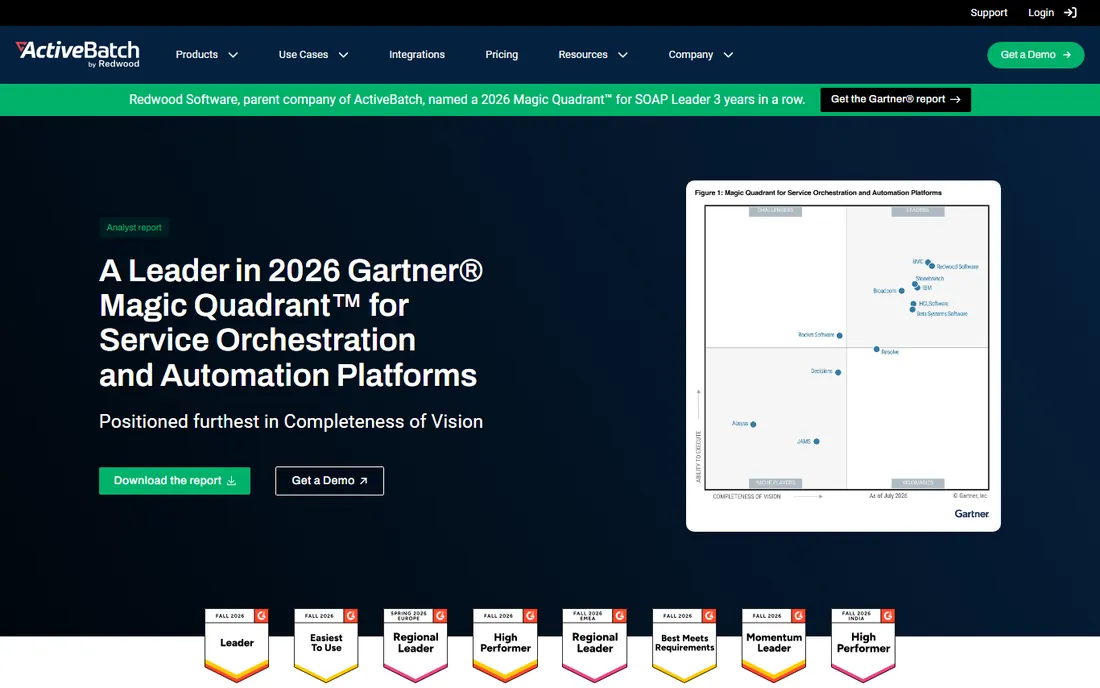
ActiveBatch, now part of Redwood, is the low-code contender that does not sacrifice depth. The graphical builder ships with hundreds of prebuilt Job Steps for common IT actions, so teams assemble workflows without writing scripts, and a REST API adapter extends that to any tool in the stack. Event-driven triggers and date/time scheduling cut the slack time that static schedules leave on the table.
Under the hood there is real sophistication: machine-learning models analyze historical runs to predict optimal resource allocation, high availability works without cluster failover complexity, and change management tools move workflows between dev and production. Security follows the Windows model with Kerberos and Active Directory, and auditing, revision history, and SLA management cover governance. The ServiceNow-certified extension is a genuine differentiator for ITSM-heavy shops.
Support is a selling point rather than an afterthought: white-glove onboarding, periodic health checks, in-house experts, and Redwood University with hundreds of courses. The catch is that you will negotiate pricing through sales, and teams standardizing on Linux-first infrastructure sometimes find the Windows roots showing.
What we like- Low-code drag-and-drop builder with hundreds of production-ready Job Steps
- REST API adapter connects to anything
- White-glove onboarding included
Watch out for- Quote-based pricing
- Windows-centric heritage shows in places despite cross-platform support
Starting priceSee website
Free planSee website
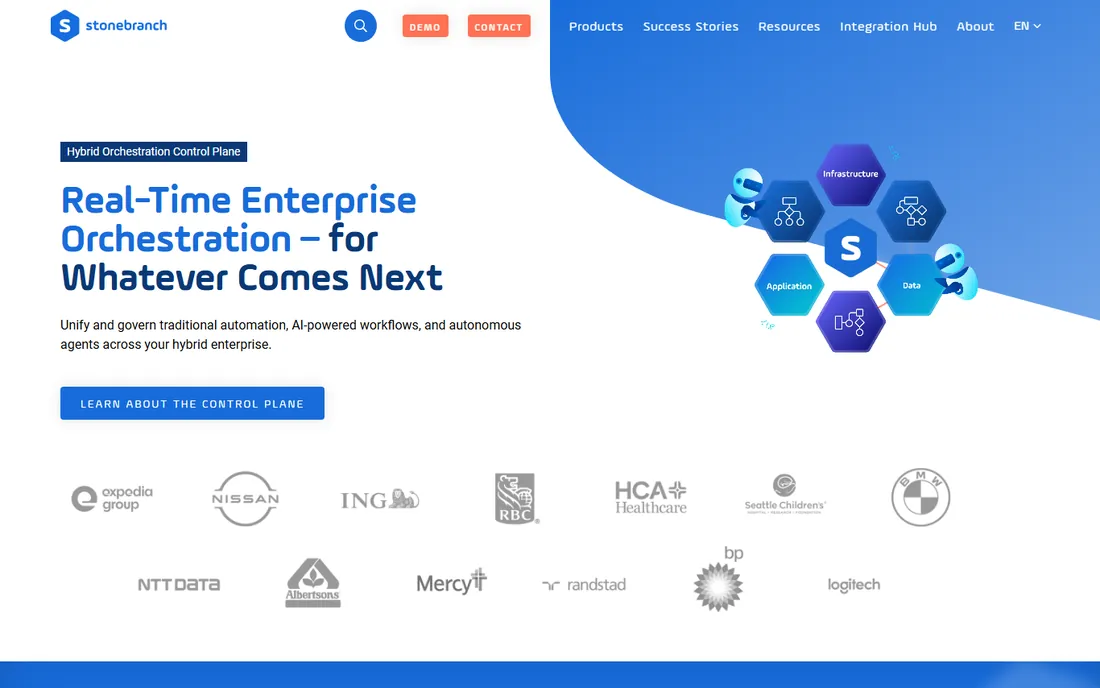
Stonebranch's Universal Automation Center (UAC) is built around a simple idea: jobs should react to events, not just clocks. File arrivals, database events, and workload thresholds can kick off workflows, which suits hybrid estates where work moves between on-premises systems and cloud services.
Managed file transfer deserves a mention. The Universal Data Mover Gateway handles orchestrated B2B file exchange with modern protocols, encryption, and federated authentication, native to the platform rather than bolted on. Stonebranch has been named a Leader in Gartner's Magic Quadrant for Service Orchestration and Automation Platforms three years running, and its customer list leans heavily into financial services, healthcare, and manufacturing.
The catch is the buying process. Like most names here, pricing is quote-based and the sale runs through demos and scoping. Stonebranch is also a smaller company than BMC or Broadcom, which matters to buyers who weight vendor size. On product merit for hybrid, event-driven shops, it belongs in eevaluation.
What we like- True event-driven automation across hybrid environments
- Universal Data Mover Gateway for managed file transfer
- SaaS option available
Watch out for- Enterprise sales motion with quote-based pricing
- Smaller vendor than BMC or Broadcom
#5
RunMyJobs
Best for: SAP-centric enterprises wanting fully managed SaaS
Visit redwood.com
Starting priceSee website
Free planSee website
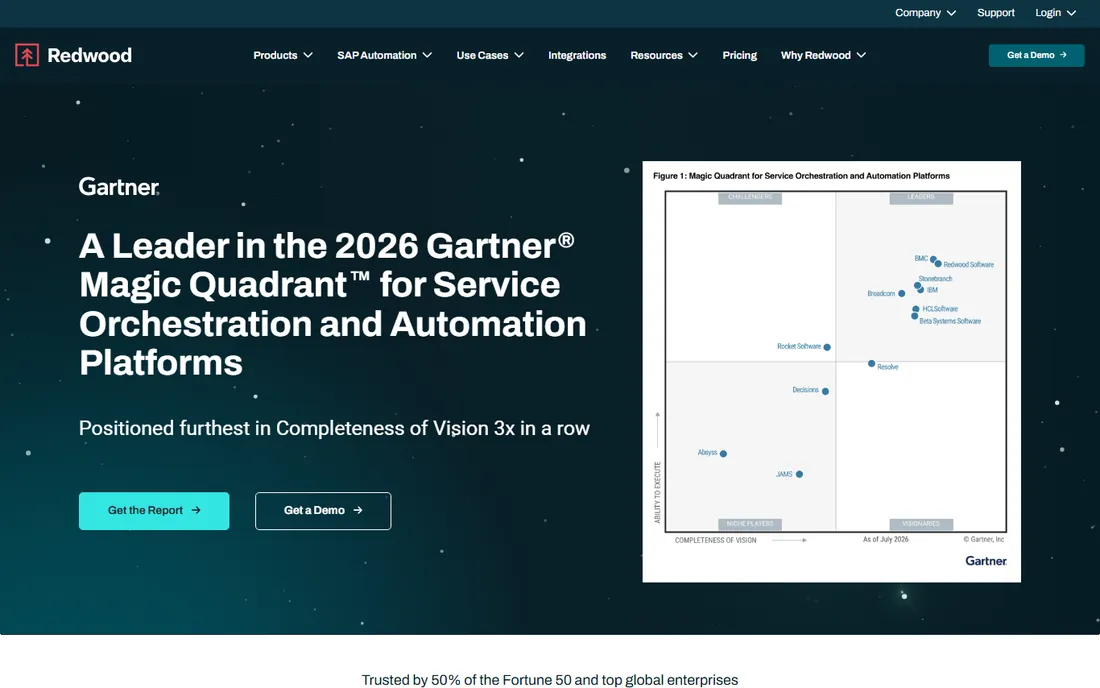
RunMyJobs is Redwood's SaaS-native answer, and it is the one to pick when you never want to patch a scheduler again. The platform is fully managed with guaranteed 99.95% uptime, agentless connectivity to applications, and event-driven orchestration across hybrid environments.
The SAP credential is the standout: RunMyJobs is a SAP Endorsed App and part of the RISE with SAP reference architecture, with integrations spanning SAP Joule, Cloud ALM, Cloud ERP, and BTP. For companies where SAP runs the business, that endorsement shortens security reviews and architecture debates. Beyond SAP, the connector catalog covers the usual enterprise spread, and RangerAI adds AI-assisted development and troubleshooting.
The catch is pricing transparency. The model is consumption-based, which fits elastic workloads but makes budgeting an exercise. Get a usage estimate mapped to your job volume before signing. If SAP is not central to your estate, the other Redwood products or a competitor may fit better.
What we like- Fully managed SaaS with 99.95% uptime
- SAP Endorsed App in the RISE with SAP reference architecture
- Agentless and event-driven
Watch out for- Consumption-based pricing can be hard to predict
- Strongest fit is SAP shops
Starting priceSee website
Free planSee website
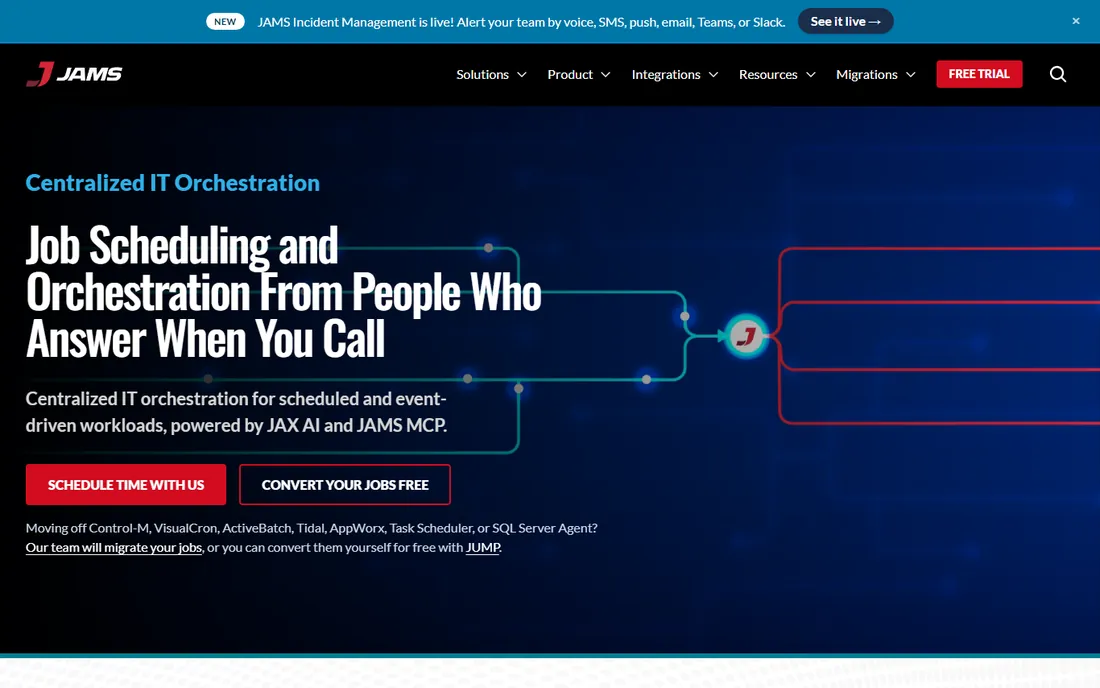
JAMS takes a deliberately old-school approach: a powerful scheduler your team installs and owns. Built on .NET with Windows roots, it now orchestrates across UNIX, Linux, IBM i, and OpenVMS too, but the heart of it is Windows automation done well. Jobs use natural-language date specifications, parameters follow DRY principles across hundreds of jobs, and 50-plus PowerShell cmdlets plus a REST API and .NET SDK give developers real control.
The commercial model is the appeal. JAMS advertises no per-job fees and no usage caps, with licensing that scales with your environment. Clients install anywhere without extra license fees, and the SQL Server backend feeds historical reporting and audit trails. Compliance is covered with a SOC 2 Type II examination and an independent HIPAA assessment completed in 2026. Support is famously human: senior engineers in the US, UK, and Australia, no outsourced tiers.
The catch is architectural. JAMS runs on a Windows server you manage, in your data center or on AWS/Azure, and it is not SaaS. Teams that want zero infrastructure should look at RunMyJobs or Prefect Cloud instead.
What we like- Straightforward licensing with no per-job fees or usage caps
- Deep PowerShell and .NET integration
- Excellent support reputation
Watch out for- Runs on Windows Server only, not SaaS
- Interface feels dated next to newer platforms
Starting priceSee website
Free planSee website
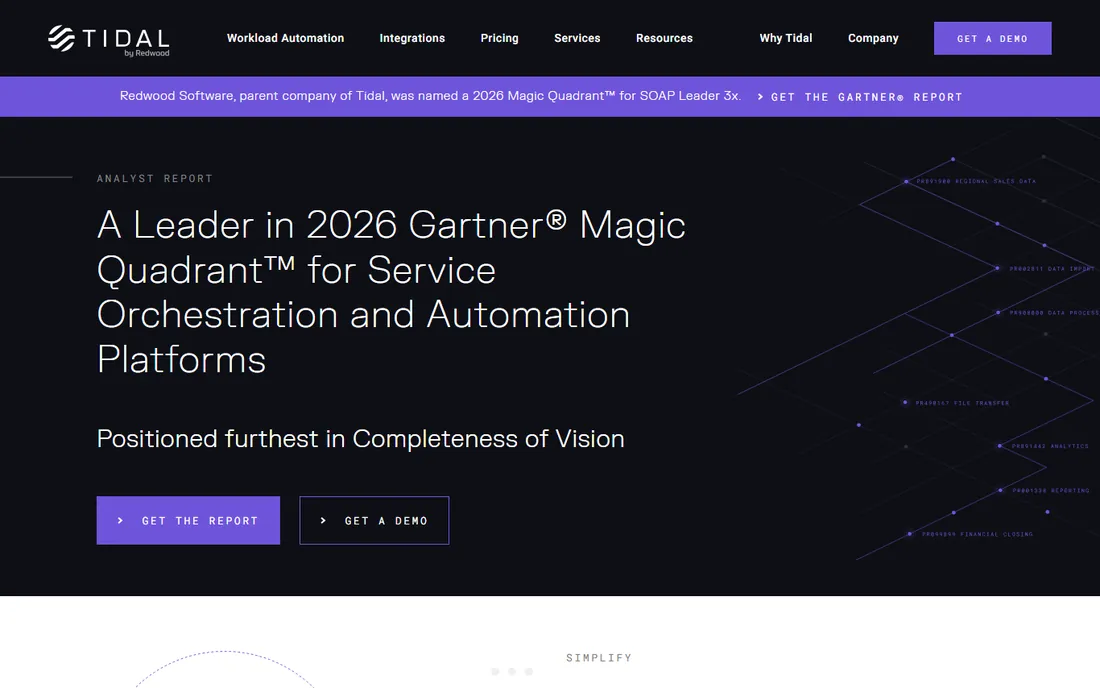
Tidal, also part of Redwood, is the focused enterprise scheduler for teams that want depth without sprawl. The platform centralizes management of complex workflows across on-premises, cloud, and hybrid environments, with dependency management that keeps jobs executing in the right order and SLA tooling that flags scheduling issues before they breach. High-integrity logs satisfy audit and compliance requirements without extra tooling.
Event-based automation responds to real-time conditions across multi-cloud environments, and self-service capabilities let authorized users build job templates and schedules without filing IT tickets. The integration library covers enterprise applications and systems with prebuilt connectors, and the interface stays approachable for operators who live in it all day. Redwood's ownership brings the Gartner recognition and support apparatus of the larger portfolio.
The catch is positioning. Tidal sits between the SaaS-first RunMyJobs and the low-code ActiveBatch, and buyers sometimes struggle to see where it fits versus its siblings. Pricing is quote-based, as expected at this tier.
What we like- Purpose-built platform with strong dependency management
- SLA-focused scheduling
- High-integrity audit logs for compliance
Watch out for- Quote-based pricing
- Narrower integration ecosystem than the biggest suites
Starting priceSee website
Free planSee website
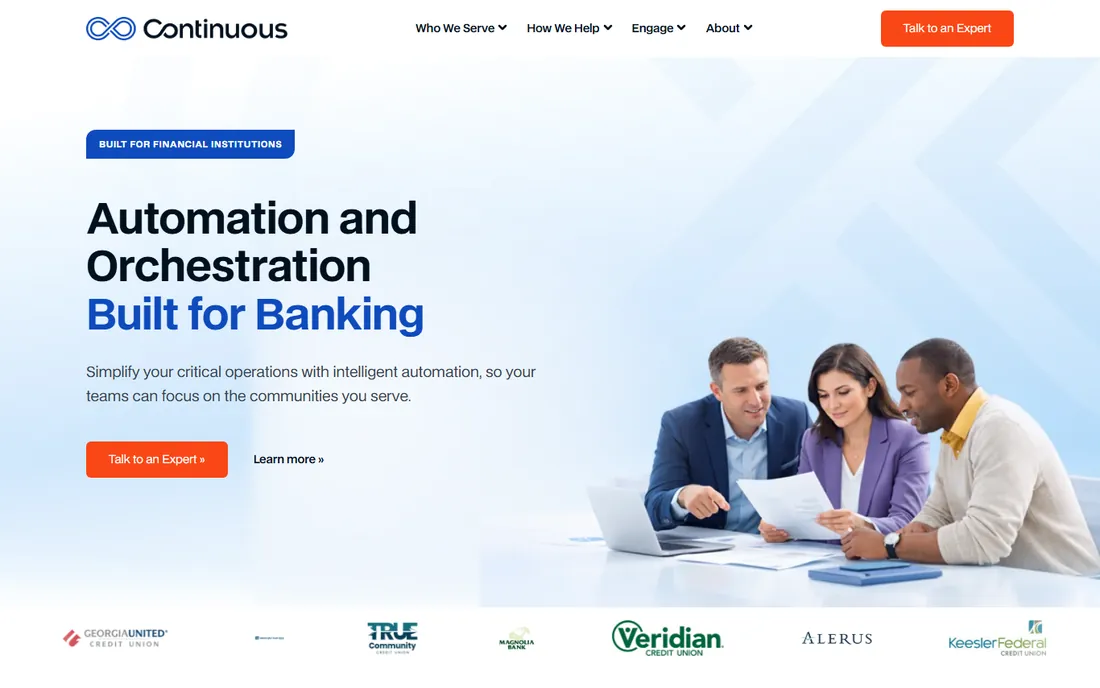
OpCon comes with a naming note: its maker, SMA Technologies, now operates as Continuous, a brand focused on automation for financial institutions. The product remains the workload automation platform banks and credit unions standardize on, and the website now leads with banking workflows: core processor connectivity, document intake and routing, loan origination from intake to close, and connectors for Jack Henry, Fiserv, FIS, and Corelation.
That vertical focus is the whole pitch. OpCon handles the intricate multi-system schedules banks run daily, with the auditability regulators expect. The company added robotic process automation and acquired Encapture for intelligent document processing, so compliance reporting and document-heavy workflows stay inside one platform. More than a thousand clients are claimed across the company's announcements, concentrated in banking and credit unions.
The catch is the obvious one: outside financial services, the fit drops. And the SMA-to-Continuous rebrand is recent enough that documentation, contracts, and community references still use both names. For a bank replacing a legacy scheduler, though, few vendors speak the industry's language this fluently.
What we like- Built for financial institutions with core banking connectors
- RPA and document processing included
- Expert-led implementation
Watch out for- Niche focus means less fit outside financial services
- Recent rebrand creates confusion
Starting priceFree (open source)
Free planYes
Airflow is the open-source standard for data pipeline orchestration, and it earns the spot. Workflows are Python code, which means dynamic pipeline generation, version control, and testing with the tools developers already use. The provider ecosystem is unmatched: plug-and-play operators for AWS, GCP, Azure, Snowflake, Databricks, and hundreds of other services. The web UI gives full visibility into runs, logs, and retries.
The price is zero for the software, and that is real. The cost is operational. A production Airflow deployment means running a scheduler, webserver, metadata database, and workers, handling upgrades, and scaling the whole thing. Managed options exist (Amazon MWAA, Google Cloud Composer, Astronomer) and they charge for removing that burden. Teams with platform engineering capacity do fine; teams without it discover the true cost quickly.
Airflow also assumes batch-oriented, DAG-shaped work. It is not a general IT job scheduler and it will not replace Control-M for mainframe batch. For data pipelines owned by engineers who live in Python, it remains the default choice.
What we like- Free under Apache 2.0 with a massive provider ecosystem
- Workflows as Python code
- Huge hiring pool and community
Watch out for- You operate everything: scheduler, metadata database, upgrades, scaling
- Meaningful platform engineering effort
#10
Prefect
Best for: Python teams wanting orchestration without operating Airflow
Visit prefect.io
Starting price$100/mo
Free planYes (Hobby free)
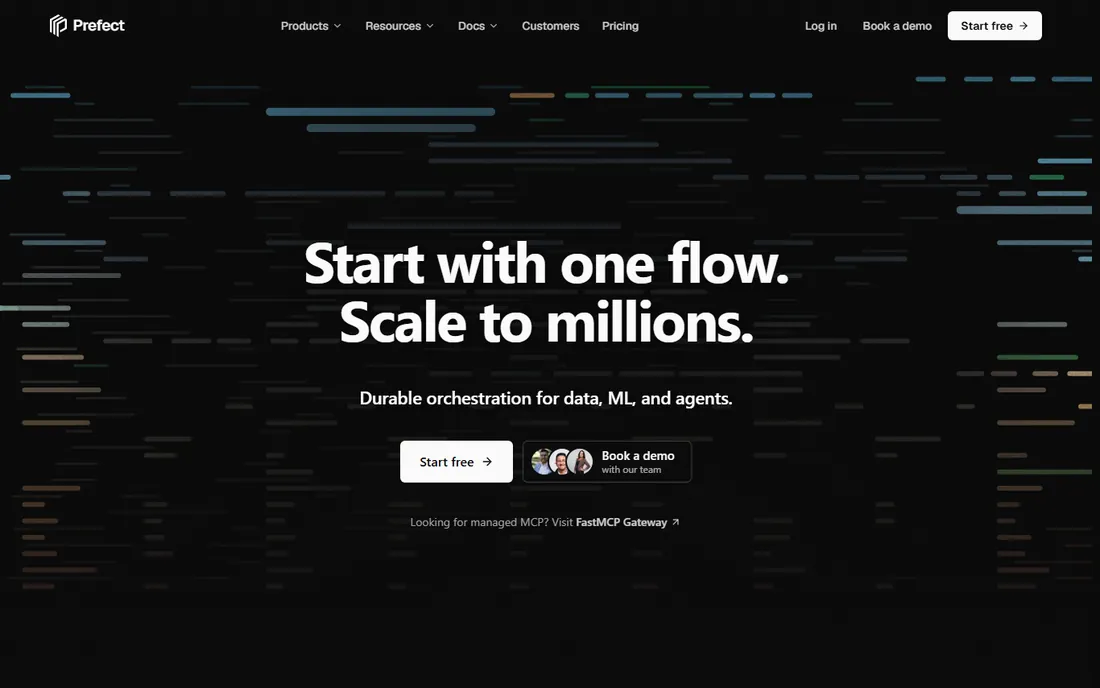
Prefect is what teams reach for when they like Airflow's idea but not its operational load. You write workflows as plain Python functions with two decorators, and the platform handles scheduling, retries, caching, and recovery. The open-source framework under Apache 2.0 shares its engine with Prefect Cloud, so there is no fork between self-hosted and managed.
The pricing is refreshingly legible. Hobby is free forever with 2 users, 5 deployments, and 500 monthly serverless minutes. Starter is $100 per month with 3 users and 20 deployments. Team is $100 per user per month. Pricing is per seat, not per run or per task, which makes costs predictable. Prefect Serverless runs flows on managed compute, while the hybrid model keeps your code inside your own environment and lets the Cloud control plane handle scheduling, a split designed to clear security reviews. Prefect acquired Dagster Labs in July 2026, consolidating two orchestration products.
The catch is ecosystem. Airflow's provider library and hiring pool are larger, and advanced governance (SSO, RBAC, audit logs) requires paid Cloud tiers. But for Python-first teams that outgrew cron and scripts, Prefect is the fastest path to production-grade orchestration.
What we like- Plain-Python flows with no new DSL
- Generous free Hobby tier
- Pricing per seat, not per run
Watch out for- Smaller ecosystem and talent pool than Airflow
- Governance features are Cloud-only
What separates the good from the expensive
Workload automation purchases fail in predictable ways. The wrong deployment model, the wrong pricing model, or a migration nobody planned for. Four questions cut through the marketing.
Which deployment model fits your team?
SaaS options (RunMyJobs, Prefect Cloud, Control-M SaaS, Stonebranch SaaS) remove infrastructure work but charge forever. Self-hosted options (Automic, ActiveBatch, JAMS, self-hosted Airflow) give control and can cost less at scale, but you own patching, upgrades, and availability. Match the model to the team you have, not the team you wish you had.
How does the pricing scale?
Vendors price four ways: per job or execution, per user or seat, flat subscription tiers, and consumption. Per-execution pricing punishes success. Per-seat pricing (Prefect) is predictable. Flat tiers (Control-M SaaS) are simple until you outgrow them. Ask evendor to model your cost at current volume and at triple volume, in writing.
How deep does the ERP and application coverage go?
If SAP, Oracle, or a core banking system runs your business, integration depth decides the shortlist. Native adapters with certified integrations (Automic for SAP, RunMyJobs as a SAP Endorsed App, OpCon for core banking) beat generic REST connectors for day-one reliability and audit support.
Who migrates your existing schedules?
Nobody talks about migration until it is late. Ask about conversion utilities for cron, Windows Task Scheduler, and legacy schedulers, and whether professional services are included or billed separately. JAMS, Redwood, and BMC all offer migration help; the difference is whether it is in the quote or a change order later.
Open source vs commercial: the real tradeoff
Airflow and Prefect prove you do not need a six-figure contract to orchestrate well. The tradeoff is not features, it is responsibility. Open source gives you the engine; you supply the platform engineering, the on-call rotation, and the upgrade weekends. Commercial platforms sell freedom from that work, plus compliance certifications and support SLAs.
The honest math: if your team already runs Kubernetes in production and has data engineers, self-hosted Airflow can be the cheapest serious option here. If it does not, the fully loaded cost of DIY operations usually exceeds a SaaS subscription within a year. Prefect sits in the middle, with a free tier that lets small teams start without either commitment. Choose based on operational capacity, not license price.
How we chose
We verified evendor homepage directly, opening each official site to confirm it loads the right company's product. Pricing comes from the vendors' own pages wherever published: BMC lists Control-M SaaS at $2,400 per month billed annually, and Prefect publishes its full Cloud pricing down to the free Hobby tier. Where vendors keep pricing behind sales, we say so rather than repeating third-party estimates.
We then compared product documentation, integration catalogs, deployment options, and compliance claims against public sources including Gartner's 2026 Magic Quadrant for Service Orchestration and Automation Platforms, vendor datasheets, and buyer reviews on G2, PeerSpot, and TrustRadius. We weighted enterprise readiness (high availability, audit trails, role-based access), migration support, and honest fit for different team shapes, from Windows-centric IT departments to Python-first data teams. Marketing claims without a verifiable source did not make it in.
Frequently asked questions
What is the difference between job scheduling and workload automation?
Job scheduling runs tasks at set times. Workload automation adds dependency management, event triggers, cross-platform coordination, SLA management, and audit trails across the whole IT estate. Think of scheduling as an alarm clock and workload automation as the operations team that reacts when the alarm reveals a problem.
How much does workload automation cost?
Published entry prices range from free (Airflow) to $100 per month (Prefect) to $2,400 per month billed annually (Control-M SaaS). Most enterprise platforms are quote-based and typically land in the five-to-six-figure annual range depending on job volume, platforms, and deployment model. Always get the cost modeled at your projected scale.
Can I migrate from cron or Windows Task Scheduler?
Yes, and most vendors expect it. JAMS, Redwood, and BMC all provide conversion utilities or professional services that import existing schedules. The migration is also the right moment to document the tribal knowledge hiding in those scripts, because the person who wrote them may not be around forever.
Do these tools work in the cloud?
All of them handle cloud workloads, but the deployment models differ. RunMyJobs, Prefect Cloud, and Control-M SaaS are managed services. Automic, ActiveBatch, Stonebranch, and Tidal offer SaaS or self-hosted options. JAMS runs on a Windows server you manage, whether on-premises or in AWS/Azure. Airflow runs wherever you deploy it.
Should a small team buy an enterprise platform?
Usually not. Enterprise platforms assume dedicated operations staff and job volumes that justify the contract. Small teams do better with Prefect's free tier, self-hosted Airflow, or JAMS, then graduate to enterprise tooling when compliance needs or scale demand it. Buying Control-M for fifty cron jobs is like hiring a freight company to move a studio apartment.
Open source or commercial: which is safer for a regulated industry?
Commercial, in most cases. Regulated industries need audit trails, access controls, compliance certifications, and a vendor to hold accountable. JAMS (SOC 2 Type II, HIPAA assessment), Control-M, and OpCon are built for those conversations. Open source can work in regulated shops, but you own the compliance evidence yourself.
Sources we checked (11)
- https://www.bmc.com/control-m
- https://www.broadcom.com/products/software/automation/automic-automation
- https://advsyscon.com/
- https://www.stonebranch.com/
- https://www.redwood.com/
- https://jamsscheduler.com/
- https://www.tidalsoftware.com/
- https://www.smatechnologies.com/
- https://airflow.apache.org/
- https://www.prefect.io/
- https://www.prefect.io/pricing
Is your product missing or out of date?
We review this list regularly. Vendors can request a listing, send updated pricing or ask about featured placement.

Shihab Mia · Founder, Rankite
Shihab has 5+ years in B2B and SaaS SEO. He writes Rankite's software buying guides from pricing pages, documentation and public user reviews. More about Shihab.