How we make this list: we compare pricing pages, product documentation and public user reviews. Ratings come from G2, Capterra or Trustpilot, with the date we checked them.
Key takeaways
- Verizon is the best wireless service for nationwide coverage, especially outside cities.
- T-Mobile suits users who want the fastest 5G and strong urban coverage.
- AT&T is a good middle choice, with broad coverage and family plan value.
- Visible is the best budget unlimited plan on the Verizon network, at $25 per month with taxes included.
- Mint Mobile is cheapest for users happy to pay a year upfront, with intro prices from $15 per month.
- Google Fi suits travelers and light data users with flexible pricing.
- Cricket gives AT&T coverage with stores and no contract.
- US Mobile lets you pick the network that works at your address.
- Coverage varies sharply by location, so check coverage at your home, work, and commute before you switch.
Quick comparison
| Tool | Best for | Starting price | Free plan |
|---|
 Verizon | Nationwide coverage | $75 per month | No |
 T-Mobile | Fast 5G and urban coverage | $55 per month | No |
 AT&T | Broad coverage and family value | $60 per month | No |
 Visible | Budget unlimited on Verizon | $25 per month | No |
 Mint Mobile | Lowest price with upfront payment | $15 per month | No |
 Google Fi Wireless | Travelers and light users | $20 per month | No |
 Cricket Wireless | AT&T coverage with stores | $35 per month | No |
 US Mobile | Pick your network | $25 per month | No |
Is your product missing or out of date?
We review this list regularly. Vendors can request a listing, send updated pricing or ask about featured placement.
The best wireless services
Starting price$75 per month
Free planNo
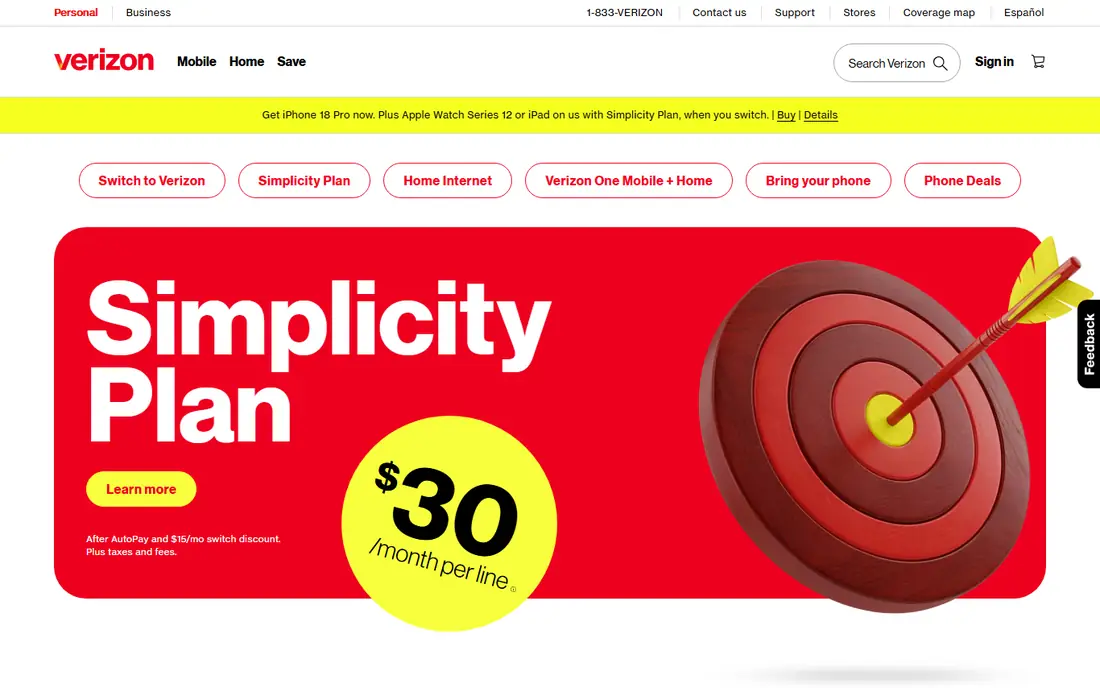
Verizon remains the coverage leader, especially outside cities and along highways where other networks thin out. Its entry unlimited plan starts around $75 per month for a single line, with higher tiers adding premium 5G, larger hotspot allowances, and streaming perks. For professionals, rural users, and families who travel widely, Verizon coverage is the safest default.
The trade off is price. Verizon costs more than the other big carriers at entry level, and taxes and fees are extra on many plans, so the bill runs above the headline price. If coverage at your address is equal across carriers, a cheaper carrier on the Verizon network may serve you better.
What we like- Widest nationwide coverage
- Strong rural performance
- Premium 5G access
Watch out for- Highest entry price among the big three
- Taxes and fees extra on many plans
- Perks cost extra
Starting price$55 per month
Free planNo
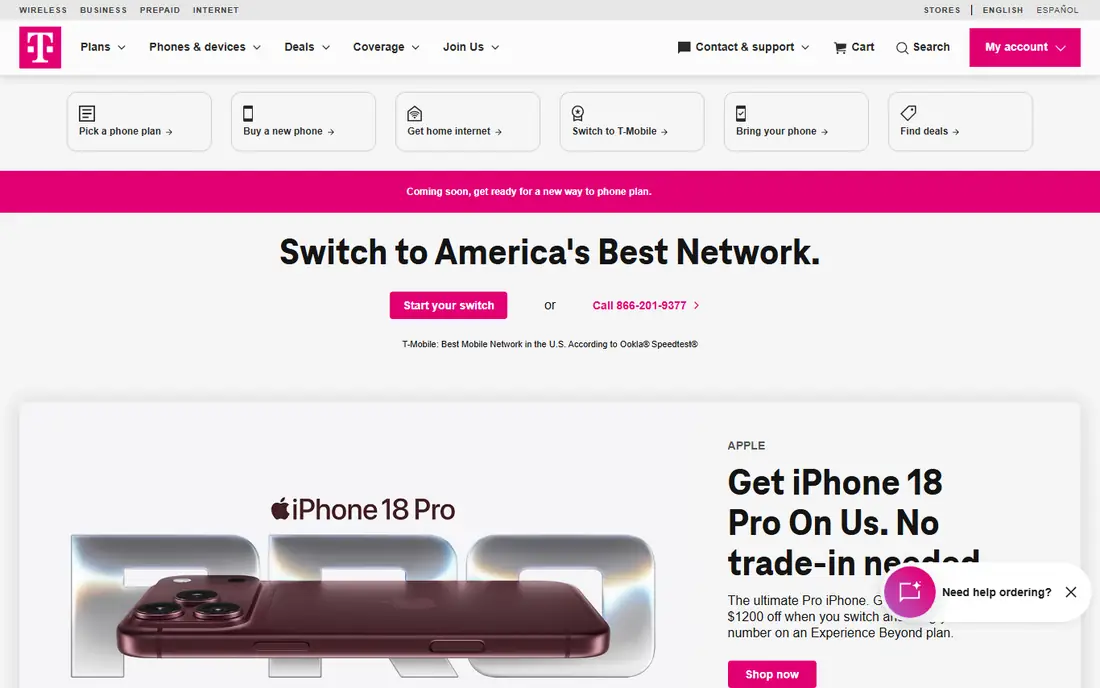
T-Mobile leads on 5G speed in most independent tests, and its entry plan starts around $55 per month for a single line. Higher tiers add premium unlimited data, large hotspot allowances, and streaming perks such as Netflix and Apple TV. In cities and suburbs, T-Mobile is often the fastest network available.
The limits are rural. In remote areas, T-Mobile coverage can lag Verizon, so rural users should check coverage maps for their exact routes. Entry plans also carry fewer perks than premium tiers. For urban and suburban users who value speed, T-Mobile is the best big-carrier pick.
What we like- Fast 5G speeds
- Strong urban coverage
- Generous hotspot on higher tiers
Watch out for- Rural coverage lags Verizon in some areas
- Entry plan has fewer perks
- Prices rise with tiers
Starting price$60 per month
Free planNo
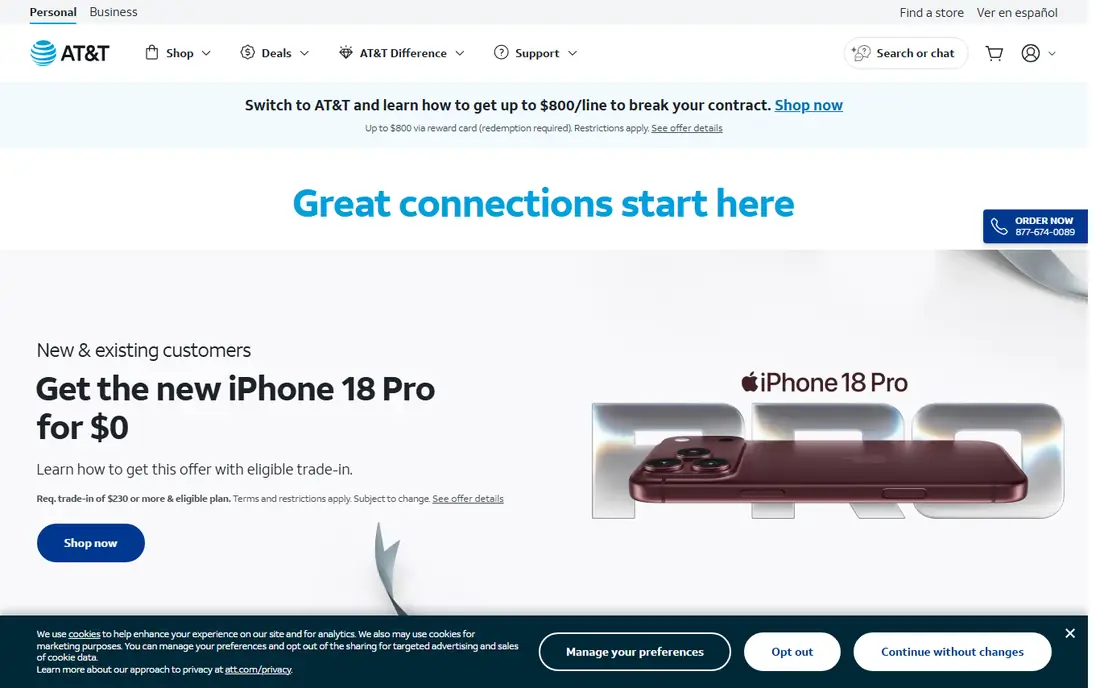
AT&T sits between Verizon and T-Mobile on coverage and price. Its entry plan starts around $60 per month for a single line, with higher tiers adding premium data, larger hotspots, and streaming bundles. Family plans bring the per-line cost down sharply, which suits households that want one bill for everyone.
The trade off is that entry plans carry smaller hotspot allowances and fewer perks than premium tiers, and taxes are extra on many plans. For families and users who want broad coverage without Verizon prices, AT&T is a solid middle choice.
What we like- Broad nationwide coverage
- Good family plan value
- Strong business plans
Watch out for- Entry plan is mid-priced
- Hotspot limits on lower tiers
- Taxes extra on many plans
Starting price$25 per month
Free planNo
Visible, owned by Verizon, is the best budget unlimited plan on the Verizon network. The base plan costs $25 per month with taxes and fees included, which means the price you see is the price you pay. It includes unlimited data and a hotspot allowance, with no contract and no stores to visit.
The trade off is priority and support. Visible data waits behind Verizon postpaid customers when towers are busy, and support is online only. For users who want Verizon coverage at a third of the price and do not need a store, Visible is the best value on this list.
What we like- $25 per month with taxes included
- Truly unlimited data
- No contract
Watch out for- Online only, no stores
- Data priority is lower than Verizon postpaid
- Hotspot capped on base plan
Starting price$15 per month
Free planNo
Mint Mobile is cheapest for users happy to pay upfront. New customers pay from $15 per month for an introductory term, and the unlimited plan runs about $30 per month on a twelve-month prepay. It runs on the T-Mobile network, so coverage matches T-Mobile at your address.
The catch is payment structure. The lowest prices require paying for three or twelve months upfront, and taxes are extra. Data priority is also lower than T-Mobile postpaid on busy towers. For users who can pay upfront and want the lowest bill, Mint is the cheapest serious option.
What we like- Lowest intro price
- Runs on T-Mobile network
- Simple plan structure
Watch out for- Requires upfront payment for best price
- Taxes extra
- Data priority is lower than T-Mobile postpaid
Starting price$20 per month
Free planNo
Google Fi suits travelers and light data users. Its Flexible plan starts at $20 per month plus $10 per gigabyte, so light users pay far less than an unlimited plan, and international roaming is simpler than on most carriers. Unlimited plans run higher, with premium tiers around $65 per month.
The trade off is heavy use. Data costs add up fast for heavy users, and the service works best on Pixel and Samsung phones, though other phones work with limits. For light users and frequent travelers, Google Fi is the most flexible pick.
What we like- Flexible pay-for-data pricing
- Good international roaming
- Runs on T-Mobile network
Watch out for- Unlimited plans cost more than rivals
- Data costs add up for heavy users
- Best on Pixel and Samsung phones
Starting price$35 per month
Free planNo
Cricket, owned by AT&T, gives AT&T coverage with stores and no contract. Plans start around $35 per month for a limited-data plan, with unlimited plans higher, and taxes are included in the listed price. Four lines run about $100 per month on some plans, which suits families.
The limits are priority and hotspot. Cricket data waits behind AT&T postpaid customers on busy towers, and lower tiers cap hotspot use. For users who want a store to walk into and AT&T coverage without a contract, Cricket is the best prepaid pick on that network.
What we like- AT&T network
- Stores for in-person help
- Taxes included
- No contract
Watch out for- Unlimited plans start higher
- Data priority is lower than AT&T postpaid
- Hotspot limits on lower tiers
Starting price$25 per month
Free planNo
US Mobile is the only carrier on this list that lets you pick from all three national networks. Its Unlimited Starter plan costs $25 per month with taxes included, and light plans start around $8 per month for 2 GB. If one network works poorly at your address, you can switch to another without changing carriers.
The trade off is support and complexity. US Mobile is online only, and switching networks takes some setup. Premium unlimited plans cost more than the starter tier. For users who want to choose the network that works best at their address, US Mobile is the most flexible carrier available.
What we like- Choice of all three networks
- Taxes included
- Low-cost light plans from $8 per month
Watch out for- Online only
- Network switching takes care
- Premium unlimited costs more
How we chose
We compared coverage, price, data priority, hotspot allowances, taxes, and contract terms. Tools that hide taxes or throttle data without disclosure scored lower. We favored carriers with clear total pricing and noted where promo prices differ from regular prices. We did not test any service hands-on, and prices here reflect published list prices that carriers change often.
Buying guide: what to check before you pay
Start with coverage at your address. Check coverage maps and ask neighbors on each network, since a cheap plan on a weak network is no bargain. Next, check data priority. Low-cost plans slow down first on busy towers, which matters most at stadiums, airports, and rush hour. Ask about taxes, since some carriers include them and others add them to the bill. Check hotspot needs too, since hotspot caps and speeds vary widely. Finally, test the service during the trial or return window with your real commute and workplace, because coverage maps promise more than they deliver.
Frequently asked questions
Which wireless carrier has the best coverage?
Verizon has the widest nationwide coverage, especially in rural areas. T-Mobile leads on 5G speed in cities, and AT&T sits in between. Coverage varies by location, so check your address before you decide.
Are cheap carriers as good as the big three?
On the same network at the same address, a cheap carrier often performs the same for calls, texts, and everyday data. The main difference is data priority on busy towers, where host carrier customers go first.
Do I need to buy a new phone to switch?
Usually not. Most phones bought without a carrier lock work on any carrier, though some features such as 5G bands or visual voicemail vary by phone and carrier. Check compatibility before you switch, and confirm that your phone supports the bands your new carrier uses in your area.
What is data deprioritization?
Deprioritization means your data waits behind higher-priority customers when a tower is busy. It affects low-cost plans most, and it matters most in crowded places rather than at home.
Can I keep my number when I switch?
Yes, number porting is free and usually completes within a day. Do not cancel your old plan before the port completes, or you may lose the number.
Sources we checked (0)
Is your product missing or out of date?
We review this list regularly. Vendors can request a listing, send updated pricing or ask about featured placement.

Shihab Mia · Founder, Rankite
Shihab has 5+ years in B2B and SaaS SEO. He writes Rankite's software buying guides from pricing pages, documentation and public user reviews. More about Shihab.