How we make this list: we compare pricing pages, product documentation and public user reviews. Ratings come from G2, Capterra or Trustpilot, with the date we checked them.
Key takeaways
- This category splits in two: affordable SaaS for consumer brands (Dyrect from $19/month, NeuroWarranty, Claimlane) and enterprise platforms for manufacturers (PTC, Syncron, Pega) that sell on custom quotes.
- Dyrect is the only pick with both a real free plan and published pricing, which makes it the easiest starting point for smaller brands.
- Implementation ranges from days to months: simple Shopify setups go live in 2 to 4 weeks, while enterprise rollouts with dealer networks take 30 to 60 days or more.
- Claim validation is the feature that pays for itself: duplicate and fraudulent claims drain an estimated 3 to 15 percent of warranty budgets, so automated eligibility checks matter more than dashboards.
Quick comparison
| Tool | Best for | Starting price | Free plan |
|---|
 Dyrect Dyrect | D2C brands doing QR warranty registration | $19/month (Registration plan, 100 credits/month) | Yes (free plan with 100 lifetime credits) |
 NeuroWarranty NeuroWarranty | QR-based claims with customer engagement | See website (custom, based on claim volume) | Free trial (14 days, per reviewers) |
 Claimlane Claimlane | Retailers wanting self-service claim portals | See website (custom quote) | No |
 WarrantyHub WarrantyHub | Home warranty firms, builders and auto TPAs | See website (volume-based pricing) | No (free demo; no long-term contracts, per vendor) |
 PTC Warranty PTC Warranty | Enterprise manufacturers in service operations | See website (enterprise license, custom quote) | No |
 Syncron Warranty Syncron Warranty | OEMs focused on supplier cost recovery | See website (custom quote) | No |
 Pega Warranty Pega Warranty | Complex multi-party claim workflows | See website (enterprise license, custom quote) | No |
 ReverseLogix ReverseLogix | Returns and warranty repair in one system | See website (custom quote) | No |
Is your product missing or out of date?
We review this list regularly. Vendors can request a listing, send updated pricing or ask about featured placement.
The best warranty management software
#1
Dyrect
Best for: D2C brands doing QR warranty registration
Visit dyrect.co
Starting price$19/month (Registration plan, 100 credits/month)
Free planYes (free plan with 100 lifetime credits)
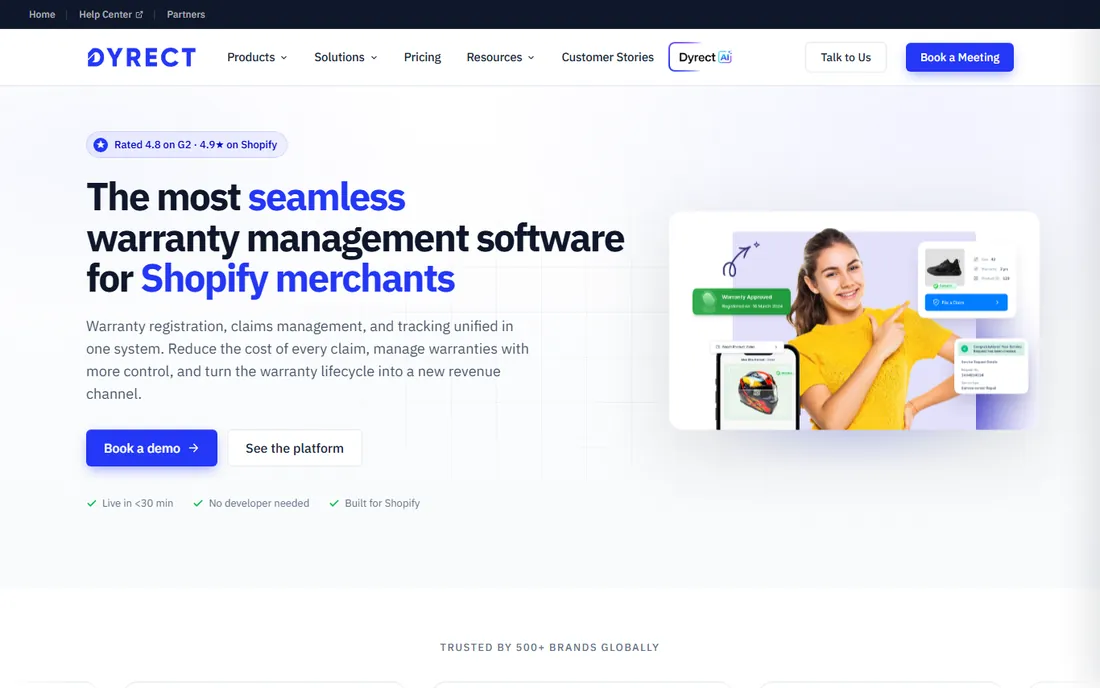
Dyrect is the most approachable entry point in this category. Its pricing page lists every plan in the open: a free tier with 100 lifetime credits, Registration at $19 per month, Claims at $49 and Claims Pro at $149, each with 100 monthly credits where one credit equals one registration, claim or repair action. Customers scan a QR code on the packaging, register through a branded page and later file claims in a self-serve portal.
The credit model is the thing to model before committing. A growing brand doing 500 registrations and 50 claims a month will burn through the included credits and pay overage fees, so project your volume honestly. The integrations with Shopify, Klaviyo, HubSpot, Mailchimp, Zendesk and Gorgias turn registration data into marketing fuel, which is Dyrect's real differentiator.
Dyrect fits ecommerce and omnichannel consumer brands that want registration, claims and post-purchase engagement in one tool. Industrial manufacturers with dealer networks should look at PTC or Syncron instead.
What we like- Published pricing with a genuine free plan
- QR-code registration and branded customer portal
- Integrations with Shopify, Klaviyo, HubSpot and Zendesk
Watch out for- Credit-based pricing needs watching as volume grows
- Built for consumer brands, not industrial dealer networks
Starting priceSee website (custom, based on claim volume)
Free planFree trial (14 days, per reviewers)
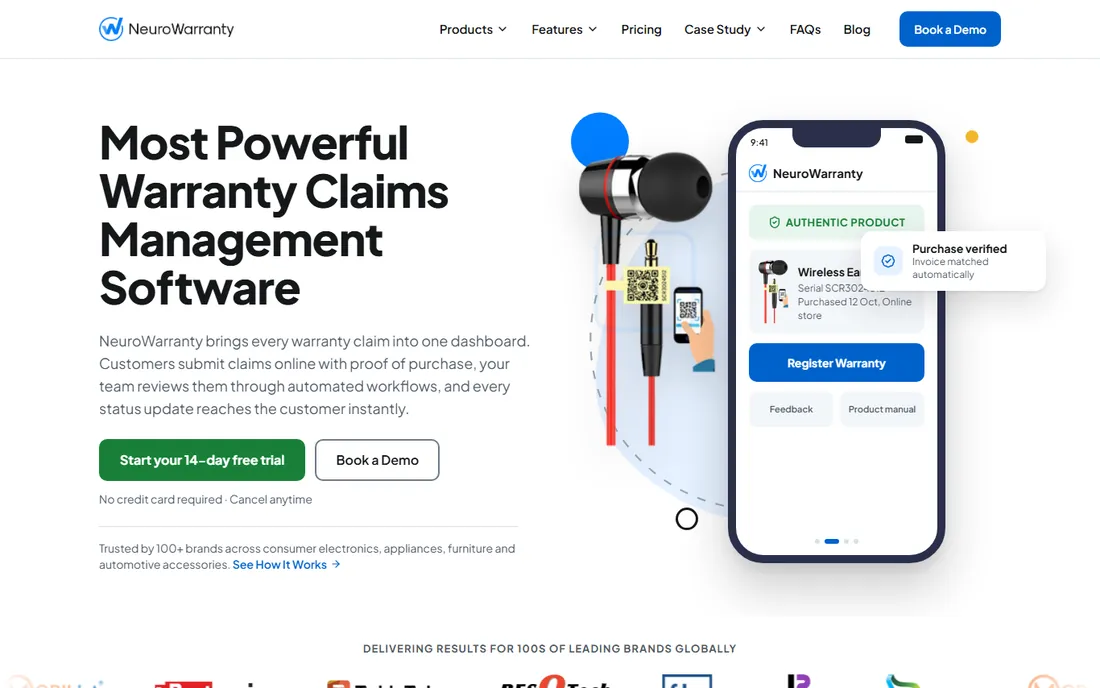
NeuroWarranty digitizes the warranty journey from product registration to claim resolution. Customers submit claims through an online form with serial numbers, invoices and photos, and the platform verifies purchase details, flags duplicates and routes each claim through rule-based workflows. Its homepage positions the product around paperless warranty processes for electronics, appliances, furniture and automotive accessories.
The built-in CRM is a nice touch: after a claim is resolved, the system collects customer feedback and helps turn satisfied customers into positive reviews. Pricing is customized to claim volume and features, so expect a demo and a quote conversation. A 14-day trial is widely reported by reviewers.
NeuroWarranty suits consumer brands that want the claim process to double as a customer engagement channel. If your buyers are dealers and distributors rather than end consumers, the enterprise picks below fit better.
What we like- No-app digital warranty experience for customers
- Duplicate claim detection
- Built-in CRM with feedback and review management
Watch out for- Pricing is not published
- Feature depth is consumer-brand focused
Starting priceSee website (custom quote)
Free planNo
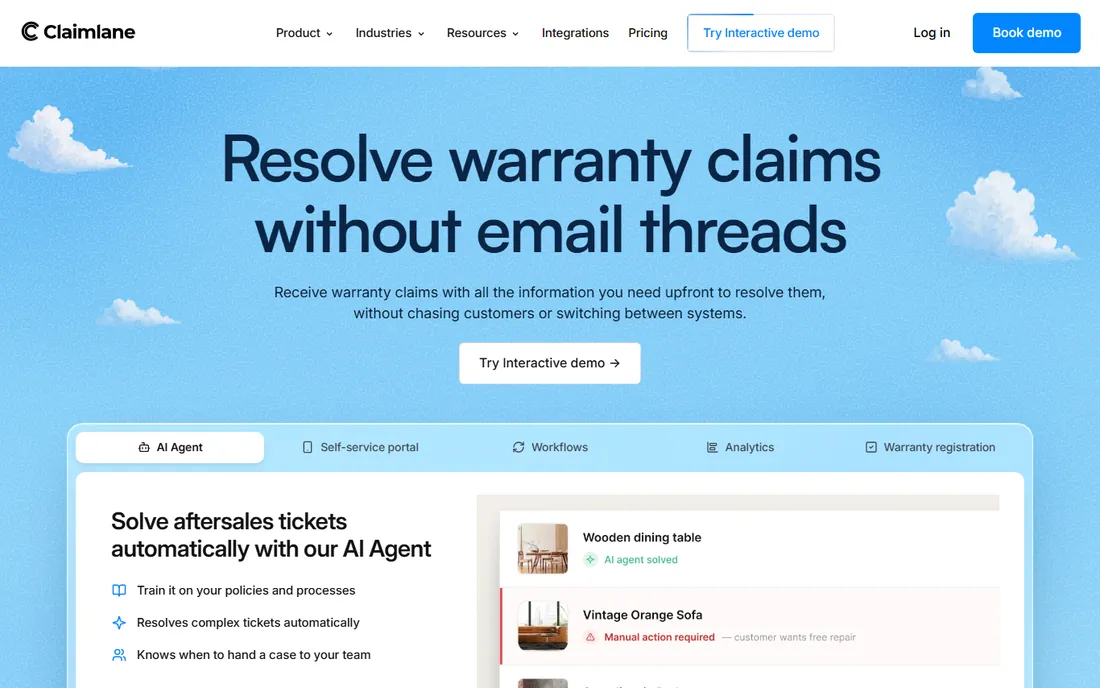
Claimlane's pitch is simple: resolve warranty claims without email threads. Customers submit claims with photos, videos and details through a branded portal, an AI agent handles routine cases by asking follow-up questions and checking warranty terms, and your team gets complete cases instead of fragments. It connects with Shopify, Magento, WooCommerce, Zendesk, Microsoft Dynamics 365, NetSuite, SAP and Klaviyo.
The vendor's own FAQ puts implementation at 2 to 4 weeks for straightforward Shopify setups and 4 to 8 weeks for complex enterprise configurations, which is honest and useful for planning. Pricing is quote-based with no public trial, so budget a proper evaluation cycle.
Claimlane fits retailers and brands whose support teams drown in aftersales tickets. Very small shops may find Dyrect's published pricing and free plan easier to start with.
What we like- Self-service portal with an AI agent that resolves routine tickets
- Strong ecommerce and ERP integrations
- Handles complex multi-part products
Watch out for- No published pricing or free trial
- Implementation takes 2 to 8 weeks depending on complexity
Starting priceSee website (volume-based pricing)
Free planNo (free demo; no long-term contracts, per vendor)
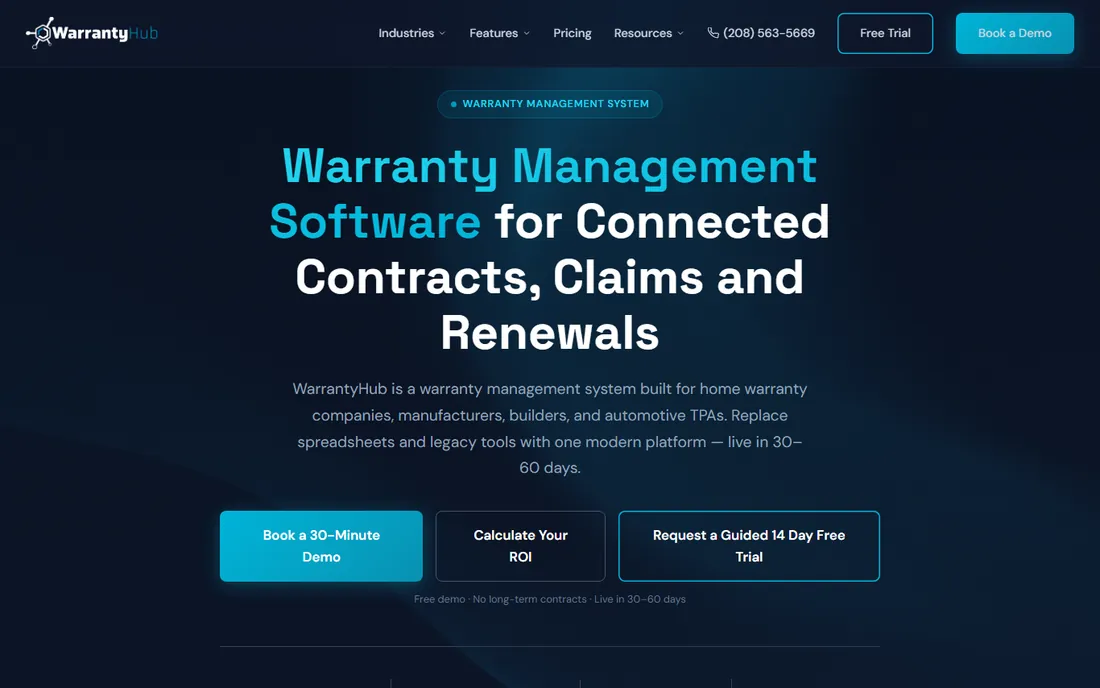
WarrantyHub is one of the few platforms built specifically for contract-style warranty businesses: home warranty companies, residential and commercial builders, manufacturers and automotive third-party administrators. It covers policy management, claims processing, contractor dispatch, renewals and customer portals in one system, with implementation quoted at 30 to 60 days.
The commercial terms stand out in a category full of lock-ins. The vendor advertises no long-term contracts and volume-based pricing, which lowers the risk of trying the platform. Integrations include Stripe, Authorize.net, Salesforce, HubSpot, QuickBooks, Xero and a public API.
WarrantyHub suits companies that administer warranty contracts rather than just product warranties. If you sell consumer products direct and need registration-led workflows, Dyrect or NeuroWarranty are closer matches.
What we like- Purpose-built for home warranty, builders, manufacturers and automotive TPAs
- No long-term contracts
- 80+ automated notification triggers
Watch out for- Pricing requires a quote
- Narrower fit for pure consumer-electronics brands
#5
PTC Warranty
Best for: Enterprise manufacturers in service operations
Visit ptc.com
Starting priceSee website (enterprise license, custom quote)
Free planNo
PTC Warranty sits inside PTC's service lifecycle management portfolio, which means it connects warranty operations with the engineering and service data most manufacturers already run on PTC products. It handles claim validation, supplier recovery, parts ordering and warranty analytics at enterprise scale, with the kind of policy management that global service networks require.
Everything about the buying and deployment process is enterprise-grade. Expect custom licensing, a structured implementation and IT involvement. This is not a tool you trial on a credit card; it is a platform decision that belongs in an annual planning cycle.
PTC Warranty fits large manufacturers already invested in PTC's ecosystem or running complex service operations across dealer networks. Mid-size brands will find it heavier and slower to deploy than the SaaS picks above.
What we like- Part of a mature service lifecycle management suite
- Strong analytics on warranty cost drivers
- Deep integration with engineering and service data
Watch out for- Enterprise-only sales and pricing
- Implementation is a serious project
#6
Syncron Warranty
Best for: OEMs focused on supplier cost recovery
Visit syncron.com
Starting priceSee website (custom quote)
Free planNo

Syncron approaches warranty as one piece of the aftermarket puzzle. Its platform standardizes claim workflows, automates approvals and ties warranty data to parts planning and pricing, so manufacturers can see the full cost picture instead of managing claims in isolation. Supplier recovery, often an afterthought, is a first-class workflow here.
The vendor's own materials emphasize reduced warranty costs through better accuracy and higher recovery rates. As with all the enterprise picks, pricing is custom and the sales cycle is consultative. Syncron's sweet spot is automotive, agriculture, construction and industrial equipment manufacturers with dealer networks.
Choose Syncron when warranty is an aftermarket profit lever, not just a cost center. Consumer brands and small manufacturers will find the platform and the process oversized for their needs.
What we like- End-to-end warranty lifecycle with supplier recovery built in
- Connects warranty data with parts pricing and inventory
- AI-assisted analytics
Watch out for- Built for large OEMs, with pricing and process to match
- Not a fit for small teams
#7
Pega Warranty
Best for: Complex multi-party claim workflows
Visit pega.com
Starting priceSee website (enterprise license, custom quote)
Free planNo
Pega Warranty is a strategic application built on the Pega Platform, and it shows. Claims move through case-based workflows covering prior approvals, validation, auto-adjudication, manual review, settlements and appeals, with predictive and adaptive analytics layered on top. Supplier recovery, dealer claim handling and corrective action programs all run in the same system.
The implementation guide on Pega's own documentation site makes clear this is a developer and architect-led project, not a plug-and-play SaaS signup. Pricing follows enterprise licensing with custom quotes based on claim volume and modules. Organizations already running Pega for other processes get the most value, since the platform skills transfer.
Pega Warranty suits large manufacturers and enterprises managing high-volume claims across dealer networks and supplier chains. Everyone else should start with a lighter tool.
What we like- Case management handles the full claim lifecycle including appeals
- Predictive analytics for fault diagnosis
- Strong multi-tier approval chains
Watch out for- Requires structured IT resources to implement
- Platform complexity exceeds what mid-market teams need
Starting priceSee website (custom quote)
Free planNo
ReverseLogix is primarily a returns management system, but its warranty capabilities earn it a place here. It validates warranty claims against terms and distributor contracts, routes units through inspection, grading and depot repair, and tracks parts consumed at the component level. For manufacturers where a warranty claim usually means a physical product coming back, that combination matters.
The platform's own comparison tables position it against stitched-together stacks of portals, ERPs and warehouse systems. It integrates with major ERPs and carriers, and the vendor emphasizes fraud alerts and audit trails. Pricing is custom and enterprise-oriented.
ReverseLogix fits manufacturers and retailers whose warranty process is inseparable from reverse logistics. If your claims rarely involve physical returns, a claims-focused platform like Claimlane or WarrantyHub will be a tighter fit.
What we like- Runs returns, warranty and repair on one system of record
- Claim validation against warranty terms and entitlements
- Component-level repair tracking
Watch out for- Returns-first platform, so pure warranty administration is not its center
- Enterprise pricing with custom quotes
How we chose
We started with the warranty platforms that surface most often in buyer guides, G2 and Capterra listings and industry roundups, then kept only products that are actively sold today. For each vendor we opened the official website and pricing page to record published prices, plan names, free tiers and trial terms. Where pricing was not published, we wrote "See website" instead of repeating third-party estimates. Feature descriptions come from vendor documentation and product pages, and the honest catches come from patterns in public user reviews, not from hands-on testing we did not do.
How to choose warranty management software
Start with who files the claim
Consumer brands need registration-led, customer-facing portals with QR codes and branded experiences. Manufacturers and warranty administrators need dealer portals, supplier recovery and contract management. These are different products, so shortlist within your half of the market first.
Price the volume, not the plan
Credit-based, per-claim and volume-tiered pricing all punish growth if you misjudge. Take your last twelve months of registrations and claims, project next year, and ask each vendor to quote that exact volume in writing. The cheapest plan on the pricing page is rarely the cheapest at your volume.
Check the integrations you actually run
Warranty software touches orders, customers and money. Confirm native integrations with your ecommerce platform, ERP and helpdesk before shortlisting. API access is a fallback, not a plan, because custom integrations add weeks to every rollout.
Ask about fraud controls specifically
Duplicate and ineligible claims are a quiet tax on every warranty program. Ask each vendor how eligibility is verified, how duplicates are flagged and what evidence the system requires before approval. Vague answers here are a red flag.
Frequently asked questions
How much does warranty management software cost?
It ranges widely. Dyrect publishes plans from $19 to $149 per month plus usage credits. Enterprise platforms for manufacturers (PTC, Syncron, Pega) sell on custom quotes that typically run into five or six figures annually. Home warranty and contract-focused tools like WarrantyHub use volume-based pricing. Always quote your actual claim volume.
What is the difference between warranty management and claims management?
Warranty management covers the full lifecycle: product registration, coverage tracking, claims, repairs and analytics. Claims management is the subset that handles intake, verification, approval and resolution of individual claims. Most platforms on this list do both, but some lean toward one end.
How long does implementation take?
Simple ecommerce setups go live in 2 to 4 weeks. Mid-market deployments with integrations typically take 4 to 8 weeks. Enterprise rollouts with dealer networks, data migration and custom workflows run 30 to 60 days or longer. Ask for a written implementation plan with acceptance criteria before signing.
Can warranty software reduce fraudulent claims?
Yes, and this is one of its clearest returns. Automated eligibility checks, serial number validation and duplicate detection catch the repeat submissions and ineligible claims that manual processes miss. Research cited by vendors in this space puts fraudulent claims at 3 to 15 percent of total warranty costs.
Do we need QR codes for warranty registration?
Not necessarily, but they remove the biggest friction point: getting customers to register at all. A scan-and-register flow on the packaging captures verified purchase data at the moment of unboxing, which speeds up every future claim. If your products ship in boxes, QR registration is worth serious consideration.
What a rollout actually looks like
A realistic warranty software rollout has four phases. First, discovery: map your current claim process, from the first customer email to the final credit note, and identify where claims get stuck. Second, configuration: build the claim forms, approval rules and coverage policies in the new system, and connect your store, ERP and helpdesk. Third, pilot: run one product line or region on the platform for a few weeks and measure resolution time against your old process. Fourth, full launch with training for agents and service partners.
The most common failure is skipping the pilot. Warranty touches money and customer trust, so a quiet trial with real claims catches configuration mistakes before they affect every customer. The second most common failure is underestimating data migration: years of spreadsheet claims need cleaning before they import cleanly. Budget time for both and your go-live will be uneventful, which is exactly what you want.
Sources we checked (9)
- https://www.dyrect.co/
- https://www.dyrect.co/pricing
- https://neurowarranty.com/
- https://claimlane.com/
- https://warrantyhub.com/
- https://ptc.com/
- https://syncron.com/
- https://pega.com/
- https://reverselogix.com/
Is your product missing or out of date?
We review this list regularly. Vendors can request a listing, send updated pricing or ask about featured placement.

Shihab Mia · Founder, Rankite
Shihab has 5+ years in B2B and SaaS SEO. He writes Rankite's software buying guides from pricing pages, documentation and public user reviews. More about Shihab.