How we make this list: we compare pricing pages, product documentation and public user reviews. Ratings come from G2, Capterra or Trustpilot, with the date we checked them.

What is the best virtual care software for hospitals?
Amwell is the best virtual care software for most hospitals, because its Converge platform covers scheduled visits, on-demand urgent care, behavioral health and automated care programs on one system with deep EHR integration. Hospitals that need inpatient virtual nursing and tele-ICU should look at Caregility instead, while Teladoc Health Solo suits systems that want one device running many bedside programs.
Key takeaways:
- Amwell leads for system-wide virtual care, with one platform for scheduled visits, urgent care and behavioral health.
- Caregility is the strongest choice for inpatient programs such as virtual nursing, virtual observation and tele-ICU.
- Teladoc Health Solo lets one bedside device run virtual nursing, virtual sitting, telestroke and AI monitoring together.
- Most hospital virtual care platforms are sold by quote only, so budget for a sales process and implementation fees.
- Fabric suits health systems that want a white-label, asynchronous first virtual care service under their own brand.
How is hospital virtual care different from ordinary telehealth?
Ordinary telehealth software connects one patient and one clinician over video. Hospital virtual care goes further. It covers inpatient rooms, emergency departments, intensive care units and patients at home. A platform built for hospitals supports virtual nursing, where a remote nurse handles admissions, discharges and documentation for several rooms at once. It supports virtual observation, where one staff member watches several at-risk patients to prevent falls. It supports tele-ICU, where remote intensivists monitor patients across units. It also has to connect to the EHR, route consults to the right specialist, and keep a full audit trail for compliance.
What should hospitals check before buying virtual care software?
Start with the care models you plan to run. A platform that excels at scheduled outpatient visits may not support virtual nursing or tele-ICU, and a platform built for inpatient care may lack patient self-scheduling. Ask vendors to show each workflow on a live demo. Check EHR integration next: the platform should write visit notes, orders and charges back to your EHR, and support single sign-on for clinicians. Check device strategy too, since some platforms need purpose-built carts and in-room cameras, which adds capital cost. Finally, check compliance documentation, including HIPAA, HITRUST or SOC 2 reports.
How much does virtual care software cost for a hospital?
Almost every enterprise virtual care platform is sold by quote only. Amwell, Caregility, Fabric, eVisit, SOC Telemed, Mend and swyMed do not publish hospital license prices, and Teladoc Health publishes self-pay visit prices but quotes its Solo enterprise platform per health system. Ask for the platform license, the hardware, implementation and training, EHR integration, and ongoing support as separate lines. Directory listings for eVisit show 600 dollars per month, and listings for Mend show either 49.99 dollars per user per month or 295 dollars per month, but neither figure comes from the vendor, and both conflict with the vendors current quote-only pricing.
We started with platforms that sell to hospitals and health systems. Each tool had to support at least one hospital-grade workflow, such as virtual nursing, tele-ICU, telestroke, virtual observation or system-wide video visits. We checked every vendor homepage on 22 November 2026 and kept only tools whose sites load and whose products are still sold. We excluded InTouch Health because Teladoc Health acquired it in July 2020 and folded it into the Solo platform, so it is no longer a standalone purchase. Prices were checked on 22 November 2026.
Quick comparison
| Tool | Best for | Starting price | Free plan |
|---|
 Amwell | Health systems that want one virtual care platform for scheduled visits, urgent care and behavioral health | Quote for enterprise licensing; self-pay urgent care visits from 79 dollars | No free plan |
 Teladoc Health | Hospitals that want one bedside device to run virtual nursing, virtual sitting, telestroke and AI monitoring | 89 dollars per visit for self-pay urgent care; Solo enterprise platform by quote | No free plan |
 Caregility | Hospitals building inpatient virtual care programs such as virtual nursing, tele-ICU and virtual observation | Quote | No free plan |
 Fabric | Health systems that want a white-label virtual care service under their own brand, starting with asynchronous visits | Quote | No free plan |
 eVisit | Hospitals and health systems that want the full visit workflow, from scheduling and intake through discharge, on one platform | Quote; third-party directories list 600 dollars per month, which the vendor does not confirm | No free plan |
 SOC Telemed | Hospitals that need on-demand acute specialist coverage, especially teleneurology, telepsychiatry and tele-ICU | Quote | No free plan |
 Mend | Hospitals and health systems that want to cut no-shows and fill schedules with self-scheduling and automated engagement | Quote; the vendor pricing page checked 22 November 2026 lists custom pricing only | No free plan |
 swyMed | Hospitals with mobile care programs, community paramedicine, telestroke in transit and rural outreach | Quote | No free plan |
Is your product missing or out of date?
We review this list regularly. Vendors can request a listing, send updated pricing or ask about featured placement.
The best virtual care software for hospitals
| Tool |
Starting price |
Free plan |
Best for |
Hospital strength |
| Amwell |
Quote |
No free plan |
System-wide virtual care |
One platform for visits, urgent care and behavioral health |
| Teladoc Health |
89 dollars per visit (self-pay); enterprise quote |
No free plan |
Multi-program bedside devices |
Solo device runs virtual nursing, sitting and telestroke |
| Caregility |
Quote |
No free plan |
Inpatient virtual care |
Virtual nursing, tele-ICU and observation at scale |
| Fabric |
Quote |
No free plan |
White-label asynchronous care |
Fast branded virtual care with clinician protocols |
| eVisit |
Quote |
No free plan |
Visit workflow management |
Scheduling, intake, waiting room and discharge in one flow |
| SOC Telemed |
Quote |
No free plan |
Acute specialist coverage |
Telemed IQ plus its own teleneurology and telepsychiatry network |
| Mend |
Quote |
No free plan |
No-show reduction and engagement |
Predictive no-show analytics and self-scheduling |
| swyMed |
Quote |
No free plan |
Mobile and field care |
Reliable video in low-bandwidth and moving settings |
#1
Amwell
Best for: Health systems that want one virtual care platform for scheduled visits, urgent care and behavioral health
Visit amwell.com
Starting priceQuote for enterprise licensing; self-pay urgent care visits from 79 dollars
Free planNo free plan
Amwell is a telehealth company founded in 2006, and its Converge platform is built to be the digital front door for a whole health system. Hospitals can run scheduled video visits, on-demand urgent care, behavioral health, psychiatry and automated care programs from the same system. The platform integrates with major EHR systems so visit documentation stays inside existing clinical workflows. Amwell Medical Group supplies a nationwide clinician network for after-hours and shortage-specialty coverage. Self-pay urgent care visits list from 79 dollars, but hospital licensing is quote only.
What we like- Single Converge platform covers many service lines, deep EHR integration, large clinician network through Amwell Medical Group, long track record with health systems and payers
Watch out for- Enterprise pricing is not published, so hospitals must go through a sales process to learn cost, and the breadth of the platform can mean a longer implementation than a point solution
#2
Teladoc Health
Best for: Hospitals that want one bedside device to run virtual nursing, virtual sitting, telestroke and AI monitoring
Visit teladochealth.com
Starting price89 dollars per visit for self-pay urgent care; Solo enterprise platform by quote
Free planNo free plan

Teladoc Health is the largest virtual care company in the United States by reach, and its Solo platform is the part hospitals buy. Solo is designed for inpatient and emergency department use, and a single Solo unit can support virtual nursing, virtual sitting, telestroke consults and AI monitoring together, which reduces the number of devices a hospital must install and maintain in each room. It supports secure video visits and embeds into the EHR through Connect Embedded. Self-pay urgent care visits list at 89 dollars, but hospital platform pricing is quoted per system.
What we like- Solo platform runs several programs on one device, strong inpatient and emergency department focus, HITRUST certified with SOC 2 Type II compliance, wide employer and health plan distribution
Watch out for- Self-pay per-visit pricing does not reflect hospital licensing cost, and buyers must scope carefully to separate the software platform from the clinician network service
#3
Caregility
Best for: Hospitals building inpatient virtual care programs such as virtual nursing, tele-ICU and virtual observation
Visit caregility.com
Starting priceQuote
Free planNo free plan
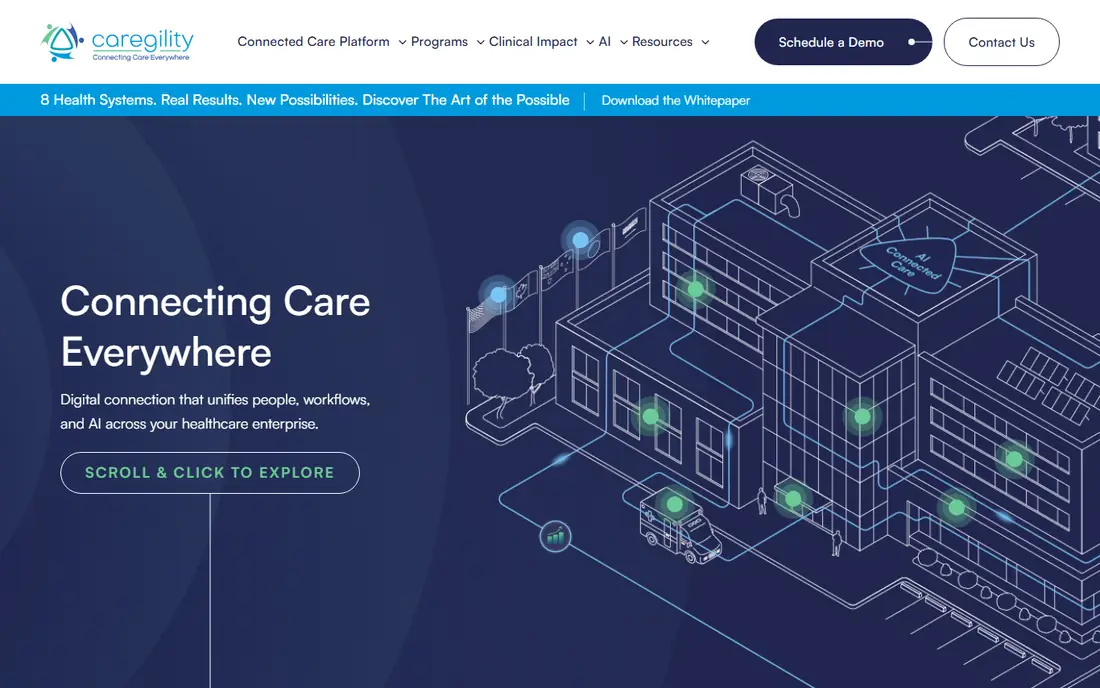
Caregility is the most inpatient-focused platform in this guide. Its Connected Care Platform runs virtual nursing, virtual observation, tele-ICU, tele-neurology consults, emergency department triage, perioperative support, hospital-at-home and behavioral health consults. Virtual nursing lets remote nurses handle admissions, discharges, dual-nurse verification and documentation, while virtual observation lets one staff member monitor several fall-risk patients with immediate alerting. The platform integrates with Epic and connects to bedside devices and sensors. Caregility reports supporting more than 1,000 hospitals across more than 75 health systems. Pricing is quote only.
What we like- Purpose-built for inpatient workflows with more than 70 documented clinical workflows, Epic integration, Best in KLAS Virtual Care Platform (non-EMR) in 2021, 2022 and 2023, proven at more than 1,000 hospitals
Watch out for- The platform is built around in-room hardware such as cameras and carts, so capital cost and installation effort are higher than for software-only tools, and it is more than a small hospital needs
#4
Fabric
Best for: Health systems that want a white-label virtual care service under their own brand, starting with asynchronous visits
Visit fabrichealth.com
Starting priceQuote
Free planNo free plan
Fabric is the current name for the company formerly known as Zipnosis, which pioneered white-label virtual care for health systems. The platform lets a health system launch its own branded virtual care service, staffed by its own clinicians or by Fabrics clinical network. Its Hybrid AI uses physician-built protocols to guide intake, support clinical decisions and draft documentation for clinician review, and the company reports more than 100 million lives covered. Patients complete an adaptive online interview for common conditions such as sinus infections, urinary tract infections and pink eye, and clinicians can treat by chat, phone or video. Pricing is quote only.
What we like- White-label experience under the hospitals brand, asynchronous visits that let clinicians treat low-acuity cases in minutes, more than 100 physician-built clinical protocols, own clinician network available for coverage
Watch out for- The asynchronous-first model suits low-acuity conditions best, so hospitals that need live video-first specialist consults will need to lean on the video and chat options or add other tools
#5
eVisit
Best for: Hospitals and health systems that want the full visit workflow, from scheduling and intake through discharge, on one platform
Visit evisit.com
Starting priceQuote; third-party directories list 600 dollars per month, which the vendor does not confirm
Free planNo free plan
eVisit is a telehealth platform founded in 2013 that positions itself as the one system for the whole virtual visit. It covers appointment scheduling, digital intake, virtual waiting room management, the video visit itself, ePrescribing, payment processing and discharge. The platform is white-label, and it is designed for organizations ranging from primary care and urgent care clinics to the largest hospital systems. Unlike many telehealth vendors that also operate as healthcare providers, eVisit sells only the platform, so it does not compete with its hospital customers for patients. The vendor publishes no pricing, and third-party directories list 600 dollars per month, a figure the vendor does not confirm.
What we like- Covers scheduling, intake, virtual waiting room, visit and discharge in one flow, white-label branding, serves health systems of all sizes, not a care provider so it does not compete with its customers for patients
Watch out for- The vendor publishes no pricing, so buyers cannot compare cost without a sales conversation, and public detail on inpatient workflows is thinner than for acute-care specialists such as Caregility or SOC Telemed
#6
SOC Telemed
Best for: Hospitals that need on-demand acute specialist coverage, especially teleneurology, telepsychiatry and tele-ICU
Visit soctelemed.com
Starting priceQuote
Free planNo free plan
SOC Telemed, formerly Specialists On Call, is an acute care telemedicine provider that sells both a platform and a specialist service. Its Telemed IQ platform supports teleneurology, telepsychiatry, tele-critical care, tele-pulmonology, tele-cardiology, tele-infectious disease, tele-nephrology and maternal-fetal medicine. Hospitals use it to get a specialist on video within minutes for time-critical cases such as stroke. The company reports its platform in use in more than 550 hospitals, and the 45-hospital Prime Healthcare system selected Telemed IQ as the platform for its national telemedicine operations. Pricing is quote only.
What we like- Telemed IQ platform built for acute care, own network of board-certified specialists available around the clock, used by large systems such as the 45-hospital Prime Healthcare network, supports many specialties from one platform
Watch out for- Pricing is quote only, and because the offer pairs a platform with a clinician network service, ongoing service fees sit on top of platform cost and buyers must understand both lines
#7Mend
Best for: Hospitals and health systems that want to cut no-shows and fill schedules with self-scheduling and automated engagement4.7/5 on
G2 (133 reviews, checked Oct 2026)
Visit mend.com
Starting priceQuote; the vendor pricing page checked 22 November 2026 lists custom pricing only
Free planNo free plan
Mend is a telehealth and patient engagement platform that combines video visits with the operational tools hospitals use to keep schedules full. Its two core buying paths are Engage, which covers appointment reminders, digital intake, portal-free SMS outreach and no-show reduction, and Access, which covers patient self-scheduling, smart waitlists and capacity recovery. The newer Coordinate product is an AI scheduling coordinator that talks with patients by text and fills open slots, and it carries a contractual 1 to 1 ROI guarantee. Pricing is now quote only: the vendor pricing page checked on 22 November 2026 lists custom pricing, and third-party directories conflict, with one listing 49.99 dollars per user per month and another listing 295 dollars per month.
What we like- Predictive no-show analytics with automated outreach, patient self-scheduling embedded in the hospitals website, smart waitlist and capacity recovery, contractual 1 to 1 ROI guarantee with the Coordinate product
Watch out for- The vendor no longer publishes prices, so older directory figures conflict and cannot be relied on, and the engagement focus makes it weaker than inpatient specialists for tele-ICU or virtual nursing
#8
swyMed
Best for: Hospitals with mobile care programs, community paramedicine, telestroke in transit and rural outreach
Visit swymed.com
Starting priceQuote
Free planNo free plan
swyMed is a telemedicine company built for care that happens outside the hospital walls and outside reliable broadband. Its platform combines software, hardware and connectivity to deliver live video in moving ambulances, rural homes and other low-bandwidth settings where ordinary video tools fail. Hospitals use it for community paramedicine and mobile integrated healthcare, remote patient evaluation, mobile telestroke, monitoring during pediatric and high-risk transports, and post-discharge follow-up to reduce readmissions. The platform integrates with EHR systems, PACS imaging and medical devices. Pricing is quote only.
What we like- Patented low-bandwidth video that holds up in moving vehicles and rural areas, purpose-built for mobile integrated healthcare and community paramedicine, EHR and PACS integration, hardware and connectivity bundles available
Watch out for- The mobile and field focus means fewer scheduled outpatient visit features than broader platforms, and the vendor is smaller than the enterprise names in this guide, so buyers should check roadmap and support capacity
Frequently asked questions
How much does virtual care software cost for a hospital?
Most hospital virtual care platforms are sold by quote only, and the vendors in this guide do not publish hospital license prices. Teladoc Health lists self-pay visit prices from 89 dollars, and Amwell lists self-pay urgent care from 79 dollars, but those are consumer visit prices, not platform licenses. Ask each vendor for a written quote covering license, hardware, implementation, EHR integration and support as separate lines, so you can compare like with like.
What is the difference between virtual nursing and tele-ICU?
Virtual nursing uses remote nurses to handle admissions, discharges, education, dual-nurse verification and documentation for patients on general wards, which frees bedside nurses for hands-on care. Tele-ICU uses remote intensivists and critical care nurses to monitor ICU patients continuously, with proactive surveillance rounds and rapid intervention when a patient deteriorates. Caregility, Teladoc Health Solo and SOC Telemed all support these models, but Caregility has the deepest inpatient workflow library of the three.
Do these platforms integrate with Epic?
Yes, the leading platforms in this guide publish Epic integration. Caregility lists Epic integration as part of its Connected Care Platform, Amwell integrates with major EHR systems including Epic, and Teladoc Health offers Connect Embedded to place video inside the EHR. Before signing, ask the vendor to confirm the exact integration points you need, such as scheduling, documentation writeback, orders and charge capture, and ask for a reference customer running the same EHR version.
Can a small hospital afford virtual care software?
A small hospital can afford it, but the right model matters. Software-only platforms with per-provider pricing, such as eVisit or Mend, have lower entry costs than hardware-heavy inpatient platforms such as Caregility. A critical access hospital can also start with one use case, such as telestroke or virtual sitting, rather than buying a full platform. Teladoc says Solo suits hospitals from 25 beds upward, and SOC Telemed supplies the specialist network as a service, which avoids hiring.
What happened to InTouch Health and Zipnosis?
Teladoc Health acquired InTouch Health in July 2020 for 600 million dollars and folded it into the Teladoc Solo platform, so it is no longer sold standalone. Zipnosis, an early white-label virtual care company, is now part of Fabric Health, and its website now serves Fabric content under the Fabric brand. Both changes matter when you read older reviews, because prices and product names from before the acquisitions no longer apply.
Sources we checked (12)
- https://www.amwell.com
- https://www.teladochealth.com
- https://caregility.com
- https://caregility.com/virtual-care-workflow-library-clinical-workflow-examples-for-hospitals/
- https://www.fabrichealth.com
- https://www.evisit.com
- https://www.soctelemed.com
- https://www.healthcareitnews.com/news/himss19-telemedicine-developments-american-well-others
- https://www.mend.com/pricing/
- https://www.swymed.com
- https://hitconsultant.net/2020/01/12/teladoc-health-acquires-virtual-care-platform-intouch-health-for-600m/
- https://www.capterra.com/p/136499/eVisit/alternatives/
Is your product missing or out of date?
We review this list regularly. Vendors can request a listing, send updated pricing or ask about featured placement.

Shihab Mia · Founder, Rankite
Shihab has 5+ years in B2B and SaaS SEO. He writes Rankite's software buying guides from pricing pages, documentation and public user reviews. More about Shihab.