How we make this list: we compare pricing pages, product documentation and public user reviews. Ratings come from G2, Capterra or Trustpilot, with the date we checked them.
Key takeaways
- Delphix is the strongest all-round enterprise pick, because it combines virtual clones, masking, and synthetic data in one platform with self-service delivery.
- GenRocket and Tonic.ai suit teams that want synthetic data without copying production data at all, while Informatica and IBM Optim suit teams that must mask and subset existing production data.
- K2view stands out for microservices and entity-based testing, since it builds a small, consistent database per customer, order, or account.
- DATPROF is the most practical mid-market choice, with modular masking, subsetting, virtualisation, and automation at a clearer price point than enterprise rivals.
- Almost every vendor here sells by quote, so a proof of concept on your own databases, with your own privacy rules, matters more than any feature comparison.
Quick comparison
| Tool | Best for | Starting price | Free plan |
|---|
 Delphix | Enterprise virtual clones and compliant delivery | See website | No / Demo |
 Informatica Test Data Management | Masking and subsetting inside a large data platform | See website | No / Demo |
 Broadcom Test Data Manager | Large organisations on Broadcom infrastructure | See website | No / Demo |
 IBM InfoSphere Optim | Regulated industries needing subsetting and archiving | See website | No / Demo |
 GenRocket | Real-time synthetic data at volume | See website | No / Demo |
 K2view | Entity-based test data for microservices | See website | Yes (free start) |
 Tonic.ai | De-identified and synthetic data for developers | See website | Yes (Fabricate free tier) |
 DATPROF | Mid-market masking, subsetting, and automation | See website | No / Free trial |
Is your product missing or out of date?
We review this list regularly. Vendors can request a listing, send updated pricing or ask about featured placement.
#1
Delphix
Best for: Enterprise virtual clones and compliant delivery
Visit delphix.com
Starting priceSee website
Free planNo / Demo
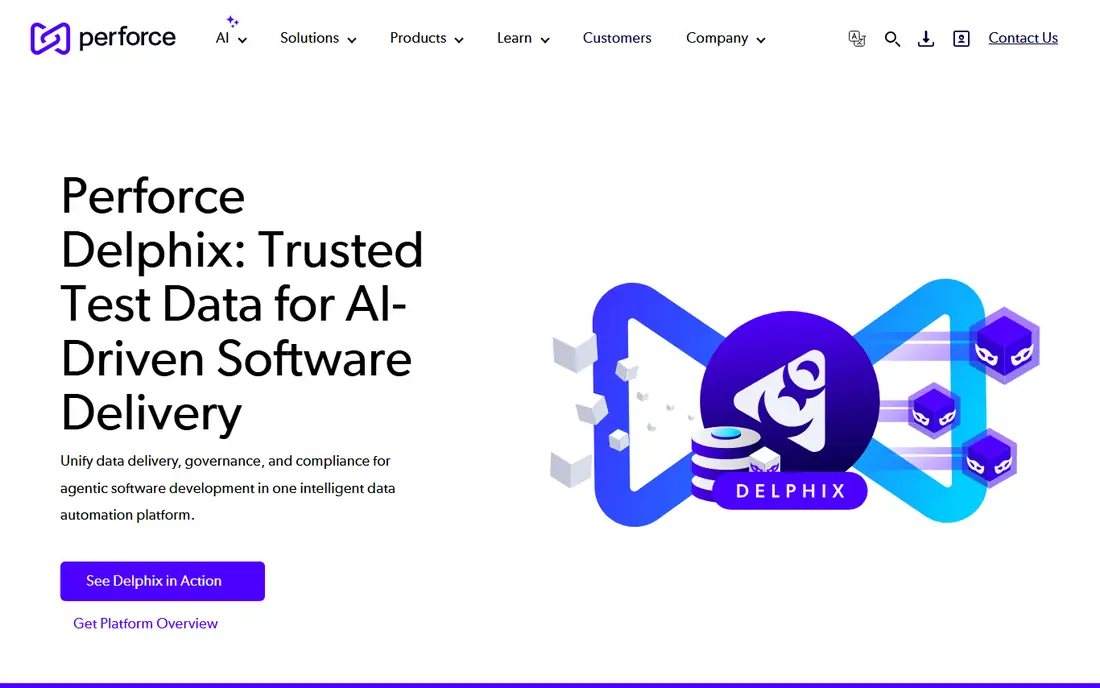
Delphix, now Perforce Delphix, suits an enterprise team that spends too long waiting for test databases. Instead of copying a full production database for each environment, Delphix virtualises it, so developers and testers can provision thin clones in minutes, refresh them, and rewind them to an earlier point when a test goes wrong. Masking identifies and hides personal and health data before it reaches non-production environments, and synthetic generation covers new scenarios and edge cases.
The cost is enterprise scope. Delphix is sold by quote and demo, implementation touches many database platforms, and running it well needs data and infrastructure skills. A team with a handful of databases and simple tests will find it heavy, while a large team with many environments, regulated data, and slow refresh cycles will gain the most from virtual clones and self-service delivery.
What we like- Virtual database clones in minutes
- Automated masking and synthetic data
- Self-service refresh and rewind
Watch out for- Enterprise pricing and implementation effort
- Needs specialist skills to run well at scale
#2
Informatica Test Data Management
Best for: Masking and subsetting inside a large data platform
Visit informatica.com
Starting priceSee website
Free planNo / Demo
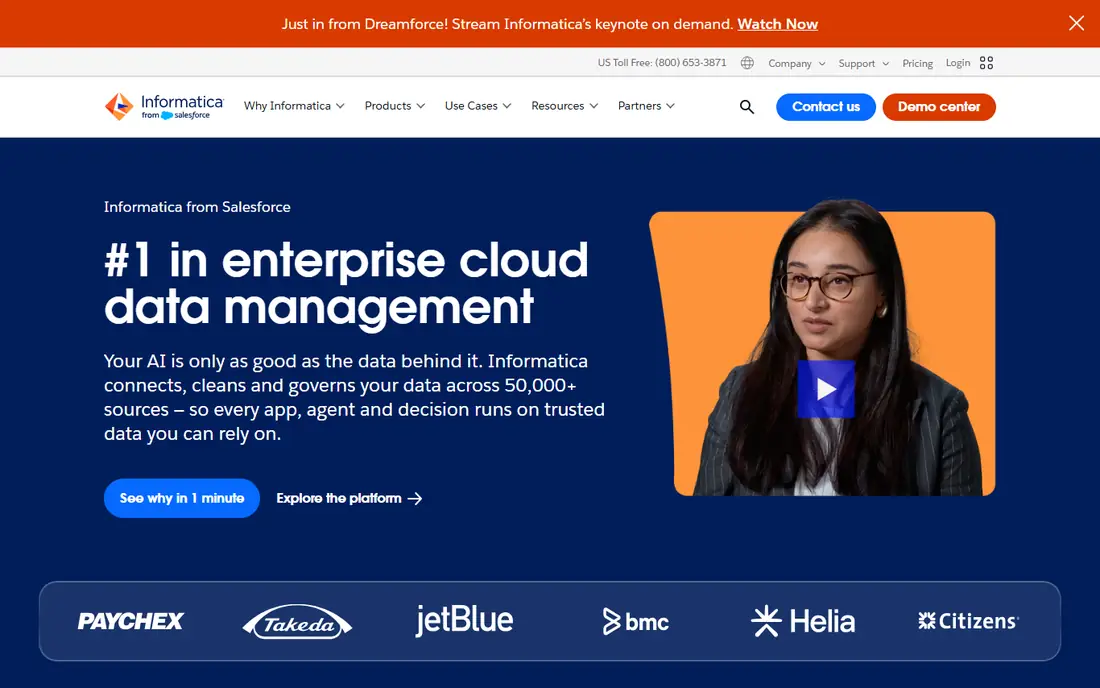
Informatica Test Data Management fits an organisation that already runs Informatica for integration, quality, or governance and wants test data handled inside the same platform. It discovers sensitive data, masks it with consistent rules, and subsets large databases into smaller, referentially intact test sets, which reduces storage and refresh time. Integration with the wider Informatica platform helps data teams apply the same governance rules in production and test.
The trade-off is complexity. Informatica is a broad platform, not a single-purpose test data tool, so deployment and administration take longer than with DATPROF or Tonic.ai. Synthetic data generation is also less central here than masking and subsetting, so a team that mainly needs designed synthetic data should compare GenRocket or Tonic.ai alongside it.
What we like- Sensitive data discovery and masking
- Subsetting for large databases
- Broad Informatica platform integration
Watch out for- Complex platform to deploy
- Synthetic generation is thinner than specialist rivals
- Enterprise pricing
#3
Broadcom Test Data Manager
Best for: Large organisations on Broadcom infrastructure
Visit broadcom.com
Starting priceSee website
Free planNo / Demo
Broadcom Test Data Manager, formerly CA Test Data Manager, suits large organisations, including mainframe shops, that already use Broadcom software. It covers data discovery, masking, synthetic generation, subsetting, and virtual test environments, with a portal and API for self-service provisioning. That breadth helps a large QA organisation standardise test data across mainframe, distributed, and cloud systems.
Outside a Broadcom estate, the case weakens. Licensing is enterprise and quote-based, and newer tools such as Delphix and Tonic.ai offer faster developer self-service for cloud-native teams. A large enterprise that already runs Broadcom infrastructure, or that must support mainframe test data, should keep it on the shortlist, while a cloud-native startup should look elsewhere first.
What we like- Masking, synthetic data, and virtual clones
- Strong mainframe and enterprise coverage
- Portal and API access
Watch out for- Enterprise licensing model
- Best value only inside a Broadcom estate
- Smaller community than newer rivals
#4
IBM InfoSphere Optim
Best for: Regulated industries needing subsetting and archiving
Visit ibm.com
Starting priceSee website
Free planNo / Demo
IBM InfoSphere Optim fits regulated industries that need to subset, mask, and archive production data with strict controls. Its Optim Data Privacy tools mask sensitive fields, its subsetting extracts referentially intact test sets from large databases, and its archiving helps manage data retention and compliance. Banks, insurers, and government teams with legacy systems and long audit trails have used Optim for years for exactly that work.
The honest catch is age and pace. Optim delivers test data more slowly than virtual clone or synthetic-first tools, and its interface feels older than Delphix or Tonic.ai. A team that mainly needs fast, self-service test data for modern CI/CD pipelines should compare newer rivals, while a team with legacy databases, archiving duties, and strict compliance needs will still find Optim a dependable choice.
What we like- Proven subsetting, masking, and archiving at scale
- Strong legacy and mainframe reach
- Audit-friendly controls
Watch out for- Older interface and slower delivery than newer tools
- Synthetic data is not its strength
- Enterprise pricing
Starting priceSee website
Free planNo / Demo
GenRocket suits a team that wants to stop copying production data altogether. Its design-driven approach lets engineers define data models, rules, and scenarios, then generate synthetic data in real time during test runs, in any volume, without touching production systems. With more than 750 generators and integrations for Jenkins, Azure DevOps, GitHub, Selenium, and JUnit, it fits CI/CD pipelines where tests need fresh, deterministic data on every run.
The trade-off is that GenRocket is not a masking tool. A team that must test against production-shaped data with masked real values will need a different approach, or a companion masking tool. GenRocket also needs design effort up front to model complex data correctly, so a team should budget time for that modelling in the proof of concept, and judge it on coverage and speed, not just on generator count.
What we like- Design-driven synthetic data in real time
- Over 750 generators
- Strong CI/CD and test framework integration
Watch out for- No native production masking focus
- Design effort needed for complex models
- Enterprise pricing
#6K2view
Best for: Entity-based test data for microservices4.6/5 on
G2 (55 reviews, checked Oct 2026)
Visit k2view.com
Starting priceSee website
Free planYes (free start)
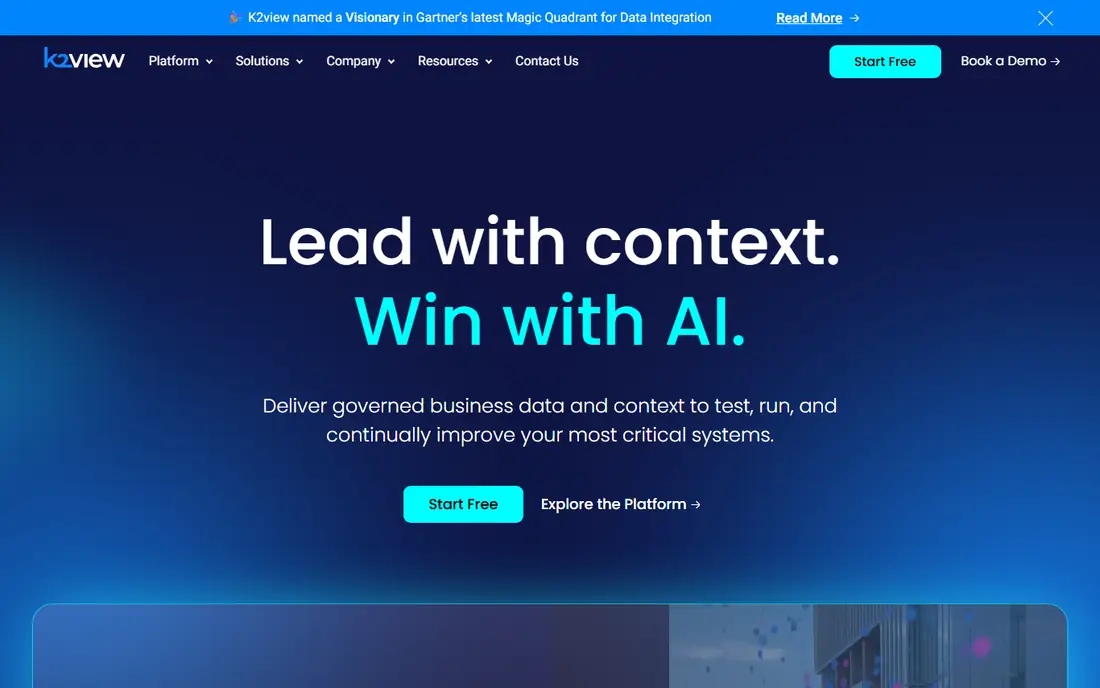
K2view suits a microservices team that struggles to keep test data consistent across services. Instead of copying whole databases, K2view builds a small micro-database for each business entity, such as a customer or an order, holding all of that entity data from every source system. Test environments then get complete, consistent entity data, with masking, synthetic generation, and tokenisation applied, and services can consume the same entity view in real time.
That entity approach needs modelling work, since each entity and its sources must be defined, but the payoff is consistency that whole-database copies rarely achieve. K2view offers a free start, which helps a team test the entity model before committing, while full enterprise use is priced by quote. For a team with distributed services and shared customer data, K2view solves a problem that masking-only tools do not address.
What we like- One micro-database per business entity
- Masked, synthetic, and tokenised data
- Strong referential integrity
Watch out for- Entity modelling takes design effort
- Enterprise focus
- Pricing is quote-based for full use
#7Tonic.ai
Best for: De-identified and synthetic data for developers4.2/5 on
G2 (38 reviews, checked Oct 2026)
Visit tonic.ai
Starting priceSee website
Free planYes (Fabricate free tier)
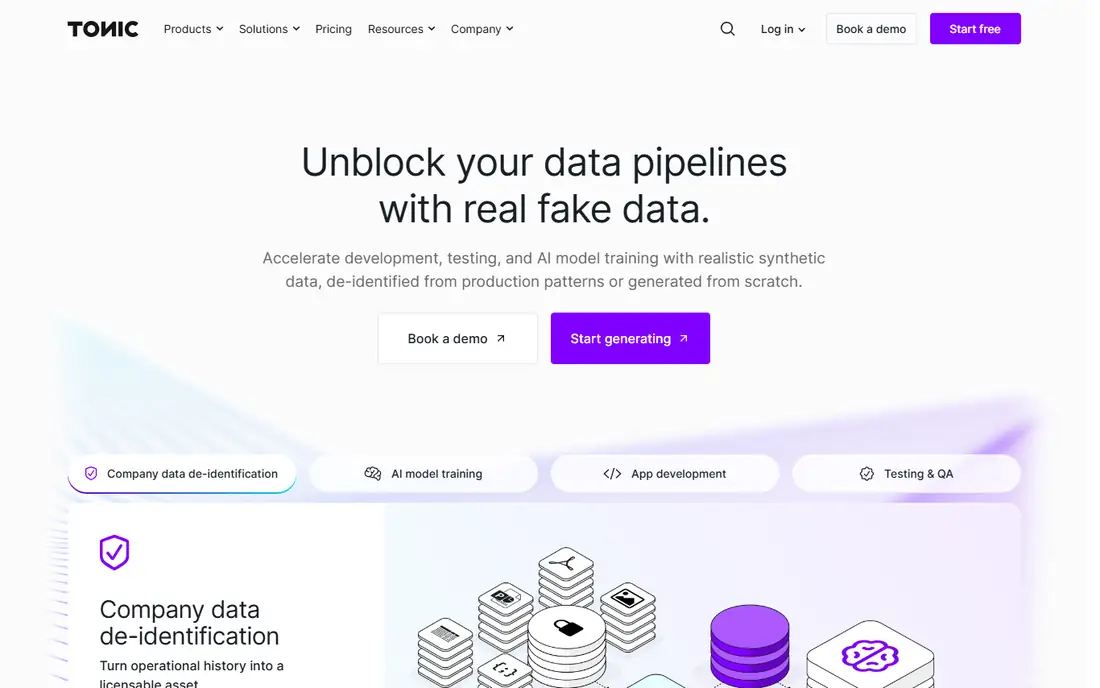
Tonic.ai, through Tonic Structural, suits a development team that wants production-like test data without production risk. It scans production databases, identifies personal data, de-identifies it with consistent transformations, and subsets the result, so relationships between tables stay intact and tests behave like production tests. Its API and CI/CD integration let teams refresh test data on demand, and Fabricate, its synthetic generation product, offers a free tier for generating data from scratch.
The product range needs a careful read, since Structural, Fabricate, and Textual cover structured, generated, and unstructured data separately. A team should confirm which products its proof of concept covers and how they are priced together. For a developer-led team that wants fast, safe, production-shaped data with a modern interface, Tonic.ai is one of the easiest tools here to adopt.
What we like- High-fidelity de-identified data with relationships intact
- Subsetting
- Developer-friendly API and CI/CD use
Watch out for- Full platform is quote-based
- Unstructured data handling sits in separate products
- Enterprise features need a demo
Starting priceSee website
Free planNo / Free trial
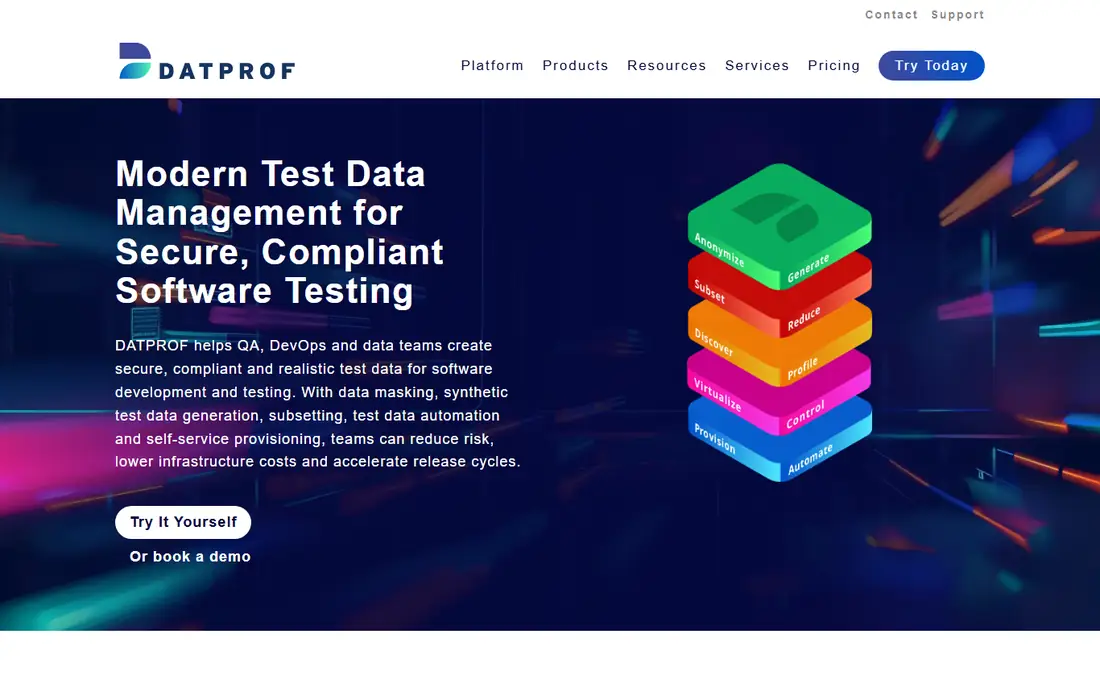
DATPROF suits a mid-sized team that wants enterprise test data practices without enterprise complexity. Its modules cover the full job: Privacy for masking and synthetic generation, Subset for smaller referentially intact datasets, Analyze for finding sensitive data, Virtualize for containerised test databases, and Runtime for automation and CI/CD integration. A self-service portal lets developers and testers request and refresh data without waiting for a central data team.
DATPROF is smaller than Delphix, Informatica, or Broadcom, and its virtualisation does not match Delphix clone depth, so a very large enterprise may still favour Delphix. For a mid-market team in banking, insurance, healthcare, or government that needs compliant, repeatable test data at a manageable scale, DATPROF offers the most practical balance of features, modular pricing, and ease of adoption in this list.
What we like- Modular platform with clear modules
- Masking, subsetting, virtualisation, and automation
- Self-service portal
Watch out for- Smaller vendor than Delphix or Informatica
- Virtualisation depth is thinner than Delphix clones
- Pricing by quote
How we chose
We compared vendor product pages, documentation, and public reviews on G2, Capterra, and specialist test data guides, and we kept only tools with current test data management products used in production by software teams. We weighed masking quality, synthetic generation, subsetting, virtual clones, CI/CD integration, privacy controls, and ease of self-service delivery, and we listed prices as See website where vendors sell by quote. We did not claim hands-on testing, and every buyer should run a proof of concept on its own databases before signing.
Choosing between masking, synthetic, and virtual clones
Start with where your test data must come from. If tests must match production shapes, volumes, and relationships, masking and subsetting tools such as Delphix, Informatica, Tonic.ai, and DATPROF are the right starting point, since they keep production structure while removing sensitive values. If production access is blocked, or edge cases matter more than production shape, synthetic tools such as GenRocket and Tonic Fabricate let you design data for every test case, including cases production data never shows.
Virtual clones solve a different problem: speed and storage. Delphix clones give many teams fast, isolated copies of the same database, which helps when full copies are too slow or too large. K2view solves consistency across services, which neither masking nor cloning alone fixes. A practical proof of concept should test all three questions on your own data: can the tool mask your sensitive fields correctly, can it generate the edge cases your tests need, and can it deliver a fresh environment in minutes rather than days.
Frequently asked questions
What is test data management?
Test data management is the practice of creating, protecting, and delivering realistic data for development and testing, without exposing real customer data. It covers masking sensitive values, subsetting large databases, generating synthetic data, and provisioning test environments on demand through CI/CD pipelines.
Is synthetic data better than masked production data?
Neither is always better, since masked data keeps production shapes and relationships, while synthetic data covers edge cases and avoids production access entirely. Many teams use both, masking production data for integration tests and generating synthetic data for edge cases, new features, and performance tests.
Can test data tools integrate with CI/CD pipelines?
Yes, most tools here offer APIs, CLIs, or pipeline integrations for Jenkins, Azure DevOps, GitHub Actions, and other CI/CD systems. Confirm that test data provisioning, refresh, and teardown can run automatically in your pipeline, and that a failed data job fails the build visibly rather than silently using stale data.
How do I keep test data compliant with privacy laws?
Use a tool that discovers sensitive fields, applies consistent masking or tokenisation, and logs what was masked and when, so compliance teams can audit non-production data. Avoid copying full production databases into test environments, restrict test data access by role, and review masking rules whenever the production schema changes.
What is the difference between subsetting and virtual clones?
Subsetting creates a smaller, referentially intact copy of a database, which saves storage and speeds refreshes, while a virtual clone presents a thin, writable copy of the full database without duplicating all its storage. Subsetting suits teams that need small, fast datasets, while clones suit teams that need full production size with fast provisioning.
How much do test data management tools cost?
Most enterprise tools here sell by quote, based on databases, environments, users, and modules, so there is no reliable public starting price. Mid-market tools such as DATPROF may offer clearer modular pricing, while free tiers, such as Tonic Fabricate and the K2view free start, help small teams test before committing.
Sources we checked (8)
- https://www.delphix.com
- https://www.informatica.com/products/test-data-management.html
- https://www.broadcom.com/products/software/continuous-testing/test-data-manager
- https://www.ibm.com/products/infosphere-optim
- https://www.genrocket.com
- https://www.k2view.com
- https://www.tonic.ai
- https://www.datprof.com
Is your product missing or out of date?
We review this list regularly. Vendors can request a listing, send updated pricing or ask about featured placement.

Shihab Mia · Founder, Rankite
Shihab has 5+ years in B2B and SaaS SEO. He writes Rankite's software buying guides from pricing pages, documentation and public user reviews. More about Shihab.