How we make this list: we compare pricing pages, product documentation and public user reviews. Rankite is independent; if a vendor ever pays for a featured spot, that listing is clearly labeled Partner.
Key takeaways
- Wolters Kluwer sells CCH AnswerConnect Tax directly for $1,499 on its own shop, one of the few transparent prices among the big research platforms.
- Bloomberg Tax lists small-firm pricing starting at $2,200 for CPA firms with fewer than 10 employees; larger firms are quote-based, per its own site.
- Blue J publishes sole-practitioner pricing at $1,498 per user per year with a 7-day trial, per its own site, making AI research accessible to solo CPAs.
- Budget picks publish their prices too: Parker Tax Publishing offers a full-access year for $422, and TheTaxBook's WebLibrary starts at $209 per year.
Quick comparison
| Tool | Best for | Starting price | Free plan |
|---|
 Thomson Reuters Checkpoint Thomson Reuters Checkpoint | Tax and accounting firms that want the deepest federal tax library with integrated AI research | See website | Free trial |
 CCH AnswerConnect CCH AnswerConnect | CPAs who want AI-powered answers grounded in CCH's century-old editorial content | $1,499 | No |
 Bloomberg Tax Bloomberg Tax | Firms and corporate tax departments that want practitioner-written portfolios plus news and workflow tools | From $2,200/year (small firms) | No |
 TaxNotes TaxNotes | Practitioners who need daily tax news, expert commentary, and primary source documents | See website | See website |
 Blue J Blue J | Solo practitioners and small firms that want AI tax research at a published price | $1,498/user/year | Free trial (7 days) |
 LexisNexis LexisNexis | Law firms and tax attorneys who need tax research inside a full legal research platform | See website | Free trial |
 Parker Tax Publishing Parker Tax Publishing | Budget-conscious preparers who want plain-English federal tax analysis without the enterprise price | $422/year | No |
 TheTaxBook TheTaxBook | Preparers who want fast, example-driven answers in a quick-reference format | From $209/year | No |
 Spidell Spidell | California tax professionals who need state-specific research and continuing education | See website | No |
Is your product missing or out of date?
We review this list regularly. Vendors can request a listing, send updated pricing or ask about featured placement.
The best tax research software
Here is the uncomfortable truth about tax research software: the three big platforms are all excellent, all expensive, and all sold by quote, which means most buyers pick one and never look back. That is a mistake. The gap between a $422-a-year independent library and a five-figure enterprise subscription is enormous, and for many practices the cheaper tool answers 90% of the questions. The nine options below span that whole range, from the industry-standard giants to focused independents and a new generation of AI research assistants.
#1
Thomson Reuters Checkpoint
Best for: Tax and accounting firms that want the deepest federal tax library with integrated AI research
Visit tax.thomsonreuters.com
Starting priceSee website
Free planFree trial
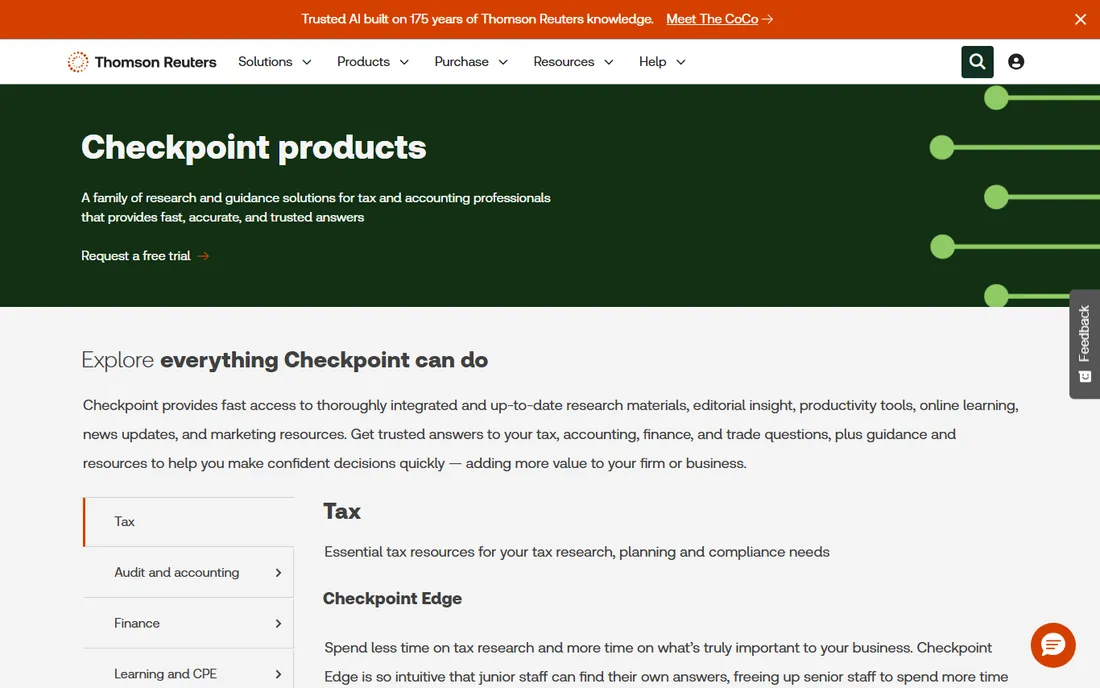
Checkpoint is the default answer in most CPA firms, and it earned that position. The platform combines the Internal Revenue Code, regulations, rulings, and case law with Thomson Reuters' own editorial analysis, most notably the Federal Tax Coordinator, which remains the gold standard for finding how a rule actually applies. Phone support is included in the subscription, with free training through webinars and self-study.
The newer story is CoCounsel, Thomson Reuters' AI assistant, which answers tax questions conversationally with citations back to Checkpoint content. Third-party comparisons describe CoCounsel-enabled seats running into four figures per user per year, though your actual quote depends on negotiation. Checkpoint offers a free trial, which you should absolutely take before signing, because the annual commitment is real. It fits firms with serious research volume; if your questions are mostly 1040-level, the budget tools below will cover you for a tenth of the price.
What we like- Broadest proprietary tax content library in the industry, including the Federal Tax Coordinator
- CoCounsel AI delivers cited answers inside the research workflow
- Free trial available on request
Watch out for- Quote-based pricing with no published rates
- Enterprise-oriented, likely overkill and over-budget for solo preparers
Starting price$1,499
Free planNo
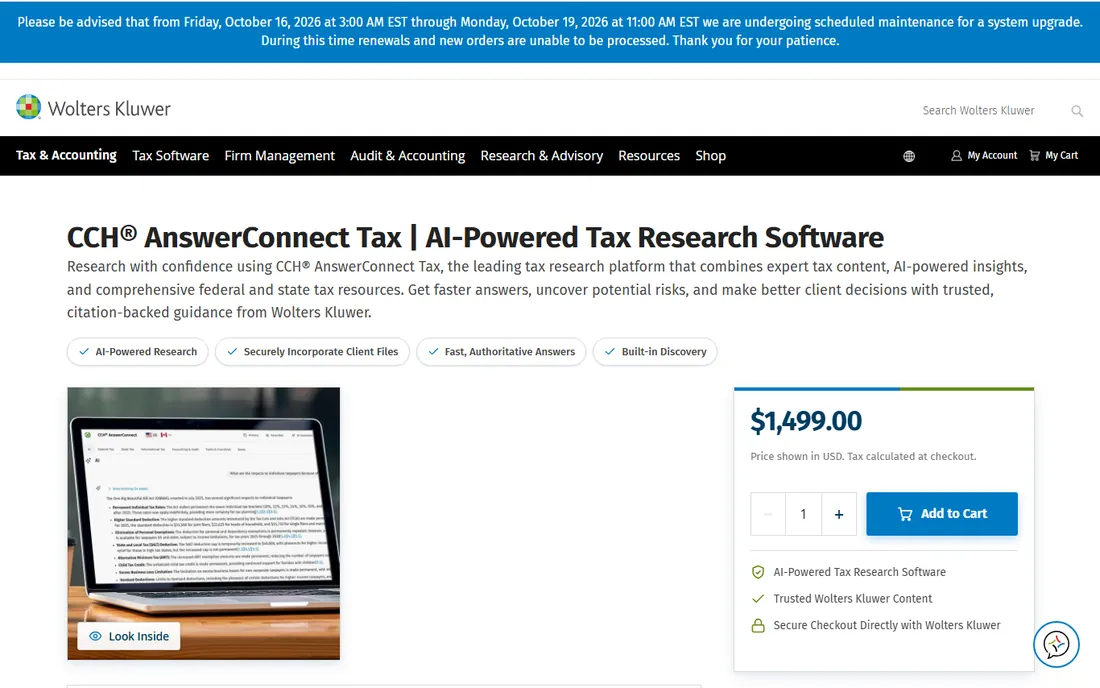
AnswerConnect is Wolters Kluwer's answer to the AI research wave, and it is the only big-platform tool here with a public buy-it-now price. The $1,499 listing on Wolters Kluwer's own shop covers the core AnswerConnect Tax platform: federal and multistate research, practitioner-ready analysis from CCH tax experts, and Expert AI, which returns fast answers with citations to authoritative sources so you can verify everything.
The CCH editorial tradition is the differentiator. Wolters Kluwer notes it is the longest-standing tax research provider in the industry, with CCH content dating to 1913, and the plain-English explanations reflect that experience. A lighter option exists too: the CCH AnswerConnect U.S. Master Tax Guide Plus goes for $415 on the same shop, a reasonable entry point if you mostly need the classic guide with AI search layered on. The honest catch is modular pricing: $1,499 gets you in the door, but comprehensive state coverage and specialty libraries add up.
What we like- Sold directly for $1,499 on Wolters Kluwer's own shop, rare price transparency in this category
- Expert AI gives citation-backed answers from authoritative content
- CCH tax content dates back to 1913
Watch out for- The $1,499 tier is a starting point, larger libraries cost more
- No free trial or free plan offered
#3
Bloomberg Tax
Best for: Firms and corporate tax departments that want practitioner-written portfolios plus news and workflow tools
Visit pro.bloombergtax.com
Starting priceFrom $2,200/year (small firms)
Free planNo

Bloomberg Tax built its reputation on the Tax Management Portfolios: in-depth, practitioner-written analyses of more than 500 topics across federal, state, and international tax, plus estates, gifts, and trusts. The portfolios are written by working tax professionals rather than journalists, which shows in the practical examples and planning pointers. Content comes from over 1,000 tax attorneys and specialists, per Bloomberg Tax, and the platform pairs research with daily news and workflow tools.
The small-firm offering is the notable pricing move. Bloomberg Tax for Small CPA Firms starts at $2,200 for firms with fewer than 10 employees, bundling research, news, and workflow tools in one subscription, per its own page. Larger firms go through the standard request-pricing process. The AI Assistant, which draws answers from Bloomberg's authoritative content with citations, adds a modern research layer. If your practice leans toward complex business and international questions, the portfolio library is hard to beat.
What we like- Small-firm pricing published at $2,200 for CPA firms under 10 employees, per Bloomberg Tax
- Over 500 Tax Management Portfolios across federal, state, and international
- AI Assistant won a 2025 CPA Practice Advisor innovation award
Watch out for- Standard enterprise pricing is quote-based
- No free trial, demos only
#4
TaxNotes
Best for: Practitioners who need daily tax news, expert commentary, and primary source documents
Visit taxnotes.com
Starting priceSee website
Free planSee website
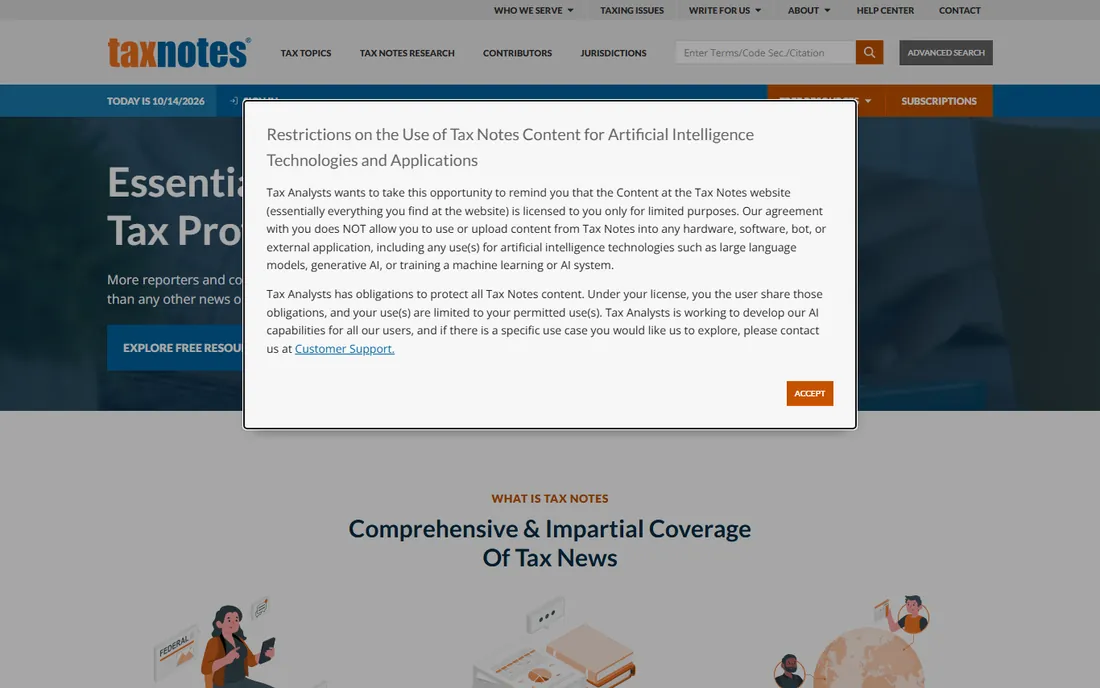
TaxNotes occupies a different corner of the market. Published by the nonprofit Tax Analysts, it is first and foremost a tax news organization: daily coverage of legislation, regulations, rulings, and court decisions at the federal, state, and international levels, with correspondents covering more than 180 countries. For practitioners who need to know what changed this morning, nothing else matches its speed and depth.
The research side includes the Internal Revenue Code, final regulations, and a large primary source database, plus commentary from well-known tax analysts. Subscriptions are tailored to your needs and billed annually, with pricing based on the products and user count; packages run from solo practitioners to enterprise setups with single sign-on. The free resources section is genuinely useful, offering curated news, podcasts, and special reports without a subscription. TaxNotes pairs well with a structured research platform: many firms use it for staying current and Checkpoint or CCH for looking things up.
What we like- Nonprofit publisher (Tax Analysts) with daily coverage of federal, state, and international developments
- Deep primary source library including the Code, regulations, and treaties
- Free resources section with news, podcasts, and special reports
Watch out for- No published pricing, subscriptions are tailored and billed annually
- Stronger on news and commentary than on structured Q&A research
#5
Blue J
Best for: Solo practitioners and small firms that want AI tax research at a published price
Visit bluej.com
Starting price$1,498/user/year
Free planFree trial (7 days)
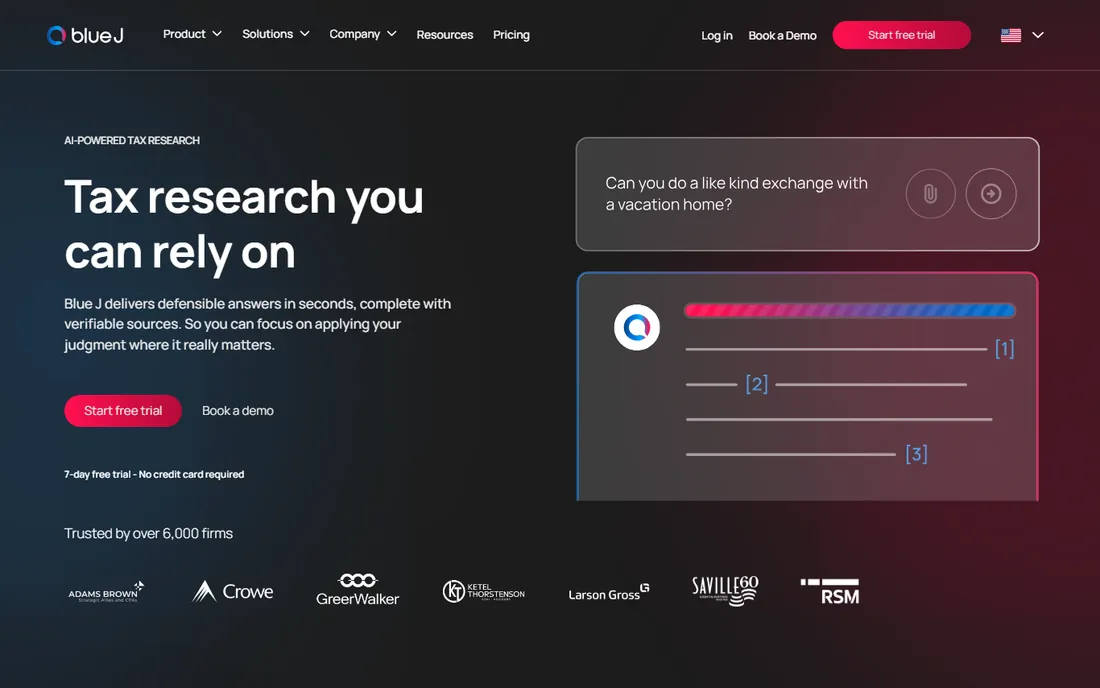
Blue J is the AI-native challenger that forced the big platforms to respond. Founded in 2015 in Toronto, it lets you ask complex tax questions in plain language and returns synthesized answers with citations to its curated library of authoritative sources. The workflow goes beyond search: it drafts client-facing memos, emails, and presentation outlines from the research, which is where the time savings compound for a busy practitioner.
The pricing transparency is the story. Blue J publishes $1,498 per user per year for sole practitioners with a 7-day trial, per its own site, putting AI research within reach of a solo CPA. Firm tiers are custom-quoted, and the company works with firms of all sizes including large enterprises. The trade-off of the AI model is verification discipline: the answers come with citations, and you should still check them, just as you would with any research tool. For practitioners comfortable with AI-assisted workflows, Blue J delivers the most modern experience at the most accessible price.
What we like- Sole-practitioner pricing published at $1,498 per user per year with a 7-day trial, per Blue J
- Conversational interface with cited answers from a curated source library
- Automated drafting of client memos and emails
Watch out for- Annual subscription only, no monthly option
- Firm and enterprise tiers are custom-quoted
#6
LexisNexis
Best for: Law firms and tax attorneys who need tax research inside a full legal research platform
Visit lexisnexis.com
Starting priceSee website
Free planFree trial
LexisNexis approaches tax research from the legal side. The tax offering sits inside Lexis+, alongside case law, statutes, and the Matthew Bender treatise library, which makes it the natural choice for tax attorneys who already research litigation and transactional law on the platform. Vendor materials describe predictable fixed-rate pricing that covers full use of the included subscription sources with no added search or document charges, a meaningful contrast to platforms where overages lurk.
The tax-specific content includes federal tax law resources, U.S. tax treaties, and estate planning materials, and the Lexis+ AI layer now extends to tax questions. Pricing is quote-based and there are no public tax-specific rates; third-party directories list general Lexis+ plans from around $152 per month, but tax packages differ. LexisNexis fits attorneys and firms that want one research subscription for everything legal. Pure tax practices will usually find deeper and more focused content at Checkpoint, CCH, or Bloomberg Tax.
What we like- Tax research integrated with the broader Lexis+ legal platform, including case law and Matthew Bender titles
- Predictable fixed-rate pricing covers full use of included sources, per vendor materials
- Free trial available
Watch out for- Quote-based pricing with no public tax-specific rates
- Tax is one practice area among many, so depth varies by topic
#7
Parker Tax Publishing
Best for: Budget-conscious preparers who want plain-English federal tax analysis without the enterprise price
Visit parkertaxpublishing.com
Starting price$422/year
Free planNo

Parker Tax Publishing is the independent alternative that Intuit community members routinely recommend when CCH gets too expensive. The pitch is simple: a full year of unlimited online access to 22 volumes of expert federal tax analysis, biweekly bulletins on new developments, election statements, client letters, and a complete primary source library, listed at $422 for a one-year subscription on its own site. That is less than a third of CCH AnswerConnect's entry price.
The content is written in plain English for working preparers rather than academics, which many small-firm CPAs prefer for 1040 and small-business questions. The trade-offs are scale and polish: it is a small independent publisher, so the editorial bench is thinner than Thomson Reuters or Wolters Kluwer, and the platform lacks the AI features and workflow integrations of the big tools. For a solo preparer or small firm whose research needs are mainstream federal tax, Parker is the value play of this list.
What we like- Full-access annual subscription listed at $422 on its own site
- 22 volumes of expert analysis plus biweekly tax bulletins
- Practice aids including election statements and client letters
Watch out for- Independent publisher with a smaller editorial team than the big three
- Interface and search are functional rather than polished
#8
TheTaxBook
Best for: Preparers who want fast, example-driven answers in a quick-reference format
Visit thetaxbook.com
Starting priceFrom $209/year
Free planNo
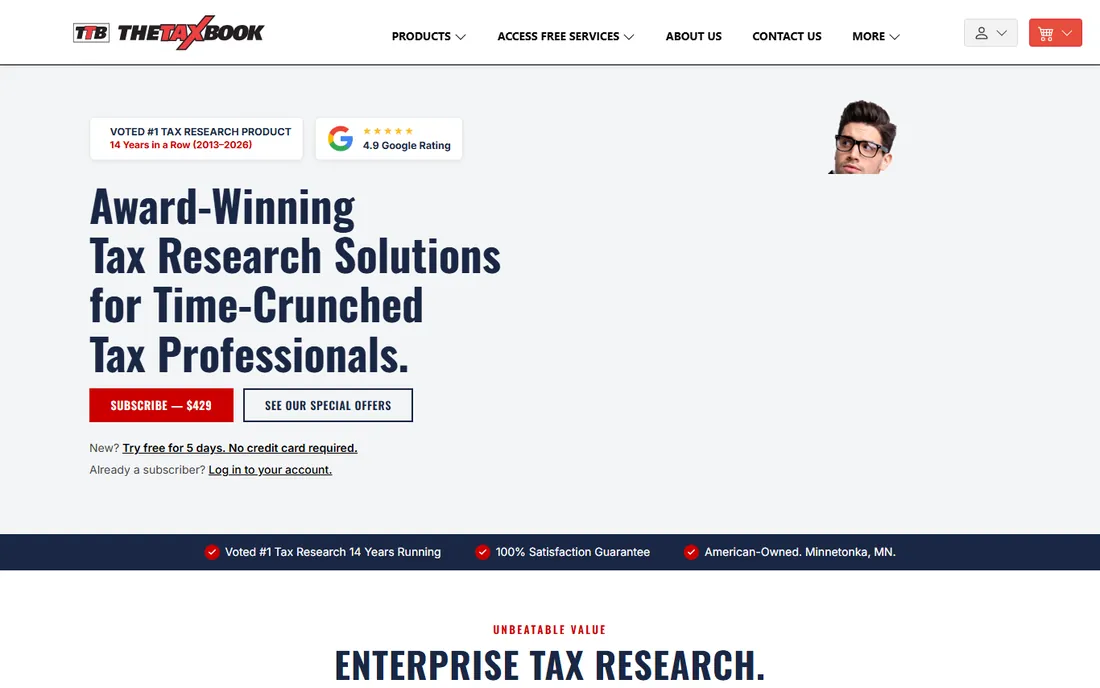
TheTaxBook takes its name literally: it started as fast-answer tax research books and moved the same format online. The WebLibrary gives you the book content in a searchable online format with examples, bookmarks, and archives of prior years, starting at $209 per year for the first user per its product catalog. It is designed for the preparer who needs the answer during a client call, not a 40-page portfolio.
The newer addition is TaxBert, a 24/7 AI tax research assistant that answers federal and state questions with citations to TheTaxBook's knowledge base. The company claims 99.86% of TaxBert responses contain accurate citations, per its own page, and bundles including WebLibrary Plus with TaxBert run $429 at retail. The limitation is depth: TheTaxBook explains rules clearly with examples, but it does not replace the analytical depth of the portfolios or coordinators for novel or complex issues. It is a speed tool, and an excellent one for high-volume 1040 practices.
What we like- WebLibrary online research starts at $209 per year for the first user, per its catalog
- Fast-answer format with examples, organized for quick lookups
- TaxBert AI assistant answers federal and state questions with cited sources
Watch out for- Organized as a quick-reference book rather than a deep analytical library
- No free trial or free plan
#9
Spidell
Best for: California tax professionals who need state-specific research and continuing education
Visit spidell.com
Starting priceSee website
Free planNo
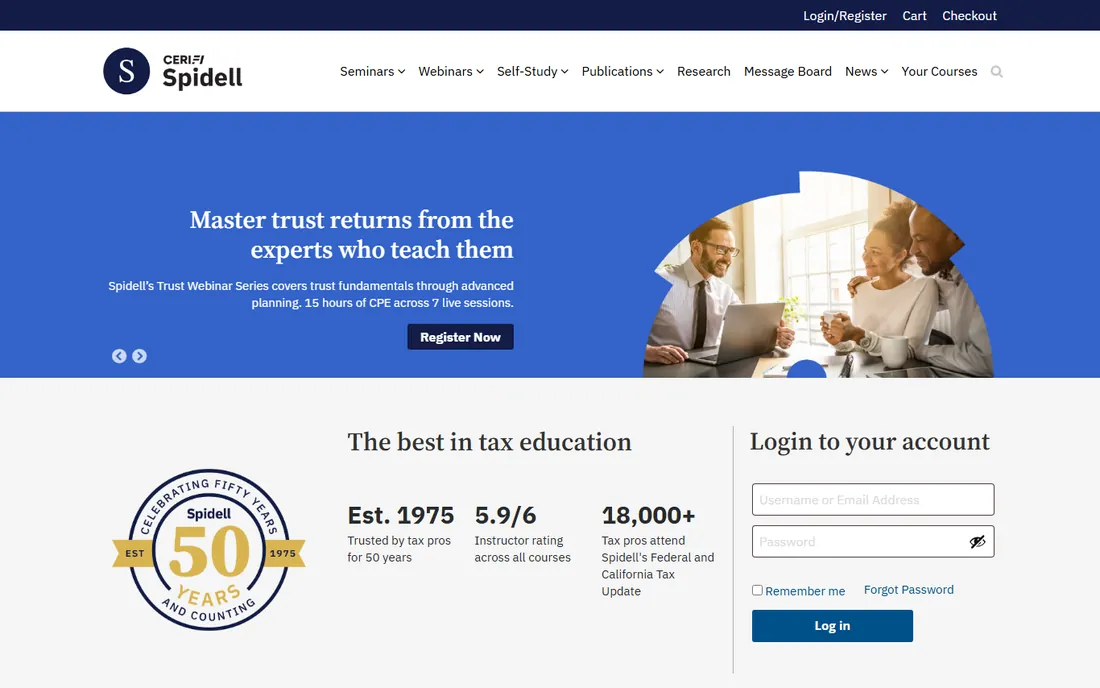
Spidell is the regional specialist on this list, and for California practitioners it punches above its weight. The company publishes the California Taxletter and the Federal Taxletter, runs an Online Research Package, and is one of the best-known CPE providers for California tax professionals, with webinars starting around $129 and full-day update seminars each fall. The content reflects decades of focus on California conformity issues, FTB positions, and state-specific traps that national platforms cover thinly.
Research pricing is not published, so you will need to contact Spidell for a quote on the Online Research Package. The education side is transparently priced and widely used well beyond California for federal updates. If you practice in California, Spidell belongs in your stack alongside a national research platform. If you practice anywhere else, the national tools above will serve you better, though the federal webinars remain a solid CPE value.
What we like- Deep California tax expertise, including the California Taxletter
- Online Research Package plus Federal Taxletter for ongoing updates
- Strong CPE education business with webinars from $129
Watch out for- No published research pricing
- California-centric, less useful for practitioners in other states
How to buy tax research without paying for libraries you will never open
Start by auditing the questions you actually research. Most small practices live in a surprisingly narrow band: individual, S corporation, partnership, and rental issues, plus the occasional estate question. If that describes you, a focused tool like Parker Tax Publishing at $422 a year or TheTaxBook's WebLibrary from $209 will answer nearly everything, and the $1,499 CCH AnswerConnect tier covers the rest with AI assistance. The big enterprise platforms earn their keep on novel, complex, and international questions; if you rarely have those, you are paying for a library you never open.
Then compare the AI layer honestly. Every major platform now offers AI-assisted research, from Checkpoint's CoCounsel to CCH's Expert AI to Bloomberg's AI Assistant to Blue J's conversational interface. The differentiator is not whether AI is present but whether answers come with verifiable citations to primary sources, because you are the one signing the return. Ask for a trial on every platform that offers one, run five of your hardest recent questions through each, and check the citations before you check the price.
The AI question: can you trust a chatbot with the tax code?
The new generation of AI tax research tools, led by Blue J and followed by every incumbent, promises to turn hours of keyword searching into a single conversational answer. The technology is genuinely useful: asking a complex multi-jurisdiction question and getting a structured, cited answer in seconds changes how research feels. But the professional standard has not changed. An AI answer is a starting point, not a conclusion, and every citation needs verification against the primary source before it goes into advice or a return.
The practical test is transparency. Tools like Blue J and CCH AnswerConnect show their work, linking each proposition to the Code section, regulation, or ruling behind it, which lets you verify in minutes. Be wary of any tool that gives confident answers without visible sources. Also check the knowledge cutoff and update frequency: tax law moves constantly, and an AI trained on last year's law is worse than useless during filing season. The firms getting the most from AI research use it to find the answer fast, then verify it the old-fashioned way.
How we chose
We researched this category through vendor pricing pages, product documentation, official press releases, and vendor-published comparison pages. We cross-checked feature claims and pricing against public buyer reviews on G2, Capterra, SourceForge, and Slashdot, plus practitioner communities and CPA industry publications. We favored tools with verifiable pricing and clear plan structures, and we mixed the industry-standard platforms with independent publishers and AI-native tools so practices of every size can find a fit. Prices shown come only from the vendor's own published pages; where a vendor does not publish pricing, we say so instead of guessing.
Frequently asked questions
What is the difference between Checkpoint, CCH AnswerConnect, and Bloomberg Tax?
All three are comprehensive tax research platforms, but their strengths differ. Checkpoint has the deepest editorial library, anchored by the Federal Tax Coordinator, and the CoCounsel AI layer. CCH AnswerConnect pairs a century of CCH editorial content with Expert AI and publishes its $1,499 entry price. Bloomberg Tax is built around 500+ practitioner-written Tax Management Portfolios and bundles research with news and workflow tools. Most firms pick one as their primary platform based on content fit and price.
How much does tax research software cost?
It ranges from about $200 to five figures per year. TheTaxBook's WebLibrary starts at $209 per year, Parker Tax Publishing lists $422 for full access, and Blue J charges $1,498 per user per year for sole practitioners. CCH AnswerConnect Tax is $1,499 on Wolters Kluwer's shop, and Bloomberg Tax starts at $2,200 for small CPA firms. Checkpoint, LexisNexis, TaxNotes, and Spidell are quote-based, with enterprise subscriptions running into the thousands or tens of thousands annually.
Do solo practitioners need an enterprise research platform?
Usually not. Solo and small-firm practices most often research mainstream individual, S corporation, and partnership issues, which focused tools like Parker Tax Publishing, TheTaxBook, and Blue J cover well at a fraction of enterprise prices. Consider Checkpoint, CCH AnswerConnect, or Bloomberg Tax when you regularly face complex business, international, or estate questions, or when clients expect opinions backed by the industry-standard libraries.
What should I look for in AI tax research tools?
Look for cited answers linked to primary sources you can verify, coverage of your practice areas including state law, and clear information about how current the underlying content is. Blue J, CCH AnswerConnect, Checkpoint's CoCounsel, and Bloomberg's AI Assistant all provide citations; verify a sample against the Code before trusting the tool. Avoid tools that answer confidently without showing sources, and never put an unverified AI answer into client advice.
Can I get tax research for free?
There are useful free resources but no full free research platform. TaxNotes offers a free resources section with curated news, podcasts, and special reports. The IRS website provides the Code, regulations, and guidance for free, though without editorial analysis. Checkpoint and Blue J offer free trials, and LexisNexis does as well. For ongoing professional research, a paid subscription is effectively required.
How often is tax research content updated?
The major platforms update continuously as new legislation, regulations, rulings, and court decisions arrive. TaxNotes publishes daily news coverage of tax developments. During busy legislative periods, same-day or next-day updates are the norm for the big platforms. When evaluating a tool, ask how quickly new guidance appears in search results and whether the AI layer draws on current content, since stale answers are the main risk with AI-assisted research.
Sources we checked (9)
- https://tax.thomsonreuters.com/en/checkpoint
- https://shoptax.wolterskluwer.com/en/cch-answerconnect-tax.html
- https://pro.bloombergtax.com/
- https://www.taxnotes.com/
- https://www.bluej.com/
- https://www.lexisnexis.com/
- https://www.parkertaxpublishing.com/
- https://www.thetaxbook.com/
- https://spidell.com/
Is your product missing or out of date?
We review this list regularly. Vendors can request a listing, send updated pricing or ask about featured placement.

Shihab Mia · Founder, Rankite
Shihab has spent more than a decade helping SaaS and e-commerce brands grow through search. He writes Rankite's software buying guides from pricing pages, documentation and public user reviews. More about Shihab.